
- Release Year: 2003
- Platforms: Windows
- Publisher: Mythic Entertainment, Inc.
- Genre: Compilation
- Game Mode: MMO
- Average Score: 85/100
Description
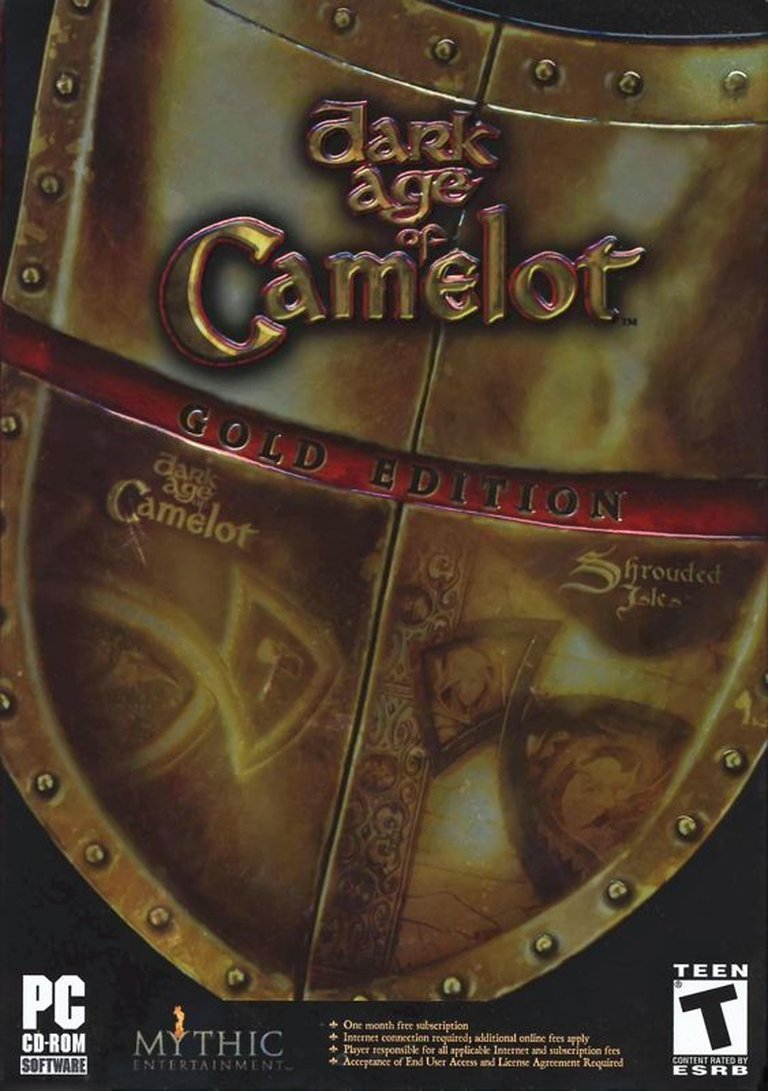
Dark Age of Camelot: Gold Edition is a definitive MMORPG compilation set in a mythic post-Arthurian world where players align with one of three realms—Albion’s Britons, Midgard’s Norse, or Hibernia’s Celts—to engage in massive, ongoing realm-vs-realm conflicts. Drawing inspiration from Arthurian legend and Celtic and Norse mythologies, this edition includes the base game, all expansions, a beginner’s guide, and a free trial, immersing players in a land of decay and war ten years after King Arthur’s death.
Dark Age of Camelot: Gold Edition Reviews & Reception
ign.com (85/100): Reasonable praise for the bundled release of the original title and the Shrouded Isles expansion.
Dark Age of Camelot: Gold Edition Cheats & Codes
PC
Type cheat codes in the in-game console or chat window.
| Code | Effect |
|---|---|
| /cheat summon armor | Summons the specified armor into your inventory. |
| /cheat summon weapons | Summons the specified weapon into your inventory. |
| /cheat Any Class | Allows the character to be any class. |
| /summon armor | Summons the specified armor into your inventory. |
| /summon weapons | Summons the specified weapon into your inventory. |
| /cheat more blood | Grants unlimited health. |
Dark Age of Camelot: Gold Edition: The Definitive Review of a Genre-Defining Masterpiece
Introduction: The Unlikely Monarch of MMORPGs
In the crowded cemetery of early 2000s MMORPGs—a graveyard populated by ambitious but faltering titans like Anarchy Online and the niche Asheron’s Call—Dark Age of Camelot: Gold Edition stands not as a forgotten relic, but as a foundational pillar. Released in June 2003, this compilation did more than just bundle the revolutionary 2001 base game with its stellar 2002 Shrouded Isles expansion and the 2003 free Foundations housing update; it codified the complete, intended vision of Mythic Entertainment’s magnum opus at its cultural and mechanical zenith. For a new player in 2003, the Gold Edition was not merely an entry point but a time capsule into the moment a small, scrappy studio from Virginia forever altered the trajectory of online gaming by proving that large-scale, meaningful, and balanced player-versus-player conflict could be the heart of a successful and enduring virtual world. This review argues that Dark Age of Camelot (as experienced through the Gold Edition) represents the apex of the “three-realm” RvR (Realm versus Realm) design philosophy—a system so potent it created a legacy of passionate community, defined an era of MMO warfare, and cast a long shadow that still influences game design today.
Development History & Context: Forging a Kingdom from scraps
The story of Dark Age of Camelot is a testament to the “garage dev” ethos, born from decades of iterative code and sheer necessity. As recounted in Mythic’s own 12-year retrospective, its DNA stretches back to 1986 with text-based MUDs like Tempest and Darkness Falls, which already featured the core three-realm (Good, Evil, Chaos) PvP framework. This server architecture and philosophical foundation were directly transplanted into DAoC. The leap to 3D graphics was similarly evolutionary, adapted from Mythic’s own fantasy FPS, Spellbinder.
The development of the Gold Edition itself must be understood within the frantic expansion cycle of early MMOs. With a team that ballooned from 12 to 37 during the original’s creation, Mythic operated on a shoestring budget of approximately $2.5 million. The challenges were immense: they built zones like Camelot Hills by manually inputting coordinates via text file, painted terrain heightmaps in Photoshop through trial-and-error, and faced a financial brick wall when Dell denied them server leases due to a lack of credit history, forcing last-minute hardware purchases from their development funds. The publisher gamble paid off spectacularly; Vivendi’s decision to print 100,000 boxes, with 50,000 hitting shelves, led to a sell-out in five days and a #1 October 2001 sales chart position. The Gold Edition, released June 3, 2003, was thus a consolidation of a runaway success story, packaging the base game, the award-winning Shrouded Isles expansion (which added vast new lands and 6 classes), and the innovative Foundations housing expansion into a single, accessible product with a beginner’s guide and free month. It represented the game at its most complete and content-rich pre-Trials of Atlantis era.
Narrative & Thematic Deep Dive: A World After the Once and Future King
Where DAoC broke from its fantasy MMO contemporaries was in its profound and specific narrative premise. It is not set during the age of Arthurian myth, but ten years after his death, in the “power vacuum” that follows the collapse of his unified kingdom. This is a world of political fragmentation, existential dread, and desperate resurgence. The lore, deeply researched from sources like Le Morte D’Arthur, The Mabinogion, and The Norse Myths, is not a pastiche but a clever, parallel-trinity construction:
- Albion (Arthurian): A realm of knights and nobility now “showing signs of decay.” The threat is internal corruption and undead raised by the sorceress Morgana, a direct echo of the betrayal that doomed Camelot. Zones like the Salisbury Plains (home to Stonehenge) and Avalon Marsh are steeped in a melancholic, post-chivalric beauty.
- Midgard (Norse): The “barbarous Norse” of icy wastes feel the stirrings of Ragnarök. They are threatened not by external invaders but by treacherous human factions like the Blodfelag, reflecting the Norse theme of internal strife and oaths broken. Lands like Myrkwood Forest and Muspelheim (a direct nod to fire giants) present a harsh, survivalist aesthetic.
- Hibernia (Celtic): The “magical Celts” face a supernatural civil war, torn apart by the malevolent Unseelie Court and the demonic Siabra. Their zones, like the Valley of Bri Leith and Connacht, are lush, ancient, and deeply tied to the Sídhe (faerie) mythos, presenting a world where the veil between the mortal and Otherworld is thin and dangerous.
The expansions dramatically deepened this tapestry. Shrouded Isles saw each realm aiding a smaller allied race (Avalonians, Sylvans, Last of the Troll Fathers) against extermination, reinforcing themes of alliance and cultural preservation. Trials of Atlantis (released after the Gold Edition but built on its foundation) introduced a wholly original high-mythology layer, discovering the drowned city and its “Twisted” trials, directly engaging with Greek and Egyptian pantheons. Crucially, the narrative is not a single player’s quest but a collective, real-time geopolitical drama. The plot is written server-side by the outcomes of millions of RvR battles, relic captures, and keep defenses. The theme is not “become the hero,” but “ensure your realm survives.” This shift from personal hero’s journey to faceless, anonymous contribution to a persistent war effort is DAoC‘s most profound and distinguishing narrative innovation.
Gameplay Mechanics & Systems: The Engine of Eternal War
The Gold Edition captures DAoC at its most polished and focused mechanical peak, before the stat inflation and complexity of later expansions. Its genius lies in systems designed explicitly to foster and sustain the three-way RvR conflict.
The Trinity, Rebalanced: The class system was famously “balanced at the RvR level, not in direct comparison.” An Albion Infantryman was not meant to duel a Hibernian Blademaster; they were both damage dealers for their respective large-scale “zerg” armies. Each realm had archetypes (Melee, Magic, Hybrid, Ranged, Support), and while classes had distinct fantasy identities (Paladin, Wizard, Runemaster, Enchanter), their power was tuned for their role in the realm war ecosystem. This created a beautiful asymmetry: Midgard’s Berserker was a melee berserk, Albion’s Paladin a tanky support, Hibernia’s Champion a flexible fighter—all filling the “frontline” role but feeling utterly unique.
The RvR Loop: A Masterclass in Systemic Design: This was the game’s true “endgame” and core loop. It operated on multiple, interconnected scales:
1. Frontiers: The contested “no-man’s-land” zones between realms, dotted with keeps (major fortresses) and towers (smaller outposts). Capturing a keep required coordinated groups, siegecraft (catapults, ballistae, later siege towers), and defense against counter-attacks. It yielded realm-wide bonuses (e.g., “All Albion players gain 5% more XP in Hibernia”).
2. Darkness Falls: The ultimate PvE/PvP dungeon, accessible only to the controlling realm of the frontier, filled with elite monsters and, crucially, relics—powerful artifacts that could be captured and brought back to the realm’s capital for additional bonuses. This created a constant, dynamic tug-of-war.
3. Relic Raiding: The “Holy Grail” of RvR. Capturing an enemy realm’s relic from their temple in their capital city was a realm-shaking event, requiring massive, stealthy incursions and triggering immediate, all-hands counter-assaults.
4. Battlegrounds: Smaller, instanced zones for more controlled, smaller-scale PvP, providing a training ground and alternative conflict space.
The Gold Edition includes the original Frontiers and the pre-New Frontiers (2004) layout, which many veterans consider the golden age of RvR—a period of distinct, choke-point-heavy frontier zones that fostered memorable, territory-specific battles.
Character Progression & Customization: Progression was a slow, meaningful grind (level 1-50 in PvE, then Realm Rank 1-10 in RvR). The Foundations expansion added critical utility: player-owned housing. More than a cosmetic feature, houses were vital for storage, guild halls, and player-run shops (consignment merchants), creating a player-driven economy and social hubs. The Shrouded Isles added the first “epic” class paths (e.g., becoming a Necromancer), requiring rare class-specific items and quests, giving long-term goals.
UI & Controls: The interface was dense but functional, built around customizable “quickbars” of 10 slots each (three bars total), keybound for rapid spell/ability use. The “stick, follow, face” commands and “Q-binds” (quick targeting), as revealed by engineers in the retrospective, were born from developer testing and became essential for coordinated group play. The UI’s slight clunkiness was a fair trade for its deep tactical control.
Flaws: The PvE (“PvE grind”) was notoriously tedious, a necessary evil to reach the RvR endgame. The server technology, while brilliant for its time (handling 4,000 concurrent players per server cluster), could not prevent “zerg” tactics from dominating. The learning curve for a new player, even with the Gold Edition‘s guide, was formidable.
World-Building, Art & Sound: Three Kingdoms, One Vision
The world’s artistic direction was a masterclass in thematic zoning. Each realm’s color palette, architecture, and creature design were meticulously aligned with its inspirational mythology:
- Albion: Warm, earthy tones. Stone castles, thatched roofs, Romanesque churches, and lush green fields. Creatures were medieval European: boars, wolves, skeletons, treants. The soundscape featured harps, choral chants, and the clamor of swords.
- Midgard: Cold blues and greys. Longhouses, timber palisades, glaciers, and volcanic badlands. Creatures were bestial: trolls, giants, raiders, dire wolves. Music employed deep drums, rough horns, and guttural chants.
- Hibernia: Vibrant greens and golds. Celtic ringforts, stark stone circles, enchanted forests, and misty swamps. Creatures were fey and ancient: sprites, kelpies, sidhe, fomorians. The soundtrack used fiddles, pipes, and ethereal vocals to evoke an ancient, magical Ireland.
This was not just skin-deep. The 2001-era NetImmerse engine (powering DAoC and later Elder Scrolls III: Morrowind) created a world that felt lived-in. The water and rain effects, as noted in the GameZone review, were praised as “very impressive and realistic.” The environmental storytelling—the abandoned mines, the fallen aqueducts of Albion, the burial grounds of Midgard—was conveyed through zone names, NPC dialogue, and the lore pages found in-game (as detailed on sites like Allakhazam). The sound design was equally crucial; the roar of a Midgard river, the chime of an Albion temple bell, the whisper of the Hibernian wind—each realm was an audible experience. The character animations, however, were acknowledged as a weakness, sometimes “jerky” and “stick-figure like,” a product of the era’s technical constraints.
Reception & Legacy: The Benchmark for PvP
At Launch & with Gold Edition: Critical reception was stellar. The original game holds Metacritic/GameRankings scores of 88/100. Shrouded Isles won GameSpot’s “Best Expansion Pack” award. The Gold Edition itself received scores like 8.5/10 (GameZone), praised as “one of the better MMORPGs available” with “excellent” controls and concept, though noted for a pricey $12.95/month sub and a lengthy install. Commercially, it was a smash: 51,000 units in four days, 115,894 in a month, totaling 300,000 U.S. sales by 2006. The franchise sold 780,000 units across all expansions by that point. It was a clear number-two to EverQuest in the West, but its RvR focus gave it a fiercely loyal, war-minded playerbase.
Evolving Reputation: Over time, DAoC shed its “graphical MUD”标签 and became revered as the purest, most influential large-scale PvP MMO ever made. Its reputation grew as later, more solo-focused MMOs (WoW) dominated the mainstream. Communities like the New OutRiders guild history (tracked from 2001-2007) show a vibrant, organized, and socially complex player experience centered on realm pride. The 2010 “Best PvP Game of the Decade” award from Ten Ton Hammer was a watershed, cementing its legacy among veterans.
Influence on the Industry: Its impact is immeasurable:
1. The Three-Faction PvP Template: DAoC perfected this. World of Warcraft‘s Alterac Valley and later Cyclone (in Wrath of the Lich King) are direct descendants. The modern ” Alliance vs. Horde” dynamic is a two-faction simplification of the DAoC model. Games from Warhammer Online (Mark Jacobs’ next project) to Guild Wars 2‘s World vs. World to Albion Online directly cite it.
2. The “Endgame is War” Philosophy: It proved that open-world, persistent territorial conflict with tangible rewards and consequences could be a sustainable, engaging endgame, not a side activity.
3. Guild & Alliance Systems: Its deep guild tools—ranks, permissions, emblem, banking, and crucially, the ability to form alliances between guilds for shared RvR chat and strategy—set the standard for social organization in MMOs.
4. The “Hardcore” PvP Vibe: It cultivated a culture where PvP wasn’t just fun but a sacred, realm-honoring duty. This attitude permeated its community for decades.
The shutdown of Mythic in 2014 and the subsequent stewardship by Broadsword Online Games, which ultimately released the free-to-play “Endless Conquest” model and “Progression” servers, demonstrate an unprecedented commitment from both the developers and the community to keep this specific vision alive long after its commercial peak.
Conclusion: The Unconquered Realm
Dark Age of Camelot: Gold Edition is more than a compilation; it is a historical document, a design blueprint, and a living museum of a specific, glorious moment in MMO history. It captures the game when its systems were most elegant, its worlds most distinct, and its community most ignited by the pure, unadulterated thrill of three-sided war. Its graphics are dated, its UI cumbersome by modern standards, and its PvE grind archaic. Yet, in an era where MMOs increasingly chase accessible, solo-friendly narratives, DAoC‘s unwavering commitment to collective, anonymous, realm-based warfare remains shockingly potent and, in many ways, unmatched.
Final Verdict: As a game journalist and historian, I place Dark Age of Camelot—in its Gold Edition form—not merely among the great MMOs, but as the most important and influential PvP-focused MMORPG ever created. It successfully translated the tabletop wargame experience into a persistent, living world on a scale never before attempted, and did so with a thematic richness that few have equaled. Its legacy is not in box sales, but in the DNA of the PvP systems in modern online games. To play the Gold Edition today, perhaps on a “Progression” server, is to witness the enduring power of a design that prioritized factional strife and strategic territorial conquest over loot-chasing and solo storytelling. It is, in the truest sense, an immortal kingdom. The wars in Albion, Midgard, and Hibernia have quieted, but the echoes of their clash will forever define the genre.