
- Release Year: 2013
- Platforms: PlayStation 3, PlayStation 4, PS Vita, Windows, Xbox 360
- Publisher: Warner Bros. Interactive Entertainment Inc.
- Developer: Armature Studio, LLC, NetherRealm Studios
- Genre: Action, Compilation
- Perspective: Side view
- Game Mode: Online PVP, Single-player
- Gameplay: Fighting
- Setting: DC Universe
- Average Score: 80/100
Description
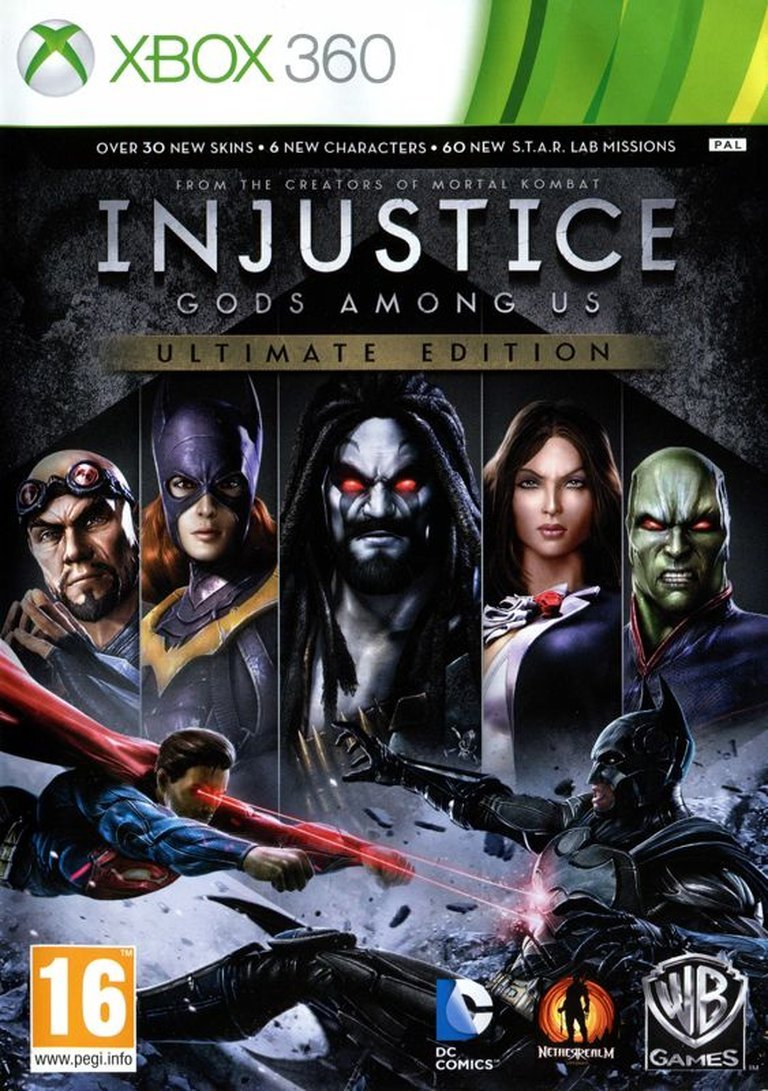
Injustice: Gods Among Us – Ultimate Edition is a fighting game developed by NetherRealm Studios, based on DC Comics characters and set in an alternate universe where heroes and villains engage in intense 2D side-scrolling combat. This comprehensive edition includes the base game along with all downloadable content, such as six additional characters, over 40 skins, 60 S.T.A.R. Labs missions, and the soundtrack, available on platforms like PC, PlayStation 4, and Xbox 360 with remastered versions for PS4 and PS Vita.
Gameplay Videos
Injustice: Gods Among Us – Ultimate Edition Free Download
Injustice: Gods Among Us – Ultimate Edition Guides & Walkthroughs
Injustice: Gods Among Us – Ultimate Edition Reviews & Reception
vgtimes.com : The story, though trivial, is told quite well and with taste.
metacritic.com (80/100): Injustice: Gods Among Us Ultimate Edition is the most complete, best-looking version of the great DC brawler.
opencritic.com (81/100): A brawler that’s bursting with content and fan service, but held back by flakey online play.
trustedreviews.com : Injustice: Gods Among Us fares better.
Injustice: Gods Among Us – Ultimate Edition Cheats & Codes
PlayStation 3
At the ‘Options’ menu select ‘Cheat Codes’ and enter one of the following case-sensitive codes (without the quotes).
| Code | Effect |
|---|---|
| WHERETO | Unlock ALL Locations |
| ALLAI | Unlock ALL AI Characters |
| COUCHES | Unlock ALL ATVs |
| GEAREDUP | Unlock ALL Gear |
| SKULLCAP | Unlock ALL Helmets |
| WINDOWS | Unlock ALL Goggles |
| KICKS | Unlock ALL Boots |
| READYTORACE | Unlock Justin Brayton and KTM Bikes in Arcade Mode |
Injustice: Gods Among Us – Ultimate Edition: A Definitive Analysis of a Landmark Superhero Brawler
Introduction
Injustice: Gods Among Us – Ultimate Edition stands not merely as a fighting game but as a cultural touchstone, a bold reimagining of the DC Universe that transcended its genre to spark widespread conversation. Released by NetherRealm Studios in the wake of their critically acclaimed Mortal Kombat (2011) reboot, this title leveraged the maturity of that design philosophy to craft something distinct: a superhero spectacle where narrative wasn’t an afterthought but the central pillar. Its thesis was audacious—to create a balanced, competitive fighting game where a man in a bat-suit could plausibly trade blows with the Last Son of Krypton. It succeeded by grounding its fantastical premise in a grittily human tragedy: the Joker’s ultimate victory. By weaving a propulsive, morally complex story into its mechanics, marketing, and ancillary media, Injustice redefined what fans expected from a licensed fighter. This Ultimate Edition, bundling the core game with all DLC, represents the definitive version of a title that captured its moment, leveraging a console transition and a hungry fanbase to achieve both critical acclaim and commercial triumph.
Development History & Context: From Mortal Kombat to Metropolis
Studio Vision and the MK9 Blueprint
The genesis of Injustice lies directly in the success of NetherRealm Studios’ 2011 Mortal Kombat reboot. Under the creative direction of Ed Boon and producer Hector Sanchez, the studio sought to apply the hard-won lessons of that game—particularly its tight, strategic combat, robust netcode (though imperfect), and filmic story mode—to a new universe unshackled from the inherent constraints of the Mortal Kombat brand. Boon explicitly stated the goal was to create a game that felt “dramatically different” within the fighting game genre, and the DC Comics license provided the perfect sandbox. It allowed for a vibrant, recognizable roster while freeing the team from the expectation of Mortal Kombat‘s signature, graphic Fatalities, forcing them toward a “Teen” rating. This constraint became a creative catalyst, leading Boon to pursue “crazy, over-the-top action” as a substitute for visceral gore, manifesting in the game’s spectacular stage transitions and super moves.
Technological Constraints and the Unreal Engine 3
Technologically, the game was built upon a heavily modified Unreal Engine 3, the same foundation as Mortal Kombat vs. DC Universe (2008) and the 2011 Mortal Kombat. However, the team’s “KoreTech” subgroup made significant advancements. Senior Producer Adam Urbano highlighted a revamped lighting system for more dynamic character and environmental illumination and a new “character material” system for increased graphical detail. Critically, a multi-threaded rendering engine allowed for approximately three times the number of on-screen objects compared to Mortal Kombat, essential for the game’s dense, destructible stages. This was a game pushing the limits of the PlayStation 3 and Xbox 360, with ports to the PlayStation 4, Windows (handled by High Voltage Software), and PlayStation Vita (by Armature Studio) serving as early next-generation and handheld showcases, albeit with varying degrees of success.
The 2013 Gaming Landscape
The game’s April 2013 release occurred during a fascinating inflection point. The PlayStation 4 and Xbox One loomed on the horizon, but the PlayStation 3 and Xbox 360 still commanded a colossal install base. The fighting game genre was experiencing a renaissance, with titles like Street Fighter X Tekken, Persona 4 Arena, and Skullgirls garnering passionate followings. Injustice entered this arena not as a niche title but as a mainstream blockbuster, leveraging one of the world’s most valuable intellectual properties. Its subsequent Ultimate Edition release in November 2013 was strategically timed for the holiday season and to serve as a strong launch title for the new PlayStation 4 and PC platforms, offering a complete package that included all six DLC characters (Batgirl, General Zod, Lobo, Martian Manhunter, Scorpion, Zatanna), over 40 skins, 60 S.T.A.R. Labs missions, and the soundtrack.
Narrative & Thematic Deep Dive: The Man of Steel as Tyrant
Plot Deconstruction: From Tragedy to Totalitarianism
The narrative of Injustice is its most celebrated and influential element. It is a story of catastrophic failure and ideological civil war, meticulously constructed to justify the game’s core premise. The inciting incident is a masterclass in villainy: the Joker, having acquired a nuclear weapon from Lex Luthor, drugs Superman with a hallucinogenic toxin. Under the hallucination that he is fighting Doomsday in the heart of Metropolis, Superman is tricked into killing his pregnant wife, Lois Lane, and their unborn child, and inadvertently triggering the device, which annihilates the city. Consumed by grief and rage, Superman murders the Joker in cold blood, shattering his own moral compass.
This act of “justice”—killing the Joker—sets in motion a five-year descent. Superman, convinced that humanity’s flaws necessitate absolute control, establishes the One Earth Regime. He is joined not by obvious villains but by a significant portion of the world’s heroes, who either agree with his methods (Wonder Woman, Aquaman, Shazam) or are swayed by fear and the promise of order (Flash, Green Lantern Hal Jordan, Cyborg). The moral center of the universe becomes Batman’s Insurgency, a ragtag group of heroes and villains (including the Joker’s Harley Quinn and this universe’s benevolent Lex Luthor) who believe that freedom, however messy, is non-negotiable.
The plot of the main game is a desperate, last-ditch effort. The Insurgency, realizing they cannot match the Regime’s raw power, uses stolen technology to pull the Justice League from a parallel, “prime” universe (where the Joker’s plan failed). This includes Wonder Woman, Aquaman, Green Arrow, and Green Lantern. Accompanying them inadvertently are that universe’s Batman and Joker. The story then becomes a complex web of rescue, infiltration, and revelation, as the prime heroes must navigate the twisted loyalties of this world, retrieve a kryptonite weapon, and confront a Superman who believes he is saving humanity by ruling it. The climax forces prime Superman to face his tyrannical counterpart, not with brute force alone, but with a painful moral argument: Lois Lane would be horrified by the monster he has become.
Themes: Power, Trauma, and the Fracturing of Ideals
Injustice uses its superhero framework to explore profoundly human themes.
* The Corrupting Nature of Trauma and Absolute Power: Superman’s arc is a direct study of how unspeakable loss, coupled with godlike power, can lead to fascism. His regime is not born of malice but of a twisted, paternalistic grief.
* Moral Absolutism vs. Pragmatism: The core conflict is between Batman’s unwavering, rule-bound ethics and Superman’s consequentialist tyranny. The game asks whether Batman’s refusal to kill, even to stop a monster, is a virtue or a fatal flaw. This is embodied in the fate of Lex Luthor in both universes—a man whose morality is defined by the company he keeps.
* The Cost of Heroism: Nearly every character is forced to choose a side, and few emerge unscathed. Shazam is murdered for dissenting. The Flash defects, horrified. Damian Wayne (Nightwing) rejects his father for Superman. Harley Quinn’s redemption arc is a standout, showing how even those complicit in evil can find a path to heroism. The narrative insists that in this world, there are no clean victories, only varying degrees of loss.
* The “MacGuffin” as Thematic Anchor: The much-maligned “Kryptonian nanotech pill” is often cited as a contrivance to level the playing field. In reality, it is perfect thematic material. It represents Batman’s pragmatic, technological ingenuity versus Superman’s innate power. Its use by both sides—including a legendary moment where an empowered Alfred punches out Superman—visually argues that resolve and intellect can challenge raw might, even if only temporarily.
Character Voice and the Importance of the Comics
The game’s story was written by NetherRealm in consultation with DC writers like Justin Gray and Jimmy Palmiotti to ensure character authenticity. This commitment is evident in the nuanced portrayals. The dialogue, while often heightened for dramatic or combat preamble effect, captures key personality traits: Superman’s rigid, booming certainty; Batman’s grim, tactical resolve; Wonder Woman’s ardent, misguided support for the Regime as a form of “order.”
Crucially, the subsequent Injustice comic book series (written primarily by Tom Taylor) expanded this universe with extraordinary depth. The five-volume Year One through Year Five prequel comics flesh out the five years between Lois’s death and the game’s start, detailing how the Regime formed, how heroes like Black Canary and Green Arrow built the Insurgency, and the specific tragedies that broke characters like Hal Jordan. Injustice: Ground Zero retells the game’s events from Harley Quinn’s perspective, enriching her journey immeasurably. This transmedia synergy was revolutionary for a fighting game, turning the story from a simple narrative wrapper into a sprawling, complex saga that fans could explore for years.
Gameplay Mechanics & Systems: Mortal Kombat’s Heir with a Heroic Twist
Core Combat Loop and the 2.5D Arena
Gameplay is strictly 2.5D. Characters and backgrounds are rendered in full 3D, but movement is confined to a 2D plane. This design choice is classic fighting game clarity, allowing for precise spacing and spacing-based gameplay. The control scheme is a direct descendant of Mortal Kombat (2011): Light, Medium, and Heavy attack buttons, plus a unique “Character Trait” button. This fourth button is where Injustice injects its DC-specific character. Each fighter’s trait is a signature ability that fuels their playstyle:
* Superman: Temporary strength boost.
* Batman: Summon mechanical bats.
* Flash: Speed boost allowing multi-hit auto-combos.
* Aquaman: Trident charge.
These traits are not just special effects; they are strategic tools that define a character’s approach to neutral, offense, and defense.
The Super Meter and the “Clash” System
The Super Meter is a key resource. It fills by landing attacks, blocking, or taking damage. Segments can be spent for:
1. Enhanced Special Moves (meter burn).
2. Countering an opponent’s special move (also a meter burn).
3. The “Clash” System: This is Injustice’s signature risk/reward mechanic. Only available after losing your first health bar, a player can initiate a Clash by tapping the trait button during a combo. Both players then secretly wager a portion of their meter. The higher bidder wins the clash, breaking the combo and pushing the opponent away. A winning bid also grants a cinematic interaction where the victor performs a dramatic beatdown. This system introduces a profound psychological layer—meter management becomes a high-stakes poker game, especially late in a match when both players are on their second bar.
Stage Transitions and Interactive Environments
Injustice fully embraces its superhero setting with interactive stages and multi-layered transitions. Every arena (Batcave, Metropolis, Fortress of Solitude, etc.) is composed of 2-3 distinct zones. Hitting an opponent with a heavy attack near a corner triggers a spectacular, cutscene-driven transition to the next area, often involving the character throwing or driving the opponent through the environment (e.g., smashing them into a chemical tank, through a wall, off a cliff). These are not just visual flair; they deal significant damage and reset positional momentum.
Furthermore, stages contain objects that characters interact with differently based on their class:
* Power Characters (Superman, Doomsday, Bane): Lift and smash heavy objects like cars or statues.
* Gadget Characters (Batman, Green Arrow, Catwoman): Use tools to interact—attach explosives, shoot propane tanks, or trigger traps.
This system cleverly reinforces character identity within the fighting game framework and adds a layer of stage-specific strategy.
Game Modes and Content Depth
Injustice was lauded for its single-player content, a direct inheritance from Mortal Kombat’s successful story mode. The Campaign Mode is a fully voiced, cinematic experience spanning several hours, with the player controlling a rotating cast aligned with the plot. S.T.A.R. Labs is a staggering collection of over 240 character-specific challenge missions, ranging from simple tutorials to brutally complex puzzle-like scenarios (e.g., “Defeat this opponent using only throws”). Battle Mode and Versus Mode round out local play. Online features King of the Hill (spectator-heavy queue) and Survivor (carrying health between matches), though online netcode and stability were frequently cited as weak points in critical reviews. The progression system, awarding points to unlock concept art, music, and skins, was appreciated but noted as somewhat thin compared to later games.
Balance and Criticisms
A persistent criticism, noted by outlets like 4Players and PC Games, was imperfect balance. The power gap between optimized “top-tier” characters and others was noticeable, a common issue in complex new fighters. The collision detection (hitboxes) was occasionally imprecise, leading to frustrating moments. The Clash system, while innovative, could feel random if meter management was mismanaged, and its late-game exclusivity sometimes limited its strategic use. For the Ultimate Edition ports, performance issues plagued the PC and Vita versions, with the latter suffering from severe frame rate drops, as detailed by Hardcore Gamer and ZTGameDomain.
World-Building, Art & Sound: A Dystopian DC Dream
Visual Direction and Character Redesigns
The art direction, led by Steve Beran, is a monumental achievement in licensed game design. It presents a unified, dystopian aesthetic for this alternate DC world. Characters forgo their traditional bright spandex for militaristic, armored suits—Superman’s black and red Regime armor, Batman’s tactical gear, Wonder Woman’s darkened, more practical armor. This visual language communicates the story’s tone before a single line of dialogue is spoken. The character models are highly detailed, with exaggerated proportions that sell the impact of hits. The stage design is exceptional, each location (the Watchtower, the Batcave, the trashed streets of Metropolis) dripping with lore and interactive possibilities. The destructibility, while not on the level of modern physics engines, is satisfying and contextually appropriate.
However, as IGN and Eurogamer noted, texture quality in cutscenes could be bland, and environmental details sometimes lacked polish, betraying the game’s generation. The PC and PS4 ports offered a high-definition remaster, clarifying textures and improving resolution, but the core asset fidelity remained that of a late-PS3 title.
Sound Design and Musical Identity
The sound design is a powerhouse. Every punch, energy blast, and stage interaction has a cinematic, weighty impact that sells the superhuman scale of the conflict. The soundtrack, composed by Christopher Drake, Dean Grinsfelder, Cris Velasco, and Sascha Dikiciyan, is a standout. It eschews traditional heroic themes for a dark, brooding, and heavily rock/metal-influenced score that perfectly complements the Regime’s oppressive atmosphere and the Insurgency’s desperate rebellion. The inclusion of licensed rock tracks from bands like Rise Against and Awolnation in the menu and during certain super moves further cemented the game’s cool, modern aesthetic. The voice acting is uniformly excellent, with veterans like Kevin Conroy (Batman), George Newbern (Superman), and Susan Eisenberg (Wonder Woman) reprising or capturing iconic roles, lending immense credibility to the narrative.
Reception & Legacy: From Critical Darling to Franchise Foundation
Critical and Commercial Launch
Injustice: Gods Among Us was a critical and commercial smash hit. Aggregated scores on Metacritic hovered in the low 80s (81 for X360, 78 for PS3). Critics universally praised its story mode (Game Informer: “a finely tuned fighter”; IGN: “a big old sloppy love letter to fans”), the innovative stage transitions, and the masterful use of the DC license. It swept the “Best Fighting Game” awards for 2013 from IGN, GameTrailers, Game Informer, VGX, and the D.I.C.E. Awards. Commercially, it was the top-selling game in the US for April 2013, moving 424,000 copies in its debut month, and topped UK charts as well.
The Ultimate Edition received an 80 on Metacritic for PS4 and 79 for PC. Reviews were consistent: it was the best version of an already great game, but its value was primarily for newcomers or those who had missed the DLC. Electronic Gaming Monthly gave it a near-perfect 95%, calling it the definitive package. IGN noted that owners of the original with all DLC had little reason to upgrade. The PS Vita and PC ports received more mixed treatment due to performance issues, with Hardcore Gamer calling the Vita version “a criminally lazy port.”
The Multi-Media Franchise and Cultural Ripple
The game’s legacy extends far beyond its initial release.
1. The Comics Empire: The success of the game spawned a prequel comic series by Tom Taylor that became a best-seller and critical darling in its own right. It expanded the universe with unparalleled depth, particularly through Harley Quinn’s redemption arc and the exploration of characters like Black Canary and Damian Wayne. The comics continued for five years, concluding with Injustice: Ground Zero and leading into Injustice 2‘s comics.
2. Influence on DC Film and TV: The “Injustice” aesthetic—the armored, militaristic hero costumes, the grimdark Superman—had a palpable impact on the DC Extended Universe, most notably Zack Snyder’s films. The themes of a Superman corrupted by loss directly informed Batman v Superman: Dawn of Justice and Zack Snyder’s Justice League. Even the TV series Supergirl incorporated design elements from the game.
3. The Animated Film: In 2021, Warner Bros. released an animated movie adaptation of the Injustice story, further cementing its place in DC canon. While drawing from the comics more than the game’s specific plot, it introduced the saga to a broader audience.
4. The Franchise Continues: The direct sequel, Injustice 2 (2017), refined the formula with a Gear System for RPG-like customization and a story that picked up after the “good” ending of the first game, introducing Supergirl and a Brainiac-led threat. It was even more acclaimed, proving the franchise’s staying power.
A Ban and a Symbol
In a notable cultural footnote, the game was temporarily banned in the UAE and Kuwait. Speculation cited the plural use of “Gods” in the title (contradicting Islamic monotheism), depictions of cleavage, and overall violent tone. This ban, later lifted, highlighted how the game’s provocative premise—gods fighting as mortals, heroes becoming villains—resonated on a geopolitical level, however inadvertently.
Conclusion: A Flawed but Foundational Masterpiece
Injustice: Gods Among Us – Ultimate Edition is a landmark title in the history of video games. As a fighting game, it is not the most mechanically deep or competitively pristine—its balance issues and sometimes-flakey online play keep it from the purest echelon alongside Street Fighter or Guilty Gear. However, as a superhero simulator, it remains peerless. It achieved the seemingly impossible: it created a world where Batman can fight Superman without the explanation feeling like fan fiction, by wrapping the conflict in a devastating, character-driven tragedy.
The Ultimate Edition is the essential way to experience this saga. It packages the complete, landmark story with all the additional characters (Scorpion’s crossover inclusion remains a brilliant piece of fan service), skins, and challenges that fleshed out the world post-launch. For all its technical flaws—collision detection quirks, performance hiccups on some ports, a super system that can feel overly random—its ambitions and achievements dwarf its shortcomings.
Its true legacy is threefold:
1. It proved that a fighting game could be a blockbuster narrative event, setting a new standard for story modes that every major fighter since has strived to match.
2. It created a successful, lasting alternate DC Universe, one so rich it spawned its own line of comics and an animated film, influencing live-action DC storytelling for a decade.
3. It demonstrated the power of a licensed game to be both a faithful tribute and a bold reimagining, satisfying hardcore fans while creating something entirely new.
In the pantheon of superhero games, Injustice: Gods Among Us is not just a great fighting game; it is the definitive comic book “What If?” scenario brought to interactive life. The Ultimate Edition cements it as a complete, essential package—a testament to a time when developers dared to ask, “What if Superman was wrong?” and built a entire, spectacular conflict around the answer.