
- Release Year: 2000
- Platforms: Windows
- Publisher: Interplay Entertainment Corp.
- Developer: Shiny Entertainment
- Genre: Special edition
- Game Mode: LAN, Online PVP
- Average Score: 89/100
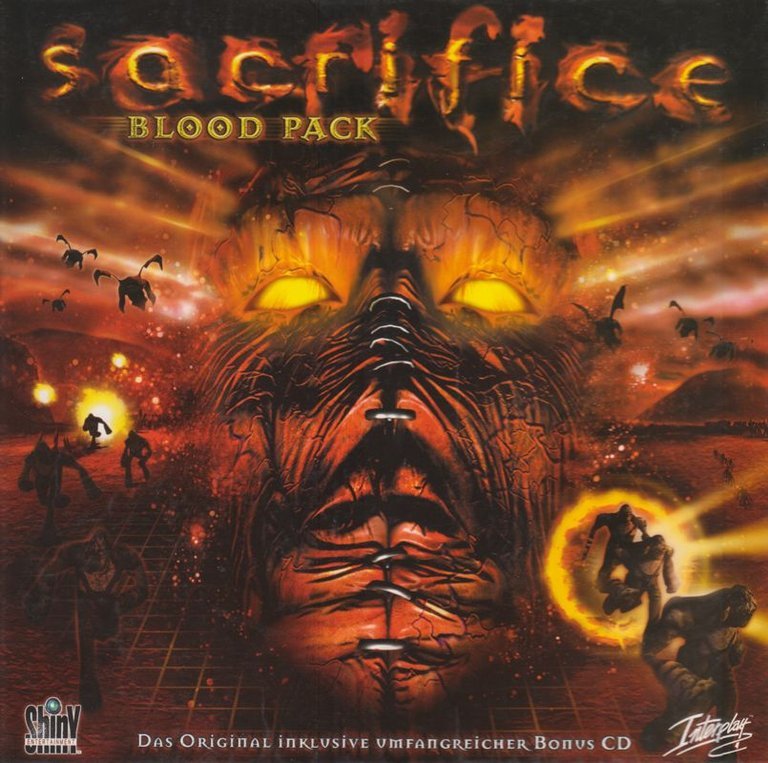
Description
Sacrifice is a real-time strategy game set in a fractured world of floating islands following a cataclysmic war. Players control a wizard avatar from a third-person perspective, pledging service to one of five eccentric gods—Persephone, James, Stratos, Pyro, or Charnel—and engage in battles by gathering souls, summoning creatures, and performing sacrificial rituals to desecrate enemy altars and banish rival wizards, with multiple story paths and endings influenced by divine allegiances.
Gameplay Videos
Where to Buy Sacrifice (Blood Pack)
PC
Sacrifice (Blood Pack) Patches & Updates
Sacrifice (Blood Pack) Reviews & Reception
metacritic.com (89/100): A hugely robust game overflowing with character and creativity.
oldpcgaming.net : A lot of soul went into Shiny’s RTS, but it’s not quite perfect.
monstercritic.com (89/100): Sacrifice weaves together an intricate story, addictive gameplay, and drop-dead gorgeous graphics.
Sacrifice (Blood Pack) Cheats & Codes
PC
Press [Ctrl] + [Shift] + ~ during gameplay to open the console. Enter codes with a space after ‘@’, one at a time, then press [Ctrl] + [Enter] to execute.
| Code | Effect |
|---|---|
| @ aplethoraof [monster name] | Spawn four of the indicated monster without using souls |
| @ alliwantforxmasisa [monster name] | Spawn one of the indicated monster without using souls |
| @ bythepowerofgrayskull | Restore wizard to full health |
| @ castratetheheathens | Allow wizard to collect red spirits (souls) |
| @ dontfearthereaper | Gain 32 souls |
| @ gimmegimmegimme [spell name] | Add the specified spell to the wizard’s repertoire |
| @ ihavethepower | Restore wizard to full mana |
| @ mywingsarelikeashieldofsteel | Make the wizard invincible |
| @ ragebuilding | Instant level up to level 9 with all spells and creatures in local multiplayer |
| @ timeisonmyside | Reset all spell cooldown timers |
| @ yourbulletscannotharmme | Make the wizard invincible |
Sacrifice (Blood Pack): Review
Introduction: The Twilight of the Gods, Reborn
In the pantheon of real-time strategy games, few titles dared to reforge the genre’s core DNA as radically as Shiny Entertainment’s Sacrifice. Released in 2000, it arrived not as an incremental evolution but as a violent schism, cleaving the traditional top-down, base-building RTS in two and reassembling it around a third-person wizard avatar. This was not a game about macro-management and resource streams, but about visceral, immediate combat where you stood atop a mountain of gibbing bodies, your own mana meter flickering as you channeled power from the ruins. The Blood Pack edition—a lavish big-box special release—didn’t just contain the game; it enshrined it, bundling a bonus disc with the experimental Sacrifice Shooter mini-game, internet multiplayer maps, the powerful Scapex level editor, and a treasure trove of assets. It was a fitting capsule for a game that was always more than the sum of its parts, a visionary, chaotic, and deeply flawed masterpiece that demanded to be experienced on its own bizarre terms. This review will argue that Sacrifice is a pivotal, if commercially tragic, landmark in RTS history—a game whose audacious hybrid design, rich narrative branching, and unparalleled artistic vision created a cult classic whose influence is felt more in spirit than in direct successors.
Development History & Context: From Earthworm Jim to Divine Warfare
Sacrifice was born from a company at a creative crossroads. Shiny Entertainment, famed for the eccentric, 2D platformer Earthworm Jim, sought a monumental shift into 3D strategy. Founder David Perry, having passed on The Matrix game to focus here, led a small, intense core team that ballooned from four key personnel (two programmers, one designer, one animator) to around 20-30. The initial concept came from lead programmer Martin Brownlow, who wanted to 3D-ify Julian Gollop’s classic turn-based wizard duel game Chaos. The goal was to merge third-person action with RTS tactics, forgoing base-building for a soul-centric economy directly tied to combat.
The development was deliberately low-profile, a lesson learned from the过度宣传 and scrutiny of their previous title, Messiah. Shiny shielded the project from outside noise, allowing the team to iterate on their weird hybrid. The script, penned by Blizzard veteran James Phinney (StarCraft), was built around branching paths from the start, a Herculean task for voice acting and mission design. The team secured notable talent: Tim Curry brought his signature smarm to the treacherous Stratos, Brad Garrett voiced the unassuming earth god James, and Jennifer Hale and Michael Bell rounded out the pantheon. Kevin Manthei composed a sweeping, orchestral score that gave the conflicts mythological weight.
Technologically, Sacrifice was a showcase for Shiny’s proprietary tessellation engine, first used in Messiah. This system dynamically adjusted polygon counts based on distance, allowing for incredibly detailed character models (200-2,500 polygons each) and lush landscapes without crippling performance. Crucially, Shiny was among the first to optimize for the new wave of graphics cards (GeForce 2, Radeon) with Transform, Clipping, and Lighting (T&L) support, giving it a visual edge. The art direction, led by Joby-Rome Otero and Jonathan Gwyn, embraced a “form follows function” philosophy, resulting in creatures that were bizarrely logical (a troll with its face on its chest, a firefist with flamethrower arms) rather than generic fantasy tropes. The world was a shattered, sky-scraping hellscape inspired by Hieronymus Bosch, a deliberate departure from Tolkien.
The game’s release in November 2000, through the financially teetering Interplay Entertainment, was its first major hurdle. Interplay’s desperate financial state meant marketing was anemic despite strong pre-release buzz. The Blood Pack special edition, with its bonus disc containing the Scapex level editor, a tutorial video by Dave Perry, multiplayer maps, and the Sacrifice Shooter—a simple arena-fight minigame—was an attempt to add value, but it couldn’t overcome the publisher’s bleak distribution reality.
Narrative & Thematic Deep Dive: A Prophecy of Betrayal
Sacrifice’s story is a Greek tragedy set in a shattered cosmos, delivered as a frame narrative. The wizard Eldred, a fugitive from his own destroyed world (Jhera), narrates his tale to the blind prophet Mithras on a battlefield strewn with divine corpses. This framing device is both elegant and deceitful. Eldred is no noble hero; he confesses to being a tyrant who summoned the demon Marduk to crush his rebels, only to lose control. He is the ultimate pragmatic survivor, an anti-hero whose allegiance shifts like sand.
The world is Stygia, a fractured realm of floating islands ruled by five squabbling, anthropomorphized elemental/personified gods:
* Persephone (Life/Nature): A self-righteous, regal entity who speaks in the royal “we.” She champions growth and healing but is quick to pronounce “righteous” crusades and wields “wrath” as purification.
* James (Earth/Order): A gentle, humble worm-like being (a direct, loving Shiny in-joke referencing Earthworm Jim). He is the “Only Sane Man,” resisting the war until forced, but capable of world-shattering “Bovine Intervention.”
* Stratos (Air/Freedom): Voiced with smarmy, megalomaniacal charm by Tim Curry, he is the game’s true architect of doom. His opening line—”In any half-civilized world, I would be its only god”—is masterful foreshadowing. He is the Devil in plain sight, a treacherous advisor who summoned Marduk to eliminate the competition.
* Pyro (Fire/Chaos): A cigar-chomping, third-person-referencing corporate arsonist. He sees followers as low-wage employees and values brutal competence over morality. His “progress” is destruction.
* Charnel (Death/Decay): The God of Evil, but an Affably Evil one. He gleefully celebrates slaughter and torture, yet understands his role in the cosmic balance (“someone must be evil so others can be good”). He is Card-Carrying Villainy incarnate, with units that vomit flesh-eating flies and throw their own entrails.
The plot is driven by Mithras’s prophecy: a traitor among the gods will bring doom. The narrative brilliance lies in its Story Branching. After each mission, Eldred chooses which god to serve next, locking and unlocking paths. This isn’t just a gameplay gimmick; it reshapes Eldred’s character and the story’s perception. Serving Charnel makes you a willing agent of slaughter; serving Persephone paints you as a “righteous” warrior. The “Chronic Backstabbing Disorder” is systemic—the gnome Thestor and Faestus switch sides repeatedly, and the player is constantly offered betrayals.
The climax is a Prophecy Twist of devastating simplicity: Mithras is Marduk. The “blind seer” was the omnicidal demon all along, manipulating the gods’ paranoia to make them destroy each other. Stratos’s plan backfired spectacularly; he wanted to use Marduk, but the demon’s “mission is to destroy everything that reflects himself”—which is everything. Eldred’s journey culminates in confronting the literal destroyer of his past. The multiple endings (five “good” ones based on final god allegiance, one bad ending of total annihilation) reinforce the theme: sacrifice is not literal ritual alone, but the philosophical cost of alignment. Do you side with the “good” James and Persephone (though Persephone’s rigidity is questionable)? Or the “evil” Charnel and Pyro, who at least are honest about their natures? The final stinger, with the betrayed centaur Jadugarr vowing revenge, hints at a sequel that never was, forever leaving the conflict open.
Gameplay Mechanics & Systems: The Art of the Warlord
Sacrifice is an RTS stripped to its combat core, where the wizard is the base, factory, and general. The core loop is: summon creatures (using souls) from your altar, channel mana (from fountains via Manaliths and Manahoars) to cast spells, and lead your army to desecrate the enemy altar by sacrificing a unit upon it. Victory is not resource denial but direct, ritualistic annihilation of the opponent’s anchor point.
Resources: Souls are finite and collected from the battlefield. Blue souls from your own slain creatures can be retrieved instantly; red enemy souls must be converted by Sac-Doctors (a vulnerable unit). This creates a brutal, Unstable Equilibrium: losing your soul lead is often fatal, as regaining it is harder than maintaining it. Mana is infinite but regenerates slowly; proximity to altars and Manaliths accelerates it. This ties strategy to territorial control—hold Manaliths to fuel spell spam.
Unit & Spell Systems: The five gods provide radically different arsenals, creating a Tactical Rock–Paper–Scissors among unit types (melee > ranged > flying > melee), but with god-specific twists.
* Persephone (Life): Jack-of-all-stats units with strong Healing Factor. Her ultimate is the Sirocco dragon, a Mighty Glacier with a life-breath that resurrects allies.She is Crippling Overspecialization if you take all her healing—lacks offense.
* James (Earth): Stone Wall units like the Rhinok and Jabberrocky. Spells involve Dishing Out Dirt and the iconic, ridiculous “Bovine Intervention” (summons a cow that dive-bombs). His ultimate spell literally drops a chunk of island on foes (Heavens Above).
* Stratos (Air): Fragile Speedster flyers and wind magic. His ultimate summons a tornado that Blow You Away and can fling units off the map (Edge Gravity). His hero, Abraxus, is a Noble Top Enforcer.
* Pyro (Fire): Aggressive, explosive units and spells. His Doomsday Device creates Lethal Lava Land. He exemplifies Playing with Fire and Corrupt Corporate Executive tropes.
* Charnel (Death): Glass Cannon undead/degenerate creatures (Abominations throwing guts) that heal by damaging others (Evil Is Visceral). His ultimate summons The Grim Reaper, an Implacable Man that kills indiscriminately. He runs on We Have Reserves.
The sacrifice ritual to desecrate an altar is a tense, vulnerable process requiring a Sac-Doctor and protection. This is the game’s central, brilliant tension: to win, you must commit a unit to a slow, exposed animation at the enemy’s heart.
Interface & Control: The third-person Fixed Camera locked to the wizard (with free rotation/zoom) is the game’s defining—and divisive—feature. It creates unparalleled immersion and chaos, placing you in the fray, but hampers situational awareness. The Symbol Drawing Interface (mouse gestures) was innovative but often slower than hotkeys. Real-Time with Pause in single-player allowed tactical breathing, a godsend for the frantic battles. The AI was notoriously flawed—Artificial Stupidity made it cautious, rarely stealing souls or committing to desecrations, enabling Attrition strategies that trivialized many campaign missions.
Campaign Structure: The 10-act campaign with branching god allegiance is the game’s RPG layer. Completing a god’s 9 missions unlocks their higher-tier spells and units permanently. This Leveling System (Eldred levels up to 9) increases mana capacity. The “Baseless Mission” for Stratos (no altar) cleverly subverts the core loop. The final mission against Marduk breaks rules—he’s an Omnicidal Maniac with cheated stats—creating a legendary difficulty spike.
Multiplayer: Supported up to 4 players over LAN/Internet (with post-patch TCP/IP). Four modes: Skirmish (last wizard standing), Slaughter (most kills), Soul Harvest (collect X souls), Domination (control Manaliths). The “Power of Legacy” here is your custom-built wizard from the campaign, a unique spellbook forged from your chosen gods. Balance relied on rock-paper-scissors between god factions, though the AI Breaker (AI never uses Teleport) gave human players a massive edge.
The Blood Pack Specifics: This edition’s value lies in the Scapex level editor—a surprisingly powerful tool allowing full terrain sculpting (using the game’s tessellation), unit placement, and trigger scripting, but not new assets. The Sacrifice Shooter minigame was a novelty, a simple arena shooter using the game’s assets. The included editor tutorial video and multiplayer maps extended the game’s lifespan, making this edition the definitive collector’s item.
World-Building, Art & Sound: A Vision of Cosmic Horror and Black Comedy
Sacrifice’s world is Stygia, a Shattered World of floating islands in a void, each realm a biome reflecting its god: Pyroborea’s volcanic wastes, the Glebe’s verdant plains, Empyrea’s stormy peaks, Elysium’s serene ruins, and Stygia’s grim deserts. The Artistic Direction is the game’s most celebrated aspect. Creature designs are Boschian nightmares—part Machine, part biological horror, part cartoon. A troll’s head is on its chest; a Pyromaniac gnome has a rocket launcher arm; Charnel’s Abomination rips out its own guts. This is Evil Is Visceral made tangible. The environments are vast, colorful, and destructible. Spells deform terrain in real-time: Pyro’s volcanoes erupt craters, Stratos’s tornadoes carve paths, James’s “Bovine Intervention” creates impact craters. This Dynamic Environment was groundbreaking for 2000.
The Voice Acting is a masterclass in tonal juxtaposition. Tim Curry’s Stratos drips with faux-courtly menace. Brad Garrett’s James is a gentle giant. Jennifer Hale’s Persephone is imperious yet brittle. Michael Bell’s Charnel cackles with sadistic glee. The dialogue is packed with hedonistic puns, Epic Ham, and dark comedy. Zyzyx’s sarcastic quips (“Sedimentary lifestyle”) and the Stop Poking Me! unit responses (full of Star Wars and Spaceballs references) puncture the epic tone with Blizzard-esque humor.
Kevin Manthei’s orchestral score is sweeping and dramatic, using a live 25-piece orchestra to give weight to divine confrontations and realm transitions. The sound design—the crunches of melee, the screams of sacrificed villagers (Video Game Cruelty Potential), the volcanic boom of Pyro’s spells—is crisp and impactful. Together, art and sound create a world that is simultaneously awe-inspiring, grotesque, and absurdly funny—a perfect reflection of its pantheon.
Reception & Legacy: Critical Worship, Commercial Failure
Sacrifice arrived to critical acclaim. It scored 89 on Metacritic, 82% on MobyGames. IGN gave it 9.4, hailing its “wonderful land full of character and imagination” and naming it Best Strategy Game of 2000. Computer Gaming World gave it Strategy Game of the Year. Reviewers universally praised its genre-busting design, stunning visuals (“as if Salvador Dalí and H.R. Giger got together”), exceptional voice acting, and the sheer creative insanity of its spells and creatures. The third-person perspective was called “the best argument for gamers to grow a third hand”—a testament to its demanding, immersive micromanagement.
Yet, it sold poorly. Estimates suggest sales were below the 75,000-copy “failure” threshold for RTSes of the era. Reasons are multiple:
1. Interplay’s Financial Collapse: The publisher was濒临破产, relying on stock offerings to survive. Marketing and distribution were crippled.
2. Niche Complexity: The steep learning curve and unconventional interface alienated traditional RTS fans. As one analyst noted, the small team built a game for their tastes, not a mass audience.
3. Release Timing: November 2000 was crowded (Diablo II released earlier that year). Its blend of RPG and RTS was hard to market.
4. AI Flaws: The campaign’s exploitable AI undermined its tactical depth for many.
This commercial failure had dire consequences. Shiny was sold to Infogrames in 2002, pivoting to contract work like Enter the Matrix. No sequel materialized. The promised follow-up from the stinger was silenced.
Its legacy, however, blossomed in the cult classic underground. It became a fixture in “top 100” lists (PC Gamer for years), praised as a “visionary strategy game” and “rare gem.” Its Scapex editor fostered a dedicated modding community that persists decades later, creating custom campaigns and maps. The sacrifice mechanic—harvesting enemy souls for units—and the environmental destruction pioneered here can be seen as precursors to the procedural destruction and resource-fluid design of later tactical games. Its influence is more spiritual than direct; it proved that RTS could be personal, chaotic, and artistically brazen. The Blood Pack edition, with its editor, became the definitive version for this community, preserving the tools that kept the world of Stygia alive for modders.
Conclusion: The Unfinished War
Sacrifice (Blood Pack) is not a perfect game. Its AI is broken, its camera can frustrate, its balance leans toward attrition, and its final act is a notorious difficulty spike that breaks its own rules. Yet, to dismiss it as a flawed curiosity is to miss its monumental achievement. It was a daring, almost foolhardy, attempt to rebuild the RTS around a single, physically present character, tying every strategic decision to the immediate, bloody reality of the battlefield. Its branching narrative was a decade ahead of its time, treating story as a dynamic outcome of player allegiance rather than a fixed track. Its artistic vision—a Boschian hellscape populated by grotesque, funny, and memorable entities—remains unmatched in boldness.
The Blood Pack edition itself is a fascinating artifact, a publisher’s attempt to cement a game’s legacy with developer tools and bonus content, acknowledging that its true life would be in the hands of players, not just critics. That prophecy came true. Sacrifice failed to conquer the commercial heavens, but it secured a place in the pantheon of cult classics—a game whose ambition exceeded its grasp, but in doing so, touched something visionary. It stands as a poignant monument to Shiny’s creative peak and the fragile, brilliant games that can emerge when a small team dares to wage war on genre conventions themselves. The final verdict is clear: Sacrifice is a flawed, magnificent, and essential artifact of gaming history—a god that, against all odds, never truly died.