
- Release Year: 2014
- Platforms: Windows
- Publisher: GUGILA, d.o.o.
- Developer: GUGILA, d.o.o.
- Genre: Action, Simulation
- Perspective: 3rd-person
- Average Score: 66/100
Description
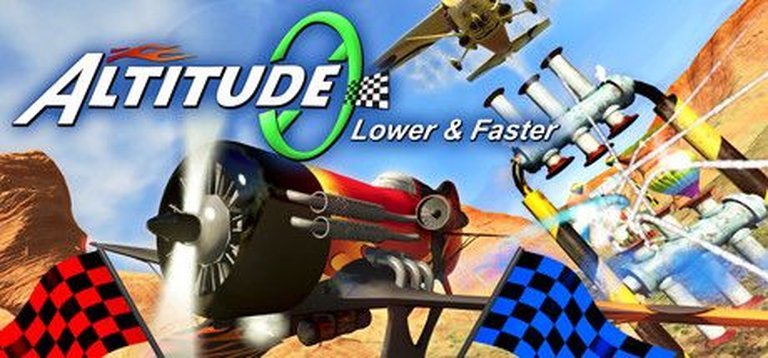
Altitude0: Lower & Faster is a skill-based competitive racing game set in a virtual aviation environment where players must navigate extremely low-altitude flights over rugged terrains filled with obstacles like blades and fire rings. It combines action and simulation elements with plane customization, team-based multiplayer, and a dynamic soft-body deformation system for chaotic crashes, offering dozens of tracks, replay value, and Hall of Fame rankings to激励 players to improve and compete.
Altitude0: Lower & Faster Guides & Walkthroughs
Altitude0: Lower & Faster Reviews & Reception
gamechronicles.com : But most of all, Altitude0 is just a fun game to play, reminding me of a more advanced version of Sonic All-Stars Racing Transformed.
familyfriendlygaming.com (66/100): I wish there was a mode that was more friendly to casual and family gamers.
Altitude0: Lower & Faster: A Review
Introduction: The Cult of the Edge
In the modern landscape of polished AAA titles and sprawling live-service ecosystems, there exists a quiet, fervent niche for games built on a single, razor-sharp premise. Altitude0: Lower & Faster is one such game—a title that wears its core design philosophy on its sleeve, literally. It is a pure, unadulterated test of player skill and nerve, distilled into the simple yet profound equation: lower altitude equals greater speed. Emerging from the Slovenian indie studio Gugila into a three-year Steam Early Access tenure, it represents a fascinating case study in meticulous, community-driven development. This review argues that Altitude0 is not merely a niche flight racer but a brilliant, if flawed, exemplar of the “skill-based competitive racing” ethos. Its legacy lies in its powerful central mechanic, its empowering customization systems, and its testament to the ethos of small-team development, even as its limited scope and technical roughness prevent it from achieving mainstream classic status.
Development History & Context: The Two-Person Skunkworks
To understand Altitude0 is to understand Gugila, d.o.o., a development studio whose public identity is almost exclusively tied to this single project. With no prior released titles documented in major databases, Altitude0 was born from a vision to create a competitive, skill-first aerial racing experience distinct from both simulation-heavy fare and arcade kart racers. Its development trajectory is intrinsically linked to the maturation of the Steam Early Access model.
The game first appeared in Early Access around September 2013/2014 (sources vary slightly), entering a period of protracted, open development that would last nearly three years. This was a critical era for Early Access, moving past its initial “pay-to-alpha” stigma toward a more collaborative model. Gugila embraced this fully. As noted by reviewer Travis Young at Game Chronicles, the studio was “active with the community and regularly rolling out patches and improvements.” This iterative process, fueled by player feedback on tracks, physics, and balance, was essential to the game’s evolution. The official description’s emphasis on user-created tracks and multiplayer events wasn’t just a feature list; it was a development mandate.
Technologically, the game was built on a proprietary engine supporting DirectX 9 and 11, using the Bullet Physics middleware. This choice speaks to a pragmatic, resource-conscious approach—capable of handling the crucial soft-body deformation without the overhead of a larger engine like Unity or Unreal. The system requirements were modest (a Dual Core 2.0 GHz CPU, 512MB shader 3.0 GPU), targeting wide accessibility. However, this also meant visual fidelity was initially basic, with the “indie roots” showing in simple geometry and textures—a point the developer steadily improved upon throughout Early Access, as Young observed with “very noticeable improvement in the visual fidelity… draw distance and smooth framerate.”
The 2014 release window placed Altitude0 in a post-FTL: Faster Than Light (2012) world, where “faster” was part of a lucrative genre naming trend, but pre-dating the massive success of Trackmania‘s modern remakes and the surge in realistic flight sims like Microsoft Flight Simulator (2020). It occupied a lonely but dedicated space: the hardcore arcade racer, a genre then experiencing a relative drought on PC.
Narrative & Thematic Deep Dive: The Mythos of the ‘Real Racer’
Altitude0 possesses no traditional narrative with characters, dialogue, or plot. Its “story” is emergent, procedural, and entirely player-driven—a narrative of personal progression and rivalry. The thematic core is explicitly stated in its ad copy: “Join real racers’ club!” This is not a game about being a hero; it is about becoming an ace.
The game constructs its mythology through systems and terminology. The “License Mode” is the protagonist’s journey. Starting as a novice, you race against the “ghosts” of predecessors—recorded replays of other players who have mastered the track before you. These ghosts are not just time trials; they are silent mentors and rivals, embodying the ideal line, the perfect brake points, the daring low passes. Improving your license is the primary solo narrative beat, a tangible measure of your assimilation into the club.
The “Hall of Fame rankings” for various stats (low flying, items collected) create a multi-dimensional leaderboard mythology. You are not just the fastest; you are the lowest, the most daring. The game constantly reinforces its title’s mantra: Lower & Faster. The environment itself is an antagonist and a narrative device. The “rugged terrains,” “blades and fire rings,” “crushers,” “giant blades or mines,” and “narrow caves and winding canyons” (as per the Game Chronicles review) are not mere scenery. They are the trials of the hero’s journey. Each successful pass through a crushing gate at terminal velocity is a story of split-second decision-making and flawless execution. The “soft body deformation system,” where “wings, tail, propellers… will twist, bend and eventually fall off,” serves a ludic-narrative purpose. A crash isn’t a “Game Over” screen; it’s a comedic, physics-driven setback that reinforces the stakes. You survive, you often can still finish the race in a mangled mess, but the visual spectacle of your destruction tells a mini-story of failure and resilience.
Ultimately, the game’s theme is the purity of competition stripped of all pretense. There is no war, no save-the-world plot. There is only the track, the plane, and the ghost ahead of you. The narrative is the improvement of your own time, the lore is the collective history of all player ghosts, and the ultimate victory is inscription in the Hall of Fame.
Gameplay Mechanics & Systems: The Precision Dance of Doom
At its heart, Altitude0 is a game about managing two inverse variables: altitude and speed. Its genius lies in making this relationship feel physically intuitive and viscerally rewarding. Flying lower grants a tangible speed boost, creating an inherent risk/reward loop where hugging the treetops or skimming the canyon floor is the optimal, yet perilous, path.
Core Loop & Racing: The primary activity is completing point-to-point circuits composed of two main gate types:
1. Ring Gates: The standard, requiring the entire plane to pass through.
2. Pole Gates: Infinitely more demanding, requiring precise threading between vertical poles. Hitting a pole results in a crash. These are the game’s signature challenge, demanding micro-adjustments and presenting a “margin for error… really thin, short, and small” (Family Friendly Gaming review).
Tracks are littered with environmental obstacles (trees, rocks, barns, caves) and Trap Gates: timed crushers, spinning blades, and fire rings that necessitate exact moment-of-passage timing. This transforms racing from a simple pathfinding exercise into a memorization and rhythm challenge. As the GamePressure summary notes, “racers have to show different skills… some races are about speed, some about precision flying but most of the time is about choosing the right strategy.”
Controls & Physics: The game offers a fascinating duality. It is “decisively arcade in nature” but with “surprisingly advanced controls allowing you full rudder control for almost sim-like maneuverability” (Game Chronicles). Players can choose between Chase Cam (dynamic, behind-plane) and Nose Cam (static, forward-facing), each trading situational awareness for precision. The flight model allows for aggressive maneuvers—loops, rolls, hammerheads—necessary to correct errors or shave tenths of seconds. An “option to simplify the controls” exists for newcomers, but as Young stresses, “I encourage you to stick with the advanced controls if you want to win (or even complete) later races.” This creates a high skill ceiling, where mastery of the advanced control scheme is the key to competitive success.
Progression & Customization: The progression system is robust and multi-layered.
* License & Career: The solo path is structured around improving your A0 license (e.g., “A0 Pro license holder”) by beating ghost racers on a curated set of “license tracks.” This teaches the game’s mechanics systematically.
* Plane Customization: This is a standout feature. Players earn “plane parts and tuning” (performance upgrades like turbines, ailerons) and “plane decorations… stickers, plane skins, colored smoke.” Crucially, the system has tactical depth: “one [plane] that accelerates fast but it is bad in the turns, another that decelerates slow but then when it has speed is good in the turns” (Steam user review). Customization isn’t just cosmetic; it’s loadout tuning for different track types. You can also “tune plane settings” for personal preference.
* Track Editor: The included editor is a monumental feature for an indie title. It empowers the community to create “dozens of… user created tracks,” ensuring virtually infinite replayability. The editor’s flexibility with “buildings like hangars, bridges, warehouse and barns” allows for creative, themed circuits.
Multiplayer & Community: Multiplayer is where the game’s “real racers’ club” ethos comes to life. It features “team-based multiplayer” where “flying becomes contact sport with plane collisions” (Steam description). While not combat, collisions add a layer of chaotic, physical competition. More structured are Official Events organized by the developers or community. The thriving online community, noted by multiple reviewers, hosts regular events—a practice Gugila actively supported with in-game gifts. A unique “Freeway” mode allows for drop-in/drop-out racing. The social fabric, described as a “very polite and pleasant community” by one Steam user, is a significant part of the game’s appeal.
Flaws & Friction Points: The game’s difficulty is its most cited flaw and feature. The controls feel “a bit loose” (Family Friendly Gaming), and the learning curve is brutal. The early “license tracks” ease you in, but the ramp-up is steep. Some users on Steam noted control issues with generic joysticks early on, though patches improved this. The lack of a cockpit view (only chase/nose cams) may dissuade sim purists. Most critically, as the Family Friendly Gaming review unflinchingly states, the offensive user-generated ghost images present a serious content risk, undermining the game’s otherwise family-friendly mechanical veneer.
World-Building, Art & Sound: Scenic Peril and Industrial Drive
The “world” of Altitude0 is not a story setting but a series of environmental proving grounds. The environments—”Alpine mountains… lush forests” and “desert canyon” (G4G.it)—are beautifully stark backdrops. They are more than pretty pictures; their geometry defines the race. The “tight spaces” of canyons, the “tree-dotted” mountain slopes, and the dusty arches of desert mesas are integral puzzle pieces. The art style favors clear, readable geometry over ultra-realism, ensuring that the crucial next pole or crusher gate is instantly identifiable at high speed.
The soft-body deformation system is the star technical and artistic feature. It perfectly encapsulates the game’s tone. Wings bend grotesquely, tails snap off, propellers spin wildly into the void. It’s exaggerated, sometimes “silly,” but always a direct, physical consequence of a mistake. It turns crashes from a failure state into a piece of entertaining, emergent comedy, perfectly aligning with the “Fun crazy plane crashing” key feature.
Sound design is functional but effective. The roar of the engine is constant and satisfying, scaling with speed. The “occasional steel thump of a crusher gate” is a distinct audio cue for near-misses or impacts. The soundtrack, however, receives high praise. Described as having “music courtesy of LastDayHere that totally energizes each race” (Game Chronicles) and noted by a Steam user for having “tracks that are sung,” it provides an unexpected layer of energetic, modern rock/electronic pumping through the headphones, crucially raising the adrenaline during high-speed runs. It’s a fantastic complement to the visual chaos.
Reception & Legacy: The Niche Cult Classic
Altitude0 exists in a curious reception space. It never achieved a Metascore (n/a on Metacritic), and its MobyScore is also not applicable. Critical coverage was sparse but positive from outlets that covered it (like Game Chronicles). On Steam, it holds a “Mostly Positive” (73%) rating from over 1,800 reviews as of the latest data. This indicates a solid, if not soaring, cult following.
Its commercial performance is that of a modest indie success. Sold at a consistent $24.99 on Steam, it found its audience—players specifically searching for challenging, arcadey flight racers. The fact that it maintained active development and community engagement for three years in Early Access is a testament to its ability to retain and satisfy that core audience.
Legacy and Influence is twofold:
1. The “Gugila Model”: It stands as a successful example of a tiny, two-person team sustaining a multi-year Early Access project through transparent communication, regular updates, and deep community integration (track editor, events). It’s a blueprint for sustainable indie development focused on a tight, expandable core mechanic.
2. Genre contribution: It filled a noticeable gap for hardcore arcade air racing on PC. Its closest relatives are titles like SkyDrift (which combined air racing with combat) and the Red Bull Air Race official games. Altitude0 carved its niche by doubling down on pure, trap-laden, precision racing without combat, and by providing an unparalleled track editor. It likely influenced the design philosophy of later, similar indie racers that emphasize user-generated content and skill-based leaderboards. Its combination of high-speed, low-altitude flying with deformation physics remains distinctive.
Its legacy is secured in the annals of “great niche racers” and “successful Early Access stories,” but it did not spawn a franchise or fundamentally alter the racing genre. Its influence is more philosophical: proof that a game built entirely around “lower and faster” can find a dedicated, appreciative audience.
Conclusion: The Uncompromising Runway
Altitude0: Lower & Faster is a game of magnificent focus and inevitable friction. Its core mechanic—the inverse relationship between altitude and velocity—is inspired, creating a relentless, white-knuckle racing experience that is uniquely its own. Combined with a deep and meaningful customization suite and a community-powered track editor, it offers immense depth for the patient player.
However, this depth comes at the cost of steep accessibility. The controls, while deep, are unforgiving. The presentation, while improved, never fully escapes its indie budget constraints. And the unmoderated user-content issue remains a significant blemish, a stark reminder of the perils of open community features.
Yet, for those who persevere, Altitude0 delivers something rare: a pure, unvarnished test of skill where improvement feels earned and victories feel legitimate. It is a testament to the vision of its small development team and the power of a single, brilliant idea executed with tenacity. It may not be a classic in the broadest sense, but within its chosen lane—the exacting, trap-filled world of extreme low-altitude racing—it is a definitive, challenging, and deeply satisfying experience. It doesn’t just ask you to fly; it asks you to dance on the razor’s edge between the ground and oblivion, and for that audacity, it deserves recognition and respect.
Final Verdict: 8/10 – A masterclass in focused, skill-based design held back from greatness by a brutally high difficulty curve and persistent community management issues. An essential experience for connoisseurs of hardcore arcade racing.