
- Release Year: 2022
- Platforms: Windows
- Publisher: Small Game Studio
- Developer: Small Game Studio
- Genre: Strategy, Tactics
- Perspective: Fixed / flip-screen
- Gameplay: Cards, Tiles
Description
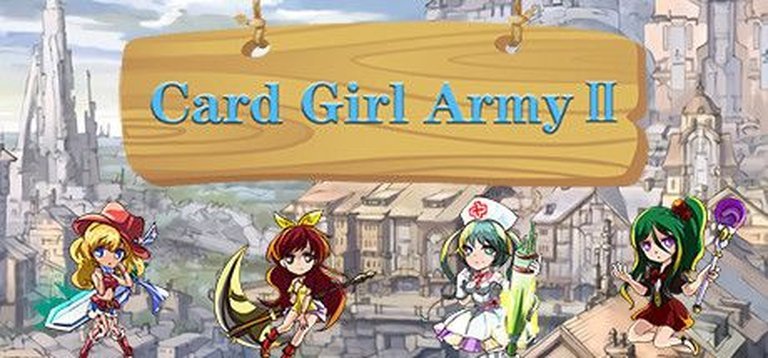
Card Girl Army II is a cartoon-style turn-based tactical card game where players collect and deploy a diverse roster of character cards, each with unique abilities such as melee attacks, magic spells, or support skills. By strategically arranging cards in formations that boost their attributes, players engage in battles using up to five cards at a time, with deep progression systems including leveling up, quality enhancements, and equipment customization to grow their team’s power.
Card Girl Army II: A Review of a Digital Ghost
Introduction: The Archaeology of Obscurity
To approach Card Girl Army II is to engage in a unique form of digital archaeology. Here is a game released on Steam on April 20, 2022, developed and published by the enigmatic “Small Game Studio” (also known as 小小游戏, or “Little Game”), yet it exists in a near-phantom state within the historical record of video games. There are no critic reviews aggregated on Metacritic. The user review count on Steambase hovers at a mere three, yielding a Player Score of 67/100. Its MobyGames page is a skeletal framework, pleading for contributors to provide a description. Kotaku’s listing is a functional, empty shell. This review, therefore, cannot be a traditional critique of mechanics, narrative, and impact in the conventional sense. Instead, it must be an examination of absence—a forensic study of a title that seems to have been purposefully designed to evaporate from cultural memory. My thesis is this: Card Girl Army II is not a failed game, but a successful artifact of digital oblivion, representing a category of release so niche, so minimally marketed, and so devoid of community engagement that it challenges the very mechanisms of game historiography. Its “legacy” is its profound invisibility.
Development History & Context: The Unseen Studio
The development context of Card Girl Army II is a study in minimalism. The sole credited entity is “Small Game Studio,” a name that functions more as a placeholder than an identity. There is no information about the team’s size, location, prior projects, or design philosophy. The game engine is listed as Unity, a common choice for indie projects due to its accessibility and cross-platform potential, but this tells us nothing about the specific constraints or ambitions of this team.
The year 2022 placed the game in a post-pandemic indie landscape saturated with digital releases. The Steam store was (and is) a deluge of titles, many from small studios hoping to carve out a niche. Card Girl Army II appears to have been one of countless such releases that launched into a void. The technological “constraint” here was not a hardware limitation but an attention-economy one. In an ecosystem where discoverability is king and algorithms favor established hits and viral trends, a game with no marketing push, no recognizable brand, and no apparent community-facing strategy is functionally non-existent from launch. The “gaming landscape” at the time is irrelevant to this title because it was never a participant; it was a ghost in the machine. Its existence is documented only by transactional metadata: a Steam App ID (1957480), a release date, a price point (noted as low as $1.19 on Steambase), and a list of supported languages (10, including English, Russian, Japanese, and Simplified Chinese, though audio and subtitles are listed as “No” for all). The DLC releases (Card Girl Army II: DLC1 and DLC2 on the same day as the base game, April 20, 2022) suggest a planned, perhaps rushed, content rollout, but without any details on their content, they become further mysteries.
Narrative & Thematic Deep Dive: The Blank Page
A deep dive into the narrative and themes of Card Girl Army II is an exercise in confronting a vacuum. The official Steam store description provides only a functional, genre-defining blurb: it is a “cartoon-style turn-based card game” involving collecting cards with different abilities (Attack, Agility, Defense, Magic, Auxiliary) and arranging them in formations for combat. There is no mention of a plot, characters, dialogue, setting, or underlying themes.
The title itself, “Card Girl Army,” hints at a possible blend of tactical card gameplay and a cast of female characters (“Girl Army”), a common aesthetic in certain anime-inspired indie titles. However, the source material offers zero confirmation. Are these “card girls” personified warriors? Are they anime-style heroines with stats? Is there a story about assembling this army? The Steam tags (“Female Protagonist,” “Anime,” “Cartoony”) support this interpretation, but they are user-applied labels, not canonical facts. The “cartoon-style” visual direction is the only aesthetic clue, but without screenshots or videos to analyze (the MobyGames and Kotaku pages are devoid of media), we cannot describe character design, world art, or tone. The narrative section of this review, therefore, must conclude with the stark finding that Card Girl Army II, as a narrative experience, is a complete unknown. It is either exceptionally bare-bones, or its story is so minor it was omitted from all official marketing copy—a rarity that points to extreme simplicity or a fundamental lack of substantive content to market.
Gameplay Mechanics & Systems: The Blueprint in the Void
The gameplay systems are the only aspect of Card Girl Army II described with any specificity, though even here the information is parsed from a boilerplate store description. We can reconstruct a basic mechanical framework:
- Core Loop: The player collects cards (growing their “team”), levels them up via battle experience, improves their quality (which boosts attributes and grants passive skills), and equips them with upgradable weapons and armor. Battles involve arranging up to 5 cards in a formation on a grid.
- Formation System: This is presented as a key strategic layer. Each position in a formation provides different attribute bonuses, and “advanced formations” offer more bonuses. The act of “dragging and dropping the mouse” to arrange cards is the primary interaction.
- Card Archetypes: Five distinct types are outlined:
- Attack Type: “Powerful melee attack ability.”
- Agility Type: “Fast attack speed, and has a high crit rate and evasion rate.”
- Defensive Type: “Has high vitality and high defense.”
- Magic Type: “Has powerful long-range attack power and a wide range of magic skills.”
- Auxiliary Type: “It can restore life, and can also increase the attributes of cards.”
From this, we can infer a tactical, position-based card battler along the lines of Frontline Chronicles or Dream Quest, but with a formation bonus mechanic. The “up to 5 cards” limit suggests a small-squad tactical focus rather than a large-scale deck-building game.
Analysis of Systems: The described systems are not inherently innovative; they represent a standard compendium of card-RPG mechanics (leveling, quality improvement, equipment, archetypes). The supposed innovation is the “formation” stat-bonus grid. However, without knowing how formations are unlocked, how complex the grids are, or how significant the bonuses are, this remains a theoretical hook. The description’s phrasing (“the formation and the reasonable combination of different cards can exert the greatest power”) suggests a puzzle-like element where optimal placement is key, but again, this is speculative.
The interface is noted as “Point and select,” consistent with the drag-and-drop arrangement. The “Fixed / flip-screen” visual style (from MobyGames) implies a static or possibly scrolling 2D battlefield, not a fully animated 3D arena.
Flaws & Unknowns: The Steam community discussions reveal player confusion. One user questions the healing logic of an “Auxiliary type” priest card, noting it “should respond to 50% of the monomer’s health” but sometimes fails to heal targets below that threshold. This indicates either a poorly explained skill description (a localization/UI flaw) or a buggy, inconsistent AI targeting routine—a critical flaw in a tactical game. Another user questions “Level of Replayability,” finding the prospect of “beating multiple different levels… in time is a bit weird,” hinting at a potentially repetitive or grind-heavy structure. These fragments are our only windows into actual player experience, suggesting systems that may be opaque or unsatisfying.
World-Building, Art & Sound: The Aesthetics of Absence
This section is, by necessity, the shortest. There is no descriptive information about the game’s setting, atmosphere, or art direction beyond the adjective “cartoon-style.” No screenshots are available on the linked MobyGames page. The Kotaku page is a metadata hub with no embedded media. The user tags (“Cute,” “Colorful,” “Anime,” “Cartoony”) are our only descriptors, painting a picture of a bright, stylized, potentially chibi or anime-inspired aesthetic. The “2D Platformer” tag is peculiar and likely a misnomer applied by users, as the core description says nothing of platforming; it may refer to the 2D card/formation display.
The sound design is a complete blank. No mention of music, sound effects, or voice acting exists in any source. The Steambase data lists “Audio” support as “No” for all 10 languages, implying either a silent game or one with only basic sound effects, no music, and certainly no voiced dialogue. This aligns with a low-budget, solo-developed project where audio may have been a low priority or omitted entirely.
The contribution of these elements to the “overall experience” is therefore unimaginable. We cannot assess cohesion, tone, or immersion because the constituent parts are not documented. The art and sound exist only as faint, unsubstantiated hypotheses.
Reception & Legacy: Statistical Zero
Card Girl Army II‘s reception is defined by its statistical near-zero. At launch and to this day, it has:
* Zero professional critic reviews on any aggregated site (Metacritic, OpenCritic).
* A minuscule 3 user reviews on Steam, as recorded by Steambase (2 positive, 1 negative), for a Player Score of 67/100.
* No mentions in any major gaming publications (Kotaku’s page is just a listing).
* A MobyGames page so bare it actively solicits contributions for a description, credits, and trivia.
Its “commercial reception” is unknown but can be inferred from its frequent discounting (listed at $1.19 vs. a potential $3.99) and its appearance in “bundles” (e.g., the “Small Game 2023 Only Games” bundle for $32.65 containing 33 games). This suggests it was a low-cost filler title in a publisher’s catalog, not a standalone product with significant sales expectations.
Evolution of Reputation: There is no reputation to evolve. The game has not been rediscovered, praised in retrospective lists, or analyzed by niche communities. Its SteamDB-like page shows fluctuating “Players In-Game” numbers (1-2 at the time of data collection), confirming a persistent state of near-total obscurity.
Influence on the Industry & Subsequent Games: The influence is nonexistent. It has not inspired clones, been cited by developers, or contributed to genre conventions. Its listing among “Related Games” on MobyGames (Keen: One Girl Army, Army Men II, Army To Army) seems algorithmic based on the word “Army” and is not meaningful. The “Smart recommender” on Steambase absurdly compares it to Cats Organized Neatly and Placid Plastic Duck Simulator based solely on the “Casual” tag, highlighting its categorization as pure noise in a recommendation system.
Its legacy is a perfect example of the “long tail” of digital distribution—a game that exists, is technically available for purchase, but has zero cultural footprint. It is a data point demonstrating the vast, dark matter of the Steam store, where thousands of titles exist in a state of perpetual, unobserved publication.
Conclusion: The Definitive Verdict on a Non-Event
To synthesize: Card Girl Army II is a game defined by the total absence of evidence for its own existence as a notable artifact. Based solely on the provided source material, we can confirm it is a:
* 2022 Unity-based Windows card battler.
* With five card archetypes and a formation-based tactical grid.
* Featuring leveling, quality improvement, and equipment systems.
* Presented in a 2D cartoon/anime visual style (inferred from tags).
* Published by the nebulous Small Game Studio / 小小游戏.
* Accompanied by two simultaneous DLCs.
* Available in 10 languages (interface only).
* Possessing a Steam player base of 0-2 concurrent users.
* Garnering a total of 3 user reviews.
Every other aspect—narrative, specific art, sound design, precise gameplay feel, depth of systems, actual developer intent, community reception—is utterly undocumented. The game is a historical non-entity.
My definitive verdict is this: Card Girl Army II holds no place in video game history beyond serving as a stark case study in digital ephemerality. It is not a “lost classic” waiting to be found; it is a title that, from all observable evidence, never sought an audience and never found one. Its value is purely as a datum for economists and archivists studying the sheer volume of content in the digital marketplace. For the player, the historian, or the critic, it is a black hole—a game whose gravitational pull is so weak it cannot even capture the light of a single comprehensive review. To play it would be to engage with a void, and the sources suggest doing so would be a solitary, unverified, and ultimately unreviewable experience. Its only enduring truth is its proof of existence in a database, a whisper of a game lost in the noise before it could even begin to speak.