
- Release Year: 2014
- Platforms: Windows
- Publisher: rokapublish GmbH
- Developer: Nijumi Games
- Genre: Puzzle
- Perspective: Top-down
- Game Mode: Single-player
- Gameplay: Cards, Tile matching puzzle, Tiles
Description
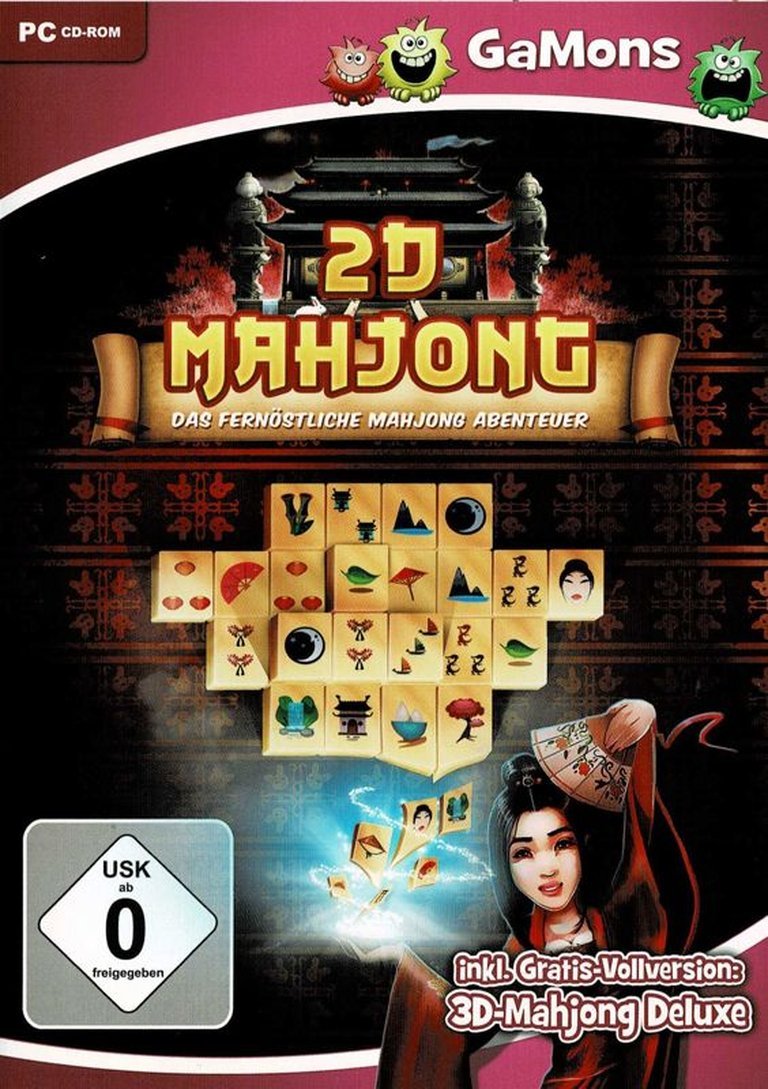
2D Mahjong Temple is a tile-matching puzzle game set in a vibrant Far Eastern temple, where players embark on a story-driven adventure to help the temple principal’s daughter rescue her runaway rabbit. Featuring 60 beautifully designed levels across three chapters with increasing difficulty, relaxing background music, and authentic oriental graphics, it blends traditional Mahjong solitaire with immersive gameplay for both casual and experienced puzzle enthusiasts.
Gameplay Videos
Where to Buy 2D Mahjong Temple
PC
2D Mahjong Temple: A Serene Stroll Through a Well-Trodden Temple Path
Introduction: The Calm Before the Storm
In the vast, ever-expanding library of digital casual games, certain titles exist not as groundbreaking revolutions but as meticulously crafted, reassuring constants. They are the gaming equivalent of a warm cup of tea on a quiet afternoon—predictable in their comfort, yet executed with a quiet professionalism that ensures satisfaction. 2D Mahjong Temple, released in 2014 by the German studio Nijumi Games and published by rokapublish GmbH, is precisely such a title. It does not seek to reinvent the centuries-old mechanics of Mahjong solitaire; instead, it wraps them in a cohesive, aesthetically pleasant package centered on a simple, almost nursery-rhyme-like narrative premise. This review posits that while 2D Mahjong Temple is a game of no great ambition or historical significance, its value lies in its demonstration of how solid, unassuming craftsmanship can create a perfectly functional and enjoyable entry within a hyper-saturated genre. It is a testament to the enduring appeal of puzzle refinement over radical innovation.
Development History & Context: A Studio’s Stepstone
Nijumi Games, the developer behind 2D Mahjong Temple, operated in the competitive yet formulaic world of casual PC gaming. The mid-2010s were a peak period for digital distribution of casual titles, with portals like Big Fish Games and Steam’s “Casual” category thriving on predictable, relaxing experiences. The technological constraints were minimal for a 2D tile-matching puzzle game, allowing the studio to focus on asset creation—graphics, music, and level design—rather than complex engine work.
The game’s original German title, 2D Mahjong: Das Fernöstliche Mahjong Abenteuer (“The Far-Eastern Mahjong Adventure”), explicitly targets a European audience seeking a sanitized, “exotic” aesthetic, a common trope in Western casual games of the era. Its publisher, rokapublish GmbH, was a known entity in the German casual gaming scene. The choice to release on Windows via CD-ROM and later Steam reflects the transitional period where physical casual game boxes still existed but digital storefronts were becoming dominant. Notably, the studio and publisher would later pivot to titles like Beasties and The Forgotten Land, which blend match-3 with other mechanics, suggesting 2D Mahjong Temple was part of an early phase focused on perfecting a single, classic genre before experimentation.
Narrative & Thematic Deep Dive: A Quest for a Missing Fluffball
The narrative of 2D Mahjong Temple is its most overtly constructed element, serving primarily as a superficial scaffold for the gameplay. The “story” is delivered via the store description and in-game chapter headers: the temple principal’s daughter loses her pet rabbit during morning prayers, and the player must embark on a “colorful adventure” to retrieve it across three chapters and 60 levels.
This premise is functionally identical to countless casual games where a simple object (a pet, a crown, a set of items) is lost and must be found through gameplay. There are no named characters beyond the “young lady” and “temple principal,” no dialogue, and no cutscenes. The thematic depth is nonexistent on a textual level. However, one can analyze the implied themes through its aesthetic and mechanical choices.
The setting—a “Far Eastern” temple—leverages a Westernized, aestheticized version of East Asian spirituality. The “morning prayer” context, the temple setting, and the “soothing background music” all work together to create an atmosphere of peace, mindfulness, and quiet ritual. The act of meticulously removing matching tiles from a complex pile becomes, in this context, a metaphorical act of purification or restoration, mirroring the goal of restoring order (finding the rabbit) to a disrupted sacred space. The game’s “Relax mode” explicitly encourages this meditative state. Thus, while the plot is paper-thin, the experience thematically aligns with tranquility, focus, and gentle perseverance—core tenets of many contemplative traditions, albeit stripped of any specific cultural context for broad Western consumption.
Gameplay Mechanics & Systems: The Unmoving Mountain of Tiles
At its core, 2D Mahjong Temple is a pristine implementation of the “Shanghai” or “Mahjongg solitaire” ruleset, with a handful of quality-of-life features.
- Core Loop: The player is presented with a fixed, two-dimensional layout (perspectively described as “fixed / flip-screen” and “top-down”) of stacked Mahjong tiles. The objective is to remove all tiles by selecting pairs of identical, unblocked tiles. A tile is “unblocked” if it has no tile directly on top of it and is not sandwiched horizontally between two adjacent tiles.
- Level Progression: The 60 levels are organized into three thematic chapters. Completion of each set of 10 levels unlocks a new visual background and soundtrack, providing a sense of progression and environmental change. The game features two primary modes:
- Story Mode: The intended path, with sequential levels of increasing complexity in layout.
- Relaxed Mode: Offers a single, presumably large and pleasing layout for endless, pressure-free play.
- Systems & Helpers: The game includes a limited set of aids, as documented by the WWGDB review:
- Undo: Allows reverting the single most recent move. This encourages strategic thinking without total penalty for misclicks.
- Auto-Hint: After a period of inactivity, a valid match is highlighted with a blue swirl. This prevents total paralysis on difficult boards.
- Reshuffle: A button that randomly reorganizes the remaining tiles. Crucially, it can only be used before the player is truly “stuck” (i.e., when no moves are possible, triggering a “game over”). This mechanic is a double-edged sword; used proactively, it can salvage a doomed strategy, but it cannot bail a player out of an unsolvable layout, reinforcing the need for careful planning.
- Combo Meter: Represented as a blue pillar on the screen, consecutive matches without a pause fill the meter, rewarding the player with additional “golden carrots” (score points). This incentivizes speed within a strategic framework but does not impose a time limit.
- Critique: The gameplay is fundamentally sound and friendly. The lack of a traditional hint system that directly reveals a move (only the idle-triggered highlight) respects the player’s agency. The “stuck” condition is the primary challenge—some layouts are genuinely devious and may require multiple attempts to discern the correct first moves. The absence of customization options (like custom tile sets or boards), noted in the WWGDB review, is a missed opportunity for personalization but aligns with the game’s focused, “pick-up-and-play” design philosophy. Its greatest flaw is also its defining feature: it offers nothing new. For veterans of Mahjong solitaire, it is a competent but forgettable entry in a genre saturated with similar titles.
World-Building, Art & Sound: The Gilded Cage
The audiovisual presentation is where 2D Mahjong Temple makes its most concerted effort to distinguish itself.
- Visuals: The game employs a clean, vector-inspired 2D art style. The tile designs are “very well defined and… very nice-looking,” with clear, distinct symbols that minimize misidentification—a critical feature for a puzzle game. The backgrounds for each chapter are “beautifully designed” in a generic “Far Eastern style,” featuring serene temple courtyards, gardens, and interiors with a soft, colorful palette. The top-down, fixed-screen perspective keeps the focus squarely on the tile pile. The overall effect is polished, consistent, and inoffensively attractive, though it lacks the hand-drawn charm of more artistic indie titles or the high-fidelity detail of modern casual releases.
- Sound Design: The soundtrack consists of “oriental-styled piano tune[s]” that are “pleasant and soothing.” Different chapters feature different tracks, providing auditory variety that matches the visual chapter changes. The sound effects—tile clicks, successful matches, combo meter sounds—are crisp and satisfying. The audio design clearly prioritizes creating a relaxed, ambient atmosphere over energetic engagement, perfectly suiting the game’s intended ” unwind ” purpose.
These elements work in concert to create a specific mood: one of calm, focused contemplation. The “Far Eastern” aesthetic, while culturally diffuse, effectively communicates a sense of ancient peace and order that complements the puzzle-solving process.
Reception & Legacy: A Whisper in the Mahjong Hall
2D Mahjong Temple occupies a modest, almost invisible niche in the history of video games.
- Contemporary Reception: Critical coverage was virtually non-existent. MobyGames shows no critic reviews and only a single player collection as of this writing. Steam user reviews are sparse (8 total) and “Mixed” (62% positive), with a player score of 63/100. PlayTracker estimates a very small player base (~13,000 owners) with a high median playtime of 1.1 hours, suggesting most who try it play through the story mode once or twice. Niklas Notes records a “Mixed” sentiment breakdown (5 positive, 3 negative).
- Commercial Performance: It was a commercial title sold at a standard casual game price ($8.99 on Steam). Its presence on platforms like Big Fish Games and GameHouse indicates it found its core audience within the established casual game distribution networks. No sales figures are available, but its continued availability on Steam and the lack of a sequel or major updates suggest modest, sustainable success rather than a breakout hit.
- Legacy & Influence: The game has no discernible influence on the industry. It did not innovate mechanically, popularize a new aesthetic, or spark a trend. Its legacy is purely as a competent example of a subgenre. In the vast ecosystem of Mahjong solitaire variants—from the iconic Shanghai to mobile juggernauts like Mahjong Titans—2D Mahjong Temple is a name that would only be recalled by the most dedicated genre completists. Its developer’s subsequent work on more hybrid games (Beasties, The Forgotten Land) shows a move away from pure Mahjong, indicating that 2D Mahjong Temple itself was likely not a defining project for Nijumi Games.
Conclusion: A Well-Tended Garden
2D Mahjong Temple is a game that excels at being exactly what it sets out to be: a pleasant, visually clean, and mechanically sound Mahjong solitaire experience wrapped in a kitschy narrative. It succeeds in its goal of providing a relaxing, accessible puzzle challenge with a gentle progression curve and helpful, non-intrusive aides. Its production values are competent for its scope and era, with a coherent aesthetic and soothing audio design.
However, its lack of ambition is also its ultimate limitation. It contributes nothing new to the genre it inhabits. There is no unique twist, no narrative depth, no artistic statement—just a reliably crafted, familiar experience. For a player seeking a new, high-quality board for an old favorite puzzle, it fills the need admirably. For the historian, it serves as a minor data point: a snapshot of the late-2010s casual PC game market, where well-polished but derivative titles could quietly find a small, satisfied audience through established digital storefronts.
Its place in video game history is therefore not on a pedestal, but on a shelf—a decent, forgettable book in a vast library of puzzle games. It is remembered not for what it did, but for what it represents: the quiet, steady, and ultimately ephemeral labor of the countless small studios that keep the casual gaming ecosystem verdant, one reliably enjoyable tile-matching layout at a time. To recommend it is to recommend a comfortable chair: it’s perfect for its purpose, but you likely already have one.