
- Release Year: 2009
- Platforms: Windows
- Publisher: Halycon Media GmbH & Co. KG
- Genre: Compilation
- Game Mode: Single-player
- Gameplay: Flight Simulation
- Setting: Civil aviation
Description
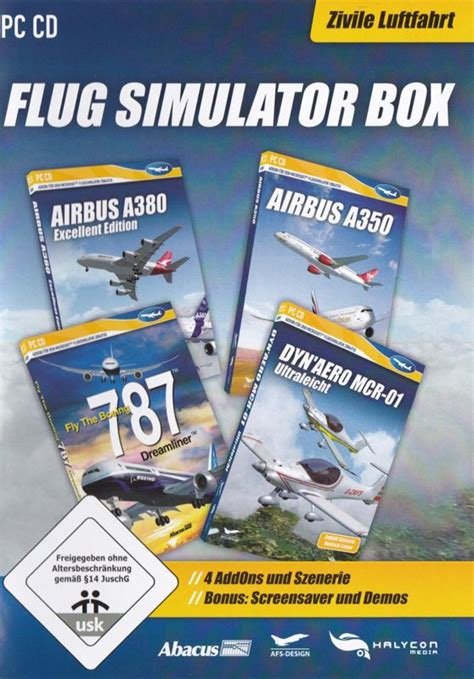
Flug Simulator Box: Zivile Luftfahrt is a 2009 Windows compilation released by Halycon Media, focusing on civilian aviation simulation. It bundles Microsoft Flight Simulator 2004: A Century of Flight with add-on aircraft packs including the Airbus A350, Airbus A380: Excellent Edition, Dyn’Aero MCR-01 Ultraleicht, and Fly The Boeing 787 Dreamliner, offering players a realistic and diverse flight experience with modern and light civilian aircraft.
Flug Simulator Box: Zivile Luftfahrt Reviews & Reception
retro-replay.com : Flight dynamics are impressively detailed across all four expansions.
retro-replay.com : Flight dynamics are impressively detailed across all four expansions.
Flug Simulator Box: Zivile Luftfahrt: A Zeitgeist in a Box
Introduction: Preserving a Legacy in Pressed DVD
In the grand museum of video game history, some titles are monumental auteurs—Pong, Doom, The Legend of Zelda—while others are quiet custodians, archivists of a beloved digital heritage. Flug Simulator Box: Zivile Luftfahrt (2009), published by the German company Halycon Media, is unequivocally the latter. It is not a game of revolutionary mechanics or narrative genius. Instead, it is a meticulously curated time capsule, a commercial repackaging that captured the twilight of an era for one of PC gaming’s most enduring franchises: Microsoft’s Flight Simulator. Released at a curious inflection point—just two years after the acclaimed Flight Simulator X and on the eve of the series’ dormant period—this compilation represents a final, pragmatic love letter to the golden age of community-driven, add-on-centric flight simulation. Its thesis is simple yet profound: it argues for the continued vitality and educational value of Flight Simulator 2004: A Century of Flight by bundling it with a quartet of premium, post-2004 commercial add-ons that pushed the boundaries of what the aging FS2004 engine could render. This review will dissect Flug Simulator Box not as a standalone creation, but as a deliberate act of historical curation, analyzing how its very existence speaks to the state of the genre, the business of niche publishing, and the unwavering passion of the flight sim community at the end of the 2000s.
Development History & Context: The Budget Publisher’s Gambit
To understand Flug Simulator Box, one must first understand its creator. Halycon Media GmbH & Co. KG, based in Germany, was (and in some forms, remains) a specialist publisher of budget software compilations, often localizing and repackaging North American and Asian titles for the European market. Their business model was predicated on finding existing, proven software and creating value-added bundles for cost-conscious consumers. In the late 2000s, the flight simulation genre was a unique ecosystem. While major releases from Microsoft were sporadic, a vibrant, global “third-party ecosystem” thrived, producing thousands of payware and freeware aircraft, sceneries, and tools. Flight Simulator 2004 (FS2004), released in 2003, was a particular sweet spot: stable, beloved, and with a deeply entrenched developer community whose software development kits (SDKs) were well-understood.
The “Zivile Luftfahrt” (Civil Aviation) subtitle is critically important. It directly references its sibling compilation, Flug Simulator Box: Militärische Luftfahrt (Military Aviation), released the same year. This bifurcation reveals Halycon’s market research: they identified two core, non-overlapping desires within the flight sim community—the civilian airliner/lightsport pilot and the military jet jockey. The 2009 release date is pivotal. Flight Simulator X (2006) had already been out for three years, but its initial reception was mixed due to performance issues and a significant break in third-party add-on compatibility. Many hardcore simmers, particularly those invested in the deep European and American aircraft add-on scenes for FS2004, had simply not upgraded. For them, FS2004 was still the pinnacle. Halycon’s gamble was that this large, dedicated segment of the market was hungry for a “one-and-done” solution to acquire the most desirable contemporary add-ons without hunting down scattered downloads or European retailers.
The technological constraint was the FS2004 engine itself—a DirectX 9-based, decades-old codebase. The included add-ons (the Airbus A350, Airbus A380 “Excellent Edition,” Dyn’Aero MCR-01 Ultraleicht, and “Fly The Boing 787 Dreamliner”) were feats of engineering within that cage. They utilized advanced modeling, texture mapping, and systems simulation that strained but did not break the engine. This compilation was, in essence, a victory lap for the FS2004 platform, showcasing its last great commercial expansions before the community’s focus shifted entirely to FSX and, later, Prepar3D and Microsoft Flight Simulator (2020).
Narrative & Thematic Deep Dive: The Pilot’s Logbook as Story
Classical video game narrative is absent here; there are no cutscenes, no dialogue trees, no plot. Yet, Flug Simulator Box possesses a powerful, emergent narrative structure built on three thematic pillars: Heritage, Progression, and Aspiration.
1. Heritage via A Century of Flight:
The core of the DVD version is Microsoft Flight Simulator 2004: A Century of Flight. Its “Century of Flight” mode is the compilation’s explicit historical narrative. It is a curated museum in software, placing players in the cockpit of 17 historically significant aircraft, from the Wright Flyer and Spirit of St. Louis to the Concorde and Boeing 747. The narrative is delivered through text briefings and period-appropriate mission objectives: “Re-enact Lindbergh’s flight,” “Deliver mail in a Ford Tri-Motor.” This mode instills a profound sense of lineage, positioning the player’s virtual aviation journey as the latest chapter in a 100-year story. The subsequent modern airliner add-ons become the natural, futuristic conclusion to this historical arc.
2. Progression through Aircraft Tiers:
The compilation itself creates a implicit, player-driven progression narrative. The journey begins, consciously or not, with the Dyn’Aero MCR-01 Ultraleicht. This is a lightweight, sharp-handling French sport plane. Flying it is pure, visceral joy—low to the ground, responsive, demanding constant attention. It teaches foundational skills: energy management, precise rudder control, and short-field techniques. The narrative here is one of mastery and intimacy with the machine.
The next logical step is the long-haul, high-altitude world of the Airbus A350 and Airbus A380: Excellent Edition. These are not just planes; they are corporate identities, systems management simulators. The narrative shifts from pilot-as-athlete to pilot-as-manager. The story is written in checklists (before engine start, after takeoff, descent, approach), in fuel planning for a 14-hour flight, in managing the complex ECAM system of the A380. The “Excellent Edition” branding hints at a story of prestige and scale—commanding the world’s largest passenger aircraft is the pinnacle of a civilian airline career.
The Fly The Boeing 787 Dreamliner add-on occupies a fascinating middle ground. It represents the cutting edge of 2009 aviation technology—a composite-body, highly automated, long-range wide-body. Its narrative is one of aspiration and modernity. Flying the Dreamliner in 2009 was like piloting a concept car; it represented the near-future of air travel. The player’s story becomes one of being at the forefront of technology, managing its electrical-heavy systems and sophisticated flight envelope protections.
3. Underlying Theme: Accessibility as Democratization
Beneath these layers is a quiet, powerful theme: the democratization of complex aviation. FS2004’s core, with its “Flying Lessons” and “Missions,” already made basic flight accessible. This compilation extends that promise to the highest echelons of commercial aviation. For the cost of one box, a teenager in 2009 could, with study, learn to “fly” an A380 from Frankfurt to Singapore. The narrative here is empowerment. The game doesn’t just simulate flight; it simulates the profession and the dream.
Gameplay Mechanics & Systems: A Layered Architecture
Flug Simulator Box is not a monolithic game but a platform ecosystem. Its gameplay must be analyzed on three levels: the foundational FS2004 engine, the individual add-on implementations, and the compilation’s wrapper.
1. The FS2004 Foundation:
FS2004 was the zenith of the pre-FSX era. Its flight models for default aircraft were competent, if not hyper-realistic. Its true strength was its world simulator: a globe with 24,000+ airports, a dynamic weather engine (with significant improvements over FS2002), and a functional ATC system (though simplistic). The “A Century of Flight” mode provided structured challenges. Crucially, it had a robust, if dated, user interface that was universally familiar to simmers. This foundation is the unglamorous but essential canvas.
2. The Add-On Aircraft as Gameplay Modules:
Each add-on is a self-contained gameplay module that overhauls a specific slice of the simulation:
* Airbus A350 & A380: Excellent Edition: These are glass cockpit masterclasses. Gameplay revolves around the FCU (Flight Control Unit), MCDU (Multipurpose Control Display Unit), and ECAM (for A380). The “game” is systems management: programming a flight plan, managing engine thrust in CLB/CRZ/DES modes, configuring the aircraft for approach. The A380 add-on famously included its extensive, multi-page ECAM system, making it a serious study simulator. The challenge is procedural literacy, not stick-and-rudder.
* Boeing 787 Dreamliner: This adds a competing philosophy—Boeing’s philosophy. Gameplay involves the Primary Flight Display/ Navigation Display (PFD/ND) suite, the functionally different CDU, and the aircraft’s unique, highly automated systems like the Electronic Flight Bag (EFB) concept (simplified) and GEnx engine management. The narrative challenge is learning a new “language” of flight deck operations.
* Dyn’Aero MCR-01 Ultraleicht: This is a pure flight dynamics challenge. Without complex automation, gameplay is about sensing the aircraft’s energy, compensating for wind shear, and making smooth, coordinated turns. It’s a return to basics, where the “game” is constant, tactile input and visual reference flying (VFR). It’s the antithesis of the A380’s automation, providing essential balance to the compilation’s scope.
3. The Compilation’s “Gameplay”: Selection & Curation.
The “game” of the Flug Simulator Box itself is curatorial. Its primary mechanic is offering a menu of four distinct, high-value experiences under one product code. The value proposition is its gameplay loop: “What do I want to experience today? The meditative precision of an ultralight over the Alps? The procedural symphony of an A380 takeoff? The futuristic feel of a 787?” It also implicitly encourages a career mode created by the player: start with the MCR-01, then fly regional routes in a default turboprop, graduate to the A350 on European hops, and finally command the A380 on intercontinental routes.
Innovations & Flaws:
* Innovation (within context): The compilation’s innovation was consolidation. At a time when downloading large add-ons was cumbersome and physical retail was king, having these four premium, professionally made add-ons in one box was a significant convenience and value play. It legitimized the add-on market by presenting it as a “complete product.”
* Flaws: The compilation has no unifying feature. There is no custom launcher, no integrated mission set that uses all four aircraft. It is, frankly, a folder on a DVD. The only “wrapper” is the printed manual and the box art, which sells a fantasy of a unified “civil aviation toolkit.” Furthermore, the CD version’s omission of FS2004 itself was a notorious consumer trap, rendering the add-ons utterly useless without the base engine. This exposed the cynical, budget-publisher underbelly of the operation.
World-Building, Art & Sound: The FS2004 Aesthetic Revisited
The visual and auditory identity of Flug Simulator Box is defined by the FS2004 engine’s distinctive aesthetic, filtered through the lens of mid-to-late 2000s third-party artistry.
World-Building & Visuals:
FS2004’s world was a patchwork quilt. Autogen (auto-generated) buildings were simple, blocky shapes in green, gray, or brown. Ground textures were low-resolution and repetitive. However, it had soul. Its weather was a masterpiece for its time: volumetric clouds you could fly into, with realistic lighting and shadows. Its lighting model—the transition from day to night, the glow of cities from altitude, the runway lights piercing fog—remained evocative. The included add-ons’ aircraft models were the stars. The A380’s external model, with its intricate landing gear and winglets, was a showpiece. The MCR-01’s transparent canopy and delicate frame offered a stunning contrast against FS2004’s sometimes-primitive terrain. The Dreamliner’s smooth, composite skin and glowing windows at night captured a modern aesthetic the base engine’s default planes couldn’t. The art was a dialogue between the aging world engine and the new, high-poly, high-texture aircraft pushing it to its limits.
Sound Design:
Sound in FS2004 was functional. Engine props had a correct pitch with RPM, jets had a whine. The ambient cockpit sounds—the hum of systems, the click of switches in the add-on cockpits—were critical for immersion. The A380’s add-on, for instance, often included distinct sounds for each of its four engines and the deep roar of its reverse thrusters. The MCR-01’s soundscape was simpler but more immediate: the wind rush, the propeller’s thrum. The sound design was less about cinematic quality and more about information and presence—using auditory cues to manage systems and feel connected to the machine.
Atmosphere:
The overarching atmosphere is one of sincere homage and practical utility. It lacks the sublimity of a dedicated, modern engine, but it possesses a nostalgic, granular realism. Flying the Dreamliner into a FS2004-era Seattle with its generic but accurate airport layout, under a dynamically generated thunderstorm, using a meticulously modeled cockpit—this created a specific, cherished kind of immersion. It was the immersion of recognition and detail, not of visual spectacle. It felt like a workshop or a museum you could fly in.
Reception & Legacy: A Niche Classic
Contemporary Reception (2009):
There is virtually no record of mainstream critical reviews. Flug Simulator Box existed in the shadows of gaming press, covered only in German-language PC game magazines and dedicated flight sim forums (like the German “Flugsimulator” forum archives). In those circles, its reception was pragmatically positive. It was seen as a good deal for the DVD version (FS2004 + 4 great add-ons for a budget price) and a confusing, inferior product for the CD version. The primary critique was not about quality—the add-ons were respected—but about Halycon’s packaging ethics. The “Militärische Luftfahrt” sibling compilation suggests a successful, targeted product line.
Evolution of Reputation:
Over time, Flug Simulator Box has not achieved “classic” status in the broader gaming canon. Within the flight sim historiography, however, it holds a small, clear place. It is cited as:
1. A Culmination of the FS2004 Era: It represents the last major commercial wave of add-ons for FS2004 before the community fully migrated to FSX.
2. A Benchmark for Value: For collectors and retro simmer, a complete-in-box Flug Simulator Box (DVD version) is a prized possession. It guarantees access to a specific, high-quality set of add-ons that can be finicky to install from old, scattered download links.
3. A Document of 2009 Aviation: The specific aircraft chosen—the A350 (then still in development), the A380 (newly in service), the 787 (just entering service)—perfectly capture the cutting edge of commercial aviation at the moment of the compilation’s release. It is a digital snapshot of the Airbus-Boeing duopoly in transition.
Influence on the Industry:
Its influence is indirect. It did not spawn clones or change design paradigms. Instead, it presaged the “Complete Edition” and “Platinum” bundles that would become common in the 2010s, especially for PC games with robust DLC ecosystems. More profoundly, it was a product of and contributor to the payware add-on market that sustained the flight sim genre during Microsoft’s 14-year hiatus (2009-2020). Companies like Aerosoft, PMDG, and ORBX built businesses on this model, and Halycon’s compilation was a retail storefront for that economy.
Conclusion: A Hangar Queen with a Story to Tell
Flug Simulator Box: Zivile Luftfahrt is not a game one evaluates on the axes of “innovation” or “narrative depth.” To do so is to miss its point entirely. It is a curatorial artifact, a commercial vessel designed to preserve and disseminate specific digital assets at a specific historical moment.
Its definitive place in video game history is as a boundary marker. It marks the end of the mainstream retail life for Flight Simulator 2004 and, by extension, the pre-Steam, physical-media-dominated era of hardcore simulation. It is the last box you could buy on a store shelf that contained the definitive civil aviation add-ons for a five-year-old sim. Its legacy is that of a useful, honest, and slightly cynical tool. It provided immense value to its target audience—the European flight simmer of 2009—by solving a real problem (acquisition) with a simple, if imperfect, solution.
Viewed through a historian’s lens, the compilation is a primary source document. Its contents tell us what aircraft were deemed commercially viable and desirable in 2009. Its packaging (two distinct versions) tells us about retail practices and consumer protection (or lack thereof). Its very existence confirms that, even as Microsoft seemed to abandon the genre, the community’s passion and the third-party economy were not only alive but robust enough to warrant a dedicated retail compilation from a mid-tier publisher.
Verdict: A Hangar Queen, not a Showplane. It has no flash, no groundbreaking systems, and no narrative to speak of. But as a preserved snapshot of a dedicated community on the cusp of change, and as a genuinely functional toolkit that delivered hours of educated, immersive flight, Flug Simulator Box: Zivile Luftfahrt succeeds precisely at what it set out to do. It is a worthy, if unglamorous, footnote in the long, proud history of virtual aviation.