
- Release Year: 1998
- Platforms: Nintendo 64, Windows
- Publisher: Disney Interactive, Electronic Arts, Inc., Gradiente Entertainment Ltda., LucasArts Entertainment Company LLC, Nintendo Co., Ltd., Nintendo of America Inc., Nintendo of Europe GmbH, Ubi Soft Entertainment Software
- Developer: Factor 5 GmbH, LucasArts Entertainment Company LLC
- Genre: Action
- Perspective: 1st-person, Behind view
- Game Mode: Single-player
- Gameplay: Shooter, Space flight
- Setting: Futuristic, Sci-fi
- Average Score: 85/100
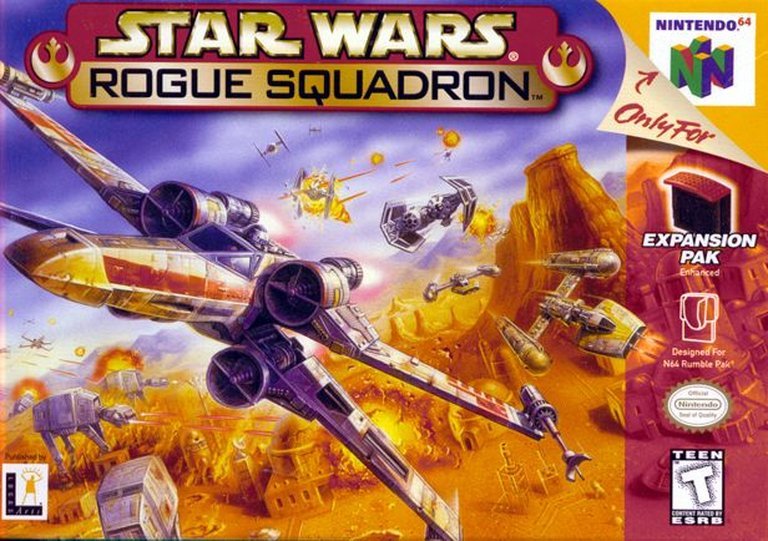
Description
Star Wars: Rogue Squadron 3D is an action-packed space combat game set in the Star Wars universe, where players take on the role of Luke Skywalker piloting Rebel Alliance starfighters such as the X-Wing, Snowspeeder, and Millennium Falcon. Through 15 main levels and 3 hidden missions, the game delivers fast-paced, arcade-style combat against the Empire, emphasizing intense dogfights and objective-based gameplay in a sci-fi futuristic setting.
Gameplay Videos
Where to Buy Star Wars: Rogue Squadron 3D
Star Wars: Rogue Squadron 3D Free Download
Star Wars: Rogue Squadron 3D Patches & Updates
Star Wars: Rogue Squadron 3D Guides & Walkthroughs
Star Wars: Rogue Squadron 3D Reviews & Reception
metacritic.com (85/100): This is a title that no self-respecting N64 owner should pass up. Nintendo has created the first true N64 classic since “Mario 64.”
gamingpastime.com : I think if you were a kid at the time this released and/or a fan of Star Wars, this game hit all the right buttons.
Star Wars: Rogue Squadron 3D Cheats & Codes
Star Wars: Rogue Squadron 3D (PC)
Enter codes in the Settings menu under Passcodes.
| Code | Effect |
|---|---|
| IAMDOLLY | Infinite lives |
| TOUGHGUY | All power-ups |
| CHICKEN | Control AT-ST |
| USEDAFORCE | Use any ship available in current level |
| LEIAWRKOUT | Activate joystick force feedback feature |
| GUNDARK | Changes force feedback control for joystick |
| MAESTRO | Music test; select ‘Concert Hall’ at high score screen. |
| DIRECTOR | View FMV sequences; select ‘At The Movies’ at high score screen. |
| CREDITS | View credits |
| WIMPAMI | Unlock all regular missions |
| OOMPAWAMPA | Unlock all levels and ships |
| WOOKIEPELT | Pilot the Millenium Falcon |
| GOODGUYTIE | Enables Tie Interceptor; position in front of Millenium Falcon and pull back on the Joystick |
| RECUER | Unlocks Imperial Shuttle |
| RADAR | New radar graphics |
| ACE | Expert mode |
| BERGLOWE | Luke’s face replaced with developer’s face |
| WUTZI | Luke’s face replaced with developer’s face |
| HIKEN | Bonus secondary weapons |
| NEUC | Destroy all Imperial Ships on radar |
| LOKJOT | Allows you to land and do repairs |
| NUMBERTWO | Unlimited secondary weapons |
| CNDDOBY | Displays a picture of the development team |
| FDTHMGS | Show the Credits |
Star Wars: Rogue Squadron (N64)
Enter codes in the Settings menu under Passcodes.
| Code | Effect |
|---|---|
| *TOUGHGUY | Charges your craft with all of the Imperial technologys. |
| *RADAR | Upgrades your radar to show you the altitude of enemies in your area. |
| *IGIVEUP | Infinite lives. |
| *ACE | Makes the game harder. |
| *MAESTRO | Opens up the music hall of the showroom. |
| *DIRECTOR | Go to the movies. |
| **GAMEFLO! | Unlocks all regular missions. |
| **WOMPRAT! | Unlocks the first bonus level. |
| **WOISTHAN | Unlocks the Death Star bonus level. |
| *FARMBOY | Allows you to pilot the Millenium Falcon |
| *TIEDUP | Combined with FARMBOY, this code allows you to fly Kasan Moor’s TIE interceptor. Go to the Falcon in the hangar and press up to use it. |
| #KOELSCH | The car (note to do on pc use LukA_YJK’s roguecar which can be found here Rogue.squadron.tripod.com) |
| #HALIFAX? | Note that neither code will make the acceptance sound when entered but they both work. To deactivate, enter HALIFAX? followed by anything of your choice. |
| + !YNGWIE! | Gives access to the Naboo Starfighter. |
| ^BLAMEUS | Shows a picture of the people who helped make RS. |
| *CHICKEN | Play a mini game as an AT-ST. B plus Z to shoot, A to go fast. |
| *DEADDACK | Opens all the levels, including the hidden ones. If you shut off the game, the hidden stages will no longer be available. |
| ^CREDITS | Shows the credits sequence |
| **CHIPPIE | Luke turns into C. Huelsbeck |
| **FLYDODGE | Luke turns into D. Jagalski |
| #HARDROCK | Luke turns into T. Engel |
| **ICHHELD | Luke turns into R. Henke |
| **PSYLOCK | Luke turns into M. Wagner |
| **RUDIBUBI | Luke turns into R. Stember |
| **SIRHISS | Luke turns into J. Petersam |
| **THBPILOT | Luke turns into B. Hoppe |
| **TIECK | Luke turns into F. Sauer |
| **TOBIASS | Luke turns into T. Richter |
Star Wars: Rogue Squadron 3D: The Arcade Maverick That Redefined a Galaxy
Introduction: A New Hope for Console Flight Games
In the late 1990s, the Star Wars gaming landscape was a study in contrasts. On personal computers, the venerable X-Wing and TIE Fighter series offered deep, system-heavy space sims for dedicated pilots. On consoles, the experience was often more limited, ranging from on-rails shooters like Rebel Assault to the occasional ambitious but flawed attempt. Into this division stepped Star Wars: Rogue Squadron 3D, a game that didn’t try to bridge the gap between these two philosophies but instead carved out its own, fiercely independent identity. Released in December 1998 for the Nintendo 64 and Windows, it was a revelation: a game that captured the raw, cinematic thrill of the films’ dogfights and ground assaults with an accessible, arcade-driven control scheme. Its thesis was deceptively simple—put you in the cockpit of an X-wing and make you feel like Luke Skywalker—and its execution was so masterful that it instantly became the new benchmark for Star Wars action on home consoles. This review argues that Rogue Squadron 3D is not merely a great Star Wars game, but a pivotal piece of software that successfully translated the mythos’ most iconic set-pieces into an interactive medium with unprecedented fidelity and exhilaration, all while showcasing the raw, innovative power of the Nintendo 64 hardware. Its legacy is twofold: as the catalyst for a acclaimed trilogy of games and as the moment console Star Wars flight combat came of age.
Development History & Context: Forging a Squadron in the hardware crucible
The Studio and the Vision
The game was born from a unique collaboration between two studios with complementary strengths. Factor 5, the German developer renowned for its technical prowess on the Amiga and its work on the Turrican series, was initially working on a sequel to their 1984 classic Rescue on Fractalus! using a new terrain-mapping engine. Simultaneously, LucasArts, seeking to capitalize on the success of Star Wars: Shadows of the Empire (1996), was planning a follow-up. A three-game exclusivity deal with Nintendo provided the catalyst. Factor 5 repurposed their engine work, and the project evolved from a Fractalus sequel into a Star Wars game. The development leadership was clear: Factor 5 handled the core engine, audio tools, and close Nintendo partnership, while LucasArts produced the story, ensured canonical fidelity, and crafted the mission designs.
The visionary spark came directly from Shadows of the Empire. As LucasArts production manager Brett Tosti stated, the Battle of Hoth snowspeeder level was “the genesis for Rogue Squadron because everybody said, ‘Why don’t you do a whole game like that?'” The goal was to distill that specific, thrilling gameplay loop—low-altitude flying, dodging walkers, and blasting AT-ATs—into a full experience.
Technological Constraints and the Expansion Pak Revolution
The Nintendo 64 presented monumental challenges. Its cartridge-based system had limited memory (4MB standard) and struggled with draw distances, leading to the infamous “distance fog” that masked the console’s rendering limits. The team developed the game with the Nintendo 64 Expansion Pak (an 8MB RAM upgrade) installed from the start, only realizing late in development that it wouldn’t run on a base console. Factor 5 engaged in a frantic effort to implement compression techniques to make it work on 4MB, while simultaneously lobbying Nintendo to release the Expansion Pak as a commercial accessory. They succeeded, making Rogue Squadron one of the first, and most compelling, games to require or strongly benefit from the add-on. With the Pak, the game’s resolution doubled from 320×240 to 640×480, a dramatic upgrade that transformed the visual clarity of planetary surfaces and ship models, setting a new standard for the platform.
On the audio front, Factor 5’s Rudolph Stember faced a Lucasfilm compromise: sound effects were provided at a low 22kHz sample rate. Objecting to the poor quality, he essentially “sampled” sounds from VHS tapes of the films for better fidelity. More impressively, the team bypassed Nintendo’s default sound drivers, creating their own MOsys FX Surround system. This custom software used the N64’s processors more efficiently, compressing audio to fit the cartridge while delivering over 80 minutes of high-quality stereo sound and, crucially, Dolby Pro Logic surround sound—a first for a console game. This wasn’t just a technical boast; it was a core gameplay mechanic, allowing players to hear TIE fighters approaching from behind.
The Gaming Landscape of 1998
Rogue Squadron 3D arrived at a crucial moment. The PlayStation dominated sales, but the N64 was fighting back with titles like The Legend of Zelda: Ocarina of Time. The Star Wars license was hot, with Shadows of the Empire having laid groundwork and Episode I – The Phantom Menace looming on the horizon. Factor 5 and LucasArts understood the need for a “must-have” title. Their decision to create an arcade-style game, rather than a hard sim, was both a response to controller limitations (the N64’s analog stick was perfect for flight, but not for complex system management) and a strategic move to capture a broader audience. It was a game you could pick up and immediately dive into a trench run, a philosophy that directly opposed the more cerebral X-Wing series.
Narrative & Thematic Deep Dive: Canon, Comics, and Original Stories
Setting and Timeline
The game’s narrative is a meticulous patchwork, weaving between official film timeline and the then-canon Expanded Universe (now Legends). The main campaign’s 15 core missions are set six months after the Battle of Yavin (A New Hope) and before The Empire Strikes Back. This interstitial period is a golden age for the Rebellion—victorious but vulnerable—and perfect for the hit-and-run missions of an elite squadron. The Finale mission, “The Battle of Calamari,” jumps six years after Return of the Jedi, depicting the New Republic’s conflict with a resurgent Empire, a bold narrative swing that hinted at the wider galaxy’s fate.
The story draws primary inspiration from the Star Wars: X-Wing – Rogue Squadron comic series by Dark Horse, particularly the formation of the unit. However, LucasArts shifted the focus from Wedge Antilles (the comic’s leader) to Luke Skywalker for maximum commercial appeal, positioning the player as the galaxy’s most famous pilot.
Plot Structure and Character Arcs
The narrative is delivered through a classic four-chapter structure, each beginning with the iconic Star Wars opening crawl. Briefings, in-mission dialogue, and simple cutscenes advance the plot, with voice acting from notable talents like Olivia Hussey (as defector Kasan Moor) and Raphael Sbarge.
- Chapter I: The Reorganization introduces Rogue Squadron. After a skirmish on Tatooine, the team undertakes escort and rescue missions (Barkhesh, Chorax), establishing their role as a rapid-response unit.
- Chapter II: The Defector is the narrative core. The learning of Imperial officer Crix Madine’s desire to defect leads to a massive Imperial assault on his homeworld, Corellia. The mission to escort Madine’s corvette to safety is a highlight, featuring Han Solo and Chewbacca in the Millennium Falcon as temporary wingmen. This success leads to the liberation of Gerrard V, where the squadron encounters and disables Imperial ace Kasan Moor. Her subsequent defection provides the Rebels with crucial intelligence and a fascinating new perspective—a former Imperial pilot now fighting for the Rebellion. Her voice, cool and analytical, becomes a constant in the cockpit.
- Chapter III: The New Threat introduces Moff Kohl Seerdon, a ruthless Imperial commander amassing forces to capture the bacta-producing planet Thyferra. The missions become more aggressive and varied: an assault on an Imperial enclave on Kile II results in Wedge Antilles being shot down and captured, a major emotional beat. A rescue mission on Kessel follows, featuring a memorable prison break. The chapter culminates in a retaliatory raid on a volcanic base on Sullust and a desperate race to Thyferra to kill Seerdon and save the planet.
- Chapter IV: Dark Empire leaps to the post-Endor era. With the Empire reborn under a mysterious leader, Rogue Squadron (now under Wedge’s permanent command) must face the terrifying World Devastators on Mon Calamari. These giant, planet-killing machines from the Dark Empire comic series provide a epic, large-scale finale that felt forward-looking and dangerous.
Themes: Legacy, Defection, and the Cost of War
The game explores several nuanced themes within its action framework:
* The Weight of Legacy: Luke is not just a pilot; he’s a symbol. The game constantly references his fame (“the kid who blew up the Death Star”), and his leadership of Rogue Squadron is about forging a new legend, not just resting on the past. The final mission, set years later, shows his legend enduring.
* Redemption and Choice: Kasan Moor’s defection is the deepest narrative thread. She is not an evil villain but a professional soldier who switches sides for ideological reasons. Her pragmatic commentary (“Are you quite done? My vehicle has been disabled for a good two minutes now”) humanizes the enemy and adds moral complexity rare in action games.
* The Grind of Rebellion: The missions are not glorious war-winning blows but costly, repetitive strikes—”hit-and-run missions,” as the briefing says. The capture of Wedge underscores that even ace pilots are vulnerable. The war is a slog of attrition, a theme later expanded in the sequels.
The “Phantom Menace” Secret: A Masterclass in Secrecy
Perhaps the most legendary aspect of the game’s development was the inclusion of the Naboo Starfighter from the then-unreleased The Phantom Menace. Lucasfilm provided design art, and Factor 5 built a sleek, fast model into the game six months before the film’s release. To preserve the surprise, most of the development team was kept in the dark, and a complex scrambling system hid its unlock code from cheat device users. The secret was so well-kept that when LucasArts finally revealed the code after the film’s premiere, it became known as the Nintendo 64’s most hidden secret. This wasn’t just an Easter egg; it was a brilliant marketing synergy that kept the game relevant for months after launch and created immense buzz among the fanbase.
Gameplay Mechanics & Systems: Arcade Precision
Core Loop and Mission Design
Rogue Squadron 3D is an arcade-style flight action game, a deliberate departure from the simulation-heavy X-Wing series. The core loop is simple: select a mission, choose your ship (within mission constraints), complete objectives, and earn a medal. Objectives are cleanly categorized into Search & Destroy, Reconnaissance, Rescue, and Protect. This clarity is key—you always know what you need to do, allowing you to focus on the flying and fighting.
The 16 primary missions are brilliantly varied in setting and scenario, though some objective repetition creeps in later. Highlights that perfectly translate film moments include:
* Ambush at Mos Eisley: A frantic defense of the spaceport, introducing basic dogfighting.
* Defection at Corellia: A high-stakes escort mission through asteroid fields with the Falcon providing help.
* Liberation of Gerrard V: The first encounter with Kasan Moor and the 128th TIE Interceptor Squadron.
* Assault on Kile II: The ambush and capture of Wedge, a mission with genuine narrative weight.
* Rescue on Kessels: A tense prison break, flying through a canyon to find a hovertrain.
* Raid on Sullust: A beautifully atmospheric mission inside a volcanic caldera, requiring precise bombing of transmitters to breach a shield.
* The Battle of Calamari: The finale, pitting you against the colossal, screen-filling World Devastators.
Flight Model and Controls
The flight physics sit in a “simplified sim” sweet spot. Ships have distinct handling characteristics:
* X-Wing: Balanced, the default workhorse.
* A-Wing: Extremely fast and agile, but fragile.
* Y-Wing: Slow, heavily armored, with powerful bombs for ground targets.
* Snowspeeder: Unique low-altitude handling, essential for the Hoth-style missions.
* V-Wing: A fast, Republic-era fighter unlocked via medals.
The control scheme is intuitive: the analog stick controls pitch and roll (banking), with automatic yaw. A central lock-on targeting system (R-button) simplifies combat, allowing you to cycle through targets and fire homing torpedoes. This is a double-edged sword—it makes the game accessible but can reduce dogfights to simple “lock, fire, repeat” cycles against weaker AI. The true skill comes in maneuvering, using the environment, and managing secondary weapons (proton torpedoes, bombs, ion cannons).
The Medal System and Unlockables: The Engine of Replayability
This is where the game transcends a simple action title. After each mission, your performance is graded across five categories: Time, Enemies Destroyed, Accuracy, Allies Saved, and Bonuses Collected. Exceeding benchmarks in all categories earns Bronze, Silver, or Gold Medals. Your overall rank unlocks content:
* Bronze Medals (All missions): Unlocks Beggar’s Canyon (a Tatooine canyon race).
* Silver Medals (All missions): Unlocks The Death Star Trench Run.
* Gold Medals (All missions): Unlocks The Battle of Hoth.
* Specific Medal Requirements: Unlock ships like the Millennium Falcon (Bronze on Trench Run), TIE Interceptor (Silver on Hoth), and the T-16 Skyhopper (for Beggar’s Canyon).
* Cheat Codes: The N64 version also had cheat codes for immediate access to the Falcon, TIE Interceptor, Naboo Starfighter, and a hidden AT-ST demo level.
This system is the game’s masterstroke. It provides a clear, compelling reason to replay missions to perfection, effectively extending the 16-mission campaign into dozens of hours of challenge. Finding the nine hidden power-ups (e.g., Advanced Shields, Homing Cluster Missiles) that persist across all missions further incentivizes exploration.
Flaws: Camera, Fog, and Repetition
The game’s weaknesses are largely products of its era and design choices:
* Camera Issues: The third-person chase camera is often too close, especially during high-speed trench runs or when harpooning an AT-AT. The camera shifts during the harpoon sequence are jarring and can cause disorientation, leading to crashes. It can also lose the ship entirely in wide-open spaces.
* Distance Fog: A necessary evil on the N64 to mask draw distance limits. While less severe with the Expansion Pak, it’s still present, particularly in early levels or on PC without mods. It breaks immersion in vast planetary vistas.
* Repetitive Objective Design: By the latter missions, the cycle of “destroy X, protect Y” can feel familiar. The game lacks the tactical depth of X-Wing‘s system management or the wingman commands of later Rogue Leader.
* No Multiplayer: A glaring omission by modern standards, though typical for single-player-focused console games of the era. The potential for deathmatch or co-op was immense.
* PC Port Quirks: The Windows version suffers from control imprecision with mouse/keyboard compared to the N64’s analog stick, and its MIDI soundtrack is a significant downgrade from the N64’s high-quality orchestral samples.
World-Building, Art & Sound: A Faithful, Cinematic Translation
Visual Design and Technical Achievement
The game’s art direction is a triumph of evocation over pure polygon count. Ship models are gorgeously detailed, with moving wings, R2 units, and distinctive Rebel/Imperial markings. Explosions are spectacular, with ships breaking apart into debris. Planetary environments are diverse and iconic: the deserts of Tatooine, the snowfields of Hoth (a standout with blizzard effects), the green hills of Corellia, the volcanic hellscape of Sullust. The use of the Expansion Pak’s higher resolution makes these worlds genuinely impressive, with clearer textures and reduced fog.
The most significant technical achievement is the frame rate. Factor 5 managed to keep the action surprisingly smooth even with numerous ships and explosions on screen, a necessity for a fast-paced action title. Pop-up (objects suddenly appearing) is minimal compared to contemporaries.
Sound Design: The Power of the Force (and Dolby)
This is where the game achieves true cinematic parity. The sound design is legendary. It uses a combination of remastered film effects and original recordings to create an immersive soundscape. Every laser blast, engine whine, and explosion is canonically perfect. But the genius lies in the Dolby Pro Logic surround sound implementation. On the N64, this was revolutionary. The position of enemy TIEs is audibly conveyed through your speakers, allowing you to “hear” a pursuer on your six and flip into them. The roar of an AT-AT’s walker feels physically imposing from any direction. This wasn’t just audio; it was a critical gameplay tool.
The soundtrack, composed by Chris Hülsbeck, masterfully adapts John Williams’ themes. It’s dynamic, swelling during combat and receding during stealth, always enhancing the mood without overwhelming. The voice acting is professional and clear, with Luke (Bob Bergen), Wedge, Kasan Moor, and brief appearances from Han and the R2 units all adding personality.
Reception & Legacy: A Benchmark Earned
Contemporary Reception
The game was a massive critical and commercial success.
* N64 Critical Scores: Aggregated at 85/100 on Metacritic (15 reviews) and 84.76% on GameRankings (19 reviews). Reviews universally praised:
* The exhilarating, film-like flight model and controls.
* The stunning visuals, especially with the Expansion Pak. IGN‘s Peer Schneider called the 640×480 mode “impossible to go back from.”
* The outstanding audio, winning IGN’s 1998 awards for Best Sound, Best Sound Effects, and Best Voice.
* The faithful Star Wars atmosphere and varied mission design.
* Common Criticisms: The fog was noted by all. The lack of multiplayer was a recurring “unforgivable sin.” Some found later missions overly difficult.
* PC Reception: Scores were slightly lower (around 78-80%). The port was praised for gameplay but criticized for inferior graphics, choppier controls (mouse/keyboard vs. analog stick), and the severe drop in audio quality from the N64’s samples to PC MIDI.
Commercial Performance and Industry Impact
Sales far exceeded expectations. Julian Eggebrecht stated it sold “about 100 times better than anybody expected.” By August 1999, it had sold over 1 million copies in the US alone and was a top seller during the 1998 holiday season. Its success was attributed to the potent combination of the Star Wars license, the impending Phantom Menace hype, and its status as a killer app for the N64 Expansion Pak.
Its legacy is cemented by the franchise it spawned:
1. Star Wars Rogue Squadron II: Rogue Leader (2001): A GameCube launch title that refined the formula with 60fps, progressive scan, squadron commands, and even more film-accurate missions. It became LucasArts’ fastest-selling game ever.
2. Star Wars Rogue Squadron III: Rebel Strike (2003): The experimental finale that controversially added on-foot combat but added robust multiplayer.
3. Star Wars: Episode I – Battle for Naboo (2000): A spin-off applying the engine to the prequel era.
The series directly influenced later Star Wars flight games, most notably Star Wars: Squadrons (2020), which developers have cited as a spiritual successor, aiming to blend the arcade accessibility of Rogue Squadron with the simulation depth of X-Wing.
Cultural and Preservation Legacy
The game is remembered for:
* Technical Pioneering: Its use of the Expansion Pak and custom audio drivers set a high bar for Nintendo 64 development.
* The “Phantom Menace” Secret: A legendary piece of hidden content that kept players discovering new things long after release.
* Defining Console Star Wars: It proved that a console could deliver a compelling, large-scale Star Wars flight experience without PC-style complexity.
* Enduring Fandom: Its presence on digital stores (Steam, GOG) and the ongoing work of fan communities and preservationists ensure it remains playable. The canceled Wii sequel, Rogue Leaders, with its motion controls, is a fascinating “what if.”
Conclusion: An Imperfect Masterpiece of Its Time
Star Wars: Rogue Squadron 3D is not a flawless game. Its camera is frustrating, its fog is a visual band-aid, and its mission structure can grow repetitive. Yet, to focus on these flaws is to miss the point entirely. It is a game of immense heart, technical audacity, and pure, unadulterated fun. It understood the core fantasy of Star Wars combat: the whoosh of a TIE fighter past your wing, the satisfying thwump of proton torpedoes hitting an ISD, the thrill of weaving through a canyon at breakneck speed.
Factor 5 and LucasArts didn’t set out to make the most realistic space sim; they set out to make you feel like a hero in a Star Wars movie. They succeeded emphatically. By marrying arcade responsiveness with jaw-dropping (for the time) visuals and immersive, gameplay-integrated sound, they created a体験 that has rarely been matched. It is the game that made Rogue Squadron a legendary unit in the minds of a generation of players and established the template for all console-based Star Wars flight combat that followed. Its influence echoes in every subsequent title that tries to capture that same lightning-in-a-bottle thrill. For its historical significance as a technical showcase, a commercial juggernaut, and a beloved piece of interactive Star Wars lore, Rogue Squadron 3D stands as one of the most important and enjoyable Star Wars games ever made. May the Force—and its lock-on targeting system—be with you, always.