
- Release Year: 2003
- Platforms: Windows
- Publisher: dtp entertainment AG
- Developer: pixon interactive media development GmbH
- Genre: Simulation
- Perspective: 3rd-person
- Game Mode: Single-player
- Gameplay: Business simulation, Managerial, RPG elements
- Setting: Contemporary
Description
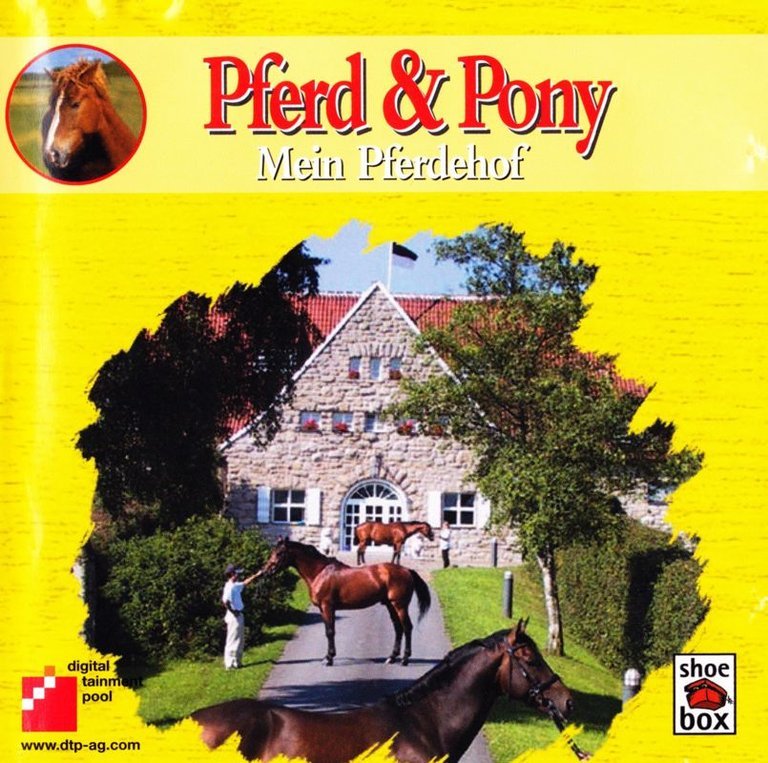
My Horse Farm is a contemporary simulation game where you inherit a small horse farm named Heidetraum and must manage its daily operations. Key tasks include caring for a mare, breeding foals, generating income through a guest house and competitions, and expanding facilities while balancing expenses like feed and veterinary costs. The gameplay blends menu-driven farm management with 2D keyboard-controlled mini-games for horse riding.
Gameplay Videos
My Horse Farm Guides & Walkthroughs
My Horse Farm Reviews & Reception
metron.com : it’s bad for their reputation.
My Horse Farm: Review
Introduction: A Niche Artifact of the Early 2000s Life-Sim Boom
My Horse Farm (German title: Pferd & Pony: Mein Pferdehof), released in 2003 by pixoN interactive media development GmbH and published by dtp entertainment AG, is not merely a game but a meticulously preserved time capsule. It emerges from a specific, fertile moment in PC gaming history—the late 1990s to mid-2000s boom in European “life simulation” titles that focused on niche, pastoral management. These games, often developed by small German studios, carved out a dedicated, primarily young female audience with their blend of straightforward business mechanics, animal care, and gentle narrative goals. My Horse Farm does not aspire to the grand narrative sweep or technical ambition of its contemporaries. Instead, it represents a pure, almost anthropological, expression of a design philosophy: accessible, task-oriented management wrapped in the romanticized aesthetic of rural life. This review posits that the game’s significance lies not in its execution but in its archetypal role. It is a foundational blueprint for the “horse farm” subgenre, a title whose legacy is felt more in the DNA of its successors than in any critical acclaim it garnered. To analyze My Horse Farm is to dissect the core DNA of a genre before it evolved into the more polished, feature-rich experiences like the later My Horse & Me series or the Horse Life franchises.
Development History & Context: The German Niche-Paradigm
The early 2000s German PC market was uniquely hospitable to games like My Horse Farm. Studios such as DTP Entertainment, InCentive, and later Seven45, thrived on a business model focused on low-to-medium budget productions with tight development cycles, often targeting specific demographics through specialized retail channels and strong branding. PixoN, the developer, was a small outfit well-suited to this model. The technological constraints of the era—Windows XP-era PCs with limited 3D acceleration for many households—made 2D sprites and menu-driven interfaces not just an aesthetic choice but a practical necessity for reaching a broad, often non-enthusiast, audience.
The game’s vision was clear from its description: a “horse farm management simulation” where you inherit a farm, manage its finances through breeding, guest house income, and competitions, and strive for championship status. This trifecta of care (horses), commerce (farm economics), and competition (championships) became the immutable trinity of the genre. The “Mein Pferdehof” series, which this game initiated, and its cousin series “Pferd & Pony,” were direct responses to a perceived gap. While The Sims offered a sandbox, and Zoo Tycoon a park manager, there was a dearth of games focused on the intimate, emotionally charged relationship between a young person and a horse within a business context. My Horse Farm was a first, blunt attempt to fill that void, leveraging a popular real-world passtime (equestrianism) and translating it into discrete, manageable gameplay loops.
Narrative & Thematic Deep Dive: The Inheritance Archetype
The narrative of My Horse Farm is famously sparse, serving purely as a mechanical justification. You inherit “Heidetraum” (Dream Heath) farm from an unknown aunt. This is a classic narrative device in life-sims—the sudden inheritance provides an instant, guilt-free reason for a young protagonist (implied to be a teenager) to take on immense responsibility. It removes family entanglement and establishes a clean slate. The initial stable house containing a single waiting mare is the inciting incident, transforming passive inheritance into active stewardship.
The “tasks” outlined—breeding a foal, raising farm income, winning the championship—form a simple, three-act structure. They are not story beats but rather meta-game objectives. There is no dialogue tree, no character beyond generic competitors or guests, and no overarching plot. The theme is explicitly self-reliance and gentle capitalism. The player is an entrepreneur whose capital is both financial and emotional (the horses). Success is measured in quantifiable metrics: money in the bank, foals born, trophies won. The thematic depth lies in what is absent: there is no conflict with creditors, no dramatic illness for the horses, no personal drama. It presents an idealized, conflict-lite version of farm management where problems are solvable through time investment and menu navigation (e.g., “call the vet,” “buy feed”). This sanitization was likely a deliberate choice to maintain a USK 0 (all ages) rating and align with a wholesome, aspirational fantasy for its target audience.
Gameplay Mechanics & Systems: The Dialectical Loop
The core genius and fatal flaw of My Horse Farm resides in its split-personality gameplay architecture. It presents two disjointed but interdependent systems:
-
The Farm Management Sim: This is the game’s skeleton. It operates entirely through a menu-driven, point-and-select interface. Players navigate hierarchical menus to:
- Finance: Track income (guest house, competition winnings, horse sales) vs. expenses (feed, vet, employee wages, building upgrades). The economic loop is transparent but simplistic.
- Horse Management: Each horse has stats (health, happiness, training) that are maintained through menu actions: feeding, grooming, training, veterinary care. Breeding is a matter of selecting a mare and stallion from a menu and waiting for a foal to be born after a set period. There is no genetics system, no visible gestation, just an abstracted outcome.
- Facility Management: Expanding the farm (new stables, guest houses) requires capital and is managed through construction menus.
- Competition: Entering events is a menu selection that consumes “training points.” The result is an abstract text or score display, not a simulation of the event itself.
This system is methodical, spreadsheet-like, and calm. It encourages planning and routine, rewarding the player for maintaining balanced books and a stable full of healthy, trained horses. The “RPG elements” noted in the specs are minimal—horses gain training levels and stats, but these are passive increments tied to menu actions.
-
The Riding Mini-Game: This is the game’s ghostly id. When the player chooses to “ride” a horse, the interface shifts to a 2D side-scrolling or behind-the-horse mini-game controlled via keyboard (likely arrow keys for gait and speed). The source material describes it simply as such. From the genre’s evolution, we can infer this mini-game was:
- Physically Awkward: Early 2000s keyboard-controlled riding games were often imprecise and punishing, lacking the nuance of later motion-control or analog stick implementations.
- Tangentially Linked: Success in the mini-game likely provided a small boost to the horse’s training or mood stats, but failure probably had minimal penalty. It served as a decorative action—a way to “see” your horse move, to fulfill the fantasy of riding, rather than a meaningful gameplay pillar.
- Atmospherically Isolated: The stark contrast between the serene, contemplative menu sim and the potentially frustrating, twitch-based mini-game created a jarring experience. They coexisted without harmony, representing two different philosophies of gameplay merge: abstract management vs. embodied action.
This schism defines My Horse Farm. It tried to be both a business sim and an action game, succeeding at neither. The menu sim is functional but dry; the riding game is a tokenistic afterthought. The innovation was in the concept of this duality, not its execution.
World-Building, Art & Sound: The Pastoral Construct
The setting is “Contemporary,” but the world of My Horse Farm is unmistakably, idealistically German. The farm “Heidetraum” evokes the Heimat ideal: neat, orderly, surrounded by the gentle, generic greenery of the heath. The art style, based on presumably low-poly 3D models for the farm and 2D sprites for horses/riding, would have been functional and clear. There is no grit, no weather, no day-night cycle—just a persistent, sunny pastoral postcard.
The visual direction prioritized recognizability and readability over artistry. Horses, while likely using reused models, needed to be distinct by color and perhaps simple tack. The farm buildings were icons representing function (stable, guest house, arena). This created a world that was a diagram of functionality, not an immersive space. The atmosphere was one of sterile tranquility.
Sound design, as with many budget sims of the era, was likely minimal. A few ambient loops (birds, wind), simple hoofbeat sounds during riding, and perhaps a single cheerful, looping MIDI-inspired track for the menus. Any audio would have been serviceable, aimed at reinforcing the calm, low-stress environment. The overall experience was designed to be soothing, not stimulating—a digital version of a horse-themed coloring book, where the pleasure comes from filling in the prescribed blocks (manage feed, ride horse, win show) in a predictable, colorful world.
Reception & Legacy: The Cult of the Functional
Critical reception for My Horse Farm is virtually non-existent in the English-language canon, a testament to its regional and niche status. On MobyGames, it has a “Collected By” count in the single digits and no critic reviews. The Reddit thread in r/abandonware, where a user laments not finding files, is the most poignant piece of reception data. This speaks to a cult, preservationist audience. The game is not remembered for its quality but for its specificity. For a certain player in the early 2000s, this was their first or primary horse game. Its mechanics—the rhythm of feeding, the click of the mouse to breed, the simple joy of seeing a new foal in the stable—formed a powerful, formative nostalgia.
Its legacy is proliferative, not influential. It did not revolutionize game design. Instead, it codified a template:
1. Inheritance narrative.
2. Menu-driven stable management with clear financial/stat tracking.
3. Abstracted breeding.
4. Mini-game for riding (a feature most subsequent series would either refine or discard).
5. Competitions as prestige/currency generators.
The “Mein Pferdehof” series continued (Mein Pferdehof 2 in 2006), and the broader “Pferd & Pony” brand spawned titles like Let’s Ride!: Sunshine Stables (2004). Later series like My Horse & Me (2007) and Horse Life evolved the formula by integrating riding more meaningfully, improving 3D graphics, and adding light RPG/story elements. My Horse Farm represents the proto-type: all the core ideas are there, raw and unrefined. Its legacy is that of a stepping stone. It proved there was a market, establishing a blueprint that later, better-funded, and more polished studios could iterate upon. Its influence is in its conception, not its craft.
Conclusion: A Historical Artifact of Genre Genesis
To judge My Horse Farm by the standards of modern gaming—deep narratives, seamless gameplay loops, technical polish—is to misunderstand its purpose. It is not a good game by contemporary metrics. Its systems are disjointed, its art dated, its scope painfully narrow. Yet, as a historical document, it is invaluable. It captures a moment when a studio identified a demographic desire—the fantasy of caring for and competing with horses—and expressed it in the most direct, cost-effective language available: Windows menus and simple 2D sprites.
Its true verdict lies in its categorization: Simulation with Managerial / business simulation and RPG elements. It is a managerial sim at heart, and a rudimentary one at that. The “RPG elements” are a statistical gloss. The riding mini-game is a cosmetic diversion. What remains is the pure, unadulterated loop of replenish resources (feed, health), grow capital (breed horses, run guest house), and achieve goals (championship). This is the game. It is a digital chore chart for pastoral fantasies.
In the annals of video game history, My Horse Farm will not be remembered for its innovations or its artistry. It will be remembered as a foundational artifact—the first clear, commercial articulation of the “horse farm sim” as a distinct genre proposition. It is the fossil record from which more complex, more engaging, and more beloved games evolved. Its charm is not in the playing, but in the understanding: of the constraints that birthed it, of the audience it served, and of the elemental gameplay fantasy it so plainly, so persistently, laid out for the world to see and, eventually, to improve upon. It is a game that is better studied than played, a historical curiosity whose true value is in the blueprint it provides, not the experience it delivers.