
- Release Year: 2001
- Platforms: Windows
- Publisher: Kingsoft Corp.
- Developer: Kingsoft Corp.
- Genre: Action, Role-playing
- Perspective: Diagonal-down
- Game Mode: Single-player
- Gameplay: Action RPG, Direct control
- Setting: Ancient, China, Imperial
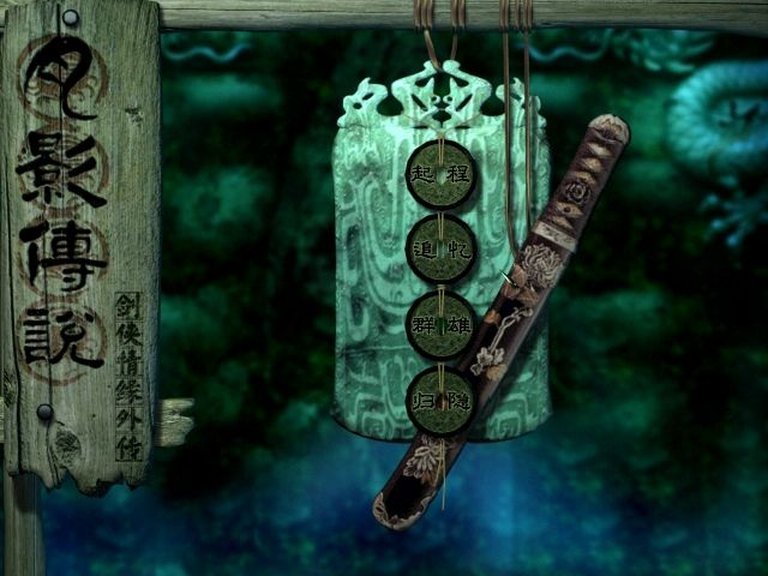
Description
Set in ancient Imperial China’s martial arts world of Wulin, Jianxia Qingyuan Waizhuan: Yueying Chuanshuo is an action RPG that follows the intense rivalry between Yang Xilie and Shangguan Feilong, culminating in a climactic battle, and then shifts focus ten years later to Yang Xilie’s son, Yang Yingfeng, as he embarks on a personal adventure intertwined with themes of crime, romance, and martial arts.
Jianxia Qingyuan Waizhuan: Yueying Chuanshuo: A Cipher in the Kingdom of Wulin—A Historical Review of a Lost Pivot
Introduction: The Shadow of a Legend
In the sprawling, genre-defining tapestry of Chinese video game history, few series command the reverence of Jianxia Qingyuan (剑侠情缘), known in the West as The Legend of Sword and Fairy or, more accurately for this entry, the Jianxia series. Born from the nascent Chinese PC gaming scene of the late 1990s, the franchise became synonymous with the melding of Wuxia (martial hero) romance, Chinese historical epic, and burgeoning RPG mechanics. Jianxia Qingyuan Waizhuan: Yueying Chuanshuo (剑侠情缘外传:月影传说), released in 2001 by Kingsoft’s Xishanju studio, exists at a critical, yet curiously under-documented, inflection point. It is a direct sequel to the seminal Jianxia Qingyuan 2, yet its official English-localized title, Tsukikage no Destiny, hints at a different destiny—a game that would briefly flicker in the consciousness of Western import hunters under the Falcom label before sinking into a deep obscurity its parent series never fully experienced. This review posits that Yueying Chuanshuo is not merely a forgotten spin-off, but a fascinating case study in transitional game design: a title straddling the last gasps of the 2D sprite-based, story-heavy Chinese RPG era and the impending boom of the MMORPG (Jianxia Qingyuan Online launched in 2003). It is a game defined as much by its absence of digital preservation and critical discourse as by its nominal presence in the historical record. Our analysis will excavate this title from the sparse data available—MobyGames entries, terse Baidu Baike summaries, a solitary, devastating Western review, and franchise context—to understand what it was, what it aspired to be, and why it remains, for most intents and purposes, a ghost in the machine of gaming history.
Development History & Context: Kingsoft’s Bridge to the Online Future
To understand Yueying Chuanshuo, one must first understand its developer: Kingsoft’s Xishanju (西山居) studio. Throughout the late 1990s, Xishanju was the crown jewel of Chinese domestic game development, achieving monumental success with the original Jianxia Qingyuan (1997) and its direct sequel Jianxia Qingyuan 2 (2000). These games were landmark achievements: robust, emotionally charged Wuxia RPGs built on proprietary 2D engines, weaving intricate plots of loyalty, betrayal, and national pride against the backdrop of the Song-Jin wars. They proved that a Chinese studio could create a compelling, culturally specific RPG that resonated profoundly with a domestic audience starved for alternatives to pirated Japanese imports.
Yueying Chuanshuo, released in July 2001, arrived at a moment of profound industry pivot. The global success of Diablo II (2000) had popularized the action-RPG loot grind, while the runaway success of Lineage and the impending launch of World of Warcraft signaled the MMO as the next frontier. In China, the PC broadband market was exploding. Kingsoft’s strategy was clear: the single-player Jianxia saga had built a world and a community. The logical, lucrative next step was to translate that into a persistent online world, which they began developing in earnest, leading to Jianxia Qingyuan Online in 2002/2003.
Yueying Chuanshuo, therefore, can be interpreted as a developmental “bridge” or “stopgap.” As a “Waizhuan” (外传, “external legend” or side story/expanson), it was a lower-stakes project. It allowed the core team to experiment with mechanics and refine the engine while the bulk of resources shifted toward the monumental task of building an MMORPG. This context is crucial. It explains the game’s apparent technical conservatism (sticking with the established 2D diagonal-down, scrolling perspective) and its narrative choice: to tell a generational story focusing on Yang Xilie’s son, Yang Yingfeng (杨影枫 in the series canon, Yen Infu in the Japanese localization), thereby bridging the timeline between Jianxia 2 and the upcoming online game’s setting.
Technologically, the game operated within the same constraints as its predecessors: a pre-rendered 2D aesthetic, a resolution likely capping at 640×480, and real-time action RPG combat controlled directly via mouse. The provided Internet Archive listing for a different Kingsoft game (Qiannian Zhanzheng) in the same release batch confirms the era’s distribution norms—large, multi-CD “big box” packaging with extensive paper manuals, a common practice for premium Chinese PC titles in 2001. This was the tail end of an era before digital distribution and before online patching became standard for single-player games.
Narrative & Thematic Deep Dive: A Tale of Two Fathers, One Curse
The narrative, as summarized on MobyGames and derived from the franchise’s Wikipedia entry, is a classic Wuxia generational saga. The events of the past—the bitter rivalry between the fierce Yang Xilie and the aloof Shangguan Feilong, culminating in a climactic duel—cast a long shadow. The protagonist, Yang Yingfeng, is not a blank-slate everyman but a young man defined by paternal legacy and unresolved historical trauma. His motivation is explicitly personal and vengeful: “He still remembers the scene ten years ago.” This is not a story about saving the world from a sudden evil; it is a story about a son stepping into the unresolved drama of his father’s life.
Thematic Core: The Cycle of Vengeance and the Search for Identity. The core conflict is Wulin (martial world) tradition versus personal peace. Yang Xilie represents the obsessive, destructive pursuit of martial supremacy and personal grievance. Shangguan Feilong represents the ultimate Wuxia ideal of transcending worldly conflict. Yingfeng’s journey, therefore, is a meta-commentary on the Jianxia series itself: the player (as Yingfeng) must navigate a world steeped in the bloody history of the previous games. The “adventure” is not just geographical, but genealogical and philosophical. Will he repeat his father’s mistakes, or will he forge a new path?
The provided synopsis is frustratingly sparse, ending on the precipice of his journey. However, within the franchise context—where Jianxia 2’s protagonists were the parents南宫飞云 (Nan Gong Feiyun) and 燕若雪 (Yan Ruoxue), and the online game is set decades later—we can infer Yueying Chuanshuo’s role. It fills the narrative gap. It tells the story of Yang Yingfeng (Nan Gong Feiyun), his romantic entanglements (likely with characters like 蔷薇/Wei Rui or 纳兰真/Na LAN Zhen from the Waizhuan’s known cast), and his ultimate decision to abandon the cycle of violence, possibly mirroring his parents’ retirement to the desert in Jianxia 2. The title, “Moon Shadow Legend” (Yueying Chuanshuo), suggests a tale of haunting memories and elusive truths—a perfect thematic fit for a son chasing phantoms of the past.
Character & Dialogue (Inferred): Based on the series’ established patterns, the cast would be a mixture of returning figures (perhaps a cameo from the now-elderly Shangguan Feilong or 杨瑛/Yang Ying, the steadfast leader of the anti-Jin resistance from the first game) and new love interests/rivals embodying different philosophical paths. The dialogue would be steeped in classical Chinese literary allusions, formal address reflecting martial world hierarchy (shīmù/师母 for master’s wife, xiōngdì/兄弟 for sworn brothers), and the eloquent, often sorrowful, poetry that characterizes the series. The emotional beats would be high: declarations of loyalty, sacrifices for national honor, and the bitter-sweetness of love complicated by duty and bloodlines.
Gameplay Mechanics & Systems: The “Off-the-Shelf” Critique
Here, the silence of official sources is deafening, and we must rely heavily on the only extant critical assessment: the scathing review of its Japanese localization, Tsukikage no Destiny. While one must consider potential localization issues or reviewer bias, the specific, mechanical complaints align with known limitations of the Xishanju engine of this period and are therefore highly credible.
- Core Loop & Combat: The game is an Action RPG with real-time, direct-control combat. The reviewer describes a system where “one click = one attack,” with holding the button inducing a passive, vulnerable state. This suggests a basic, non-queueable attack animation with no input buffering. The combat is described as “button-mash-y and superficial,” lacking both the strategic positioning or skill chaining of an “arcade-style” brawler and the tactical depth of a tactical RPG. This points to a design philosophy prioritizing accessible, immediate feedback over deep mechanical mastery—a hallmark of the era’s Chinese action RPGs, which often focused on narrative and character growth over combat complexity.
- Enemy Engagement & “Swarming”: The most damning critique is the complete absence of aggro management or turn-order logic. “If 20 enemies pounce… he gets hit 20 times. All at once.” This implies a simultaneous, area-of-effect damage model where any enemy within attack range can strike concurrently, with no limit on simultaneous hits. Combined with “overwhelming fights” triggered by scripted, unavoidable events (the hero “rushing in” uncontrollably), this creates a punitive, un-strategic difficulty curve. Survival depends not on tactical withdrawal or crowd control (which are seemingly absent), but on having sufficiently high HP/defense to endure the barrage and spamming healing items with “no cooldown period.”
- Progression & Systems: The MobyGames genre tags (“Action,” “Role-playing (RPG)”) and franchise context imply a class/lineage-based progression. The parent series Jianxia Online famously featured “28武功路线” (28 martial arts paths/lineages) across 10 sects. It is almost certain Yueying Chuanshuo implements a scaled-down version of this system, where choosing a sect (e.g., 天王/Tian Wang “Heavenly King,” 峨眉/Emei, 武当/Wudang) determines starting stats, available skill trees, and eventual “route” (e.g., “枪天王” Spear Tian Wang, “剑宗” Sword Sect). Equipment likely follows a standard RPG tiering (normal -> superior -> “黄金”/Gold equipment), with crafting/forging mentioned in the Online series’ descriptions, possibly present here.
- UI & Presentation: The reviewer’s complaint about unreadable visuals and hidden items is critical. A 2D, pre-rendered game with cluttered foreground art and poor contrast can make navigation and item discovery a chore. The need to “waft the cursor” to find hidden objects indicates a failure in visual communication, a significant flaw in an exploration-heavy RPG. This suggests a UI/UX design that prioritized atmospheric backgrounds over functional clarity, a common trade-off in ambitious 2D games of the era.
World-Building, Art & Sound: Drab Grandeur
- Setting: Unambiguously, the game is set in Ancient/Imperial China, specifically the Song Dynasty period (circa 12th century, given the lineage from Jianxia 2). The world draws from the established Jianxia canon: the ten great sects (少林 Shaolin, 武当 Wudang, 峨眉 Emei, etc.), the looming threat of the Jurchen Jin invaders, and the legendary “山河社稷图” (Map of Mountains and Rivers), a MacGuffin that drives much of the series’ political and martial intrigue. Locations would range from serene sect headquarters (mountaintop monasteries, misty bamboo forests) to war-torn border towns and Jin-occupied territories, reflecting the era’s nationalist, anti-invasion thematic core.
- Visual Direction: Evidence points to a 2D scrolling, anime/manga-influenced art style. The “pre-rendered” comment suggests environments may be hand-drawn bitmap backgrounds, with 2D sprite-based characters. The reviewer’s description of the art as “drab” and “not especially readable” is a major point of critique. This implies a muted color palette and possibly overly detailed or busy background art that obscures interactable elements and pathways. This is a fatal flaw for a top-down exploration game, as it directly impedes player agency and comprehension of the game space. Character sprites, while likely following the conventions of the day (large heads, expressive but limited animations), would not compensate for environmental confusion.
- Sound Design: No source provides any information on sound or music. However, within the Jianxia series tradition, the soundtrack would be a critical pillar of atmosphere. It would feature traditional Chinese instrumentation (erhu, dizi, pipa, guzheng) blended with contemporary (for 2001) synth-orchestral scoring. Themes would be thematic: somber, melodic pieces for story moments; tense, rhythmic drums for combat; and grandiose, patriotic fanfares for scenes involving the Song resistance. The silence on this front in all sources is a significant gap, but it is a safe assumption that, as with its predecessors, the audio was a high point—even if the rest of the production faltered.
Reception & Legacy: The Unreviewed Ghost
- At Launch (2001, China): There are zero professional critic reviews on MobyGames or any accessible Western database. The single “5.0 out of 5” rating on MobyGames is from a player with no review text. This absolute critical vacuum is itself a data point. The game was released in a crowded, pirated market where domestic reviews were scarce and fragmented across magazines like 大众软件 (Popular Software) or online forums (e.g., the nascent Baidu Tieba). Its commercial performance is unknown but can be inferred as modest-to-poor. Kingsoft’s pivot to the MMORPG Jianxia Online the very next year suggests Yueying Chuanshuo did not achieve the success needed to justify a larger single-player sequel.
- The Japanese Localization (Tsukikage no Destiny, 2003): This is the game’s only significant brush with international attention, thanks to Falcom’s short-lived localization initiative. Falcom, a company revered for its Japanese RPGs (Ys, The Legend of Heroes), licensed and localized several obscure Korean and Chinese PC games in the early 2000s. Tsukikage no Destiny was the third in this line. The review from Kimimi The Game-Eating She-Monster provides a brutal, contemporaneous Western assessment. It lambasts the game as “achingly generic,” with a bland protagonist, poor art direction, and a combat system it calls fundamentally broken. While harsh, the review is specific in its criticisms. It validates the suspicion that the game’s mechanics were deeply flawed by contemporary (Western) action-RPG standards. This localization was a commercial footnote, quickly forgotten even by Falcom fans, and the game was never localized into English.
- Legacy within the Franchise: Within the Jianxia canon, Yueying Chuanshuo is a mandatory but often glossed-over chapter. The Wikipedia timeline for the series lists it matter-of-factly between Jianxia 2 and Xin Jianxia Qingyuan (The New Jianxia Qingyuan, a 2002 remake/remix of the first game). Its narrative contributions—solidifying Yang Yingfeng/Feiyun’s story—are absorbed into the wider series lore, but the game itself is rarely discussed with the fondness reserved for the original duology or the ambitious Jianxia Online. It represents a creative nadir between two peaks: the beloved single-player classics and the industry-shaping MMORPG.
- Overall Historical Impact: On the grand scale, Jianxia Qingyuan Waizhuan: Yueying Chuanshuo has negligible direct influence. It did not pioneer a mechanic, define a genre, or achieve cult classic status. Its significance is entirely contextual: it is a canary in the coal mine for the Chinese RPG industry’s shift from single-player narrative epics to online persistent worlds. It demonstrates the strain of that transition—a project likely under-resourced and rushed to fulfill a release schedule while the studio’s eyes were on the MMO horizon. Its obscurity is a testament to how ruthlessly the market moved; a game that might have been a respectable mid-tier title in 1998 was rendered obsolete by 2003’s online revolution.
Conclusion: A Forgotten Pivot, A Cautionary Tale
Jianxia Qingyuan Waizhuan: Yueying Chuanshuo is not a game to be sought out for enjoyment. The available evidence, though sparse, paints a picture of a mechanically shallow, visually confusing, and narratively conventional product that failed to capitalize on the rich legacy it inherited. The Western review’s description of a game with “no strategy,” “swarming” enemies, and “drab” art is damning and, given the engine’s known limitations, plausible.
Yet, its historical value lies precisely in its failure. It is the missing link, the awkward adolescence of one of China’s most important game series. It showcases the pitfalls of a studio in transition: stretched thin, experimenting without innovation, and producing a product that feels like a hollow echo of its former glories. It reminds us that not every entry in a beloved franchise is a gem, and that industrial pivots are rarely smooth. In the grand narrative of the Jianxia series, Yueying Chuanshuo is the necessary, unloved bridge between the solitary, tear-stained Wuxia of the 1990s and the sprawling, communal, nation-defining battles of the MMORPG era that would define the 2000s. Its legacy is not in what it achieved, but in what it represents: the moment the sword and the fairy were forced to log on.
Final Verdict: A historically significant but artistically deficient footnote. It is a game best understood not through play, but through analysis—a case study in missed opportunities and industry transition. Its place in history is secured not by quality, but by chronology, serving as a stark monument to the end of an era. 5/10 for historical interest, 2/10 for the likely player experience.