
- Release Year: 2020
- Platforms: Windows
- Genre: Simulation
- Perspective: Behind view
- Gameplay: Music, rhythm
- Setting: Contemporary
Description
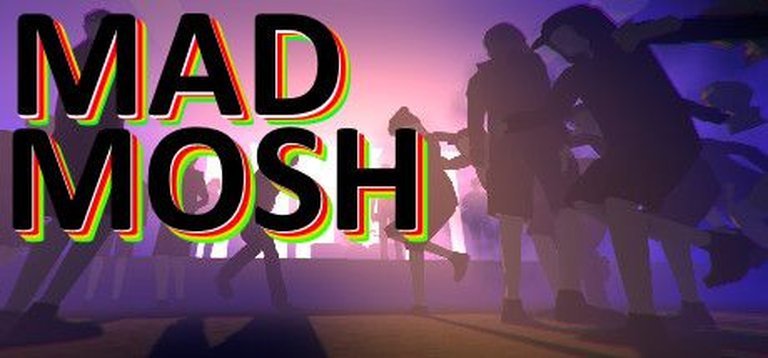
Mad Mosh is a contemporary simulation and action game set in a vibrant disco where players engage in a chaotic mosh pit to the rhythm of music. Users can upload their own tracks and employ classic metal mosh moves, stage jumps, and head waving to destroy opponents and conquer the dance floor in this minimalistic, music-driven experience.
Where to Buy Mad Mosh
PC
Mad Mosh: A Rhythmic Rampage in the Digital Pit
Introduction: The Sound of Rebellion in a DataStream
In the vast, meticulously catalogued library of video game history, some titles exist not as monolithic landmarks but as sharp, dissonant shards of pure, unfiltered concept. Mad Mosh is one such title. Released on August 14, 2020, for Windows by the sole developer known as khos85, it arrives not with a cinematic trailer or a marketing blitz, but with a stark, almost confrontational proposition: a “next level heavy metal music sim” that reduces the concert experience to its most kinetic, chaotic core. It is a game that asks you to provide the soul—your own music library—while it furnishes the simplistic, physics-driven body. This review will argue that Mad Mosh is a fascinating, deeply flawed, and profoundly honest artifact of indie development, representing a deliberate rejection of polished game design in favor of a raw, user-driven simulation of cathartic release. Its legacy is not one of commercial success or critical acclaim, but of a persistent, niche idea: that the essence of a mosh pit can be distilled into a few variables, a dance mode toggle, and a folder of .wav files.
Development History & Context: The Solo Developer’s Antidote
The context of Mad Mosh’s creation is as minimal as its in-game environments. Emerging in 2020, a year of global lockdowns and the sudden evaporation of live music culture, the game was developed by khos85, a pseudonymous entity with no discernible prior credits in the MobyGames database. This points to a classic indie scenario: a passion project born from a specific personal vision, untethered from publisher demands or trend analyses. The technological constraints were self-imposed and practical. Built for Windows using what is likely a mainstream engine like Unity (inferred from the directory structure MadMosh_Data\StreamingAssets common to Unity builds), the game’s visual style is “stylized” and “cartoony,” per user tags, but fundamentally simple—a testament to a scope limited by a single developer’s resources. It was released directly on Steam for free (“$0.00 new”), a distribution model that eschews upfront cost for sheer accessibility and potential word-of-mouth.
The gaming landscape of 2020 was dominated by photorealistic AAA blockbusters and polished indie darlings. Against this, Mad Mosh was a deliberate anachronism, echoing the spirit of late-90s/early-2000s “party” games or the anti-simulator sensibilities of titles like Mosh Pit Simulator (2019), its obvious spiritual predecessor. Its closest cousins are not rhythm games like Guitar Hero (which focus on performing music), but chaotic physics sandboxes like Human: Fall Flat or even the earliest iterations of QWOP. The vision was not to simulate the skill of music, but the feeling of uncoordinated, joyful violence within a musical context.
Narrative & Thematic Deep Dive: The Plot is the Pit
To discuss “narrative” in Mad Mosh is to engage with a post-modern void. There is no plot, no characters with arcs, no dialogue. The “hero” is an amorphous, player-avatar, a vessel for your chosen musical aggression. The setting is a “disco” or “club,” but one stripped of all social pretense—no bar, no VIP lounge, just a vast, featureless dance floor populated by identical, simplistic NPCs (“lots of NPC’s doing the same”).
The theme, then, is not story but ritual. The game mechanizes the communal, anarchic ritual of the mosh pit. The “narrative” is generated in real-time by the interaction between your input (key presses) and the ebb and flow of the track you’ve loaded. The underlying theme is one of pure, unadulterated kinetic expression as catharsis. The Steam store description’s permission—”Hone your inner Metal head or be straightedge, or go punk and destroy everything, or play some classical Beethoven while moshing, we don’t mind”—reveals the core thesis: the act of rhythmic, violent motion is the game, divorced from any specific cultural baggage. The setting “contemporary” is meaningless; the disco is a universal, timeless space for sonic assault. It’s a narrative of pure form over content, where the story is what you, the player, write with your flailing limbs against the pulsing beat of your chosen soundtrack.
Gameplay Mechanics & Systems: The Architecture of Chaos
Mad Mosh’s genius and fatal flaw lie in its almost夭折的 simplicity. The core loop is: 1. Select a .wav file. 2. Place it in the game’s StreamingAssets folder. 3. Launch game, select track. 4. Enter “dance mode” (Left Ctrl). 5. Use keyboard inputs to perform actions and collide with NPCs.
-
Core Mechanics & Controls: The control scheme is a direct, almost physical mapping. Left/Right Shift for stage diving (with a “BIG” dive for holding both).
M,,,?keys for “power moves” (undefined, suggesting simple animation triggers).Lfor headbanging (with “realistic hair physics,” a noted feature).Eto drink for stamina recovery.Cfor slow motion. This is not a nuanced system; it is a series of discrete, one-to-one command-states. The “gameplay” is the juxtaposition of these canned animations and physics interactions against the rhythmic pulse of the music. -
The Central, Flawed Innovation: User-Generated Soundtrack. This is the game’s defining system and its greatest risk. By requiring users to manually manage .wav files in a system directory, Mad Mosh creates a significant barrier to entry. The Steam store’s “IMPORTANT – Setup instructions” section is a red flag for mainstream accessibility. The game’s core mechanic—”the music you load drives the game, your experience”—is also its Achilles’ heel. It bases gameplay tempo (NPC movement, potential BPM detection) on the first few seconds of the track. A user on the Steam Community reported: “Does anybody elses songs just stop? Only one song completed from beginning to end so far.” This suggests catastrophic instability in the audio parsing system. The “beat detection” or track progression is clearly fragile, breaking the fundamental contract: the music must drive the action from start to finish.
-
Progression & Systems: There is none. No scoring system beyond implied destruction. No character progression. No unlockables. The “options, help, player customisation” accessed via Escape are likely limited to visual tweaks. The only “progression” is the player’s own mastery of controlling the avatar’s flailing within the rhythmic constraints, a purely intangible and unrewarded skill.
-
UI & Innovation: The UI was so problematic that a community update was issued: “Bigger UI components update… on larger 4k screens the UI is not easy to use.” This highlights a development process reactive only to direct community feedback, lacking a broader UI/UX design phase. Its innovation is not in interface, but in its audacious lack of traditional systems.
World-Building, Art & Sound: The Blank Canvas Pit
The world of Mad Mosh is the ultimate minimalist stage. The “disco” is a blank, likely low-polygon space with a floor and perhaps some ambient lighting. There is no “atmosphere” in the traditional sense; the atmosphere is solely generated by the user’s imported music. The visual direction is “stylized” and “colorful” but functionally generic, serving only as a collision arena for physics models. The “realistic hair physics” on the avatar during headbanging is a single, specific technical touch amidst otherwise rudimentary visuals.
The sound design is bifurcated. 1. The User’s Music: This is the entire auditory and motivational core. The game provides no default soundtrack of note (“default in-game music will play” is a fallback). 2. The Game’s Sounds: Skeletal. Likely comprised of impact sounds, stage dive whooshes, and drinking glugs. The sound design’s purpose is purely functional feedback for the player’s actions, wholly subservient to the external audio track.
The contribution to experience is thus entirely parasitic. The game provides the body—the space, the physics, the commands—but the soul (the rhythm, the energy, the aggression) must be injected by the player. This makes it a fundamentally incomplete experience without user curation, a “world” only as vibrant as your hard drive’s music collection.
Reception & Legacy: The Whisper in the Pit
At launch and to this day, Mad Mosh exists in a state of near-total obscurity. Critical reception is non-existent; Metacritic lists “critic reviews are not available.” MobyGroups lists it with a “n/a” MobyScore and a plea for contributors: “We need a MobyGames approved description!” On Steam, it sits at a user rating of “2.8” out of 5 from its tiny player base, with the most upvoted review noting the fatal flaw: songs stopping prematurely. VGtimes.com aggregates a single user score of 6.1/10.
Its commercial performance is invisible, save for the fact that it is now free, a status announced in a 2023 Steam post citing the “Unity Runtime Fee” as a motivator—a poignant footnote in the economics of indie game preservation. Its “legacy” is purely cultic and referential. It is listed as a “Related Game” to Mosh Pit Simulator (2019), indicating it exists within a tiny micro-genre of “mosh pit simulators.” It has no discernible influence on mainstream game design. Instead, its legacy is that of a proof-of-concept and a curio. It proves that the core loop of “move rhythmically to music while causing mayhem” can be technically implemented in a minimalist fashion. It is a curio for metalheads, experimental game designers, and those fascinated by the “software toy” model—a toy with one, specific, obsessive function.
Conclusion: The Verdict on the Void
Mad Mosh is not a good game by any conventional metric. It is buggy,它在视觉上简陋, demands non-trivial user setup, offers zero progression, and its central mechanic (track parsing) appears broken for many users. Yet, to dismiss it outright is to miss its peculiar, almost philosophical value. It is the purest expression of a single, eccentric idea: “What if a game was just a controllable ragdoll in a box, and the music you love told it how to move?”
It fails as a product but succeeds, in glimpses, as an artifact. It is a digital mosh pit in its most theoretical form—a space of potential chaos awaiting a catalyst. Its place in history is not on a pedestal but in a display case labeled “Ambitions Undone by Scope, Elevated by Concept.” For 99% of players, it is a forgotten, broken Steam curio. For the 1% who yearn for a game that asks absolutely nothing of them but their own MP3 library and their willingness to press L until their keyboard aches, Mad Mosh is a weird, wonderful, and ultimately tragic ghost in the machine of gaming. It is the sound of one developer’s headbanging, echoing in an empty server.