
- Release Year: 1994
- Platforms: DOS, Linux, Macintosh, Windows 16-bit, Windows
- Publisher: MicroProse Software, Inc., Night Dive Studios, LLC, Tommo Inc.
- Developer: MicroProse Software, Inc., MPS Labs
- Genre: Compilation
- Perspective: First-person
- Game Mode: Single-player
- Gameplay: Campaigns, Carrier landing, Deflection shooting, Energy management, Flight Simulation, Missions, Stalls, Takeoffs, Torpedo realism
- Setting: Pacific, World War II
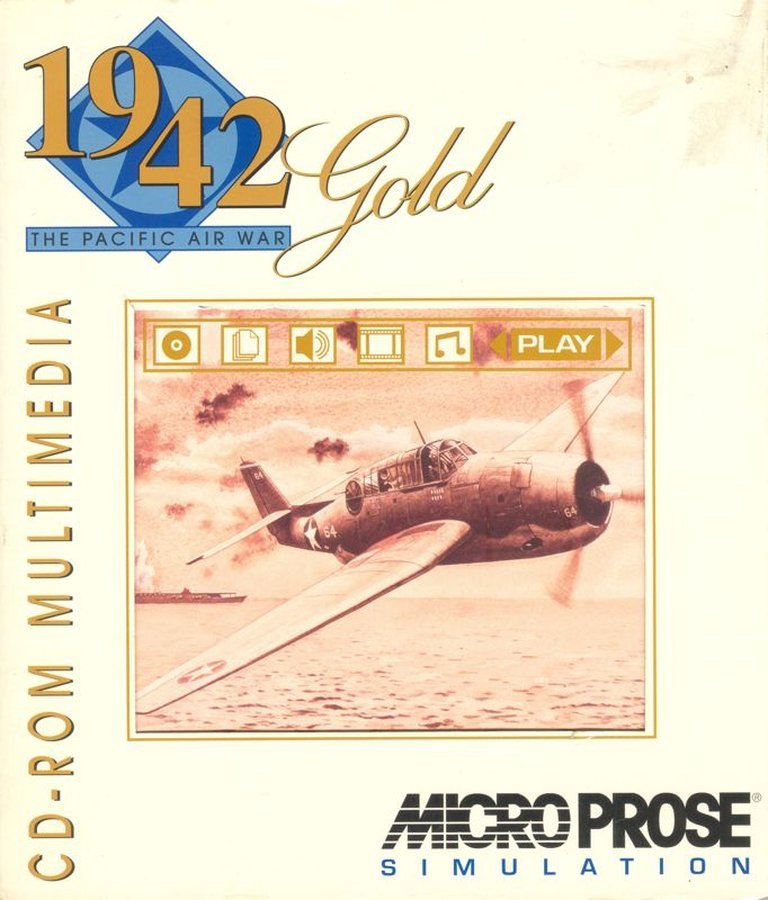
Description
1942: The Pacific Air War Gold is a compilation of the 1994 flight simulator and its 1995 expansion, set in the Pacific Theater during World War II. It focuses on realistic air combat simulation, featuring authentic flight dynamics like stalls and energy management, detailed aircraft handling for fighters, dive bombers, and torpedo bombers, dynamic AI combat maneuvers, and carrier operations, all within immersive campaigns and missions.
1942: The Pacific Air War Gold Guides & Walkthroughs
1942: The Pacific Air War Gold Reviews & Reception
dosdays.co.uk : The flight model in PAW is excellent
mobygames.com : This is the best possible realistic flight simulation that could have been made with the technology of 1994
rockpapershotgun.com : 1942: The Pacific Air War is the game I think is worth saving from 1994
1942: The Pacific Air War Gold Cheats & Codes
PC
Enter ‘RASTA’ during gameplay to enable the cheat menu.
| Code | Effect |
|---|---|
| RASTA | Enables cheat menu |
1942: The Pacific Air War Gold: A Monument to Wartime Simulation and Flawed Ambition
Introduction: The Unfinished Symphony of the Pacific
Long before Ace Combat’s arcade swoops or IL-2 Sturmovik’s painstaking authenticity, there existed a chasm in the WWII flight sim genre—a gap between the accessible thrills of Red Baron and the daunting, spreadsheet-heavy complexity of early naval wargames. Into this void, in the autumn of 1994, MicroProse’s MPS Labs unleashed 1942: The Pacific Air War. It was not merely a game but a thesis statement, an audacious attempt to fuse the visceral terror of a dogfight with the grand, chess-like strategy of carrier task force command. The 1995 Gold compilation, bundling the original with the expansive Scenario disk, represents the definitive crystallization of that vision—a sprawling, infamously demanding, and profoundly influential simulation that captured the colossal scale and terrifying intimacy of the Pacific War like no title before or, in many ways, since. This review will argue that 1942: PAW Gold is a landmark of historical simulation, a game whose genius lies in its pioneering systemic integration of strategy and tactical action, even as it remains forever tethered to the technological and design paradigms of its era.
Development History & Context: MicroProse’s Pacific Pivot
The Studio and the Vision: Developed by MPS Labs (MicroProse’s internal studio) under the design trio of Ed Fletcher, John Paquin, and Michael Rea, 1942 emerged from the same creative wellspring that gave the world Sid Meier’s Civilization and X-COM. MicroProse was synonymous with deep, systemic strategy, but naval aviation simulation was a new frontier. Their previous foray, Task Force 1942 (1992), was a pure fleet command sim. 1942 was its evolutionary offspring—a hybrid that sought to let players command fleets and dogfight in the same campaign. The development team’s goal, as gleaned from post-release interviews and manual essays, was authenticity: to model not just aircraft performance but the fog of war, the limitations of intelligence, and the brutal cost of operational failure.
Technological Constraints and Triumphs: The game was built for the 486DX and DOS, with a recommended 4MB of RAM (a significant ask in 1994). Its most famous technical challenge was the Expanded Memory Specification (EMS) requirement—a hurdle that led to the ubiquitous “boot disk” creation step for many users. Graphically, it operated at a fixed 320×200 resolution with 256 colors, a VGA standard that severely limited draw distance (the infamous ~5km view range). Yet within these constraints, the team achieved wonders: detailed, textured aircraft models, a dynamic day-night cycle, swell and weather effects, and—most revolutionary—a fully 3D virtual cockpit (optional) that allowed pilots to look around with the mouse, a first for a consumer flight sim. The sound, supporting AdLib, Sound Blaster, and Roland MT-32, featured crisp digital samples for engine whines, gunfire, and, in later patches, digitized speech for wingmen and controllers.
The Gaming Landscape: 1942 arrived in a crowded field. Dynamix’s Aces of the Pacific (1992) was its primary competitor, praised for its graphics and accessibility. MicroProse’s own F-15 Strike Eagle III offered a more contemporary, less historically grounded experience. 1942 distinguished itself by refusing to be either a pure action game or a pure wargame. It demanded both strategic foresight and piloting skill, a dual mandate that would become its defining characteristic and its greatest barrier to entry.
Narrative & Thematic Deep Dive: The War as an Abstract Force
1942 possesses no traditional narrative with characters or dialogue-driven plot. Its “story” is the Pacific War itself, rendered not through a script but through operational history and consequence. The game’s genius is thematic: you are not a lone hero but a cog in a vast, indifferent machinery of conflict.
Historical Framing: The manual and in-game briefings are soaked in historical context. As noted in the Dedoimedo review, the game captures the desperate inversion of 1942: the Japanese at the zenith of their offensive power with the superior Zero fighter, and the Americans scrambling with inferior Wildcat fighters, fighting a defensive war of attrition. The progression of a pilot career mirrors this historical arc; early US missions are brutally difficult, with the Corsair and Hellcat’s arrival later marking a tangible, mechanical turning point.
The Mechanics of Storytelling: Narrative emerges from systems and outcomes. A successful torpedo run on a carrier isn’t just a points sink; it’s a mission that might prevent an enemy air strike that would otherwise obliterate your fleet. The “story” is the chain of cause and effect: I sent scouts north because I suspected a threat, which led to a sighting, which led me to commit my strike force, which I then had to personally lead through a flak-barrage to sink the *Shokaku. That sequence is your personal narrative.* The Rock Paper Shotgun retrospective captures this perfectly, calling it a game about “wondering where the Japanese fleet has gone” and the tension of “holding steady and hoping your last torpedo will destroy the carrier.” The lack of personal failings or triumphs—the pilot is a nameless asset—elevates the strategic stakes. Your failure is not a character death; it is a tactical loss that weakens the fleet’s position on the map.
Thematic Dualities: The game explores several profound themes:
* The Fog of War: The carrier battle mode is a masterclass in simulating uncertainty. Spotter planes provide delayed, incomplete intel. Fleets can vanish into the vastness of the map. Every decision is a gamble based on fragments.
* The Cost of Specialization: The stark difference between flying a nimble Zero (a fighter’s dream, a bomber’s nightmare) and a lumbering TBD Devastator (a torpedo bomber’s death wish) instills a visceral understanding of role vulnerability. As one player noted, “It demonstrates… how utterly bonkers anyone was to fly warplanes from a carrier.”
* Scale and Agency: As Rock Paper Shotgun argues, this is the game’s paramount achievement. You feel responsible for the macro (fleet positioning) and the micro (a single bombing pass). A hit with your last torpedo matters because you chose to launch that strike. This sense of consequential agency is rare in modern gaming.
Gameplay Mechanics & Systems: A Dual-Edged Sword of Depth
1942’s gameplay is a bifurcated beast: the Strategic Carrier Battle map and the Tactical Flight Simulation. The Gold edition’s Scenario expansion adds Army Air Corps missions in New Guinea and the Philippines, but the core duality remains.
1. Carrier Battle Mode (The Strategic Layer):
Here, you assume the role of Task Force Commander. You manage the disposition of carriers, battleships, and airbases on a strategic map of one of five historic theaters (Midway, Marianas, etc.). You assign CAP (Combat Air Patrol), launch scout planes, plot courses, and decide when to commit your precious strike aircraft. The seamless transition is key: at any moment, you can click on an incoming enemy contact and “jump into the cockpit” of any plane in your responding force. This is not a mini-game; it is the same simulation engine. This feature was extraordinary in 1994 and remains a design holy grail today. The AI, while exploitable (a noted weakness in post-release patches like v1.5b), creates a believable adversary that also operates under informational constraints.
2. Pilot Career / Single Mission Mode (The Tactical Layer):
This is where the legendary flight model shines. The simulation is physics-based, emphasizing:
* Energy Management: Speed and altitude are your currency. In a dogfight, a lower-speed turn can give you an edge. Stalls and spins are realistic and deadly.
* Deflection Shooting: Leading a moving target is mandatory. Gunnery is skill-based, not auto-aim.
* Role-Specific Challenges: Dive bombers must use the bombsight and endure steep, vulnerable dives. Torpedo bombers require low, straight, slow approaches—literally painting a target for enemy gunners. Tailgunners can be manned by the player in certain bombers.
* Damage Modeling: Engines can be hit, fires can start, pilots can bail (a chillingly implemented detail, noted by players who saw burning AI pilots parachute). Landings, especially on carriers, are terrifyingly precise.
Progression & Content: The career mode spans 1942-1945 for Navy pilots (Fighter, Dive Bomber, Torpedo Bomber tracks). The Scenario disk added Army careers and six new aircraft (including the P-38 Lightning and Japanese “Tony”/“Frank”), plus hundreds of missions. The Mission Builder and robust Flight Film recorder/editor (allowing saved replays with free camera placement) fostered a modding community.
Innovations and Flaws:
* Innovations: The integrated strategy-tactics loop. The virtual cockpit. The systemic emphasis on information (spotter planes) and logistics (limited ammo/fuel if realism is maxed). The ability to switch planes mid-mission if your own is shot down, treating aircraft as a squadron resource.
* Flaws: The learning curve is a sheer cliff. The manual is an 82-page textbook. Carrier landings are brutal. The graphics, while detailed for the resolution, make identification at range difficult. The AI, while improved by patches, still had quirks (planes crashing for no reason, lazy turns under fire—fixed in v1.5b). The “view range” limitation is a constant tactical headache. Most critically, the interface for the strategic layer is clunky by modern standards, and the sheer scale of the Pacific map can be daunting.
World-Building, Art & Sound: Authenticity Over Polish
Visuals and Atmosphere: The game’s art direction prioritizes functional clarity and period authenticity over aesthetic spectacle. Aircraft models are accurate and recognizable. The ocean, while a flat texture by today’s standards, successfully creates a sense of vast, empty space. The dynamic sky—transitions from dawn to dusk, cloud layers—is a standout effect. The virtual cockpit, a technological marvel, is dense with working gauges (altimeter, airspeed, artificial horizon, engine temperature). The UI is sparse and diegetic, keeping the screen clean for the pilot’s view. The Gold edition’s Windows 3.x multimedia extras (historical documentaries, aircraft ID videos) are charmingly low-resolution but valuable educational tools.
Sound Design: The soundscape is minimalist but effective. The roar of a radial engine, the chatter of machine guns, the distant drone of an approaching formation—all are crisp and functional. The later-added digitized speech for wingmen (“Bandit at 12 o’clock high!”) and the flight controller (carrier “wire” calls) was a huge immersion boost, anchoring you in the moment-to-moment tension of a combat sortie. The music is sparse, moody, and largely relegated to menu screens, which is appropriate for a sim meant to be played with sound effects front and center.
Contribution to Experience: Together, these elements create a “wetware” simulation. You are not watching a movie; you are in a cockpit, squinting at a grainy horizon, listening for engine coughs, feeling the gut-lurch of a stalled spin. The art and sound serve the mechanics, not the other way around. The world feels real because its systems are real, not because it’s photorealistic.
Reception & Legacy: Critical Darling, Niche Classic
Contemporary Reception (1994-1995): The critical response was overwhelmingly positive, confirming MicroProse’s ambition was recognized.
* Computer Gaming World (90%): Praised its graphics, frame rate, and virtual cockpit, noting the flight model forced real-world tactics and had “staying power to spare.”
* PC Gamer US awarded it “Best Simulation of 1994,” calling it “an essential component of any flight-sim fan’s library.”
* PC Gamer UK later ranked it #71 on its “Top 100 PC Games of All Time” (1997).
European magazines (PC Games 83%, Power Play 82%, Play Time 82%) were slightly more tempered, noting the Scenario disk was the real value-add for owners of the original.
Commercial Performance & Longevity: It was a strong seller for MicroProse. The Gold compilation, bundling the base game and the substantial Scenario expansion (300+ new missions, new theaters, new planes), became the definitive version. Its re-release under the PowerPlus budget label (1997) and later digital distribution by Tommo/Retroism (2015) and Night Dive Studios (GOG/Steam) has kept it alive for retro enthusiasts. Steam user reviews are “Mixed” (58% positive as of this writing), with praise for its depth but criticism for dated graphics and steep difficulty.
Influence on the Industry: 1942’s direct legacy is seen in MicroProse’s own European Air War (1998), which refined the formula for the European theater. More broadly, its most significant influence—the seamless strategic/tactical transition—remains a grail for simulation designers. Games like War Thunder’s combined arms battles and DCS World’s campaign integration owe a conceptual debt, even if they approach it differently. It represented the peak of a certain kind of “hardcore” PC simulation design that prioritized systemic authenticity over accessibility—a philosophy that receded with the mass-market turn of the 2000s. As Rock Paper Shotgun laments, its sense of scale and consequential agency is “like an idea that got left behind.”
Conclusion: A Brilliant, Flawed Artifact of its Age
1942: The Pacific Air War Gold is not a perfect game. Its graphics are a pixelated blur beyond 5km. Its installer demands arcane DOS memory configurations. Its carrier landings will cause more controller-throwing than any modern “hard” game. Yet, to dismiss it on these grounds is to miss its monumental achievement.
This is a simulation of revolutionary scope. It correctly identified that the Pacific air war was not just about dogfights, but about the agony of Intelligence, the calculus of risk in launching a strike with scarce assets, and the terrifying, exhilarating moment when a strategic decision (launch scouts north) becomes a tactical one (jink your Zero to avoid flak). It gave the player the god’s-eye view of the admiral and the worm’s-eye view of the pilot, and made them feel accountable in both.
Its place in history is secure: it is the apotheosis of MicroProse’s “deep simulation” era, a title that aggressively courted realism in flight physics, historical context, and strategic integration. It is a challenging, unforgiving, and deeply rewarding experience that educates as it entertains. For the historian, it is a functional museum of carrier air doctrine. For the simulation purist, it remains a benchmark in atmospheric, physics-driven flight. For the modern player, it is a demanding but priceless artifact—a window into a design philosophy that believed a game could, and should, make you feel the weight of command and the thrill of survival in equal measure.
Final Verdict: 9/10 – An Essential, Period-Specific Masterpiece. Its flaws are inseparable from its epoch. Its genius, however, transcends it. 1942: The Pacific Air War Gold is not merely a game to be preserved; it is a design document on how to build a world of consequential play, a lesson in ambition that the industry would do well to revisit. It is, as Rock Paper Shotgun proclaims, the game most worth saving from 1994.