
- Release Year: 2004
- Platforms: Windows
- Publisher: Cosmi Corporation
- Developer: Centron Software, Inc.
- Genre: Puzzle
- Perspective: Text-based
- Game Mode: Single-player
- Gameplay: Word construction
Description
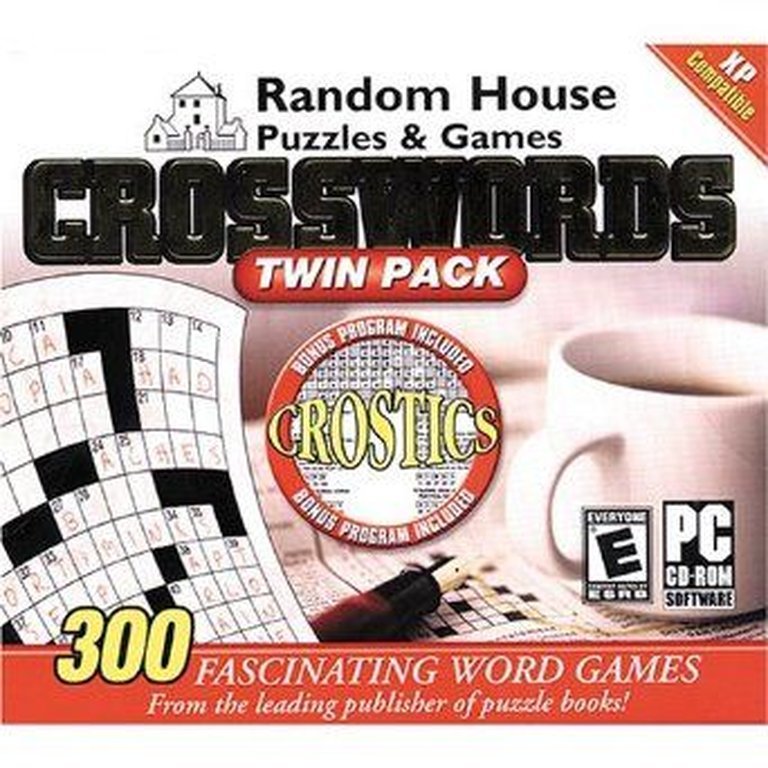
Random House Puzzles & Games: Crosswords, released in 2004 for Windows, is a compilation that combines two distinct puzzle games—Crosswords and Crosstics—each offering 150 puzzles derived from Random House book series. The Crosswords include themed varieties like Golf Crosswords and Tournament Crosswords with timed challenges, while the Crosstics feature unique formats such as ‘Crostics With A Twist’ where initial letters of answers spell clues to famous personalities, and standard crosstics that reveal quotation sources. Players can solve all puzzles interactively using keyboard and mouse on computer or print them for traditional paper-based solving, providing flexible options for word puzzle enthusiasts.
Random House Puzzles & Games: Crosswords: A Time Capsule of Print Puzzle Culture in Digital Form
Introduction: The Quiet Revolution of the Digital Crossword
In the early 2000s, as video games were aggressively pursuing 3D photorealism, cinematic narratives, and online multiplayer ecosystems, a quiet revolution was happening in a different corner of the software aisle. It was here, amidst the edutainment and “casual” sections, that the tangible, tactile experience of the Sunday morning crossword puzzle underwent a subtle but significant metamorphosis. Random House Puzzles & Games: Crosswords (2004), developed by Centron Software and published by Cosmi Corporation, is not a game in the conventional sense of the term. It possesses no protagonist, no branching narrative, no fail state, and no victory screen in the traditional way. Instead, it is a meticulously crafted piece of software archaeology—a digital museum and functional workshop for a specific, revered form of analog intellectual play. This review argues that Random House Puzzles & Games: Crosswords is a historically significant artifact, not for its technological innovation, but for its role as a definitive bridge between the golden age of book-based puzzle compilation and the emerging era of digital puzzle platforms. It represents a moment of preservation, adaptation, and quiet excellence, capturing the essence of Random House’s puzzle legacy with a fidelity that would soon be overshadowed by flashier, gamified competitors.
Development History & Context: The Cosmi-Centric Model and the Puzzle Boom
The Studios and the Publishing Synergy
The development landscape for this title is a study in niche specialization. Centron Software, Inc., the developer, is a name that resonates with enthusiasts of early Windows “easy-play” and compilation titles. Their portfolio is a catalog of utility software, basic games, and puzzle packs—titles designed for the mass market, often sold in bargain bins or through mail-order catalogs like those from Cosmi Corporation. Cosmi, the publisher, was a powerhouse of this very model: acquiring rights to established brand names (from Reader’s Digest to Random House), bundling content, and distributing widely through non-traditional retail channels. This was the antithesis of the “premium” game development model. The vision was not to create a novel interactive experience but to faithfully port a pre-existing, proven product line—Random House’s puzzle books—into a convenient digital format. The goal was utility and brand trust, not artistic ambition.
Technological Constraints and the 2004 Landscape
The year 2004 sits at a curious inflection point. The casual gaming market was nascent but growing, fueled by the rise of PC puzzle games like Bejeweled (2001) and the impending explosion of browser and mobile games. For a puzzle compilation, the technological “constraints” were minimal by design. The game required no complex graphics engine, no physics simulation, no network code. Its demands were simple: a stable text-rendering system, a reliable grid interface, and the ability to save progress. This simplicity was its strength and its limitation. It was built for the ubiquitous Windows PC, leveraging standard libraries for its text-based/spreadsheet and top-down perspective. The fixed/flip-screen “visual” style means there are no scrolling backgrounds or animated transitions; the puzzle grid is a static, central focus. The point-and-select interface was the universal standard for PC UI, requiring no learning curve. The choice of CD-ROM as the physical media, while standard then, now underscores its status as a preserved artifact of a physical-distribution era.
The gaming landscape at the time was crowded with puzzle titles, but most were original IPs (Bust-a-Move, Myst) or adaptations of TV game shows (Wheel of Fortune, Jeopardy!). A straight, un-gamified compilation of book-derived crosswords was a different beast. It catered directly to a demographic that likely viewed their PC not as a primary entertainment hub, but as a versatile tool—a place to do taxes, write letters, and, yes, solve puzzles. Random House Puzzles & Games: Crosswords was software for the “serious casual” puzzler, a market segment that valued content volume and brand authority over interactive flair.
Narrative & Thematic Deep Dive: The Plot is the Puzzle Itself
To analyze “narrative” in this context is to analyze the narrative of puzzling. There is no linear story, no characters with arcs, no dialogue to parse. The “narrative” is inherent in the player’s journey through a curated collection of intellectual challenges. The theme is mastery through pattern recognition, linguistic retrieval, and sustained focus.
The game is thematically bifurcated, presenting two distinct “modes” that reflect two different philosophies of wordplay:
-
Random House Crosswords: This is the classic, mainstream experience. Sourced from three distinct book lines—Golf Crosswords, Tournament Crosswords, and Random House Ultrahard Crosswords Omnibus—it offers a curated spectrum of difficulty and theme. The inclusion of target solve times in the Tournament Crosswords subset is a crucial thematic element. It introduces the concept of the puzzle as a sport, a timed challenge against the clock and one’s own previous performance. This taps into the deep-seated crossword culture of “speed-solving” and personal bests. The “Ultrahard” puzzles cater to the masochistic virtuoso, for whom the joy is in the extreme resistance.
-
Random House Crosstics: Here, the theme elevates from simple word completion to meta-puzzling. A “crostic” is a specific format: a quotation is provided, and the answers to the crossword clues are used to fill in the quotation. The genius is in the additional layer. In “Crostics With A Twist” (50 puzzles), the first letters of the crossword answers spell out a title. This title, combined with the text of the quotation, forms a clue to a famous personality. The solver must first solve the crossword to get the letter string, then interpret that string as a title, and finally connect that title+quotation theme to a person. It’s a puzzle wrapped in a puzzle, a recursive intellectual exercise. The second set (100 puzzles from Volumes 4 & 5) uses a similar but distinct meta-layer: the first letters of answers spell out the author and title of the work the quotation is from. This is a direct test of literary knowledge, creating a beautiful loop where cultural literacy unlocks the puzzle’s own “answer key.”
The underlying theme unifying both halves is trust in editorial authority. The player is not solving randomly generated grids; they are engaging with puzzles constructed by America’s best constructors (as noted in the book description for Random House Crosswords), selected and curated by veteran editor Mel Rosen. The game’s value proposition is the Random House seal of quality—the promise of clean, fair, and interesting puzzles, free of the sloppiness or obscurity that can plague lesser compilations.
Gameplay Mechanics & Systems: Elegant Simplicity and the Power of Print
The core gameplay loop is blissfully, intentionally simple:
1. Selection: Choose a puzzle from a list (presumably sorted by type: Golf, Tournament, Ultrahard, Crosstics With A Twist, etc.). There is no progression system, no unlockables. All 300 puzzles are available from the start—a respectful acknowledgment of the player’s time and intelligence.
2. Interaction: The point-and-select interface is executed flawlessly. A click on a grid square highlights it and its corresponding clue. Arrow keys or mouse can navigate. Typing enters a letter in the active square (and its symmetric partner, in standard crossword fashion). Right-clicking or toggling a mode allows filling in letters one-way.
3. Feedback: The primary feedback is the player’s own satisfaction. There is no “check” button that validates answers in real-time, preserving the integrity and tension of the solve. The game likely offers a “reveal” or “check” function for stuck solvers, but its use is a quiet admission of defeat against the editor’s design.
4. Completion: Solving a puzzle is its own reward. Unlike modern puzzle games that shower you with coins, stars, and animations, completion here is a silent, internal victory. A “Congratulations” message is the only digital ceremony.
Innovative/Flawed Systems:
* Innovation – The Dual-Purpose Print Function: The most significant mechanical innovation is the stated ability to print any puzzle and solve it on paper. This is not a minor feature; it is philosophically central. It acknowledges that the digital format is a convenience layer over the core, timeless activity. It allows for solving in a park, on a commute, or with a pencil (the purist’s tool). It also serves as a perfect backup and a way to share a puzzle physically. This feature elevates the software from a “game” to a puzzle management system.
* Flaw – The Absence of Dynamic Systems: The “flaws” are the features a modern audience might expect: no hint system that adapts to difficulty, no tracking of solve times across puzzles (except presumably within the Tournament set), no leaderboards, no achievements, no themes or background music. The UI is purely functional. For the target audience—people who buy Random House Crosswords books—this is a virtue. For others, it can feel sterile and unrewarding. The “game” provides nothing beyond the puzzle itself.
World-Building, Art & Sound: The Aesthetics of Focus
There is no “world” to build in the fantasy sense. The setting is the abstract space of the grid and the mind. The atmosphere is one of quiet concentration.
- Visual Direction: The aesthetic is pure, unadorned utility. The grid is black lines on a white (or off-white) background. Clues are in a standard serif or sans-serif font. The colors are limited to high-contrast black and white, with perhaps a blue or black highlight for the active cell. There are no decorative borders, no thematic flourishes (like golf clubs for the Golf Crosswords, or a ticking clock for Tournament). The visual world is the printed page made digital. This minimalism serves a purpose: to eliminate all distraction. The only “art” is the perfect symmetry and logic of the crossword grid itself.
- Sound Design: The sound design, based on the era and genre, is either nonexistent or strictly functional. We would expect a soft, perhaps muted “click” when a letter is entered, and perhaps a simple chime upon completion. Any music would be optional, generic, and likely turn-off-able. The soundscape is the sound of the player’s own keyboard taps and ambient room noise. The silence is part of the design, encouraging deep thought.
These elements contribute to an experience that is anti-ludic in the modern sense. It is not about stimulation but about the removal of stimuli. The game-world builds itself in the solver’s head, fueled by the clues and the interlocking words. The “atmosphere” is one of a library study carrel or a favorite armchair.
Reception & Legacy: The Niche Memorialized
Critical and Commercial Reception:
At launch, this title existed almost entirely outside the主流 (mainstream) gaming press. It was not reviewed by IGN, GameSpot, or PC Gamer. Its audience was puzzle enthusiasts, older demographics, and shoppers in the “software” aisle of office supply stores or bookshops. Its commercial success would have been modest but steady, driven by the boundless trust in the Random House brand for puzzles and the Cosmi distribution model. The lack of a MobyScore or critical reviews on platforms like Metacritic (which lists it but has no scores) is not a sign of failure but of its target market’s separation from the “games” discourse. It was a product, not a title.
Evolution of Reputation and Influence:
Its reputation has evolved from a commodity software item to a historical preservation tool. Its significance is now retrospective:
1. Archival Value: It serves as a perfect digital snapshot of a specific slice of Random House’s output circa the early 2000s. The puzzles themselves, sourced from books published in prior years, are now out of print or difficult to find. This software is a time capsule for those specific puzzle series.
2. The “Print-First” Pedigree: In an era where many digital-native crosswords (like those in The New York Times app) have evolved features like “track your stats,” “hints,” and “reveal,” Random House Puzzles & Games: Crosswords stands as a testament to the print-first design philosophy. Its puzzles were not designed for a screen; they were designed for paper and adapted for a screen with minimal intrusion. This makes its puzzle design more “pure” but less interactive than some modern counterparts.
3. Influence on the “Casual” Genre: Its influence is subtle and downstream. It helped solidify the business model of brand-licensed puzzle compilations for the PC casual market. This model was later perfected by companies like PopCap Games (with Bookworm) and, most directly, by the wave of Nintendo DS puzzle games (CrossworDS, Professor Layton’s puzzle collection ethos). It proved there was a market for serious, non-frivolous word puzzles on digital platforms.
4. Contrast with the Modern Ecosystem: Its legacy is best understood in contrast to today’s ecosystem. Compare it to The New York Times Crosswords app or Wordscapes. Those games are services: subscription-based, constantly updated, with social features and gamification. Random House Puzzles & Games: Crosswords is a finite object: 300 puzzles, no connection, no updates. It represents an earlier, more “closed” and artifact-like approach to digital puzzles.
Conclusion: A Definitive Verdict on a Digital Artifact
Random House Puzzles & Games: Crosswords is not a “great game” by conventional metrics. It has no thrilling gameplay, no emotional narrative, and no technical prowess to admire. To judge it thus would be a profound category error.
It is, instead, a masterpiece of editorial translation and archival preservation. It is a flawless, no-frills conduit between the beloved, physical experience of solving a book-based crossword/crostic and the convenience of a digital format. Its success is measured in its absolute fidelity to its source material and its unwavering respect for the solver’s time and intelligence. It offers no hand-holding, no artificial difficulty scaling, and no digital accolades—only the pure, unadulterated pleasure of a well-constructed clue and the satisfying click of a correct letter.
In the grand canon of video game history, its place is niche but secure. It is a benchmark for the “software utility” genre and a critical link in the chain of puzzle game evolution. It represents the moment when major print publishers (Random House) fully committed to digital distribution of their core products through reliable software partners (Cosmi/Centron), creating a bridge for a generation of puzzlers who would later migrate to more dynamic platforms.
For the historian, it is an invaluable primary source. For the puzzle enthusiast, it is a treasure trove of classic, editorially pristine challenges. For the game scholar, it is a perfect case study in adaptation without augmentation—a digital format that seeks to replicate rather than transform its source. Its quiet, unassuming presence on a Windows 2000/XP machine, now preserved in archives like the Internet Archive, is a monument to a simpler, more focused era of digital play. It receives a verdict not of stars, but of scholarly approval: a perfectly preserved artifact of its time, serving its purpose with impeccable, understated integrity.