
- Release Year: 1999
- Platforms: Dreamcast, Macintosh, Nintendo 64, Nintendo Switch, PlayStation 4, Windows, Xbox One
- Publisher: Aspyr Media, Inc., Disney Interactive Studios, Inc., LucasArts Entertainment Company LLC, THQ Nordic Japan KK
- Developer: LucasArts Entertainment Company LLC
- Genre: Driving, Racing
- Perspective: Behind view
- Game Mode: LAN, Online PVP, Single-player
- Gameplay: Pod Racing, Track racing, Vehicle upgrades
- Setting: Futuristic, Sci-fi
- Average Score: 70/100
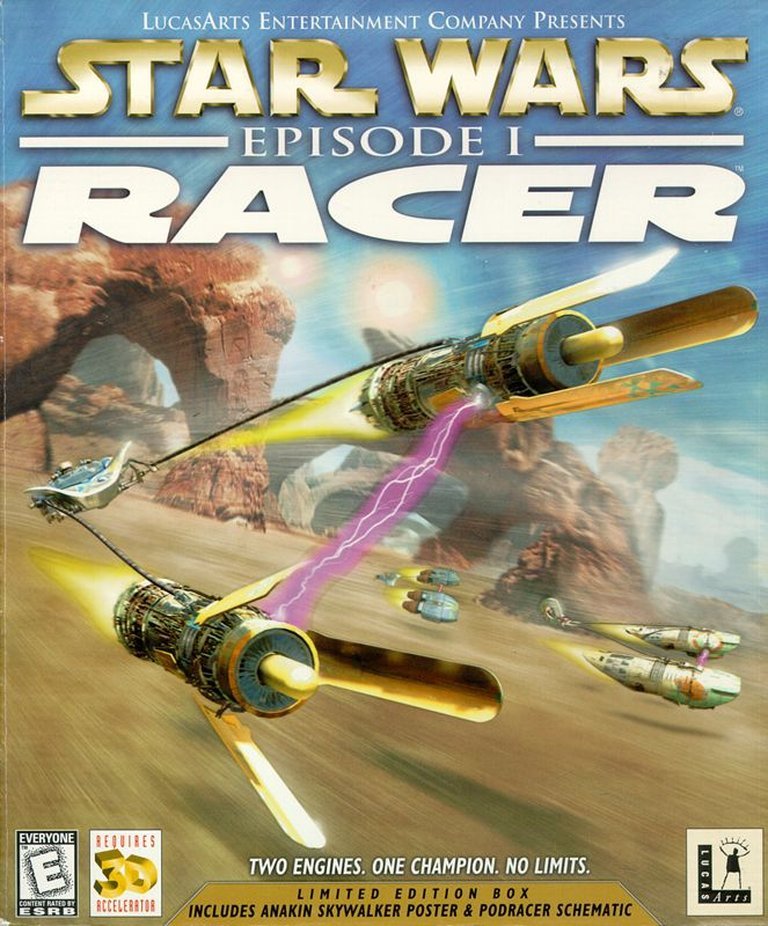
Description
Based on the iconic Pod Racing scenes from Star Wars: Episode I – The Phantom Menace, this racing game immerses players in high-speed competitions across the Star Wars galaxy. Taking on the role of Anakin Skywalker or a diverse cast of characters, players pilot customizable pods, earning credits to upgrade their vehicles and tackling challenging tracks like the desert dunes of Tatooine to gain prestige and advance through increasingly difficult races in a sci-fi, futuristic setting.
Gameplay Videos
Where to Buy Star Wars: Episode I – Racer
Star Wars: Episode I – Racer Free Download
Star Wars: Episode I – Racer Cracks & Fixes
Star Wars: Episode I – Racer Patches & Updates
Star Wars: Episode I – Racer Mods
Star Wars: Episode I – Racer Guides & Walkthroughs
Star Wars: Episode I – Racer Reviews & Reception
metacritic.com (70/100): Remembered perhaps even more fondly than The Phantom Menace itself by some fans, Star Wars Episode I: Racer is as fun as you recall.
imdb.com (80/100): the only game I can think of based entirely on a scene from one of the prequel movies that counts as a better-than-good game.
techraptor.net : Not the strongest game graphically, but that doesn’t matter as much when you consider the good gameplay.
ign.com (60/100): Climb on, strap in and experience the pure adrenaline-pumping excitement of the Podracing sequence from STAR WARS: EPISODE I The Phantom Menace.
Star Wars: Episode I – Racer Cheats & Codes
PC
Enter codes during gameplay by typing or using microphone, or at the parts purchase screen for money cheats.
| Code | Effect |
|---|---|
| Shift + F4 + 4 | Extra $1000 at the Buy New Parts Screen |
| Ctrl + F4 + 4 | Extra $3000 at the Buy New Parts Screen |
| SW_IWANNABEAJEDIKNIGHT | God Mode On/Off |
| SW_PRINCESSLEIAISAHOTCOOKIE | Access to All Weapons |
| SW_YODAWANTSTOBEAREALBOY | Makes All Racers Tiny (and Green) |
| SW_EWOKSTURNMEON | Access to All Levels |
| SW_THEFORCESUCKS_TRYSCIENTOLOGY | Instant Death |
| SW_DONTSEEAUSTINPOWERS | Win Current Level |
| SW_IWISHMYDADDYWASDARTHVADER | Bonus Level – ‘Dark Insemination’ |
| SW_ICANTBELIEVEIACTUALLYFELLFORTHISCRAP | Display’s ‘April Fool’s’ on the Screen |
Nintendo 64
Enter codes in the name entry screen during tournament mode by holding Z and pressing L for each letter, then highlight End and press L and A. Start a race, pause, and press Up, Left, Down, Right to access cheat menu and enable cheats.
| Code | Effect |
|---|---|
| RRTANGENTABACUS | Unlock cheat menu and characters Cy Yunga and Jinn Reeso |
| RRDEBUG | Enable debug option |
| RRDUAL | Enable dual controller option |
| RRJABBA | Enable invincibility |
| RRTHEBEAST | Enable mirror mode |
| RRJINNRE | Play as Jinn Reeso |
| RRCYYUN | Play as Cy Yunga |
PlayStation 4
Enter ‘RRTANGENTABACUS’ in the name entry screen during tournament mode by pressing L2 then L1 for each letter. For stats alteration, pause a race and enter the D-pad sequence Up, Left, Down, Right, Up, Left, Down, Right.
| Code | Effect |
|---|---|
| RRTANGENTABACUS | Unlock Cy Yunga and Jinn Reeso |
| Up, Left, Down, Right, Up, Left, Down, Right | Alter in-game stats |
Nintendo Switch
Enter ‘RRTANGENTABACUS’ in the name entry screen during tournament mode by pressing L2 then L1 for each letter. For stats alteration, pause a race and enter the D-pad sequence Up, Left, Down, Right, Up, Left, Down, Right.
| Code | Effect |
|---|---|
| RRTANGENTABACUS | Unlock Cy Yunga and Jinn Reeso |
| Up, Left, Down, Right, Up, Left, Down, Right | Alter in-game stats |
Star Wars: Episode I – Racer: A Definitive Historical Review
Introduction: The Thrill of a Lifetime, Captured in Pixels
In the pantheon of film-to-game adaptations, few moments are as iconic—or as seemingly tailor-made for interactive translation—as the Podrace sequence from Star Wars: Episode I – The Phantom Menace. For twelve breathless minutes, George Lucas’s prequel delivered a spectacle of speed, danger, and exotic alienPageCount that felt ripped from a sci-fi racing fantasy. It was the film’s undisputed highlight, a chaotic ballet of repulsorlift craft and thundering turbine engines blasting across the Tatooine desert at suicidal velocities. When LucasArts set out to expand that sequence into a full-fledged video game, the challenge was not just to simulate speed, but to bottle lightning—to translate that cinematic, heart-pounding exhilaration into a playable, repeatable experience. Star Wars: Episode I – Racer (1999) accomplished this with a fervor that surprised many, becoming not only the preeminent game of its troubled film era but also a cult classic that endures as a masterclass in licensed game design. It is a game of blinding velocity, creative trackcraft, and frustrating inconsistencies, a title that rises above the limitations of its source material and its own design flaws through sheer, unadulterated kinetic joy. This review will argue that while Racer may not have revolutionized the racing genre, it stands as one of the most successful and evocative adaptations in history, a game that understands the essence of its license and executes it with thrilling precision, even if its longevity is ultimately hampered by repetitive structure and uneven difficulty.
Development History & Context: From Film Clip to Galactic Circuit
The genesis of Episode I – Racer lies in the post-production of The Phantom Menace itself. LucasArts, having recently completed Star Wars: Shadows of the Empire, assigned project leads Jon Knoles, Eric Johnston, and Brett Tosti to spearhead a new project based on the film’s most marketable sequence. The development cycle spanned approximately two years, a notably tight schedule even by late-’90s standards, especially considering the team’s daunting task: they had to create a physics simulation for podracing from only a few short film clips. As Tosti later recalled, their educated guesses about vehicle dynamics and track geometry ended up remarkably close to the finished film’s vision, a testament to their analytical approach. The team employed industry-standard tools like 3D Studio Max, Alias Wavefront, and Autodesk Softimage, and rigorously tested multiple graphical APIs, including 3dfx Glide, OpenGL, and Direct3D. Ultimately, they shipped with Direct3D support only, finding no significant performance gains with the alternatives—a decision that would define the game’s multiplatform consistency.
The project’s original title was Star Wars: Podracer, but legal entanglements forced a change. As Knoles explained, another company (Ubisoft) owned the trademark for games with “Pod” in the title due to their 1997 game POD (Planet of Death). Thus, the more cumbersome Episode I – Racer was adopted, a name that would stick across all subsequent ports. The game was a major cornerstone of the Phantom Menace merchandising blitz, backed by a reported $10 million marketing budget. Actor Jake Lloyd (Anakin Skywalker) even promoted the game at E3 1999 and provided voice work, while Greg Proops (the voice of Fode, one of the race commentators) also contributed.
The technological constraints of the era heavily influenced the game’s form. The Windows and Macintosh versions could leverage CD-ROM capacity for higher-resolution textures and pre-rendered FMV sequences. The Nintendo 64 cartridge, however, presented a severe storage limitation; the game shipped without any FMV cutscenes to preserve space for core gameplay data. It did, however, support Nintendo’s Expansion Pak memory unit, which added texture detail and smoothed frame rates—a feature so integral that critics often noted the game was “unplayable” without it. The Dreamcast port (2000) was a straight conversion of the PC code, but critics found it visually lackluster compared to the system’s capabilities. Most radically different was the Game Boy Color version, which abandoned 3D entirely for a top-down, 2D “Micro Machines-style” duel format due to the handheld’s hardware limitations. A PlayStation version was announced but cancelled, and the game wouldn’t see modern re-releases until 2020, when Aspyr Media remastered it for Nintendo Switch, PlayStation 4, and Xbox One—ports that, while functional, were widely criticized for offering negligible enhancements (no online play, minimal texture upgrades) despite the twenty-one-year gap.
Narrative & Thematic Deep Dive: An Underdog Saga on a Galactic Scale
Narratively, Racer is an exercise in “Adaptation Expansion” taken to its logical extreme. The film presents a single, albeit monumental, race—the Boonta Eve Classic on Tatooine. The game transforms this into a full, multi-planet “Galactic Podracing Circuit,” spanning dozens of events across various worlds. The plot is an “Excuse Plot” at best: you are a podracer pilot seeking glory and credits, competing in tournaments to unlock new courses and vehicles. There is no overarching story, no dialogue trees, no character arcs. Yet, within this minimalist framework, the game succeeds by leveraging the rich, implicit worldbuilding of Star Wars and the specific personalities of its racers.
The roster is the game’s greatest narrative asset. It includes all the film’s racers—Anakin Skywalker (the wide-eyed human underdog), Sebulba (the snarling, cheating Dug heel), Gasgano, Clegg Holdfast, Mawhonic, etc.—plus several pods based on unused concept art, like the four-engine Ben Quadinaros and the sleek “Bullseye” Navior. Each racer has a brief bio (accessible via the game’s “Racer Profiles” menu) that hints at their history, homeworld, and racing style, turning them from background extras into galactic celebrities. This is “Ascended Extra” in action; characters who received seconds of screen time now have distinct identities within a sport with its own lore, rivalries, and spectators. The game’s world is further populated by iconic cameos: Watto (Anakin’s slaver) runs the parts shop, while the droids C-3PO and R2-D2 occasionally loiter near his counter. Most crucially, in a decision praised by every critic, the game entirely omits Jar Jar Binks, a blight on the film that thankfully does not appear here.
Thematically, Racer is about pure, unadulterated velocity and the cult of the individual pilot. It embodies the “dangerous sport” aesthetic of Rollerball or Death Race 2000, where the track itself is a weapon. The courses areNot just circuits but deadly obstacle courses, reflecting the “No OSHA Compliance” trope of the Star Wars underworld. Themes of engineering and customization emerge through the upgrade system—your pod is not a fixed machine but a cobbled-together assemblage of parts you improve with winnings. There’s also a clear underdog narrative in choosing Anakin, the only human and the lowest-ranked pilot at the start, though his pod’s balanced stats make him a viable choice from the beginning. The most persistent thematic thread is the glorification of speed itself. As project lead Jon Knoles stated, the goal was to make it feel like “an eyeball-peeling racing game, where you’re going so fast, you’re just nervous.” This philosophy permeates every design choice, from the dizzying track layouts to the audio design that drowns out the musical score until the final lap, simulating the sensory overload of extreme velocity.
Gameplay Mechanics & Systems: The Engine of Adrenaline
At its core, Racer operates on a deceptively simple loop: Race → Earn Credits → Upgrade Pod → Race Faster. The genius lies in how this loop is executed with a focus on tactile feedback and escalating challenge.
Core Racing Dynamics: Players pilot a podracer—a two-engine craft connected by an energy “mag beam” coupler—across courses that last 2-3 minutes of white-knuckle intensity. The control scheme is unique: one input (typically the Z button on N64, left trigger on modern controllers) governs the afterburner boost, which provides a massive speed increase but simultaneously heats the engines via an on-screen thermometer. Overuse leads to catastrophic engine fires, forcing a lengthy respawn. This creates a constant risk/reward calculus: boost to gain positions, but manage heat lest you explode. Simultaneously, the pod is vulnerable to collision damage from walls, obstacles, and other racers. Each impact degrades engine integrity; too much damage destroys the pod. Players can initiate a mid-race repair sequence (default: the R button), which slowly restores health but drastically reduces speed, turning a pit stop into a strategic gamble. These two meters—heat and health—are the game’s primary tension drivers, demanding constant attention even as you navigate complex tracks at 700+ mph.
Vehicle Customization & Progression: The upgrade system is substantial. After each race, you’re awarded credits based on finishing position and a pre-race bet (a “Winner Takes All” option adds risk). These credits buy parts from Watto’s shop, categorized into five areas: Engines (top speed, acceleration), Repulsors (handling, traction), Cooling (heat dissipation), Armor (damage resistance), and Repair Droids (passive mid-race fixes). Each category has multiple tiers, allowing for deep specialization. Do you make your pod a fragile speedster with maxed engines and cooling, or a durable bruiser with heavy armor? This system extends the game’s lifespan significantly, as experimenting with different builds for different tracks is essential for mastering the later circuits. The “Defeat Means Playable” trope is also present; beating certain racers on their favored tracks unlocks them for your own use, expanding your roster from an initial six to over twenty.
Track Design & Difficulty Curve: The game features 25 courses across eight planetary environments. The design philosophy is one of escalating spectacle and complexity. Early tracks like the Boonta Training Course (a truncated version of the film’s race) and Mon Gazza Speedway are relatively simple, serving as tutorials. However, the difficulty curve is notoriously steep. Critics repeatedly noted that the first few tournaments are trivial to win, while the final “Invitational Circuit” tracks—such as the volcanic Fire Mountain Rally, the zero-gravity asteroid tunnels of Oovo IV, and the precarious gas-platform jumps of Ord Ibanna—are brutally demanding, requiring flawless execution and heavily upgraded pods. This “Easy-Hard-Easy” rhythm (where the middle tier is still manageable but the endgame is a quantum leap) is a major point of contention. Some see it as rewarding dedication; others, like Computer Gaming World, found it unbalanced, with too many early races feeling like a “slog.”
Control Schemes & Platform Disparities: Control feel is the game’s most divisive aspect and varies wildly by platform. The Nintendo 64 version is almost universally praised for its analog stick control, which provides the precise 360-degree input needed for subtle steering corrections at high speeds. The trigger button for boost and the C-buttons for camera/repair are intuitively placed. Conversely, the PC version’s reliance on keyboard (arrow keys) is roundly criticized as inadequate. As one MobyGames user review starkly put it, “You probably shouldn’t play a racing game with a keyboard anyway, you have no real sense of direction.” Gamepads or steering wheels are strongly recommended for PC, but the default experience is clunky. The Dreamcast port, while visually similar to PC, uses a controller with a serviceable analog trigger but lacks the N64’s ergonomic perfection. The 2020 remasters on Switch and PS4 add optional motion controls (tilting the Joy-Con/controller simulates the dual-throttle lever setup from the film), a neat nod to authenticity that some find fun but others consider gimmicky.
Multiplayer: Multiplayer implementation is platform-dependent and a mixed bag. The N64 and Dreamcast offer 2-player split-screen, a mode that inherently reduces framerate and visual fidelity but was a staple of console racers. The PC and Mac versions support LAN play via IPX (Windows) or TCP/IP (Mac) for up to 8 players—a technically impressive feat for 1999, but one that required physical network setup and is now largely defunct. Notably, no version ever included online play over the internet, a major omission lamented by critics even then (Tom Byron of LucasArts cited “latency issues” in a 1999 IGN interview). The 2020 remasters continue this trend, offering only local multiplayer—a significant drawback for a title now sold digitally. The Game Boy Color version had its own link-cable duels, but its simplified gameplay made it a different experience entirely.
World-Building, Art & Sound: A Galaxy of Speed and Sound
Racer’s immersion hinges on its ability to make you feel like you’re in the Star Wars universe, barreling through alien landscapes. This is achieved through a combination of bold artistic direction, creative track engineering, and a soundscape that prioritizes visceral impact over musicality.
Environmental Diversity & Trackcraft: The game’s eight planetary settings are more than just cosmetic changes; each introduces unique hazards and visual motifs that demand adaptation:
– Tatooine: Sandy canyons, moisture farms, Tusken Raider snipers, and the looming Sarlacc pit. The Boonta Classic is the star, a wild ride through mesas and canyons.
– Ando Prime: A frozen, Tibetan-inspired world with frictionless ice lakes, ice caves, and treacherous jumps. The Centrum track is a confusing maze of divergent paths.
– Baroonda: A jungle swamp planet (Grabvine Gateway) transitioning into volcanic hellscapes (Fire Mountain Rally, The Inferno), where lava pools threaten engine fires.
– Mon Gazza: A spice-mining industrial hellscape with active drill rigs, conveyor belts, and waste dumps.
– Aquilaris: An underwater city with shark-filled transit tunnels and crumbling ruins.
– Oovo IV: An asteroid penal colony with anti-gravity tubes where floating rocks can send you spinning; speeds here can exceed 1,000 mph.
– Ord Ibanna: A gas giant with floating Tibanna gas platforms; missing a jump means an endless fall into clouds.
– Malastare: A methane-swamp world with toxic ponds and flying creatures.
The tracks are lauded for their size, verticality, and “chaotic architecture.” They feel less like sanitized racetracks and more like improvised, deadly obstacle courses, perfectly capturing the outlaw spirit of podracing. The use of “No OSHA Compliance” as a design principle means there are no guardrails, only sheer drops, industrial machinery, and environmental threats.
Visual Presentation: Graphically, the game is a product of its time and platform. The N64 version, especially with the Expansion Pak, features crisp, colorful textures and a solid framerate (though it dips in split-screen). The podracers themselves are detailed, with unique engine configurations and animations. However, pop-up and distance fog are common, and the draw distance is limited—a necessary compromise for speed. The Windows and Dreamcast versions offer higher resolutions and smoother performance on capable hardware, but the Dreamcast port was specifically criticized (NowGamer called it “a cheap, lazy port”) for not leveraging the system’s power. The 2020 remasters run at a stable 60fps on modern hardware but have not received a proper texture overhaul; as Nintendo Life noted, it looks “as clunky as the CGI from Attack of the Clones.” The Game Boy Color version is a remarkable technical achievement for the hardware but is visually and mechanically a separate game.
Sound Design: Where the visuals are sometimes dated, the sound remains exceptional. The engine roars are a cacophony of screaming turbines and mechanical whine, uniquely layered for each podracer model (though some player reviews noted they can sound similar). The audio design is functional first: the roar of your own engines dominates, with competitors’ voices and crashes punctuating the chaos. True to the film, the first two laps of each race are largely sans music, building tension through ambient sound and announcer chatter from Fode and Beed. Then, on the final lap, John Williams’ heroic “Duel of the Fates” or other themes from The Phantom Menace score kick in, a “Near Victory Fanfare” that dramatically ramps up the excitement. This audio cue—the moment the music swells as you approach the finish—is one of the game’s most iconic and effective touches. The use of the Mos Eisley Cantina theme hummed by Wato on the results screen is a perfect, whimsical Star Wars Easter egg.
Reception & Legacy: A Beloved Flawed Gem
Upon release in May 1999, Star Wars: Episode I – Racer was a critical and commercial smash. Aggregate scores were strong: 79% on MobyGames (based on 69 critic reviews), with platform-specific highs like 86% for Nintendo 64 (#38 ranked N64 game) and 83% for Macintosh. Major outlets heaped praise: Total! (Germany) gave 95%, calling it “a fantastic presentation” and “the absolute driving force” of the N64. GamePro awarded 5/5, stating it “packs enough high-octane thrills” to overlook its flaws. Jeuxvideo.com (France) gave 18/20, praising its “impressive speed” and “excellent graphical and sound realization.” It won the AIAS “Console Racing Game of the Year” award (the precursor to the D.I.C.E. Awards) and was nominated for a Blockbuster Entertainment Award.
Commercially, it was a juggernaut. By 2011, it held the Guinness World Record for best-selling sci-fi racing game with 3.12 million units sold worldwide, ahead of the Wipeout and F-Zero series. Its success was driven by the Phantom Menace hype machine, but its staying power came from genuine quality. For many, it was the only Episode I product worth owning; as one MobyGames user review succinctly stated, it would “forever stand as the one true game that defined that generation of Star Wars gamers.”
However, the praise was not unanimous. Critics consistently identified several flaws:
– Control Issues (PC): The keyboard control scheme was almost universally panned. As IGN’s PC review noted, it’s “hit and miss,” and Trixter on MobyGames argued the control system had “featureitis” with unnecessary roll/repair functions that complicated a simple racing setup.
– Shallow Gameplay & Repetition: Many felt the core experience, while thrilling, lacked depth. PC Gamer (76%) criticized the “lack of a challenge” early on and the “extremely difficult and misguided final tracks,” calling it “a damn shame” that it was shipped before full realization. FiringSquad (50%) was harsher, calling it “mediocre” and stating that “if this weren’t a Star Wars title, few people would give it a second look.”
– No Weapons/Items: Unlike Wipeout or F-Zero, there are no power-ups or weapons, which some saw as a purity (“a quick, fair racing game” – 64 Power) and others as a missed opportunity for more dynamic races.
– * Difficulty Spike:* The abrupt jump from beginner-friendly early tracks to brutally complex late-game circuits was a common complaint, making the middle feel either too easy or frustratingly hard.
– Lack of Online Multiplayer: Even in 1999, the omission of internet play was seen as a major oversight, especially for PC.
Its legacy is that of a cult classic with no true franchise successor. A direct sequel, Star Wars: Racer Revenge (2002 for PS2), was developed by Rainbow Studios but was a combat-focused arena racer that discarded the upgrade system and track variety, and was critically panned. An arcade cabinet (Racer Arcade, 2000) simplified gameplay. The 2020 HD re-releases on modern consoles were met with tepid reviews: 4Players (65%) called it “a timid update” that added no new features like online leaderboards, while Nintendo Life (60%) noted it was “a long way from being one of the best racers on Switch.” Yet, its reputation among fans remains stellar. It consistently places in top Star Wars game lists: GMR (#5, 2004), PC Gamer (#3, 2015), Game Informer (#11, 2016). Its position is secure as the quintessential podracing experience and one of the few Phantom Menace tie-ins that did not disappoint.
Conclusion: The Force is Strong with This One
Star Wars: Episode I – Racer is a game of exhilarating contradictions. It is a shallow yet deeply engaging racer, a technically uneven yet visually distinctive title, a game with a non-existent story that somehow feels mythic in its execution. Its triumph is not in innovation—it borrows the “race-upgrade-race” loop from countless arcade racers—but in its unwavering commitment to a singular sensation: speed. From the moment your engines ignite and you rocket down the Boonta sand dunes, the game delivers a visceral, heart-pounding thrill that few racing games have matched. The track design is wildly creative, the vehicle customization meaningful, and the integration of Star Wars lore is respectful and intelligent (no Jar Jar, authentic sound design, canonical locations).
Its flaws are undeniable. The PC control scheme is historically bad without a proper controller. The progression is lopsided, with long stretches of trivial races bookended by mercilessly difficult courses. The lack of online multiplayer, even by 1999 standards, was a disappointment, and the 2020 remasters did nothing to address this decades-old omission. It is, in the end, a brilliant but brief experience; once all tracks and pods are unlocked, there’s little reason to return beyond time trials or split-screen bouts with friends.
Yet, within the crowded field of Star Wars video games, Racer occupies a unique space. It is not a narrative epic like Knights of the Old Republic, nor a faithful lightsaber dueler like Jedi Knight. It is a pure, unadulterated piece of interactive spectacle—a love letter to a single, glorious scene from a flawed film. In capturing the essence of podracing, it transcends its license and becomes a great racing game first, a Star Wars game second. It is a testament to LucasArts’ understanding that sometimes, the best way to honor a franchise is not to overcomplicate it, but to embrace one core fantasy and execute it with precision, passion, and, above all, speed. For that reason, Star Wars: Episode I – Racer remains not just a fascinating historical artifact, but a timelessly fun ride—a flawed gem that still shines brightly in the pantheon of licensed gaming.