
- Release Year: 2017
- Platforms: PlayStation 4, Windows, Xbox One
- Publisher: Vision Games Publishing Limited
- Developer: Snap Finger Click Ltd
- Genre: Puzzle
- Perspective: Fixed / flip-screen
- Game Mode: LAN
- Gameplay: Game show, quiz, trivia
- Average Score: 68/100
Description
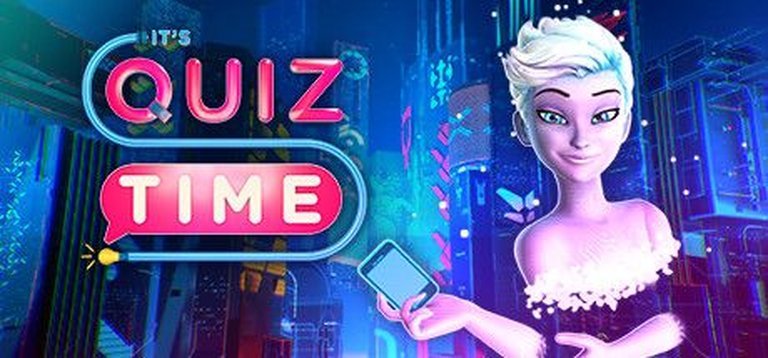
It’s Quiz Time is a multiplayer trivia party game that simulates a lively game show experience, hosted by the sarcastic and witty robot Salli. Players compete in rounds of questions across diverse categories, receiving personalized trash-talk and praise based on their performance, with features like tailored messages, social media sharing, and custom playlists designed for fun gatherings with friends and family.
Gameplay Videos
Where to Buy It’s Quiz Time
It’s Quiz Time Guides & Walkthroughs
It’s Quiz Time Reviews & Reception
opencritic.com (68/100): It’s a fun quizzer to play with either friends or family, even if the host is a bit annoying.
metacritic.com (69/100): Aside from its robotic hostess, It’s Quiz Time is as robust a trivia game as a person can find on the next-gen market.
thesixthaxis.com : It’s a bit of a shame that Salli is so mean, as there’s the core of a good quiz game here.
It’s Quiz Time: The Digital Game Show Renaissance That Almost Was
Introduction: The Quiet Giant of the Party Game Genre
In the landscape of modern party gaming, few titles have attempted to fill the monumental void left by the Buzz! series with such ambition—or such polarizing results—as It’s Quiz Time. Released in late 2017 by Snap Finger Click, a studio comprised largely of former Buzz! developers, this trivia game arrived not merely as a successor but as a bold reimagining of the living-room quiz show for the smartphone era. Its thesis was clear: to combine the vast, customizable question banks of its predecessor with a dynamically personalized host and seamless mobile integration, creating the ultimate trivia experience for a generation that no longer needed physical peripherals. However, as the critical reception reveals, It’s Quiz Time is a game of profound contradictions—a technically impressive, feature-rich package whose most central element, its AI host Salli, became the very thing that divided players and critics alike. This review will dissect the game’s multifaceted identity, arguing that while it falls short of transcending its genre due to several core design missteps, its ambition in scale, personalization, and streaming integration marks it as a significant, if flawed, milestone in the evolution of social gaming.
Development History & Context: From Buzz! Buzzer to Smartphone Screen
To understand It’s Quiz Time is to understand the legacy of Buzz!. Developed by Relentless Software and published by Sony, the Buzz! series (2007–2010) defined the console quiz genre on the PlayStation 2 and PSP, famous for its colorful, tactile buzzers and jaunty, host-driven shows. By the mid-2010s, that specific formula had faded, leaving a gap in the market for a modern equivalent. Enter Snap Finger Click, founded in Brighton, UK, in November 2015 by veterans including Development Director Martijn van der Meulen, who had worked extensively on the Buzz! series. Their first game, Act It Out XL! A Game of Charades (2016), was a quick-turnaround project that already experimented with smartphone controllers and Twitch integration via a “Live Show” mode.
It’s Quiz Time was their magnum opus, announced in September 2017 and released on November 28 for PC (via Steam), PlayStation 4, and Xbox One. The technological context was crucial: the rise of the Jackbox Party Pack series (2014–present) had proven that the smartphone-as-controller model was not only viable but preferable for large-group local play. Snap Finger Click’s vision was to apply this model to the trivia genre but supercharge it with features they felt were missing from both Buzz! and Jackbox: hyper-personalization, an enormous question bank, and deep streaming integration. They aimed to create a “living” quiz show where the host knew you, the questions adapted to your age, and a stream could include thousands. The constraints were significant—building a stable companion app, generating or sourcing tens of thousands of quality questions, and creating an AI host with enough personality to fill the role traditionally played by a human voice actor. The studio’s experience with Buzz! gave them a foundational understanding of quiz game pacing and structure, but the pivot to digital-only input and AI-driven narration was a significant risk.
Narrative & Thematic Deep Dive: The Illusion of a Living Show
Trivia games typically eschew traditional narrative, but It’s Quiz Time constructs a thematic framework around its AI host, Salli, and the concept of adaptive entertainment. The “story” is that of a futuristic, perhaps post-human, game show where the boundaries between player and host, audience and contestant, are blurred by data.
Salli: The Synthetic Showman (and Woman): Salli is not merely a narrator; she is the game’s central thematic device—a manifestation of algorithmic personality. Described in marketing as “the latest in AI-technology,” she is “witty and devious,” designed to “remember you, your friends, and how you play.” This creates a narrative of surveillance and tailored experience. During gameplay, she references players by name (pulled from the companion app), comments on their performance (“trash-talking and praising”), and adjusts her banter based on round outcomes. Thematically, this explores the idea of games as personalized mirrors, reflecting and commenting on the player’s knowledge and social dynamics. However, her execution reveals the fragility of this theme. Reviews consistently describe her voice as robotic (using text-to-speech), her animations as “borderline creepy and looping,” and her humor as inconsistent, veering into “bullying” or merely “unfunny” (TheSixthAxis). This dissonance—between the intended theme of a clever, engaged AI and the reality of an often-irritating, repetitive bot—undermines the immersive narrative. She represents the uncanny valley of game show hosting: attempting human-like interaction but exposing the limitations of 2017-era AI synthesis.
Thematic Underpinnings: Beyond Salli, the game’s themes are those of classic game shows amplified: the democratization of knowledge (“Everyone Can Play” with thousands of categories), the social friction of competition, and the spectacle of public failure/success. The “Live Show” mode extends this into the theme of participatory media, where viewers become contestants, prefiguring the rise of interactive streaming. The optional birthdate-based question tailoring introduces a theme of generational relevance, attempting to bridge knowledge gaps so that a 60-year-old and a 10-year-old can compete on vaguely equal footing. Ultimately, the game’s narrative is one of connection—connecting friends via phones, connecting past pop culture to the present via age-based questions, and connecting streamers to massive audiences. Yet, the pervasive issue of Salli often serves to break that connection, reminding players of the artificial, flawed system orchestrating their fun.
Gameplay Mechanics & Systems: A Robust Engine Marred by a Faulty Interface
The core gameplay loop of It’s Quiz Time is solid, built on a foundation of diverse round types and a vast question bank, but its systems are a study in clever design hampered by questionable implementation choices.
Core Loops and Round Innovation: The game excels in round variety. Beyond standard multiple-choice trivia, it features:
* Guesstimation: Drag a slider to estimate a number (e.g., population, year).
* Connections: Identify correct answers from a grid of 16 options within a category (e.g., “actors born in the 1960s”).
* Truth or Bust: Wager on whether the current player will answer correctly.
* All in Order: Sequence items chronologically or by preference.
* Describe It: One player describes a topic while others “flag” mentioned descriptors.
* Snap Decision: Ultra-fast (4-second) multiple choice.
This variety is a major strength, preventing fatigue and catering to different cognitive skills (memory, estimation, logic). Custom playlist creation allows players to curate their preferred rounds. The question bank is touted as over 25,000 (Steam says 30,000; later reviews note 34,000+), spanning categories from video games and movies to history and science. The age-based personalization (optional) is a genuinely smart feature, aiming to make questions more relevant.
The Companion App: A Necessary Evil? The game’s most controversial system is its mandatory companion app for mobile phones, required for multiplayer. This decision, following the Jackbox model, has both advantages and fatal flaws.
* Advantages: It lowers the barrier to entry—no need for extra controllers—and allows for easy, wireless 8-player setups. The app generally works smoothly for connection and input (though not always, as noted in reviews).
* Disadvantages & Flaws: 1) Exclusion: It requires smartphones with modern OS (iOS 7+/Android 4.4+), excluding players with older or no devices. Reviews noted specific cases where family members couldn’t play. 2) Attention Split: Unlike a controller where answers are on-screen, the app displays only lettered buttons (A, B, C, D). Players must constantly shift gaze between the TV (question/answers) and their phone (to select), a jarring experience, especially in fast rounds. 3) Reliability & Longevity: Several reviews (Outcyders, Metacritic user reviews) report frequent app disconnections, slow response times, and difficult re-joining processes. More damningly, this creates a permanent online dependency for multiplayer modes. If servers are shut down, the core multiplayer experience becomes unplayable—a significant “games as a service” risk for a paid, single-purchase title. 4) No Offline Multiplayer: The game cannot be played locally with multiple players without an internet connection to facilitate the app, a stark limitation compared to Jackbox games that can generate room codes offline.
The Host as a Gameplay Mechanic: Salli’s role extends beyond narration to actively shaping gameplay. She introduces rounds, provides transitions, and delivers post-round personalized stats and social-media-shareable messages. This is a innovative touch, making each player feel seen. However, her intrusive, often negative commentary (“she will troll you in the most unfunny way that borders on bullying” – TheSixthAxis) can actively degrade the fun, especially for younger or less knowledgeable players. The ability to skip her dialogue or turn off her voice is a crucial but concessionary feature—it admits the host is a problem.
Single-Player and Modes: The Solo Score Attack mode is widely panned as dull—a 30-question run with a chosen specialist subject and score penalties for wrong/slow answers. It exists primarily for leaderboard chasing but lacks the energy of multiplayer. The “Live Show” mode for streamers is technically impressive, allowing 10,000+ viewers to participate via chat, but its utility is niche. The promised “Event Quizzes” based on real-world events were noted as “not yet live” at launch, a sign of a live-service model in its infancy.
World-Building, Art & Sound: The Game Show Facade
It’s Quiz Time effectively builds the aesthetic of a contemporary, slightly-techy game show, but its execution is uneven.
Visual Direction & Atmosphere: The game uses a fixed, flip-screen presentation typical of the genre. The main stage is a sleek, blue-and-purple digital set with abstract geometric shapes and glowing accents, evoking a modern, almost Tron-like game show. This is competently done and clean on the eyes. The standout visual element is Salli herself—a floating, androgynous, robotic head with a minimalist face. Her design is divisive. Some find her “sassy AI” persona fitting; others call her “the bizarre lovechild of Halo’s Cortana, Elsa from Frozen, and Rayman” (TheSixthAxis) and “awkward.” Her animations are limited and often repetitive, contributing to the sense of a low-budget CGI host. The visual feedback for correct/incorrect answers and score updates is clear and snappy.
Sound Design & Music: The soundscape is a more successful element. It features a punchy, upbeat “game show” theme with dramatic stings for reveals and tension-building music during rounds. This effectively pumps up the competitive atmosphere. Salli’s voice, however, is the major audio flaw. Utilized via text-to-speech synthesis to avoid recording thousands of lines, it results in a flat, robotic, often mispronouncing cadence. Reviews highlight specific butcherings of words like “Onomatopeia” and names, which repeatedly breaks immersion. The choice prioritizes scalability and cost-efficiency over charismatic performance, a trade-off that clearly backfired for many listeners.
The overall atmosphere is that of a competent but impersonal digital arcade game. It captures the form of a game show—lights, music, a host—but struggles with the feeling, largely due to Salli’s failed attempt at personality.
Reception & Legacy: A Cult Success with Critical Schism
Launch Reception (2017): It’s Quiz Time received a mixed-to-positive critical reception, with scores varying significantly by outlet. On Metacritic (PS4: 69 from 10 critics; OpenCritic: 68, 57th percentile), it sits solidly in “mixed or average.” However, the spread is telling:
* Praises: The sheer volume and variety of questions (Gaming Age: 91%, Pure PlayStation: 90%, Level 1: 92%), the innovation of age-based personalization, the successful smartphone integration (when it worked), and the depth of game modes and customization.
* Criticisms: The near-universal condemnation of Salli as an unlikeable, annoying, or “bullying” host (TheSixthAxis 6/10, Gameblog.fr 6/10, Video Chums 48%). Technical issues with the companion app’s stability and the requirement for an online connection for local play. Questions sometimes being inaccurate (e.g., misclassifying Fable III or Smite), too obscure, or lacking intra-category variety. The single-player mode being weak.
The Daily Star’s quote, “It’s Quiz Time fills a gap in the market that’s been begging for something to fill it since the Buzz games on PS2,” captures its primary appeal: it was the modern spiritual successor for a hungry niche.
User Reception: Steam user reviews are “Mostly Positive” (73% of 223 reviews), and user scores on Metacritic (7.8) are notably higher than many critic scores. This suggests a core audience of trivia enthusiasts and families who prioritized the question content and multiplayer functionality over hosting flaws, or simply found Salli’s insults funny rather than mean. Positive user reviews frequently cite family fun and extensive replay value.
Legacy and Influence: It’s Quiz Time did not achieve the cultural penetration of Buzz! or the Jackbox series. Its legacy is that of a capable but troubled specialist title. It demonstrated that the trivia genre could support massive question banks and sophisticated personalization on digital platforms. Its “Live Show” mode was a direct response to the streaming era, a feature few competitors offered at the time. However, its reliance on a mandatory, online-dependent app—and the subsequent risk of vendor lock-in and server shutdowns—likely served as a cautionary tale. Subsequent trivia games have largely avoided requiring a specific companion app for local play, instead favoring built-in controller inputs or more universal browser-based solutions. The game remains available (as of 2025) on stores, but its long-term playability is entirely contingent on the persistence of its servers for the app to function.
In the canon of quiz games, it is remembered as the game that tried hardest to be the next Buzz! with cutting-edge features but stumbled at the final hurdle of personality. It proved the audience for deep trivia games was still there, but also that the host—that crucial bridge between game and player—cannot be an afterthought.
Conclusion: A Flawed Artifact of a Transitional Moment
It’s Quiz Time is a game of immense ambition and palpable compromise. Its strengths are undeniable: a staggering and diverse question library, innovative and varied round designs, robust customization (custom playlists, age-based tailoring), and a forward-thinking embrace of streaming culture. For a group of trivia buffs with compatible devices and a tolerance for AI quirks, it offers countless hours of competitive fun and truly feels like the biggest trivia game on the market.
Its fatal flaws are equally clear. Salli, the intended centerpiece, is a catastrophic misjudgment in voice acting and AI presentation, transforming from a potential charm into a grating liability for a significant portion of players. The mandatory companion app, while convenient in theory, introduces unnecessary barriers to entry, splits player attention, and—most damningly—makes the core multiplayer experience contingent on an online service that may not last. Inaccurate or poorly distributed questions and a lackluster solo mode further dent its luster.
Verdict: It’s Quiz Time is a 7/10 experience—a “good” game that consistently strains to be “great.” Its place in video game history is that of a passionate but imperfect bridge between the peripheral-based quiz shows of the 2000s and the app-driven party games of the 2020s. It showed the path forward—massive scale, personal data use, streaming integration—but also the pitfalls of over-relying on unproven tech and underestimated the irreplaceable value of a charismatic, human host. For historians, it is a fascinating case study in adaptation and the perils of the “digital transition.” For players, it remains a highly specific recommendation: only for those who can overlook a terrible host and have a reliable network and smartphone for every player, and who crave a deep, modern trivia experience above all else. It’s a testament to the Buzz! legacy that can’t quite escape its shadow, and a warning that in the theatre of the game show, the host is king.