
- Release Year: 2015
- Platforms: Linux, Macintosh, Nintendo Switch, Windows
- Publisher: HypeTrain Digital, LLC, Pinkapp Games
- Developer: Ink Stains Games
- Genre: Action, Dual, Twin-stick shooter
- Perspective: Top-down
- Game Mode: Online PVP, Single-player
- Gameplay: Manual reloading, Perk system, Stealth, Survival arena, Twin-stick controls
- Setting: North America, Old West, Western
- Average Score: 67/100
Description
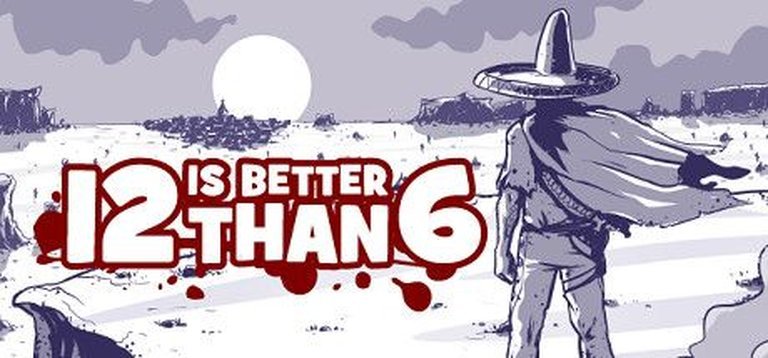
Set in 1873 North America, 12 is Better Than 6 is a top-down shooter where players control a Mexican slave fleeing to Texas from relentless headhunters. Blending brutal, fast-paced combat reminiscent of Hotline Miami with stealth tactics, the game features a unique purple-hued hand-drawn art style and a linear campaign across four acts with optional side content.
Gameplay Videos
Where to Buy 12 is Better Than 6
PC
12 is Better Than 6 Free Download
12 is Better Than 6 Mods
12 is Better Than 6 Guides & Walkthroughs
12 is Better Than 6 Reviews & Reception
opencritic.com (60/100): 12 is Better Than 6 has good combat and a great art style, but is held back by technical issues, unpredictable AI and some odd design decisions.
metacritic.com (59/100): 12 is Better Than 6 provides quick, intense battles coupled with a great soundtrack and visuals.
12 is Better Than 6: A Ballad of Blood, Ink, and the Unforgiving West
Introduction: The Jury of Twelve and the Coffin of Six
In the vast, often-overlooked archives of indie gaming, there exist titles that defy easy categorization, burning brightly for a passionate few before fading into a niche sort of legend. 12 is Better Than 6, developed by the Russian trio Ink Stains Games and released in 2015, is precisely such a game. Its title, a piece of grim folk wisdom referring to the twelve jurors who decide your fate versus the six pallbearers who carry your coffin, promises a narrative about judgment, death, and the razor-thin line between survival and annihilation. What the game delivers is a brutal, stylistically audacious, and deeply flawed top-down shooter that wears its Hotline Miami influences on its sleeve while clumsily trying to carve its own identity in the dust-choked trails of the Wild West. This review will argue that 12 is Better Than 6 is a fascinating case study in ambition outstripping execution—a game whose核心 mechanical innovation and stunning visual identity are perpetually at war with its inconsistent AI, repetitive structure, and a story that never escapes the shadow of better-executed peers. It is not a forgotten masterpiece, but it is a memorable and instructive artifact of mid-2010s indie development.
Development History & Context: From Kickstarter to Steam Greenlight
12 is Better Than 6 emerged from the global, democratized ecosystem of crowdfunding that defined the early 2010s. Developed by Ink Stains Games—a small team comprising Denis Momotov (art/design), Anton Grischenko (programming/AI), and Mihail Barkov (scenario/level design)—the project was born on Kickstarter. Its campaign notably met its modest £15,000 goal by a mere £13, a cliffhanger finish that speaks to its precarious origins. This financial pressure-cooker environment likely shaped the final product: a game with a singular, potent vision but evident corners cut in polish and depth.
The technological context is GameMaker Studio, the engine that empowered countless indie studios with accessible 2D tools but also imposed limitations on complex AI and sophisticated physics. The team’s choice to use a hand-drawn, pen-and-paper aesthetic, digitally colored in a restrictive purple-and-red palette, was both a stylistic defiance of mainstream graphical trends and a practical decision that played to GameMaker’s strengths in 2D sprite rendering. The development process was unusually transparent, with three pre-alpha builds released to backers, allowing for community feedback that directly influenced final tuning—a practice that fostered loyalty but may have also led to design by committee.
The game’s release in November 2015 placed it in a crowded field of top-down, ultra-violent shooters dominated by the towering legacy of Hotline Miami (2012). Its subsequent port to the Nintendo Switch in 2019 was a logical, if unspectacular, fit for the console’s portable and pick-up-and-play ethos, though reviews suggest the port suffered from technical issues like frame rate drops.
Narrative & Thematic Deep Dive: Amnesia, Revenge, and a Protagonist Who Irritates
The plot, set in the lawless summer of 1873, follows an unnamed Mexican protagonist (who adopts the name “Juan” from a fellow slave) who awakens in a mine with total identity amnesia, only the last five years of brutal slavery clear in his mind. His escape is the inciting incident, but the narrative that unfolds is a picaresque quest for vengeance against a seemingly endless parade of betrayers. Per TV Tropes, Juan is less a traditional hero and more a Villain Protagonist—abrasive, self-serving, and implied to be a former gang leader responsible for a town’s burning and a ranger regiment’s slaughter. His motivation is not justice but a deeply personal, scorched-earth “forgetting” through killing.
Thematically, the game grapples with Identity Amnesia and Chronic Backstabbing Disorder. Every faction—from corrupt sheriffs to rival gang leaders to opportunistic conmen like Slippery Pitt—ultimately betrays Juan. This creates a world where trust is fatal, and violence is the only reliable currency. However, the execution is fatally weak. Critic reviews are nearly unanimous in panning the writing as “shallow,” “cliched,” “awkward,” and “entirely forgettable” (GameGrin, TheSixthAxis, Indie Game Website). Dialogue is described as one-dimensional, and the story’s potential for exploring racial tensions in the post-Civil War frontier or the psychology of a man with nothing left to lose is completely squandered. The narrative serves purely as a connective tissue between shooting galleries, a justification for moving from point A to point B and killing everyone in between. The ending, per TV Tropes, is a textbook A Winner Is You moment: a landslide Juan orchestrated to kill his enemies buries him as well, followed by a singlestatic image and credits—an abrupt, tonally confused finale that underscores the narrative’s disposable nature.
Gameplay Mechanics & Systems: A Finger on the Trigger, a Mind for Tactics
Here lies the game’s most compelling and controversial core. 12 is Better Than 6 is a twin-stick shooter where one shot kills. This isn’t a numbers game; it’s a precision puzzle. The revolution is in its manual reloading/cocking mechanic. For revolvers and pistols, after each shot, the player must release the aim button (mouse) to cock the hammer before firing again. This transforms every engagement from a frantic spray into a tense, rhythmic ritual: aim, fire, release, aim, fire. It forces deliberate pacing and makes fumbling for cover to reload a matter of life and death, not just convenience. Shotguns (two shots, then a full manual reload), rifles (single-shot, slow), and bows (hold to draw) each have their own physical verbs.
The level design, while often linear, encourages a tactical stealth-action dichotomy. You can “kick in the door” with a shotgun blast, but often, silently peeling a door open to knife a guard or using a bow to pick off a patrolling enemy is safer. The AI has specific, limited sensory: they react to gunshots and screams, and investigate bodies, showing a simplified footprint trail of patrol paths. However, this AI is notoriously inconsistent—sometimes hyper-perceptive through walls, other times oblivious to a gunfight next door (TheSixthAxis, eShopper Reviews). This inconsistency is the game’s greatest source of frustration, turning what should be a tactical exercise into a lottery.
The progression system is sparse but impactful. Money dropped by enemies can be spent between levels on permanent perks: homing dynamite rats, a 50% bullet-deflecting breastplate, dual-wielding, or the ability to load two bullets at once. These offer meaningful build variety but are applied in a static, pre-level shop, lacking in-game dynamism. The unlimited lives system is a double-edged sword: it prevents total discouragement but encourages trial-and-error that can feel less like learning and more than testing the game’s arbitrary rules.
Ultimately, the gameplay loop is: infiltrate area, silently eliminate guards, trigger an alert, survive the ensuing wave with pixel-perfect reload timing, repeat. The lack of evolution is frequently cited (Multiplayer.it): the same stealth takedown and reload mechanic operates unchanged for 4-5 hours. The final “Mêlée à Trois” level, where you lure all your enemies into one town, is a brilliant idea that becomes a chaotic, uncontrollable mess due to the very AI and one-shot-kill rules.
World-Building, Art & Sound: A Purple Haze of Brilliant Style and Functional Flaws
This is where 12 is Better Than 6 achieves undeniable greatness. The visual direction is its signature and primary salvation. Everything is rendered in a hand-drawn, pen-and-paper aesthetic, colored almost entirely in varying shades of indigo and purple. The world feels like a living engraving or a nightmare sketch from a frontier diary. The sole exception is blood, which erupts in shockingly vibrant, cartoonish crimson red—a visceral, cathartic punctuation on every kill. This limited palette is a stunning artistic statement that makes every drop of blood a narrative event.
However, this brilliance is also the game’s most significant functional flaw. The monochromatic scheme makes visual clarity a constant struggle. Distinguishing a stationary enemy from a shadow, a crawlspace from a dead body, or a character from the environment is notoriously difficult (eShopper Reviews, Gameblog.fr). This isn’t just an aesthetic choice; it’s a core gameplay obstacle that directly contradicts the precision the mechanics demand. The art style sacrifices readability for mood, a trade-off that many players, and several critics, find unacceptable.
The soundtrack is a fusion of distorted electric guitar riffs and twangy, classical guitar pieces—a “rock-western” hybrid that is either passionately embraced or swiftly muted. It perfectly captures the game’s dissonant, anachronistic spirit. Sound design for guns (the sharp crack of a cocked revolver) and environmental cues is generally effective, though some critics note repetition.
The setting—the American frontier circa 1873—is evoked through sparse but effective iconography: saloons, mining towns, desert outposts, and Indian territories. It feels less like a historically accurate West and more like the mythic, grim ‘n’ gritty West of 1970s revisionist cinema, filtered through a European indie game’s perspective. The world-building is environmental storytelling at its most minimal, leaving the oppressive atmosphere to do the heavy lifting.
Reception & Legacy: The Cult of the Flawed Gem
12 is Better Than 6’s reception is a study in contradiction. Its critical aggregate on MobyGames/OpenCritic sits at a mediocre 66%, with Nintendo Switch ports faring worse (59-63% on Metacritic) due to technical issues. The critical consensus is a perfect bell curve: reviews range from the effusive 85% (GamePitt), praising its addictive gameplay and unique style, to the scathing 20-40% (Video Chums, TheSixthAxis, Gameblog.fr), who see it as a flawed clone with unplayable design.
Yet, its Steam user score tells a radically different story: a “Very Positive” 84% from nearly 9,500 reviews (Steambase). This massive divergence suggests the game has found a cult audience that forgives or never encounters its most severe issues, or simply latches onto its unique aesthetic and core combat loop with a passion critics do not share. These players likely appreciate the challenge, the hand-drawn beauty, and the simple, brutal satisfaction of a perfectly timed shot.
Its legacy is therefore not one of widespread influence like itsinspiration Hotline Miami, but of being a curated favorite. It exists in the “games you play because they’re weird and personal” canon. The “Apostles” DLC (2017), which tells side stories of three encountered characters, shows the developers’ continued interest in this world but did little to change the main game’s reputation. Its influence is likely seen more in the continued niche for stylized, hardcore top-down shooters than in any direct mechanics borrowing. It stands as a testament to the Kickstarter-era dream: a small team can produce a game with a fiercely unique visual identity and a compelling core loop, but without the resources for deep AI testing, narrative refinement, and fundamental usability polish, that dream can easily become a frustrating artifact.
Conclusion: Judgment Day for a Nameless Gunslinger
12 is Better Than 6 is not a great game. Its narrative is paper-thin, its AI is maddeningly inconsistent, its level design grows repetitive, and its artistic genius actively harms its playability. It is, however, a significant and fascinating game. It represents a daring, if flawed, marriage of a hyper-specific, punishing mechanical system with an unforgettable visual identity. The cocking-reload mechanic is a genuine innovation for the twin-ststick genre, creating a tension and rhythm that no other game quite replicates. The purple-and-red world is a piece of interactive art you will not forget.
For the historian, it is a primary source document on the ambitions and limitations of mid-2010s indie development—the dream of a personal, auteur-driven game clashing with the realities of a small budget and the high-wire act of balancing style with function. For the player, it is a highly divisive experience. You will either succumb to its oppressive atmosphere, master its brutal rhythm, and forgive its sins as part of its rustic charm, or you will be permanently repelled by its obfuscated view, unfair AI, and shallow story.
Its place in video game history is secure not as a classic, but as a cult artifact. It is the game whose title you remember, whose aesthetic you can picture perfectly, and whose core moment-to-moment gunplay, for all its frustration, you might occasionally crave. It is better than six—better than being forgotten, carried away. But it is not the twelve, the definitive, universally acclaimed classic it aspired to be. It is a bloody, beautiful, broken monument to a jury of its own making, and we, the players, are left to decide its fate. The verdict, like the game itself, is a messy, passionate, and deeply divided thing.