
- Release Year: 2007
- Platforms: Windows
- Publisher: Intenium GmbH
- Developer: Intenium GmbH
- Genre: Puzzle
- Perspective: First-person
- Game Mode: Single-player
- Gameplay: Tile matching
- Setting: Ancient Egypt
- Average Score: 70/100
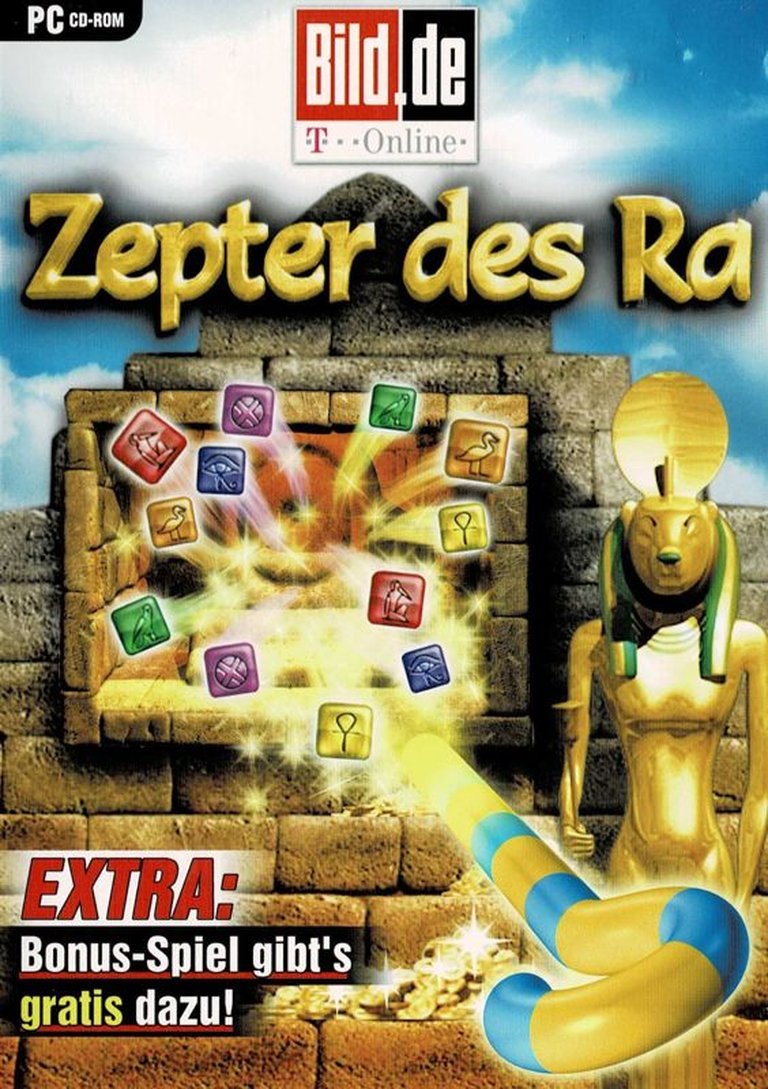
Description
Scepter of Ra is a first-person tile-matching puzzle game set in ancient Egypt, where players push hieroglyphic stones onto the board to fill it and score points by linking three or more of the same color. With 150 perplexing levels, multiple game modes, and fantastic bonuses, the goal is to uncover the secrets of the Golden Pyramid in this pharaonic challenge.
Scepter of Ra Reviews & Reception
gamezebo.com (70/100): the end result is a fun and frenetic puzzler
Scepter of Ra Cheats & Codes
PC
| Code | Effect |
|---|---|
| hltme | Disable timer on solitaire levels after reaching level 42. Requires version 1.2. |
| FNFWPM | Unlock level 2 |
| SIELPO | Unlock level 3 |
| HLGKEP | Unlock level 4 |
| TUSFTQ | Unlock level 5 |
| YOEGPE | Unlock level 6 |
| GOKELM | Unlock level 7 |
| SUETXR | Unlock level 8 |
| OGLJBF | Unlock level 9 |
| ODETJK | Unlock level 10 |
| JWUTSF | Unlock level 11 |
| LVTHGE | Unlock level 12 |
| WOGKFB | Unlock level 13 |
| ODKEHF | Unlock level 14 |
| KODJEL | Unlock level 15 |
| ODPGKE | Unlock level 16 |
| FSPGFS | Unlock level 17 |
| KKOEPJ | Unlock level 18 |
| KEGKWO | Unlock level 19 |
| WGKEWO | Unlock level 20 |
| JKGEJP | Unlock level 21 |
| FEGKYY | Unlock level 22 |
| GKEDCB | Unlock level 23 |
| ZWZGEI | Unlock level 24 |
| LPJEFT | Unlock level 25 |
| VEGELM | Unlock level 26 |
| KEWOGE | Unlock level 27 |
| CWWZGE | Unlock level 28 |
| VJDWCO | Unlock level 29 |
| PEMMFX | Unlock level 30 |
| PNZYFT | Unlock level 31 |
| LLGKKK | Unlock level 32 |
| IUVXQB | Unlock level 33 |
| SFMMJL | Unlock level 34 |
| UFTOVT | Unlock level 35 |
| QVTOVT | Unlock level 36 |
| VNMJIQ | Unlock level 37 |
| MJIQNV | Unlock level 38 |
| XTYHBR | Unlock level 39 |
| XXTYYY | Unlock level 40 |
| BHBHBH | Unlock level 41 |
| FNFLPQ | Unlock level 42 |
| MJLVPZ | Unlock level 43 |
| SBDSBD | Unlock level 44 |
| JLTUFK | Unlock level 45 |
| SFETBE | Unlock level 46 |
| SFEOPX | Unlock level 47 |
| FNFQPI | Unlock level 48 |
| NSFQVT | Unlock level 49 |
| LELENA | Unlock level 50 |
| 64738 | Unlock level 51 |
| 67802 | Unlock level 52 |
| NIBELUNGEN | Unlock level 53 |
| HAGEN VON TRONJE | Unlock level 54 |
| DONAR | Unlock level 55 |
| SKIDBLADNIR | Unlock level 56 |
| DAGON | Unlock level 57 |
| SLAWOTSKI | Unlock level 58 |
| CULLINANA | Unlock level 59 |
| ARTA MYRDHYN | Unlock level 60 |
| ANNA MAGDALENA | Unlock level 61 |
| PHILLIP EMANUEL | Unlock level 62 |
| GRACELAND | Unlock level 63 |
| SOLLY ROGER | Unlock level 64 |
| GET FUNKY | Unlock level 65 |
| TWILIGHT | Unlock level 66 |
| DRAGONLANCE | Unlock level 67 |
| HATHEGA KLA | Unlock level 68 |
| INQUANOK | Unlock level 69 |
| KIRAN | Unlock level 70 |
| OUKRANOS | Unlock level 71 |
| THRAN | Unlock level 72 |
| ULTHAR | Unlock level 73 |
| THALARION | Unlock level 74 |
| NGRANEK | Unlock level 75 |
| CHATHURIA | Unlock level 76 |
| ENTROPIE | Unlock level 77 |
| HEISSENBERG | Unlock level 78 |
| LAPLACE | Unlock level 79 |
| SONA NYL | Unlock level 80 |
| DIFFERENTIAL | Unlock level 81 |
| INTEGRAL | Unlock level 82 |
| HYPERZYKLUS | Unlock level 83 |
| APFEL MANN | Unlock level 84 |
| CHAOS | Unlock level 85 |
| DYAKHEE | Unlock level 86 |
| DENDRIT | Unlock level 87 |
| NEURON | Unlock level 88 |
| DANKREAS | Unlock level 89 |
| PANAKREA | Unlock level 90 |
| UNORDNUNG | Unlock level 91 |
| DEUTSCHLAND | Unlock level 92 |
| GERMANY | Unlock level 93 |
| MUSIC TELEVISION | Unlock level 94 |
| JOHN BELUSHI | Unlock level 95 |
| RHYTHM N BLUES | Unlock level 96 |
| GLEICHRICHTER | Unlock level 97 |
| TRANSLATION | Unlock level 98 |
| CTHUGA | Unlock level 99 |
Scepter of Ra: A Chamber of Perplexing Puzzles
In the sprawling necropolis of casual puzzle games from the mid-2000s, some titles achieve eternal life through ubiquitous bundling and relentless branding (Bejeweled, Zuma), while others fade into the digital sands, known only to a dedicated few. Scepter of Ra (2007), also known by its German title Zepter des Ra, is firmly entrenched in the latter category. It is a game that whispers from the discount aisles of digital storefronts and the depths of MobyGames databases, its existence a testament to the era’s voracious appetite for “match-three” mechanics wrapped in any thematic skin—in this case, the ever-popular allure of Ancient Egypt. This review excavates Scepter of Ra from obscurity, examining it not as a lost classic but as a competent, if flawed, artifact of its time: a game that innovates just enough on established formulas to feel fresh, yet stumbles in its presentation of that innovation, ultimately cementing its status as a fascinating footnote rather than a cornerstone in puzzle game history.
1. Introduction: The Unfamiliar Scepter
To encounter Scepter of Ra today is to engage in a act of digital archaeology. It has no Metacritic score, no critic reviews on aggregators, and a scant two collectors on MobyGames. Its legacy is defined by absence. Yet, within its 150 levels lies a core mechanic more dynamic and physically engaging than the static grids of its contemporaries. My thesis is this: Scepter of Ra is a game of compelling potential hampered by a critical failure in player onboarding. Its “stone-pushing” mechanic is a clever subversion of tile-matching, creating a spatial, almost action-puzzle dynamic. However, as attested by the Gamezebo review, its tutorial system fails to communicate this nuance, creating an initial wall of confusion that likely contributed to its obscurity. This review will argue that Scepter of Ra deserves recognition not for its narrative or presentation, but for its mechanically distinct heart, a heart that beats just out of reach for many players.
2. Development History & Context: From German Studios to Big Fish Games
The development history of Scepter of Ra is as shadowy as the interiors of the pyramids it depicts. The primary source of record, MobyGames, credits both development and publishing to Intenium GmbH, a German company known for casual and family-friendly titles. This suggests a small, in-house team creating the game for the burgeoning casual download market. The game’s platform—Windows—and its medium—CD-ROM—place it squarely in the transition period between boxed retail casual games and the rise of digital storefronts like Big Fish Games.
Interestingly, Metacritic lists the developer as Absolutist and the publisher as Big Fish Games. This discrepancy points to a common industry practice of the era: a studio (Intenium) developing a game for a larger publisher (Big Fish) who would handle distribution, marketing, and sometimes rebranding. “Absolutist” may have been a publishing label or a studio acquired by Intenium. This ambiguity itself is a marker of the casual game space, where corporate lineages were often fluid and undocumented.
The game was released in July 2007. This was a peak year for the casual puzzle genre. Puzzle Quest: Challenge of the Warlords (2007) had successfully married match-three to RPG mechanics, and PopCap’s Peggle (2007) was a zeitgeist-capturing phenomenon. Against this backdrop, Scepter of Ra entered a crowded field. Its necessity to stand out meant leaning on its unique mechanic, but its failure to properly teach that mechanic likely doomed it to niche status. The technological constraints were those of a standard PC casual title: 2D fixed or flip-screen visuals, simple sound, and a focus on accessible, low-system-requirement gameplay (noted as requiring a 600MHz processor). It was a product designed for the “every-PC” of the mid-2000s, a time before HD graphics or complex physics engines were expected in the casual space.
3. Narrative & Thematic Deep Dive: A Pharaoh’s Empty Promise
Narrative in Scepter of Ra is not merely thin; it is functionally nonexistent, serving only as a thematic veneer for the puzzles. The official ad blurb from Big Fish Games states: “Take on the challenge of the pharaohs and connect the hieroglyphic stones to reveal the amazing Golden Pyramid!” This is the entire plot: an abstracted “challenge” issued by unnamed pharaohs, with the reward of a “Golden Pyramid.”
There are no characters to speak of—no protagonist explorer, no Egyptian deities, no antagonistic force. The player is an unseen, anonymous entity interacting directly with a game board. The “setting” is Ancient Egypt, represented solely through the visual motif of colored stones etched with hieroglyphics and the pyramid-themed level progression (“lost Pyramid of the Pharaoh”). The “thematic deep dive,” therefore, is a dive into a shallow decorative pool. The hieroglyphics are not translated or contextualized; they are texture, not lore. The Scepter of Ra itself is never visualized or explained; it is merely implied by the game’s title and the final reward of the “Golden Pyramid.”
The underlying theme is pure, unadulterated puzzle escalation. The narrative is a scaffolding: “You are in a pyramid. Solve puzzles to go deeper.” It is a missed opportunity. The rich mythology of Ra, the sun god, the symbolism of the scepter as a tool of creation and destruction, is ignored in favor of a generic “ancient mystery” aesthetic common to dozens of other casual games (Pyramids of Ra, Scarab of Ra, etc.). The game’s world is not built; it is merely named.
4. Gameplay Mechanics & Systems: The Brilliant, Baffling Core
This is where Scepter of Ra stakes its claim to relevance. Its core mechanic is a sophisticated twist on the “tile matching puzzle” genre, as cataloged on MobyGames. The Gamezebo review provides the essential, if initially confusing, description:
“You’re presented with a board that houses colored stones (with hieroglyphics on them), all laid out in a specific pattern. On the edges of the board are arrows, which indicate the direction you can fire additional stones at… By successfully matching these stones, it removes them from the board… and it clears the colored spot on the board itself; when all colors are removed, you advance to the next level.”
The innovation lies in the “pushing” mechanic. When a player fires a stone from an edge arrow:
1. It travels in a straight line.
2. Upon hitting an existing stone on the board, it pushes that stone one space forward in the direction of travel.
3. This can create a chain reaction, pushing a line of stones.
4. If the pushed stone is of the same color as one adjacent to it (vertically or horizontally), a match is formed and those stones are cleared.
5. The fired stone stops in the vacated space, or if it pushes a stone into an empty space, it continues its trajectory until it hits another stone or the board edge.
This is not a passive matching game like Bejeweled. It is an active board-manipulation game, sharing DNA with Zuma (shooting) and Puzzle Bobble (cascading removal), but with a crucial difference: you are moving the targets directly, not just adding to a chain. You are not merely placing; you are pushing, acting as a physical force on the board state. The Gamezebo reviewer’s initial confusion is understandable; this mechanic is not intuitive from a cursory glance. It requires spatial reasoning to predict how a single shot will ripple through the board’s arrangement.
Systems & Loop:
* Objective: Clear all colored squares on the board by matching stones. The board itself has a pattern of colored tiles; a match clears that tile’s color.
* Core Loop: Observe board → Queue next stone (right-click to cycle) → Aim shot via edge arrows → Fire stone → Watch push/cascade → Match clears → Repeat until board clear.
* Game Modes: The ad blurb mentions “3 unique game modes.” The Gamezebo review explicitly names Relaxed Mode (no timer) and implies a standard timed mode (“Unless you’re playing the Relaxed mode, a timer also counts down”). A third mode is not detailed but likely a challenge or endless variant.
* Progression: 150 levels with increasing complexity. Early levels are simple corridors for pushing; later levels introduce obstacles and power-ups: “blazing fireballs that help remove stones for you or glass-like blockers that need to be smashed.”
* Fail State: Timer runs out or you run out of moves (implied by not completing the board). The review notes you can skip a level “but it will cost you a life!” indicating a limited life system.
* UI/Innovation/Flaws: The UI is minimal: the board, the queue, a timer/lives display. The innovation is the core push mechanic. The fatal flaw is the tutorial. As Gamezebo states, “the rules didn’t make much sense to me until my brain caught up with my mouse-clicking finger.” This is a catastrophic design oversight. A game whose core pleasure is in the aha! moment of understanding spatial cascades should not obscure that understanding. The tutorial fails to illustrate the pushing consequence effectively, leading to frustration and likely player drop-off.
5. World-Building, Art & Sound: A Serviceable Sandstone Facade
Given the game’s minimalist narrative, the “world” is purely aesthetic. The setting is “Egypt (Ancient),” a theme so broad it could describe a pyramid, a temple, or a desert. The game’s presentation adheres to the standard of mid-2000s casual PC games.
- Visual Direction: The perspective is 1st-person, meaning the player looks at the puzzle board as if it’s placed before them. The visual style is Fixed / flip-screen, suggesting static backgrounds for each level or set of levels, with the puzzle board as the central, unchanging element. The stones themselves carry the hieroglyphic textures, providing the only direct Egyptian imagery. The Gamezebo review praises the “attractive background art,” implying detailed, painted scenes of desert landscapes, temple interiors, or hieroglyph-covered walls that change between levels or sections. It’s competent, atmospheric stock art for the genre—not groundbreaking, but professional and thematically consistent.
- Atmosphere: The atmosphere is one of “mysterious contemplation” broken by frantic clicking. The lack of a story or characters means the atmosphere is generated solely by the visual backdrop and the sound design.
- Sound Design: The Gamezebo review calls out the “good music” as an “asset.” This suggests a soundtrack that leans into typical Egyptian cues—droning ney flutes, rhythmic hand drums, mysterious harp melodies—but likely in a low-key, ambient arrangement to avoid distracting from the puzzle. Sound effects are probably limited to stone clicks, whooshes, chimes for matches, and timer beeps.
These elements are entirely functional. They create a veneer of place but do not integrate with the gameplay. The pyramid you’re exploring is just a backdrop; the Golden Pyramid you “reveal” is likely just a splash screen. The art and sound don’t enhance the mechanical understanding or tension; they simply sit beside it, providing a familiar, comforting theme for players who enjoy “ancient mysteries.”
6. Reception & Legacy: The Silent Aftermath
The critical and commercial reception of Scepter of Ra is defined by its near-total absence from the record.
- At Launch (2007): There are no critic reviews on Metacritic. MobyGames shows no critic reviews either. It was not reviewed by major outlets like IGN, GameSpot, or casual-focused sites beyond the single Gamezebo review. Its commercial existence is tied to Big Fish Games, the dominant platform for casual downloads at the time. It was sold as a commercial CD-ROM and later as a digital download, likely bundled in “5 Games” packs or sold at a discount. The lack of any user reviews on MobyGames or Metacritic (as of the data cut-off) suggests it did not inspire a community or achieve significant word-of-mouth.
- Evolving Reputation: Its reputation has not evolved because it never formed one. It remains a forgotten title, a “also-ran” in the crowded 2007 casual puzzle space. Its MobyGames entry was only added in March 2024 by contributor Rainer S., underscoring its obscurity.
- Influence & Industry Place: Scepter of Ra had no discernible influence on the industry. It did not pioneer a new sub-genre. Its pushing mechanic is clever but appears to have been a dead end. Looking at the list of “Related Games” on MobyGames—titles like The Curse of Ra (1990), Pyramids of Ra (1991), Scarab of Ra (1987)—reveals the true legacy. Scepter of Ra is part of a long, low-volume series of unrelated games (mostly from other developers) that simply use “Ra” in the title to denote an Egyptian theme. It is a thematic clone within a thematic clone series. It represents the commodification of a theme rather than an evolution of a mechanic. In the grand history of puzzle games, it is a forgotten branch on the match-three tree, one that withered because its most interesting branch—the pushing mechanic—was not properly explained to those who might have nurtured it.
7. Conclusion: A Worthy But Flawed Relic
Scepter of Ra is a game of profound contradiction. Its core loop—the spatial puzzle of pushing stones to clear a board—is inventive, tactile, and possesses a depth that many static match-three games lack. It requires prediction, planning, and an understanding of cause and effect. For a puzzle aficionado who discovers it, it can provide a genuine “aha!” moment and several hours of engaged play.
However, as a complete package, it is fatally compromised. The abysmal tutorial that fails to communicate its own rules is an unforgivable sin in game design, especially for a casual title. It gates the very innovation the game is built upon. The narrative and world-building are non-existent, reducing the Egyptian theme to a skin-deep label. The presentation is merely adequate, and its lack of any critical or community reception is a direct result of these compounded issues.
In video game history, Scepter of Ra does not represent a milestone. It is not a lost classic. It is, instead, a perfect case study in wasted potential. It demonstrates that a brilliant central mechanic is not enough; it must be married to clear communication, compelling context, and effective presentation. It is a curiosity for historians of the casual puzzle genre—a game that tried to push the boundaries (literally and figuratively) of tile-matching in 2007 but was ultimately lost in the desert because no one could read the directions on its scepter. Its verdict is one of qualified, niche recommendation: seek it out only if you are a puzzle scholar curious about mechanical variants, and be prepared to teach yourself its rules through stubborn trial and error. For the world at large, the sands of time have already claimed it, and rightfully so.