
- Release Year: 2019
- Platforms: Linux, Windows
- Genre: Adventure
- Game Mode: Single-player
- Gameplay: Dating simulation, Visual novel
- Setting: Fantasy
Description
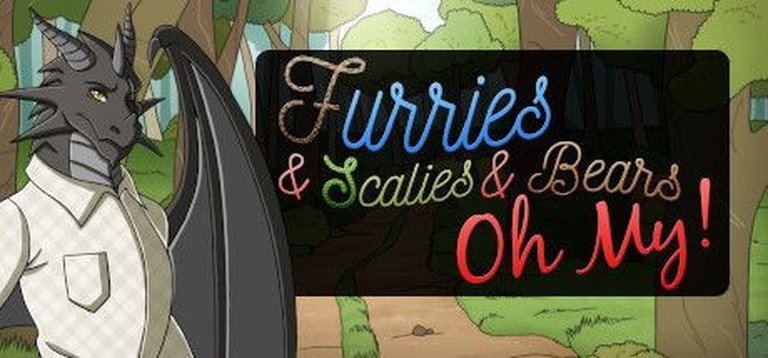
Furries & Scalies & Bears OH MY! is a fantasy visual novel and dating simulation game where the protagonist and a friend are transported from a routine walk in the woods to a vibrant world populated by talking anthropomorphic animals, such as furries, scalies, and bears. Set in a land resembling our own but with mythical creatures, players engage in daily interactions with a cast of over ten characters, making choices that affect relationship levels and the world’s outcome, blending adventure, comedy, and romance in a Ren’Py engine-driven narrative.
Gameplay Videos
Where to Buy Furries & Scalies & Bears OH MY!
PC
Furries & Scalies & Bears OH MY! Guides & Walkthroughs
Furries & Scalies & Bears OH MY!: Review
Introduction: A Portal to a Problematic Paradise
In the vast, ever-expanding universe of indie visual novels, few titles wear their niche identity as boldly—or as confusingly—as Furries & Scalies & Bears OH MY! Released in January 2019 by the virtually unknown Stegalosaurus Game Development (primarily the effort of Stefan Klaus), this game promised a quintessential “isekai” fantasy: a human protagonist, on a simple walk, is transported to a vivid world of talking, anthropomorphic animals. Yet, beneath the catchy, alliterative title and the inviting blurb lies a game that has become a fascinating case study in ambition versus execution, niche appeal versus mainstream accessibility, and the perils of development on a shoestring. My thesis is this: Furries & Scalies & Bears OH MY! is not merely a flawed game; it is a critical artifact of the late-2010s indie visual novel boom, representing both the liberating potential and the profound pitfalls of the Ren’Py engine’s democratization of game development. Its reception—a starkly mixed “Mixed” rating on Steam with only 46% positive reviews from a tiny pool of 14 users—is not a simple verdict of quality, but a symptom of a title caught between competing identities: a comedic adventure, a dating sim, a surreal mystery, and a technically unstable prototype, all vying for attention within a single, compressed narrative.
Development History & Context: The One-Person (or Two) Show
The development history of Furries & Scalies & Bears OH MY! is, by necessity, inferred from its structure and presentation, as no traditional “making-of” documentation exists. The game was developed and published by Stefan Klaus and Stegalosaurus Game Development, entities that are, for all practical purposes, synonymous. This places the project squarely in the tradition of the solitary or micro-team indie developer, leveraging accessible tools to realize a personal creative vision.
The technological constraint is immediately apparent: the game was built in Ren’Py, the open-source visual novel engine. This choice is both its greatest strength and its most glaring weakness. Ren’Py’s accessibility allowed a developer without a large budget or a team of programmers to create a cross-platform (Windows, macOS, Linux) game with Steam achievements and basic branching narrative. However, the source material reveals a game that consistently battles with technical stability. Steam community discussions are littered with crash reports and missing file errors:
OSError: Couldn't find file '[outfit_skin]/3_ly/3 pj.png'.
Exception: DynamicImage '[outfit_skin]/7 pj.png': could not find image. ('regular/7 pj.png').
These are not isolated incidents but a recurring theme, suggesting asset pipeline mismanagement, issues with DLC integration, or patching errors. The presence of extensive post-launch patches (noted in SteamDB and Steam community updates), including fixes for “Broken quests” and “Image pathing,” tells a story of a game that required significant—and perhaps ongoing—technical triage after release. This context is crucial: we are not evaluating a polished AAA product, but a passion project released into the wild, for better or worse.
The gaming landscape of early 2019 was ripe for such a title. The “furry” visual novel/dating sim niche was established, with predecessors like Brave Furries (2014) and contemporaries in the broader indie VN space. Steam’s Greenlight (or direct indies) era was in its twilight, but the platform remained a viable, if crowded, marketplace for niche interests. The game’s tag assemblage on Steam—”Dating Sim,” “Visual Novel,” “Comedy,” “Surreal,” “Psychological Horror”—reveals an attempt to straddle multiple genre camps, a risky strategy for a small title seeking an audience.
Narrative & Thematic Deep Dive: A World of Unfulfilled Potential
The official ad blurb provides the only firm narrative premise: a protagonist and a friend are transported to a fantasy world “much like ours… but with talking dragons and upright, walking, talking animals.” The setting is Kale Bay, a village that serves as the primary node for interaction. From this simple inciting incident, the game promises “new mysteries and adventures” and a cast of “10+ characters.”
Plot Structure and Pacing: User reviews consistently highlight a major narrative flaw: extreme linearity and brevity. One player reported finishing the game in 95 minutes, describing it as feeling “like reading over the bullet points to something that will eventually be written.” The structure appears to be a “one location per day” system, where the protagonist interacts with a subset of the cast daily. This creates a sense of frantic time-skipping and a lack of substantive world-building. Plot points are described as coming “out of left field” with “almost no build-up.” The narrative momentum is consistently interrupted, preventing emotional investment. As one reviewer succinctly put it, “You do not feel involved in what’s going on.”
Characters & Relationships: The game advertises “10+ characters” and the ability to interact with “8 different people” daily. VNDB tags list “Dragon” and “Furry,” confirming key species within the cast. Steam screenshots and user awards highlight specific characters like a “blushing porcupine” and a character named “Chase.” However, the dating sim element is where the narrative promises most spectacularly fail to deliver. Multiple reviews express profound disappointment with the romance mechanics. The most cited example is a character named Lois, where players report being unable to achieve a romantic ending regardless of choice perfection, consistently resulting in a “friend zone” outcome. This fundamentally breaks the core promise of a “dating sim,” rendering a key portion of the gameplay arguably pointless. The relationships feel transactional and shallow, lacking the gradual development necessary for genuine attachment.
Themes and Tone: The most intriguing aspect of the narrative, hinted at only in tags and fleeting user comments, is the jarring tonal dissonance. The game is officially tagged on Steam with “Psychological Horror” and “Surreal”, alongside “Comedy” and “Cute.” This suggests an ambition to blend lighthearted furry antics with unsettling or bizarre undercurrents. The “vortex” portal, the abrupt shifts, and the reported lack of consistent logic could be deliberate attempts at surrealism, but user feedback indicates they more often read as poor pacing and incoherence. The presence of “Science” and “Sci-fi” tags alongside “Fantasy” further complicates the tonal landscape, hinting at a world with potentially mixed or ambiguous rules that are never satisfactorily explained. The narrative, therefore, is a collage of unmet genre expectations: a comedy that isn’t funny enough, a mystery without enough clues, a dating sim with no satisfying relationships, and a horror that fails to scare.
Gameplay Mechanics & Systems: Choice Without Consequence
At its core, Furries & Scalies & Bears OH MY! is a Ren’Py visual novel with light dating simulation and adventure elements. The gameplay loop is straightforward: each “day,” the player selects which characters to visit and engage in dialogue trees. Choices are presented per scene and are said to “determine your friendship levels with each individual.”
The Friendship/Gossip System: The primary mechanical system is a hidden relationship point counter (or “gossip” meter, as one guide mentions) for each character. The goal appears to be raising these levels to unlock scenes, story progression, and, ostensibly, romantic endings. However, the system’s opacity is a critical flaw. Players have no in-game feedback on their standing with any character until it’s too late. The choices themselves are described as sometimes switching between a character’s first and last names, causing confusion. Furthermore, as noted in the Lois example, the thresholds for romantic outcomes may be impossibly high or bugged, making the entire dating sim premise moot for at least some characters. The promise that “not every choice will lead to massive change” is technically true but becomes a damning indictment when no choice leads to the change the player desires.
Exploration and Progression: The “Adventure” tag is tenuous. There is no traditional exploration or puzzle-solving. “Exploration” seems to mean selecting which character’s “location” to visit from a menu. Progression is purely narrative and tied to the invisible relationship meters. The “Multiple Endings” tag is present, but the paths to them are poorly signposted, encouraging a frustrating cycle of trial-and-error without clear cause-and-effect.
UI and Accessibility: The Ren’Py default interface is functional but uninspired. The system requirements (Intel Celeron 1.80GHz, 1GB RAM) indicate an extremely lightweight engine utilization, which is good for accessibility but does little to compensate for the game’s other shortcomings.
Innovation vs. Flaw: There is little to no mechanical innovation here. The game’s sole potential innovation—blending a day-to-day life sim with a portal fantasy—is undermined by its rushed execution. The most notable “feature” is its post-launch support via DLC, including:
* The Bear DLC
* Halloween Harvest Festival
* Charity Bonus DLC
* NSFW for Charity
The existence of an NSFW DLC for a game whose base content is described as having “no nudity, nor explicit conversation” and being “Safe / Tame (14)” on VNDB is a fascinating, almost schizophrenic business and design choice. It suggests either a last-minute monetization strategy or a radical split in the game’s intended audience and content, further muddying its identity.
World-Building, Art & Sound: Charming Aesthetics in a Vacuum
Visual Direction and Art: The game employs a 2D, cartoony, colorful anime-style aesthetic, as per Steam tags. The art is consistently described by reviewers as “cute” and the character designs as having “each their own personality, up to a stereotypical point.” Screenshots confirm a bright, simple palette with clean line work. The “porcupine in a suit” is a frequently celebrated image. However, the technical issues directly impact the art: the recurring missing image errors (Couldn't find file...) demonstrate a fundamental problem in how art assets are compiled and referenced, breaking immersion with brutal, ugly crashes. This turns the charming art from an asset into a liability when the game cannot reliably display it.
Sound Design and Music: This is a consistent point of criticism. The music is described as “not very good, and sometimes doesn’t fit the action at all.” There is no indication of a memorable or dynamic soundtrack. The sound design appears functional at best, with no evidence of advanced audio implementation. In a genre where audio is crucial for setting mood—especially one flirting with “Psychological Horror”—this is a significant missed opportunity and a contributor to the emotional flatness noted by players.
Atmosphere and Setting: The world of Kale Bay is conceptually intriguing but poorly realized. The “talking animals” premise is delivered with a matter-of-factness that fails to instill wonder. The lack of environmental description, coupled with the rapid scene-hopping, prevents the setting from feeling like a place. It exists solely as a backdrop for character interactions, and since those interactions are underdeveloped, the world feels empty and un-lived-in. The potential for “surreal” or “sci-fi” atmosphere is completely neutered by the pedestrian writing and pacing.
Reception & Legacy: A Niche Footnote with a Caveat
Critical and Commercial Reception at Launch: Furries & Scalies & Bears OH MY! received virtually no professional critical coverage. Its MobyGames page has no approved critic reviews and only a handful of user reviews. Its Steam release debuted to the “Mixed” status it maintains years later (46% positive from ~14 reviews as of 2026). Commercial success was likely minimal. Its price has fluctuated on third-party sites (from $9.99 to $4.99), and it is frequently bundled, suggesting it is used more as a bundle filler than a standalone draw. The tiny player base (only 2 players recorded as “Collected By” on MobyGames) confirms its status as a deep-niche product.
Evolution of Reputation: The reputation has not meaningfully improved. The user review corpus over time shows consistent complaints about:
1. Technical Instability: Crashes and missing assets.
2. Narrative Incoherence: Rushed pacing and undeveloped plot.
3. Dating Sim Failure: Ineffective or broken romance mechanics.
4. Misleading Titling: The title Furries & Scalies & Bears OH MY! prominently features “Bears,” yet a dedicated “Bear DLC” exists, leading to accusations that bears were held back for paid content. One review explicitly calls this out: “what’s up with that misleading title?”
Positive reviews are rare and often caveated: “I really enjoyed this game… It was a short sweet ‘adventure’… The only thing that could have made this better was of course MORE!!!!!” or “I absolutely loved this game!… it’s a shame it’s not well reviewed!” These suggest a small, undemanding audience perfectly aligned with its ultra-specific niche.
Influence and Industry Impact: The game’s influence is negligible to non-existent within the broader industry. It did not pioneer mechanics, define a trend, or achieve enough visibility to inspire clones. Its legacy is confined to the micro-ecosystem of furry-oriented Ren’Py games. However, it serves as a cautionary tale within that ecosystem about the importance of:
* Scope management: A 90-minute game cannot credibly support 10+ characters and multiple endings.
* Playtesting and QA: The pervasive asset errors and broken romance paths indicate a severe lack of testing.
* Genre fidelity: If you market as a “dating sim,” the romance mechanics must be functional and satisfying.
* Honest marketing: The “Bear DLC” issue damages trust.
It is a testament to the “anyone can publish” ethos of Steam and the Ren’Py community, but also a stark example of the quality control vacuum that such openness can create.
Conclusion: A Curio of Unrealized Potential
Furries & Scalies & Bears OH MY! is, in the final analysis, a deeply flawed artifact. As a narrative experience, it is frustratingly abbreviated, tonally confused, and emotionally sterile. As a dating sim, it is fundamentally broken for at least one core romance path, betraying its central promise. As a technical product, it is notoriously unstable, with a community plagued by missing file errors that suggest a rushed or careless release. Its world is a charming concept without the substance to sustain it.
And yet, to dismiss it entirely is to miss its historical value. It is a pure, unfiltered document of indie ambition. Its existence proves that a developer with a specific vision—no matter how niche, no matter how poorly executed—can still find a platform and an audience, however small. Its 50/100 Player Score on Steambase is not just a rating; it’s a perfect representation of its dual nature: half of its players found enough of its quirky charm and character designs to overlook its manifold deficiencies; the other half walked away feeling cheated by a game that could not deliver on its basic promises.
Its place in video game history is not on a pedestal, but in a case study. It is a textbook example of the pitfalls that await developers who prioritize vision over vasculature—who build a world without building the systems to support it, who promise intimacy but deliver only acquaintance, who release a product that feels less like a finished game and more like a rough sketch of one. For scholars of indie game development, furry fandom in media, or the Ren’Py ecosystem, it is a required, if painful, data point. For the average player, it remains a hard pass. The vortex may have transported the protagonist to a world of talking animals, but for most players, Furries & Scalies & Bears OH MY! merely transports them to a world of frustration and missed potential.
Final Verdict: 5/10 – A historically interesting but fundamentally broken niche visual novel. Its value lies entirely in its status as a cautionary curio, not as a recommendable game.