
- Release Year: 2018
- Platforms: Windows
- Publisher: Laush Studio
- Developer: Laush Studio
- Genre: Puzzle
- Gameplay: Tile matching
Description
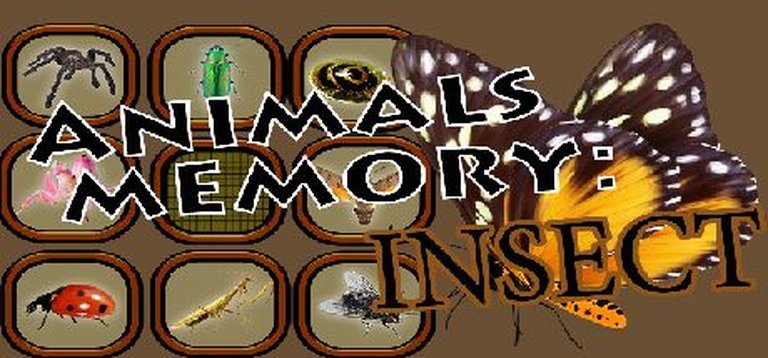
Animals Memory: Insect is a puzzle game that tasks players with matching pairs of insect-themed tiles in a fixed-screen layout, testing memory and concentration as part of the Animals Memory series. The gameplay involves flipping cards to recall and pair identical insect images in a minimalist visual style.
Where to Buy Animals Memory: Insect
PC
Animals Memory: Insect Cracks & Fixes
Animals Memory: Insect Guides & Walkthroughs
Animals Memory: Insect: Review
Introduction: A Quiet Pivot in the Memory Maze
In the vast, sprawling labyrinth of the video game industry, where blockbuster narratives and complex systems command the spotlight, there exists a serene, almost meditative corner dedicated to a mechanic as old as play itself: matching memory. Animals Memory: Insect, released on January 26, 2018, by the enigmatic solo developer operation Laush Studio, is not a game that seeks to revolutionize its genre. Instead, it represents a deliberate, focused refinement of a timeless puzzle format, filtered through the lens of digital accessibility and thematic specialization. This review posits that while Insect may lack the narrative grandeur or mechanical complexity of its contemporaries, its value lies in its unyielding commitment to a single, pure premise. It is a digital concentration card game stripped to its essentialist core, and its place in history is that of a meticulously crafted artifact within a specific niche: the educational, casual, and therapeutic puzzle game. Its thesis is simple: memory training, cloaked in the gentle aesthetic of entomology, can be a perfectly fulfilling game loop when executed with clarity and purpose.
Development History & Context: The Laush Studio Model
The development history of Animals Memory: Insect is inextricably linked to its creator, identified only as “Laush Dmitriy Sergeevich” on Steam and operating under the publisher/developer banner “Laush Studio.” This points to a classic indie, likely solo-developer or very small-team, model. The game was built in Unity, the ubiquitous game engine that has democratized development for over a decade by 2018, allowing a single developer to deploy to Windows with relative ease and low overhead.
The technological constraints of the era were less about pushing hardware and more about optimizing for the “casual” and “accessible” market. In 2018, the PC digital storefront landscape (Steam being primary here) was saturated with hyper-casual and “clicker” games. Insect was not attempting to compete with graphical fidelity or complex 3D worlds. Its “Fixed / flip-screen” visual style, as cataloged on MobyGames, is a direct and functional choice, minimizing asset creation and technical risk. The 50-100 MB storage requirement confirms a game built from simple 2D sprites and basic UI elements.
Crucially, Insect was not an isolated project but part of a rapidly produced series. The MobyGames “Animals Memory series” and Steam news posts reveal a Factory-like output: Underwater Kingdom, Cats, Dogs, Dinosaurs, Birds, Horses, Monkeys, and the original Animals Memory were all released in close proximity in 2018, with Monkeys following in 2021. This context is paramount. Insect is a tile in a mosaic of themed asset packs and reusable code. The “vision” was not for a singular, profound experience, but for a scalable, sustainable formula. The gaming landscape at the time was seeing a rise in “asset-flip” critiques, but also a healthy market for cheap, stress-free, and family-friendly puzzle games. Laush Studio positioned itself squarely in the latter camp, offering a predictable, reliable product for a specific audience: parents, educators, and adults seeking low-stimulation cognitive exercises.
Narrative & Thematic Deep Dive: The Absence as a Statement
One cannot perform a literary analysis on a game with no story, no characters, and no dialogue. The source material is uniformly silent on any narrative layer. The Steam store description states the aim: “to find pairs of cards.” There is no protagonist, no world to save, no text to read. This is not a oversight but a thematic and design choice.
The theme is “insects.” The 38 cards feature images of various insects. This is the game’s entire narrative identity. It posits a world reduced to taxonomic classification and visual pattern recognition. The underlying theme, therefore, is taxonomy and observation. The player is not an adventurer but a cataloger, an amateur entomologist matching specimens. This aligns perfectly with the game’s stated suitability for “children of all ages, babies, preschoolers, school children, teenagers and adults.” The educational value is not in learning facts, but in training the visual memory and pattern discrimination skills fundamental to scientific observation. The “atmospheric” user tag on Steam is ironically applied; the atmosphere is not one of dread or wonder, but of calm, clinical focus. The game’s world is the tabletop grid itself. Its conflict is internal (memory vs. forgetfulness). Its resolution is the satisfying click of a matched pair. In the history of games that use theme, Insect uses its theme not to tell a story, but to provide a consistent, non-threatening visual vocabulary for a core cognitive task.
Gameplay Mechanics & Systems: The Elegance of the Loop
At its mechanical heart, Animals Memory: Insect is the classic Concentration or “Memory” game. The core loop is: 1) View a grid of face-down cards (18 levels, with grid sizes scaling with difficulty). 2) Flip two cards per turn. 3) If they match (same insect image), they remain face-up and are removed from play. 4) If not, they flip back face-down. 5) Repeat until all pairs are found.
The stated “different levels of difficulty” and “18 levels” suggest a progression not in mechanics, but in grid size and card count. Simpler levels likely use a 4×3 grid (12 cards, 6 pairs), while complex ones may use a 6×6 grid (36 cards, 18 pairs). The game features 38 unique insect cards, meaning some levels will reuse insect art, ensuring the matching challenge is based on memory, not counting unique assets.
Innovations/Flaws within the Constraints:
* Purity as Innovation: The game’s primary “innovation” is its ruthless purity. No timers, no scoring penalties for mismatches, no arbitrary lives. It is a pure memory exercise. This is its greatest strength for its target audience and its greatest limitation for those seeking traditional game “juice” or stakes.
* The 38-Card Anomaly: The mention of 38 cards is interesting. A standard memory game uses an even number of total cards, all paired. 38 suggests either a) the base set has 19 pairs, or b) it’s a typo/oversimplification in the description, and the actual set is 36 or 40 cards. This minor inconsistency hints at the potentially slapdash nature of the series’ production.
* User Interface & Systems: The Steam community reports a bug: “Mute only mutes the music, not the sound effects.” This is a significant flaw for a game marketed as “relaxing” and suitable for children, where uncontrolled sound effects could be jarring. It suggests a lack of rigorous QA, a common trait in high-volume, low-budget indie production. The UI is presumably minimalistic: a grid, a score/timer (if any), and menu buttons. The presence of 38 Steam Achievements is a notable system. This is a huge number for such a simple game, indicating the achievements are likely granular (“complete level 1,” “complete level 2,” etc.) or based on perfection (“no mismatches on level X”). This directly serves the “Determined Completionist” player personality identified in the PlayTracker data, artificially extending playtime and providing goal structures where the core game loop has none.
World-Building, Art & Sound: Functional Atmosphere
The “world” of Animals Memory: Insect is a non-space. There is no background, no environment beyond the card grid on a neutral color. The “visual” is purely the card art. The quality of this art is not described in sources, but given the context of a rapid asset-based series, it is almost certainly competent, simple vector or painted raster art, likely sourced from an asset store or created with efficiency in mind. Its function is clear identification. The “Fixed / flip-screen” descriptor from MobyGames confirms a static, non-animated view. The “atmospheric” tag may refer to a subtle, calm color palette or soft edges on the card art.
Sound design is the other key atmospheric element. The description mentions “Full Audio” in Steam’s feature list. Community posts do not discuss it, implying it is unobtrusive and likely consists of: 1) A simple, looped music track—probably calming, melodic, and non-intrusive (likely classical or ambient). 2) Sound effects for card flips, successful matches, and perhaps level completion. The mute bug indicates these are separate audio channels, a basic but essential feature that was implemented imperfectly. The sound’s role is to provide sensory feedback without introducing stress or distraction, perfectly aligning with the “Relaxing” and “Family Friendly” tags. It is functional atmosphere, not immersive world-building.
Reception & Legacy: The Quiet Success of the Niche
Critical Reception: There are virtually no professional critic reviews. Metacritic lists “Critic reviews are not available.” This is the norm for ultra-budget, hyper-casual indie titles. The critical discourse for such games happens in user reviews and algorithmic aggregation.
Commercial & User Reception:
* Steam Store Status: “Mostly Positive” (76% of 43 reviews at the time of data aggregation). This is a solid, if not spectacular, reception for a niche product.
* PlayTracker Insight: A Player Score of 79/100 from 48 reviews, with an estimated ~46K owners. This suggests a modest but real audience.
* User Tag Consensus: The community-defined tags are a perfect map of the game’s perceived identity: Casual, Indie, Puzzle, Relaxing, Singleplayer, Card Game, Educational, Family Friendly, Logic. This is not a game for “Hardcore” or “Action” fans; it is explicitly categorized.
* Common Player Feedback: The Steam community discussions are revealingly sparse. There are achievement guides (proving the completionist hook), a bug report about the mute function, and a few screenshots. One user notes in Chinese: “就……僅是個兩兩配對的記憶小遊戲” (“It’s… just a simple memory matching game”). This blunt assessment, neither positive nor negative, is perhaps the most accurate summation. Another user’s screenshot caption, “That it? :(” hints at the pale expectations for such a title—its value is in what it is, not what it could be.
Legacy & Influence:
Animals Memory: Insect has no discernible influence on mainstream game design. Its mechanics are centuries old. Its influence is demographic and market-based. It is part of a wave of ultra-cheap, functionally simple, thematically varied digital games that serve specific non-gaming purposes: cognitive exercise for the elderly, distraction for children, low-stress time-killing for adults. It validates the business model of the “asset-flip series” when executed with consistent quality (even if that quality is minimal). It demonstrates that a market exists for games that are explicitly not challenging, narrative-driven, or competitive. Its legacy is as a data point in the grand taxonomy of gaming, firmly filed under “Casual Puzzle > Memory > Themed.”
Conclusion: A Definitive Verdict
Animals Memory: Insect is a game that must be judged not by the standards of interactive storytelling or mechanical innovation, but by the standards of its own declared purpose. It is a competent, flawless (aside from the mute bug) execution of the memory-card format, delivered at a price point ($3.99, often on sale for less) and with a production volume that targets a mass, casual audience.
Its historical significance is not that it changed games, but that it perfectly occupies a pre-existing niche. In an industry obsessed with “more”—more story, more systems, more spectacle—Insect is a quiet manifesto for “enough.” It provides a clean, bug-free (mostly), stress-free loop of cognitive engagement wrapped in a harmless, educational skin. For its intended user—a parent wanting a quiet game for a child, an adult seeking five minutes of mental quietude, a completionist hunting easy achievements—it delivers exactly what the store page promises.
Therefore, the verdict is this: Animals Memory: Insect is a successful artifact of its category. It is not a “great” game by conventional critical metrics, but it is a “good” game for what it intends to be. Its place in video game history is as a testament to the enduring power of simple mechanics, the viability of the hyper-niche, asset-based indie model, and the profound market demand for games that ask for nothing more from the player than a moment of focused attention. It is a small, clear, and perfectly formed pixel in the vast mosaic of the medium.