
- Release Year: 2016
- Platforms: Linux, Macintosh, Windows
- Publisher: tinyBuild LLC
- Genre: Compilation
- Average Score: 72/100
Description
Party Hard is an action-stealth game where players assume the role of a serial killer infiltrating various parties across the USA to silently eliminate all attendees, motivated by a mission to stop loud and disruptive gatherings. Set in semi-procedural environments, the gameplay focuses on strategic kills, trap-setting, body disposal, and evading witnesses and escalating police responses to achieve a clean sweep without capture.
Party Hard: Collector’s Edition Reviews & Reception
metacritic.com (85/100): While it may not have the most captivating of storylines, the game itself is fun and addictive.
metacritic.com (80/100): Party Hard is a really entertaining and old school title, with both action and stealth approaches, fine soundtrack and pretty 8-bit pixel art visuals.
metacritic.com (100/100): Игра хорошая. В ней интересный сюжет, интересно сделанные уровни. Игра короткая но жизнь продлевает уровнями сделанными игроками.
metacritic.com (100/100): Party Hard is a good game not only for the soundtrack has a good history and a good levels. 🙂
metacritic.com (75/100): It has a solid concept, but it does need some improvements here and there. We had fun playing it, though, and we’re already looking forward to playing a sequel with some fixes and tweaks.
metacritic.com (70/100): Party Hard combines the killing playground of Hitman with the styling advise of Hotline Miami. To creatively disturb parties in a very bloody way is a lot of fun, but it does get boring pretty quickly as well.
metacritic.com (60/100): When you’ve wasted 15 minutes watching two pixel people chat each other up but never move to the bedroom to seal the deal; it’s these scenarios where getting caught by the cops or feds becomes a frustration instead of a punishment. It’s almost like some people don’t want to get murdered. Rude.
metacritic.com (58/100): Party Hard really is a one-trick pony, and once you’ve seen that trick a few times you’ll be ready for the next thing.
metacritic.com (20/100): Party Hard is not a game that rewards players who take chances or attempt to learn the layout of levels, since the developers randomize the stages after each failure. Tr
gamesasylum.com : Yet within this simplicity lies elegance – it’s because of the game’s basic nature that everything works and operates in clockwork and reliable fashion.
Party Hard: Collector’s Edition: A Cult Classic of Dark Comedy and Tactical Mayhem
Introduction: The Silence Before the Slaughter
In the mid-2010s, as the indie scene flourished with retro-inspired aesthetics and streaming culture began to permeate game design, Party Hard emerged not with a whisper, but with the deafening crash of a disco ball through a window. It presented a premise so simultaneously absurd and viscerally relatable it demanded attention: what does a person do when the neighbor’s party won’t stop? The game’s infamous answer—become a meticulous, hockey-mask-wearing serial killer—was a calculated provocation that masked a surprisingly deep and systemic stealth action title. The Collector’s Edition, bundling the core game, the narrative-expanding High Crimes DLC, and a remastered soundtrack, serves as the definitive package for one of the decade’s most peculiar and enduring indie successes. This review argues that Party Hard transcends its shock-value premise through brilliant, emergent gameplay design, a deceptively complex narrative about fractured identity, and a pioneering integration with live-streaming culture, cementing its status as a cult classic that cleverly subverts both stealth conventions and player expectations.
Development History & Context: From Game Jam to Global Phenomenon
Party Hard was the creation of Pinokl Games, a small Ukrainian studio with a history of developing successful social network and mobile games like Real Steel, which amassed over 2 million installs on VK.com. The project originated not as a full-fledged title but as a rapid prototype for a game jam. Developer Alexandr Ponomariov, who handled the pixel art, channeled the studio’s experience with accessible, visually clear styles. As POTAPENKO and team explained in an interview with 80.lv, pixel art was a practical choice: “the entry level of pixel art games is very low,” allowing a small team to produce compelling visuals efficiently. The initial Flash version was built in a mere three days, but its provocative concept and tight core loop generated immediate interest.
Recognizing potential, publisher tinyBuild—known for curating quirky, potent indie projects—signed the studio. The transition to Unity for a more polished Steam release took about a month. Crucially, the development team’s initial vision for a “slow tactical game with elements of puzzle” was radically altered by early feedback from streamers and YouTubers. As they noted, the audience “preferred unexpected situations, like UFO, a murderer of a cop, a horse in the middle of a house.” This insight prompted a pivot toward a more chaotic, emergent, and streamer-friendly experience. The final development cycle spanned over six months, culminating in the PC release on August 25, 2015.
The technological constraint was the Unity engine, which the team was already familiar with. Project management was famously informal for such a successful project, relying on Trello and even Telegram for communication—a testament to the small, agile team size. The Collector’s Edition arrived on November 10, 2016, consolidating the base game, the High Crimes DLC, and a remastered soundtrack, effectively archiving the project’s first major phase before the sequel, Party Hard 2, arrived in 2018.
Narrative & Thematic Deep Dive: A Mystery Wrapped in a Hockey Mask
The narrative of Party Hard is its most unexpectedly sophisticated component, delivered through dim, neon-bathed cutscenes that evoke the retro-styled synthwave aesthetic of modern films like Drive or It Follows. The frame story presents Police Inspector John West being interrogated by a mysterious man named Darius about a string ofmass murders across America known as the “Party Hard Killings” of Autumn 2000. West’s narration guides the player through the killer’s alleged cross-country rampage, from a San Francisco BBQ to a Las Vegas casino, a sinking cruise liner near Miami, and finally a San Francisco subway party.
The genius of the plot lies in its unreliable narrator and its devastating final twist. The killer, always controlled by the player and never given a name in gameplay, is seemingly a man driven to murder by the simple frustration of noisy neighbors. However, the climax reveals that John West and Darius are two personalities of the same individual—a classic case of Dissociative Identity Disorder. The interrogation room was a psychological battleground within West’s own mind. The trophy he carries, a policeman’s hat and hockey mask, symbolizes this fractured self. The narrative masterfully reframes every preceding event: the killer’s “motive” was a psychotic break, and the detective’s dogged pursuit was a literal internal struggle. This reframes the game from a simple tale of a psychopath to a tragic exploration of a man battling—and ultimately losing to—a violent alter ego that represents his repressed id.
The High Crimes DLC adds a fascinating chronological and thematic layer. Set ten years after the original killings, it depicts the killer (now explicitly the Darius personality) as a vigilante targeting drug kingpins and corrupt officials. His dialogue shows a moderated morality, sparing a group of junkies to go after their suppliers. This suggests a possible, fragile integration of his personalities, ending with an actual boss fight against the Police Chief/drug lord, providing a narrative catharsis the base game’s downer ending denies. The Dark Castle DLC, meanwhile, operates as a thematic side-story, casting the killer as a vampire hunter against ghoulish partygoers who attack on sight, altering the core stealth-paranoia dynamic into a more direct action-horror experience.
Gameplay Mechanics & Systems: The Elegant Clockwork of Chaos
At its core, Party Hard is a single-screen, top-down stealth action game. The objective is brutally simple: eliminate every partygoer on the map without being caught by witnesses or police. The genius is in the systemic interplay of its mechanics, which create a tense, puzzle-like sandbox.
-
Core Loop & Stealth: The player navigates a semi-procedural party environment (NPC placements, trap locations, and item spawns are randomized per attempt). The basic stealth rule is paramount: if a kill is witnessed, that NPC will head to a phone to call the police. If a body is discovered, the same happens. The player can carry and hide bodies in dumpsters or specific containers to delay discovery. A unique “dance” mechanic allows the player to perform a terrible routine that drives nearby partygoers away, creatingopportunities to isolate targets. This dance is a masterstroke of comedic game design, using humor as a functional tool.
-
Environmental Traps & Chaos: Levels are filled with interactive elements: poisoned punch bowls, exploding speakers, electrocutable fuse boxes, cuttable trees, and gas canisters. These allow for “accidental” mass kills, which are often the key to efficiently clearing a crowded level. However, traps are random and sometimes counterproductive; poisoning drinks causes victims to collapse randomly, and the person closest may be blamed, bringing the police. The chaos is magnified by “random events”—summoned via the “Make a Call” phone trap—which can introduce zombies, aliens, a butcher, or a pest-control team that fumigates areas. The infamous Twitch integration allowed viewers to vote on these events, injecting pure, unpredictable anarchy into streamers’ runs, a feature later made available offline.
-
Character Progression & Unlockables: The base Darius character is a blank slate. Completion of specific, often challenging, achievements unlocks seven distinct characters, each altering the core rules dramatically:
- Ninja: Unlimited smoke bombs and a katana; becomes invisible near walls but is instantly busted if seen moving. High risk, high reward.
- Policeman (John West): Can carry bodies without suspicion and “blame” murders on others, but cannot use traps. A more direct, investigative playstyle.
- Katie: Only available on the Miami level (story reasons). She knocks out victims first, requiring a two-step kill but allowing non-lethal takedowns.
- Butcher/Maniac: Unlocked by a 20x kill combo. Wields a chainsaw with a chance to splatter victims (leaving no body), but has a cooldown and is slow. The ultimate glass cannon.
- Hinter: A speed-based character with a 3-minute hard timer, charging which speeds him up but drains time faster. Rewards aggressive, fast play.
- Edward One (from Dark Castle): Partygoers attack on sight instead of calling cops. Uses holy water to permanently eliminate bodies, has a sprint-based invisibility, and a dog companion. Transforms the game into a survival-horror action romp.
-
AI & Law Enforcement: Party NPCs exhibit “Artificial Stupidity” (they ignore missing friends, walk into fires) but have a consistent panic logic. Witnesses with exclamation points won’t report other bodies, creating exploitable windows. Police response is tiered: initial patrols, then SWAT after bombs or multiple officer deaths, and finally Special Agents (unavoidable if too many cops die). Bouncers, present on many levels, chase on sight but can be scared off by witnessing violence. The AI’s predictability becomes a tool; learning sightlines and NPC routes is essential, even if the initial placements are random.
-
Flaws & Frustrations: The most cited flaw is the randomization. While it ensures no two runs are identical, it can make strategy feel futile. A critical trap like the punch bowl might not spawn, forcing a tedious 1v1 grind against 60 NPCs. The level editor, added post-launch, was a brilliant solution, allowing the community to create controlled, puzzle-like challenges that the procedurally generated levels sometimes lack. The fixed camera on a single screen can also create frustrating sightline issues, where an NPC on the edge of the screen can see you perfectly while you cannot see them.
World-Building, Art & Sound: A Vapid Party, A Vital Atmosphere
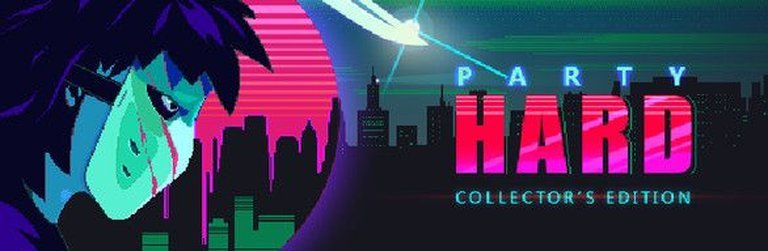
Party Hard’s world is a collection of American party archetypes rendered in a deliberate, Retraux pixel art style. The visual design channels an 8-bit console aesthetic, but with a modern, grimy polish. The color palette is washed out, dominated by sickly neon pinks, purples, and night-time blues, creating a sleazy, synthwave atmosphere that perfectly complements the dark comedy. The sprite work is functional and clear—it’s easy to read the game state at a glance, a critical feature for a title about spatial awareness.
Where the art truly shines is in its lighting and environmental storytelling. The glow of dance floors, the flicker of fluorescent lights in a suburban BBQ, the stark neon of a casino—these elements create mood and define spaces. The settings are not just backdrops but active participants: the burning cruise ship, the sinking party bus (After Party DLC), the vampire castle. They each have a unique set of traps and layout quirks that fundamentally change player strategy.
The sound design is equally iconic. The chiptune-inspired soundtrack, composed by Ressa Schwarzwald, consists of short, catchy, infinitely looping electronic dance tracks. They are perfectly serviceable as party music but are intentionally grating over long periods, reinforcing the game’s theme of obnoxious noise. One track famously features a distorted voice belching “DUBSTEP” at random intervals, a peak of the game’s self-aware, meme-friendly humor. The sound effects—screams, bounces, police radios—are sharp and provide crucial audio cues. However, as noted by reviewers, the limited sound library can become repetitive, leading some to mute the game after hours of play.
Reception & Legacy: From Mixed Reviews to Cult Staple
Party Hard’s launch reception was polarized but generally positive. On Metacritic, it holds scores of 64 (PC), 65 (PS4), 51 (Xbox One), and a higher 75 (Nintendo Switch). Critics praised its clever premise, addictive “one more round” gameplay, and effective retro style. Destructoid (6/10) and GameSpot (7/10) acknowledged its fun but noted repetitiveness. More negative reviews, like GameCritics’ 20/100, slammed the randomization as fundamentally unfair androbbing the game of meaningful skill progression.
This critical contrast is stark when compared to its player reception, which is overwhelmingly positive. On Steam, it boasts a “Very Positive” rating with over 12,000 reviews and a Player Score of 90/100. This massive disconnect highlights a key truth: Party Hard is a cult game whose appeal is experiential, not intellectual. Players embraced the chaotic fun, the satisfaction of perfect trap setups, and the hilarious absurdity of the premise. Its Steam charts show remarkably stable, even growing, player counts years after release, bolstered by updates, a level editor, and the DLC.
Its legacy is multifaceted:
1. Streaming & Interactive Media Pioneer: Its native Twitch integration, letting viewers trigger events like SWAT raids or sharknados, was ahead of its time. It understood the appeal of shared, chaotic spectator experiences before platforms like Twitch Plays Pokémon had fully saturated the zeitgeist.
2. Indie Design Touchstone: It joined the ranks of games like Hotline Miami and Super Meat Boy in proving that tight, challenging mechanics wrapped in a distinctive retro aesthetic could find a massive audience. Its “villain protagonist” stealth formula influenced smaller titles exploring anti-heroic play.
3. Community & Longevity: The in-game level editor, added in April 2016, was a watershed. It transformed the game from a finite 12-level campaign into an endless platform. The community created thousands of levels, from brutal challenges to vaporwave-themed aesthetic showcases, extending its lifespan indefinitely. This model of supporting a game with user-generated content became a standard for indie longevity.
4. Series Provenance: It spawned a direct, improved sequel (Party Hard 2), a discontinued tycoon spin-off (Party Hard Tycoon), and multiple DLCs, establishing a recognizable, if niche, franchise for tinyBuild.
Conclusion: The Unkillable Party
Party Hard: Collector’s Edition is more than the sum of its provocative parts. It is a masterclass in distilling a simple, controversial fantasy into a deep, systemic game of patience, planning, and opportunistic chaos. Its brilliant character unlock system reframes the entire campaign, offering new lenses on the same maps. Its narrative, a lurid pulp story revealed as a psychological horror, elevates it from a mere action title to a story with something to say about duality and repressed violence. While its randomization can frustrate and its audio can grate, its core loop—the tense, silent stalking of a crowded room, the crisp satisfaction of a perfectly triggered trap—remains potent.
The Collector’s Edition package is the ideal way to experience this piece of gaming history. It bundles the core revelation of the Party Hard Killings with the vigilante redemption arc of High Crimes and the tonal shift of Dark Castle, all backed by a polished soundtrack. In the grand tapestry of video game history, Party Hard will not be remembered for its graphical fidelity or its innovation in storytelling alone. It will be remembered as the game that asked, with a straight face and a pixelated knife, “What if murder was the only solution to bad neighbors?” and then, against all odds, built a compelling, re-playable, and strangely thoughtful game around that answer. It is a testament to the idea that even the most dubious premise can birth a classic, provided the mechanics are tight, the theme is committed, and the community is engaged. The party may be over, but the killing—and the playing—never really ends.