
- Release Year: 2005
- Platforms: Browser, Windows
- Developer: Simon Tatham
- Genre: Puzzle
- Perspective: Top-down
- Game Mode: Single-player
- Gameplay: Logic puzzle, Map coloring
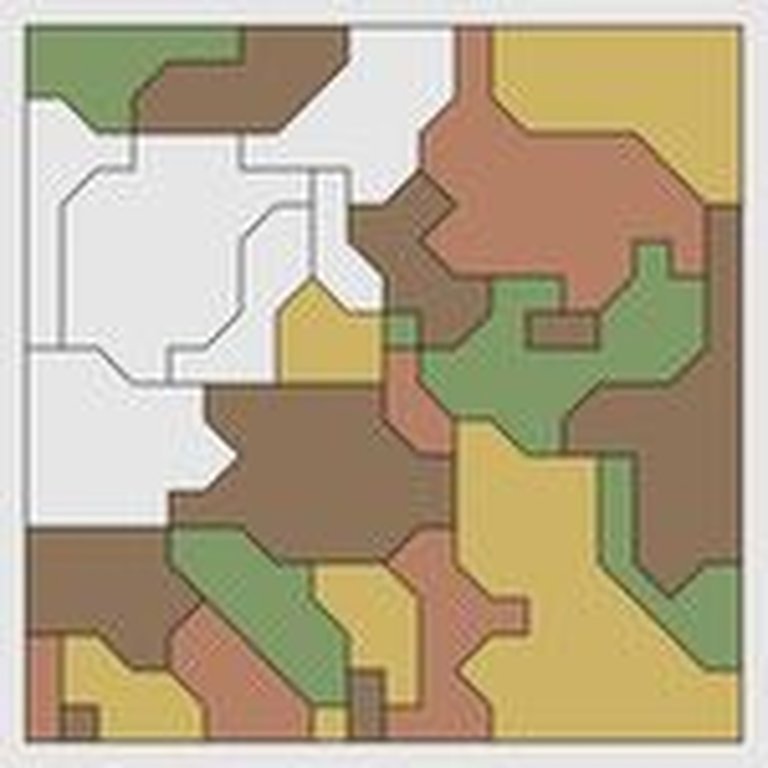
Description
Map is a freeware puzzle game developed by Simon Tatham and released in 2005 as part of his Portable Puzzle Collection. Players must color each region of a map using exactly four colors, ensuring that no two adjacent regions share the same color, based on the mathematical four-color theorem. The game offers flexibility with customizable map sizes and region counts, providing an accessible yet challenging experience in graph theory and logic.
Map: A Review
Introduction: The Elegance of a Constraint
In an era dominated by cinematic narratives, open-world sprawl, and ever-expanding skill trees, the 2005 release of Map by Simon Tatham stands as a profound and deliberate act of subtraction. It is not a game of spectacle but of contemplation; not of discovery but of deduction. At its core, Map asks a single, brutally simple question: can you color this map using only four colors so that no two adjacent regions share a hue? This is the Four Color Theorem, a fundamental problem in graph theory, transformed into a pure, endless puzzle. Its legacy is not one of chart-topping sales or cultural saturation, but of being a perfect, distilled artifact of a specific design philosophy: that constraint breeds creativity, and that elegance can be found in the most minimalist of interactions. This review will argue that Map is not merely a puzzle game but a conceptual sculpture, a digital ur-puzzle whose significance lies in its historical position at the intersection of academic mathematics, the burgeoning indie scene, and the puzzle genre’s evolution.
Development History & Context: The Portable Puzzle Ethos
Map was developed by Simon Tatham, a British programmer, and released as part of his Portable Puzzle Collection on August 13, 2005. Tatham’s project was, from the outset, an exercise in accessibility and portability. Written in C using the Simple DirectMedia Layer (SDL), the collection was designed to run on virtually any system—Windows, Linux, macOS—and later even on web browsers via JavaScript or native ports. This cross-platform, open-source ethos was a direct counterpoint to the closed, hardware-specific ecosystems of the seventh-generation consoles (Xbox 360, PS3) that launched in 2005. While the industry was captivated by the graphical fidelity of Resident Evil 4, God of War, and Shadow of the Colossus, Tatham was focused on the timelessness of logic.
The game’s genesis is credited to a suggestion from Owen Dunn, with intellectual lineage traced through Nikoli (the Japanese publisher famous for Sudoku) and Verity Allan‘s insights. This places Map within a grand tradition of paper-and-pencil puzzles being meticulously translated to the digital realm. The technological constraints of 2005—the very year the Xbox 360 debuted with its dashboard of slick media options—were irrelevant to Map. Its graphics are ASCII-art or simple geometric tiles; its sound is optional clicks. It required no powerful GPU, only a functional CPU and a mouse. In this context, Map was a quiet, stubborn outlier: a game that ran on a potato and demanded nothing but thought, embodying the “portable” in its series title with solemn dedication.
Narrative & Thematic Deep Dive: The Absence of Story as Story
Map possesses no narrative, no characters, no dialogue, and no explicit themes in the conventional sense. To analyze it through this lens requires a shift in perspective. The “story” of Map is the progression of the player’s own cognitive journey. The “themes” are the mathematical and philosophical principles embedded in its mechanics:
- The Triumph of Pure Logic: The game is a pure interface with a mathematical truth. The Four Color Theorem, proven in 1976 with computer assistance, posits that four colors suffice to color any planar map. Map makes this theorem tangible. The player is not discovering a story but verifying a law of mathematics through iterative application. Each successful coloring is a personal, hands-on proof of a profound truth about connectivity and separation.
- The Aesthetic of Minimalism: The absence of narrative framing forces a focus on form and function. The regions are abstract shapes, often reminiscent of territories, islands, or simply topological blobs. The four colors (typically red, green, yellow, blue) have no assigned meaning. This neutrality strips away all cultural or associative baggage, reducing the act of coloring to a sterile, almost scientific process. The “world” is a graph, and the “art” is the clean, unambiguous partition of that graph.
- Infinite Play and the Zen of Completion: There is no “game over,” no fail state in the traditional sense (you can always backtrack and try again). The satisfaction is not in overcoming a villain but in achieving a state of global, non-contiguous harmony. The player sets the size and complexity, creating their own mountain to climb. This frames play as a meditative, self-directed exercise—a digital mandala of logic that one fills in, section by section, until the entire form is resolved and平静 (calm).
Thus, while it lacks a plot, Map is deeply thematic. It is a game about order from chaos, solution from possibility, and the beauty of a system perfectly satisfied.
Gameplay Mechanics & Systems: The Engine of Deduction
The gameplay loop is brutally simple, yet its depth is nearly bottomless:
- Core Loop: The player is presented with a top-down, fixed-screen map divided into contiguous regions (countries, states, etc.). Using the mouse, they click a region to assign it one of four colors. The primary constraint is that no two regions sharing a border (an edge, not just a point) may have the same color.
- Key Mechanic – The Dot System: This is the game’s singular innovation and the key to its solvability and enjoyability. Right-clicking (or a toggle) allows the player to place small colored dots inside a region. This acts as a private “scratchpad” or notation system, marking which colors are still possible for that region given the current assignments. A region without dots must still be assigned; a region with three red dots means red is forbidden there. This system externalizes the player’s working memory, transforming the puzzle from a daunting global problem into a series of local, logical deductions.
- Customization & Variables: The player has complete control over the puzzle’s parameters. They can generate maps of arbitrary size (from tiny 4-region maps to sprawling 100+ region monstrosities) and with varying degrees of connectivity (from simple, distinct blobs to complex, interlocking shapes). This is the game’s “infinite” replayability. The difficulty is entirely player-determined.
- UI and Interaction: The interface is the pinnacle of function over form. Left-click colors, right-click dots. There is a “check” button to verify the solution, an “undo” function, and a “hint” system (which, in purist terms, slightly undermines the self-contained deduction but aids frustrated players). The UI is invisible; it does not obstruct. It is a direct neural link between the player’s deductive reasoning and the game’s logical state.
- Innovation & Flaws: The innovation is the dot-system as a cognitive tool. It is flawlessly integrated. There are no significant mechanical flaws. The only potential “flaw” is the game’s utter lack of guidance or progression curve. A newcomer to graph theory is dumped into the deep end. This is not a bug but a feature of its pure intent; it expects the player to educate themselves through play. The absence of a scoring system, timer, or move counter is intentional, refusing to gamify the experience with external pressure.
World-Building, Art & Sound: The Architecture of Nothingness
Here, Map makes a statement through radical absence.
- Setting & Atmosphere: There is no setting. The “world” is a purely topological entity. It has no geography, no climate, no history. It could represent a continent, a factory floor, a neural network, or abstract fiction. This universal abstraction is its power. The atmosphere is one of silent, focused contemplation. The only “environment” is the player’s own mental space.
- Visual Direction: The art is functional ASCII or simple solid-color polygons on a stark background. In the original Windows version, it is often black-and-white or low-color, with regions outlined in black and colors filled in flatly. There is no shading, no texture, no animation. This is not a limitation of 2005 indie development; it is a design philosophy. Visual complexity would distract from the logical core. The art serves one purpose: to clearly delineate regions and communicate state (colored vs. uncolored, possible vs. impossible). It is the visual equivalent of a clean sheet of graph paper.
- Sound Design: Sound is entirely optional and minimal. Typically, it consists of simple, satisfying clicks or beeps for color assignment and dot placement. There is no music, no ambient sound. The soundscape is as sparse as the visuals, reinforcing the quiet, cerebral mood. The player is alone with their thoughts and the soft report of a solution being set in place.
Collectively, these elements create an experience of extractive minimalism. Every ounce of development effort appears to have been poured into the integrity of the puzzle logic and the dot-system interface. Nothing extraneous remains. It is the Platonic ideal of a map-coloring game.
Reception & Legacy: The Quiet Giant
Map’s reception at launch was, by commercial standards, nonexistent. It was a free, niche puzzle in a sea of commercial releases. MobyGames records it as having a mere 2 player ratings (averaging a mediocre 2.0/5) and 0 critic reviews. This low profile is not a mark of failure but of its nature. It was never meant for the mainstream. It circulated in academic circles, puzzle enthusiast forums, and among fans of Tatham’s other excellent puzzles (like Mines, Net, Pattern, and Slant). Its “distribution” was primarily through Tatham’s website and bundled in the Portable Puzzle Collection.
Its legacy is intellectual and design-oriented, not cultural:
- Preservation of a Mathematical Theorem: It serves as the most accessible, interactive digital artifact of the Four Color Theorem. For students and enthusiasts, it is a hands-on demonstration far more engaging than a textbook proof.
- Influence on the “Pure Puzzle” Genre: It stands as a high-water mark for the “pure logic puzzle” genre, alongside titles like Namari no Uta (which also involves regional coloring) and the work of developers like Zachtronics (e.g., TIS-100, Shenzhen I/O), who champion system purity over narrative dressing. It proves that a game can be about one thing, and one thing only, and still be a complete, rewarding experience.
- The Indie Prototype: Long before Steam Early Access and itch.io saturated the market with minimalist experiments, Map demonstrated that a single, elegantly executed mechanic could be a complete game. Its code is open-source, a testament to a philosophy of sharing and preservation. It is a touchstone for designers considering how to strip a game concept to its bare essence.
- Historical Context of 2005: In a year defined by the launch of the Xbox 360, the rise of mobile gaming (Nintendo DS, PSP), and blockbuster sequels, Map is a fascinating counter-narrative. It represents the persistent undercurrent of PC and independent development focused on brains over brawn, on timeless ideas over technological showcase. While the industry raced forward, Tatham looked steadfastly at a 29-year-old mathematical problem and found endless play within it.
Conclusion: The Unchanging Game
Final Verdict: Map is not a great game in the conventional sense of the word. It is a great object—a perfect, self-contained intellectual toy. Its score on any scale measuring graphics, story, or sound would be zero. But on a scale measuring conceptual purity, mechanical elegance, and philosophical consistency, it is a 10/10 masterpiece.
Its place in video game history is not on a shelf of “best-selling” or “most-influential” in a broad sense. Instead, it occupies a special wing dedicated to conceptual clarity. It is a museum piece for the “Art of Game Design,” a silent argument that a game’s worth can be measured in the elegance of its rules and the depth of its deductive space. It is immune to the ravages of time because it has no assets to degrade; its code and its logic are as fresh today as they were in 2005.
For the historian, Map is a vital data point: proof that the “puzzle” genre was not stagnant in the mid-2000s but was undergoing a quiet renaissance of minimalist design on PC. For the player, it is a lifetime subscription to a single, infinitely variable logic problem. It asks for nothing but your attention and offers nothing but the profound, quiet satisfaction of a mind perfectly aligned with a system, coloring within the lines that define the very nature of planar separation. Map is, in the end, a map to nowhere and everywhere: a guide to the interior landscape of your own reasoning. It is, and will likely remain, perfect.