
- Release Year: 2000
- Platforms: Windows
- Publisher: Electronic Arts, Inc.
- Genre: Compilation
- Game Mode: LAN, Online PVP
- Setting: Civil war
- Average Score: 90/100
Description
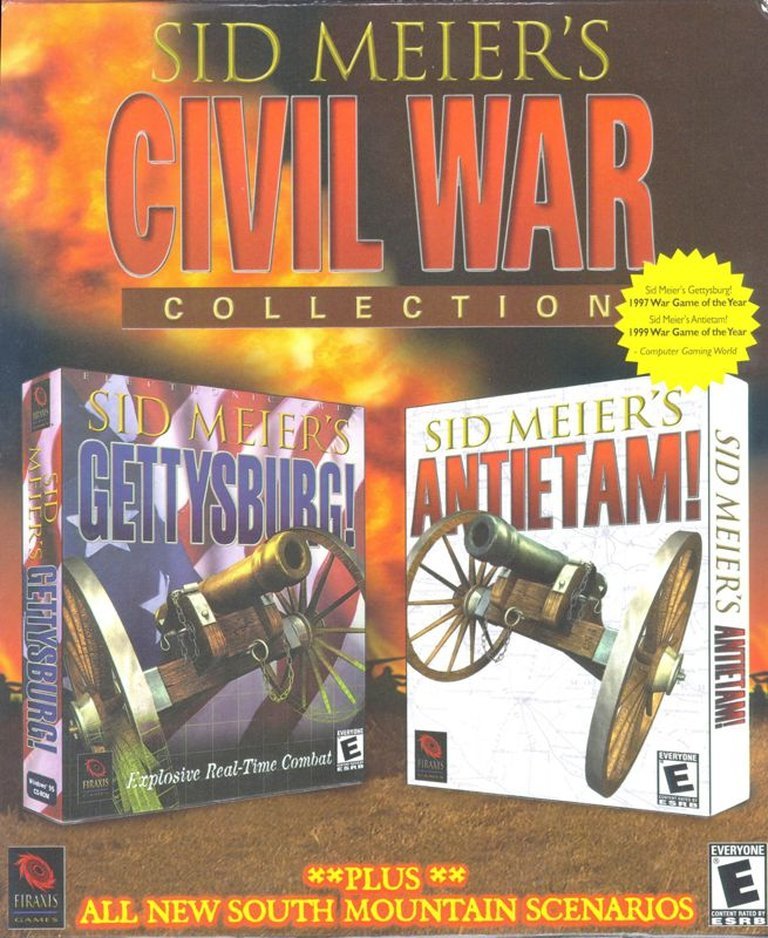
Sid Meier’s Civil War Collection is a compilation bundle released in 2000 that includes Sid Meier’s Gettysburg! (1997) and Sid Meier’s Antietam! (1999), two strategy games set during the American Civil War. The collection represents the culmination of Sid Meier’s decade-long effort to develop a Civil War title, shifting from a grand strategy concept to focused tactical battles, allowing players to engage in historically inspired conflicts with deep strategic gameplay.
Sid Meier’s Civil War Collection Free Download
Sid Meier’s Civil War Collection Patches & Updates
Sid Meier’s Civil War Collection Reviews & Reception
homeoftheunderdogs.net (90/100): Civil War Collection is a superb compilation that includes Sid Meier’s Gettysburg! and Sid Meier’s Antietam!, two excellent real-time wargames from a master of the strategy genre.
metacritic.com (90/100): The pinnacle of historical wargaming, “Sid Meier’s Civil War Collection” brings the greatest Civil War in history to your screen and even better you take charge of the events that will unfold.
Sid Meier’s Civil War Collection: Review
Introduction: The Dream of a Decade, Realized in Two Battles
To understand Sid Meier’s Civil War Collection is to understand a ghost. The legend, as preserved in MobyGames’ crucial trivia entry, tells of a game announced in the early 1990s, shortly after the seismic success of Civilization. This was to be “Sid Meier’s Civil War”—the grand, sweeping, nation-spanning simulation of the entire American conflict. Pre-orders were taken. The gaming press buzzed. Then, silence. The project succumbed to the immense scope that had likely daunted even Meier, a designer who famously championed “fun” over unmanageable scale. The ghost lingered for nearly a decade until, in the late 1990s, Firaxis Games—the studio Meier co-founded after leaving MicroProse—exorcised it not with one game, but with two. The Civil War Collection (2000), bundling 1997’s Sid Meier’s Gettysburg! and 1999’s Sid Meier’s Antietam! (plus the South Mountain expansion), is that ghost made manifest. It is not the grand strategy epic once envisioned, but the concentrated, tactical essence of what that dream became. This review will argue that the Collection represents a pivotal, if imperfect, milestone in historical wargaming: a title that successfully translated the brutal complexity of Civil War combat into an accessible, real-time tactical system without sacrificing depth, and in doing so, established a template for “accessible hardcore” strategy that would influence Firaxis’s own future and the broader genre. Its legacy is two-fold: as the refined culmination of a decade-long personal project for Meier, and as a bundle that, despite its compilation nature and some notable omissions, remains a uniquely vivid and playable entry point into the operational history of America’s defining conflict.
Development History & Context: From Grand Ambition to Tactical Focus
The origin story of this collection is its most fascinating historical footnote. Sid Meier’s fascination with the American Civil War dates back to the early 1990s. As chronicled in the MobyGames entry, media reports covered the development of a full-scale “Sid Meier’s Civil War,” and mail-order sellers accepted pre-orders. The project’s collapse was likely due to the same insurmountable design challenge that has plagued many a grand-strategy wargame: simulating the political, economic, and military dimensions of a four-year war across a continent is a Herculean task, especially with the technology of the early 1990s. The cognitive load on the player, and the processing demands on the system, would have been astronomical.
Meier’s pivot was decisive and brilliant. Instead of the “big picture,” he focused on the “small picture”—the individual battle. This shift from strategic to operational-tactical scale was a perfect match for Firaxis’s capabilities and design philosophy in the late 1990s. The technological context is key: the late ’90s saw the rise of accessible 3D acceleration (with 3dfx Voodoo cards leading the charge) and more powerful CPUs capable of real-time simulation of numerous unit entities. Gettysburg! (1997) and Antietam! (1999) leveraged this to create what were then stunningly animated battlefields. They moved away from the sterile, hex-based, turn-only wargames of the past (like SSI’s Civil War series) toward a real-time-with-pause (RTwP) system where regiments of men visibly marched, deployed, and fired.
The gaming landscape was ripe for this. The late ’90s was a golden age for deep strategy titles, but many historical wargames remained niche due to complex interfaces and steep learning curves. Firaxis, with Sid Meier’s Gettysburg!, aimed to bridge the gap between the simulation purist and the curious newcomer. The 2000 Collection, then, was not a new development but a savvy repackaging by Electronic Arts, Firaxis’s publisher. It bundled the two flagship tactical titles with the South Mountain campaign (a digital-only expansion for Antietam!) and crucial compatibility patches for newer Windows OSes. This timing placed it in a market alongside other Civil War titles like the solid but more traditional Wargame Construction Set III: Age of Rifles (1996) and the ambitious but flawed American Civil War: From Sumter to Appomattox (1999). The Collection distinguished itself by prioritizing visceral, animated engagement over spreadsheet management.
Narrative & Thematic Deep Dive: History as a Sandbox
It is a critical point that Sid Meier’s Civil War Collection has no traditional narrative. There is no linear story, no protagonist arc, no scripted plot. Its narrative is historical and emergent, delivered through three primary channels: the scenario framework, the pre-battle vignettes, and the gameplay itself.
1. The Scenario as Narrative Unit: Each battle is a self-contained story. The Collection offers hundreds of scenarios, from the massive, multi-day campaigns of Gettysburg or Antietam to tiny skirmishes involving a few companies. The “story” of a given playthrough is written by the player. Will you, as Lee, replicate Longstreet’s controversial assault on the third day at Gettysburg, or will you execute a daring flanking maneuver against the Union right? The freedom to explore “what-if” scenarios—”what if Stonewall Jackson had been at Gettysburg?” or “what if McClellan had attacked Lee at Antietam with his full force?”—is a core thematic pillar. It transforms players from passive observers into active participants in historical speculation, grappling with the fog of war and the weight of command decisions.
2. The “You Are There” Vignettes (and Their Absence): This is where a critical divergence between the two main games emerges, as perfectly articulated in the Home of the Underdogs review. Sid Meier’s Gettysburg! features a groundbreaking (for wargames) “General’s Briefing” system. Before each scenario in the historical campaign, an actor portraying the relevant general (e.g., a leonine Lee, a grim Meade) stands before a map, pointing out terrain, stating objectives, and sometimes offering branching choices. You might be given the option to accept command of additional units at a “points penalty” (a fascinating meta-game resource), or to decline an attack on a specific hill. These vignettes directly link the outcome of one scenario to the setup of the next. Win or lose, your choices carry forward, creating a branching, personalized narrative of the battle. This is a masterstroke of thematic integration, making the player feel the pressure and responsibility of command.
Antietam, and by extension the South Mountain campaign, lacks this system entirely. The review notes this omission sharply: “That masterstroke is missing from Antietam and its sequel.” The narrative becomes more detached, more purely tactical. You are presented with a map and an order of battle, but the dramatic, theatrical “hand-off” from one chapter to the next is gone. This is a significant regression in narrative cohesion and emotional engagement, making Antietam feel more like a standalone set of exercises and less like an unfolding epic. The theme shifts from “Your command is a story” to “Here is a puzzle to solve.”
3. Emergent Drama and the “Faulknerian Dream”: The Underdogs review’s closing line is profound: Meier’s games are “the most likely to fulfill that Faulknerian dream so vital to Civil War gamers.” This references William Faulkner’s idea that the past is not dead and gone but alive and present, a burden and a source of identity. The Collection achieves this through its sheer, granular animation. When you zoom in to the tightest view, you see individual soldiers loading, firing, falling. You see flags flutter and break. You hear the crackle of musketry and the roar of cannons. The human cost becomes viscerally apparent. The emergent moments—a brigade holding a critical ridge against impossible odds, a cavalry charge shattering a wavering line, a sudden rout cascading through your own ranks—create personal stories that echo the grand history. The theme is not just about the Civil War; it feels like the Civil War, with all its terror, confusion, and bravery.
Gameplay Mechanics & Systems: The Engine of Tactical Brilliance
The core of the collection’s enduring appeal lies in its deceptively deep real-time tactical system, first perfected in Gettysburg! and refined in Antietam!.
Core Loop & Command Structure: The player commands at the brigade level. Each brigade is composed of 2-5 regiments (infantry, cavalry, artillery). The hierarchy is clean: you select a brigade commander, who then issues orders to his constituent regiments. This creates a wonderful simplification that prevents overwhelming micromanagement. You don’t command every company; you command the colonel or brigadier general who commands them. Orders are given via a point-based system. Each unit has a pool of “Action Points” (APs) per turn (which are consumed in real-time, but can be paused). Moving, firing, reloading, and forming defensive lines all cost APs. This creates a constant, tense resource management puzzle: do I move my infantry to that woods for cover, costing APs I might need to fire, or do I let them be exposed but ready to volley?
The Holy Trinity: Morale, Fatigue, and Terrain: This is where the simulation depth shines. The system is built on three interdependent pillars:
* Morale: The single most critical stat. Morale degrades from casualties, being under fire, friendly units routing nearby, and prolonged combat. Low morale causes units to retreat or, at worst, break and surrender entirely. Boosting morale is key: victorious units regain it, as do units in secure positions (like behind a stone wall or in a forest). The visual and audio cues for morale—the wavering flag, the sound of panicked shouts—are clear and dramatic.
* Fatigue: Units tire from movement and combat. Fatigued units move slower, reload slower, and are more susceptible to morale loss. Managing the ebb and flow of units, keeping some in reserve, and allowing others to rest is vital for sustained offensives or defenses.
* Terrain: The 3D battlefield is not just for show. Every hill, wood, cornfield, and fence line has a tangible effect. Woods provide cover (defensive bonus) but slow movement. Hills grant elevation advantages (increased range and damage) but are costly to assault. Fences are obstacles that break formations. Rivers are nearly impassable except at fords/bridges, turning them into deadly chokepoints. Understanding and manipulating terrain is the essence of winning a battle.
UI, Zoom, and Pacing: The interface is a landmark of clarity for its time. The top-down, isometric view can be zoomed from a strategic “big picture” showing regiments as colored dots, down to a dramatic close-up where you can see individual soldiers loading and firing. This zoom functionality is not just a gimmick; it’s core to the experience. The “big picture” is for maneuver; the close-up is for savoring the tactical moment and assessing precise unit conditions. Game speed is fully tunable, from a slow, contemplative crawl to a “turbo” setting for rapid movement across the map. This flexibility allows players to set their own pace, pausing frequently to issue orders or letting the battle unfold in semi-real time.
Innovations and Flaws:
* Innovations: The seamless blending of real-time movement with pause-based tactical control was innovative. The visual fidelity of unit animations and the clear graphical communication of unit status (wounded men limping, flags drooping) was ahead of its time. The scenario editor, mentioned in the Retro Replay source, was a powerful tool that fostered a massive custom scenario community, extending the game’s life indefinitely.
* Flaws: The Collection as a bundle exposes a key flaw in Antietam’s design: the “big map” option for the entire Antietam battlefield, while ambitious, is often cited as “unwieldy” (Underdogs). Managing dozens of brigades across a sprawling map in real-time can become a logistical nightmare. Furthermore, the removal of the Gettysburg! campaign’s dramatic linkages is a profound narrative and mechanical loss, making the Antietam campaign feel like a disconnected series of battles rather than a cohesive story.
World-Building, Art & Sound: Painting the Bloody Fields
The games’ world-building is a masterclass in functional, period-accurate aesthetics that serve gameplay over realism.
Visual Direction & Setting: The battles are rendered in an isometric 3D engine using pre-rendered sprites and terrain tiles. While primitive by modern standards, the art direction is clear and evocative. The maps themselves are the stars. They are historically based on the actual topography, thanks to research using sources like Ezra A. Carman’s maps (as noted for Antietam). You don’t just fight on generic hills; you fight on Cemetery Ridge, Little Round Top, Burnside’s Bridge, the Sunken Road (“Bloody Lane”). The terrain types are distinct and readable: the dark green of the woods, the golden yellow of the wheat fields, the grey stone of the walls. This graphical clarity is paramount; you must instantly recognize advantageous ground.
Unit sprites are small but detailed. You can distinguish between line infantry, sharpshooters, and zouaves by their uniforms. Artillery pieces are clearly limbered or unlimbered. The animations—the rhythmic motion of a marching column, the puff of smoke from a volley, the chaotic scramble of a routed unit—add immense life and chaos to the battlefield. The “close zoom” view, while not necessary for gameplay, delivers the “Faulknerian dream” by making the conflict personal.
Sound Design: The soundscape is sparse but period-perfect and critically informative. The sounds of bugle calls (assembly, charge, recall) and drum rolls are not just atmosphere; they are gameplay cues. A “Cease Fire” bugle call means your unit has run out of ammunition. A “Charge” call means an enemy brigade is about to assault. The crack of musket volleys, the boom of cannons, and the screams of the wounded create a soundscape of violence that is never overwhelming but always present. The music is minimal, mostly swelling orchestral pieces for the opening movies and brief, tense drums during scenarios. The design trusts the natural sounds of the battlefield to immerse the player.
Together, these elements don’t create a photorealistic world, but a legible one. Every visual and auditory cue has a gameplay meaning, creating a tight loop between perception and decision that is the hallmark of excellent strategy game design.
Reception & Legacy: A Quiet Masterpiece
The contemporary critical reception of the Collection itself is nearly non-existent, a common fate for compilations. MobyGames shows a mere two user ratings averaging 3.2/5, and Metacritic has no critic or sufficient user scores listed. This suggests it was viewed as a value re-release rather than a new title. The real reception is in the retrospective, community-driven assessment.
Home of the Underdogs, a canonical source for classic game curation, rates the compilation (primarily for Gettysburg! and Antietam!) a stellar 9.01 out of 10 based on 81 votes. Their in-depth review praises the games as “superb,” highlighting the “real-time action, bold animations and brash sounds” and their status as the pinnacle of Civil War wargames for fulfilling the “Faulknerian dream.” The review’s critique about the missing campaign linkages in Antietam is the only significant flaw noted by this ardent advocate.
The Collection‘s commercial performance is opaque, but its longevity is proven by its continued presence on abandonware sites (My Abandonware, Internet Archive), its inclusion in later EA bundles like The Conqueror’s Collection (2004), and the active modding community that creates high-resolution texture packs, as mentioned by Retro Replay. Its legacy is multi-layered:
- On Wargame Design: It proved that deep, historical tactical simulations could have mainstream appeal through intuitive interfaces, real-time pacing, and spectacular battlefield choreography. It prioritized visualization and immediate feedback over abstract numbers. This directly influenced Firaxis’s later tactical masterpiece, XCOM: Enemy Unknown (2012), which shares the same design DNA: a clear isometric view, impactful animations, simple stats with deep interactions, and a “one more turn” compulsion.
- On the Civil War Gaming Genre: For a generation, these were the definitive visual representations of Civil War battles. They moved the genre forward from the turn-based, hex-and-counter paradigm. While later titles like Take Command: Bull Run or the Total War series’ Shogun 2/Fall of the Samurai would expand on tactical realism and campaign integration, Gettysburg! and Antietam! remained benchmarks for pure, focused tactical combat on Civil War terrain for years.
- On Sid Meier’s Career: The collection represents the final, mature expression of Meier’s early-90s aborted dream. It shows his willingness to scale back scope to achieve excellence in a specific domain. The design lessons here—clean hierarchy, clear visual feedback, the power of “zoom” levels—would permeate all of Firaxis’s future work.
Conclusion: A Flawed Jewel in the Treasury of Wargaming
Sid Meier’s Civil War Collection is not the game Sid Meier originally set out to make a decade prior. That phantom, the grand-strategy epic, remains one of gaming’s great “what-ifs.” But what arrived in its place is something perhaps more valuable: a perfected artifact of a specific, brilliant idea. It is the definitive digital simulation of tactical Civil War combat for its era.
Its strengths are monumental: an intuitive yet profoundly deep real-time tactical system where morale, terrain, and fatigue create endless dramatic tension; a visually communicative battlefield that makes history legible; and a scenario framework that is both historically rigorous and creatively open-ended. The inclusion of South Mountain adds value, even if it shares Antietam’s structural shortcomings.
Its weaknesses are tied to its compilation nature and the iterative development of its components. The absence of Gettysburg!‘s dramatic campaign linkages in Antietam! is a genuine step backward in narrative design, leaving the latter feeling incomplete. The “big map” in Antietam! is often more headache than joy. And as a 2000 release, its graphics and sound are products of their time, requiring tolerance or community mods for modern display.
Ultimately, the Sid Meier’s Civil War Collection earns its place in history not as a flawlessly complete package, but as a vital historical document in two senses. First, it preserves the tangible result of a famous aborted development saga. Second, and more importantly, it is a document of game design philosophy at its most focused. It demonstrates how to build a complex simulation around a simple, elegant core (brigade-level commands in real-time) and then lounge it with layers of emergent depth and historical flavor. For the student of wargame evolution, it is essential. For the Civil War enthusiast, it remains one of the most playable and immersive battlefield experiences available. It is a flawed jewel, to be sure—a rough-cut diamond from a decade of ambition—but its facets still catch the light with remarkable brilliance. It stands as a testament to the idea that sometimes, scaling down your dream is the only way to finally realize it. Verdict: Highly Recommended for strategists and historians, with the caveat that Gettysburg! is the superior, more cohesive experience.