
- Release Year: 2022
- Platforms: Windows
- Publisher: KurokumaSoft
- Developer: KurokumaSoft
- Genre: Action
- Perspective: 1st-person
- Game Mode: Single-player
- Gameplay: Shooter
- Setting: Fantasy
Description
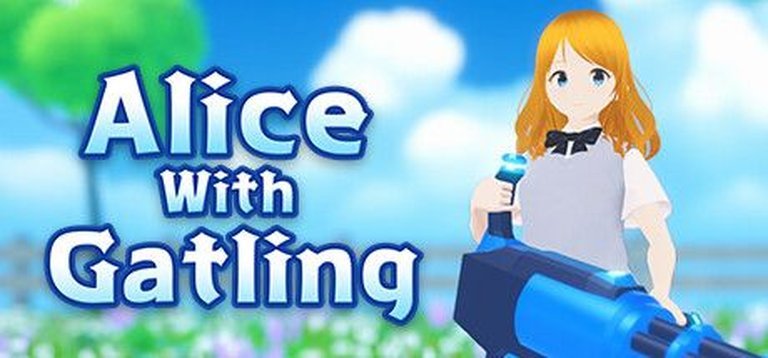
Alice with Gatling is a first-person shooter set in a fantasy anime-inspired world, where players control the cute protagonist Alice as she wielded a customizable Gatling gun to blast through waves of enemies. The game focuses on pure, stress-relieving shooting action with infinite ammo, weapon mods, and companion characters, offering both a casual 16-level story mode and a procedurally generated challenge mode for replayability.
Gameplay Videos
Where to Buy Alice with Gatling
PC
Alice with Gatling Patches & Updates
Alice with Gatling: A Micro-Review of a Macro-Conviction
Introduction: The Specter of Simplicity
In an era where first-person shooters are sprawling, live-service behemoths defined by intricate progression systems, battle passes, and multiplayer ecosystems, Alice with Gatling arrives not with a bang, but with the relentless, deafening roar of a single, modified weapon. Released in November 2022 by the singular entity KurokumaSoft, this game is a deliberate and profound act of reductionism. It is not merely a game; it is a thesis statement in executable form: that the core, primal joy of the FPS genre—the act of aiming, firing, and seeing enemies dispatched—can be isolated, purified, and presented as a complete experience. My thesis is this: Alice with Gatling is a fascinating, if academically sparse, case study in hyper-focused design, a game that achieves its stated goal of “stress relief” through a near-ascetic removal of all traditional FPS baggage, making it a deliberate counterpoint to the genre’s evolution and a curious artifact of indie minimalist philosophy.
Development History & Context: The Solo Developer’s Manifesto
The context of Alice with Gatling is almost entirely contained within its own production details. Developed and published by KurokumaSoft, a one-person studio, the game was built in Unity, the quintessential engine for accessible indie development. The technological constraints were self-imposed: with a tiny 300 MB storage footprint and minimum specs of a 2.0 GHz Dual Core processor and 2GB VRAM, it targets the lowest common denominator of PC gaming, ensuring maximum accessibility. This is not a game pushing graphical fidelity; it is a game designed to run on a potato.
The gaming landscape of late 2022 was dominated by sequels to major franchises (God of War Ragnarök, Elden Ring DLC), the continued rise of deck-builders and roguelikes, and the persistent cloud of post-pandemic industry consolidation. Against this backdrop, Alice with Gatling’s release feels like a quiet protest. Its official description, repeated verbatim across Steam and itch.io, reads less like marketing hype and more like a developer’s pitch to themselves: “No need to do troublesome explorations or difficult actions. Shooting and defeating enemies is what this game is all about.” The vision was one of purity. The name itself, “Alice with Gatling,” immediately evokes the classic American McGee’s Alice series—a dark, psychological horror-action title. This is no accident; it’s a deliberate juxtaposition. Where McGee’s Alice battles her traumatic psyche in a grotesque Wonderland with a vorpal sword and explosive toys, KurokumaSoft’s Alice wields a Gatling gun against generic fantasy monsters in a bright, stylized world. It inverts the expectations set by the “Alice” franchise, trading psychological depth for pure, unadulterated kinetic feedback.
Narrative & Thematic Deep Dive: A Story Told in Level Counts
The narrative of Alice with Gatling is famously, intentionally skeletal. The Story Mode consists of 16 levels where “Alice going to defeat the Demon King.” This is not a plot; it is a destination. There are no cinematics, no elaborate text logs, no character motivations beyond the implied. The only narrative beats exist in the form of “conversations between characters on the way” with your “allies,” as per the store description.
This extreme minimalism forces a thematic reading that is almost entirely inferential. The game’s title and premise position “Alice” as a archetype—the curious, determined girl from Wonderland—but strips away Carroll’s satire and McGee’s trauma. This Alice is an avatar of pure agency. She is not descending into madness; she is advancing with mechanical, unstoppable purpose. The “Demon King” is not a symbol of repressed memory but a generic final boss, a macroscopic target for the Gatling gun’s macro-destruction.
The thematic core, therefore, is not story but process. It aligns with concepts of “flow state” and mindfulness through repetitive, mastery-based action. Each 3-5 minute level is a discrete, contained ritual of violence and release. The absence of exploration, puzzle-solving, or item management transforms the game into a meditative treadmill of destruction. The “allies” who accompany you serve not as narrative devices but as audience surrogates—their presence, and their chatter, validates Alice’s rampage, making it a shared, social act of stress relief rather than a lonely slaughter. The fantasy setting, with its “monsters,” removes any moral or realistic weight from the violence, framing it as a purely ludic catharsis.
Gameplay Mechanics & Systems: The Church of the Gatling
Here, the game’s philosophy is codified into mechanics. The core gameplay loop is a masterclass in focus:
1. Spawn in level.
2. Wield the Gatling gun.
3. Destroy all enemies.
4. Proceed to next arena/level.
That is the entire loop. There is no deviation.
-
The Weapon: The Gatling gun is not just the primary weapon; it is the only weapon. Its modifiability in the “Garage” is the game’s entire progression system. Players can tweak bullet type, rate of fire, accuracy, and reload speed. This is not a skill tree but a pre-loadout optimization. It allows players to tailor the feel of the gun to their preferred rhythm: a slow, high-damage, accurate weapon for deliberate shooting, or a wildly inaccurate but rapid-fire bullet hose for pure sensory overload. The “Infinite Ammo!” feature (with a reload mechanic) eliminates resource management, ensuring the player’s focus never strays from the trigger.
-
Combat & Enemies: Enemies “appear one after another,” typically in waves or in fixed positions within small arenas. Their AI is likely rudimentary—charge, shoot, die. The challenge comes from volume and positioning, not tactical complexity. The game’s entertainment value is directly tied to the player’s ability to handle crowd control with the Gatling’s spin-up time and spread. It’s a test of spatial awareness and trigger discipline, not of strategic planning.
-
Interface & Design: The “Direct control” interface (standard FPS controls) is presented without HUD clutter. No health bars (likely a one-hit kill or very forgiving system), no ammo counter (infinite), no minimap. The HUD presumably shows only the crosshair and perhaps an ally status. This is critical: the screen space is reserved for the enemy and the muzzle flash.
-
Game Modes as Thematic Extremes:
- Story Mode (16 levels): The “casual” experience. It is a curated tour de force, designed to be completed in under an hour total. It teaches the game’s language and delivers its “story.”
- Challenge Mode (Randomly generated): The “severe” experience. Here, the minimalist formula is stress-tested. Randomly generated levels and enemy placements remove the possibility of memorization, forcing pure on-the-fly execution. The ~15 minute duration per run frames it as a high-score chase, a return to the arcade roots of the genre.
The “innovations” are all acts of subtraction. The flaw, if one exists, is that this hyper-focus will be perceived as crushing simplicity by those expecting any form of depth. There is no exploration, no character development, no loot, no narrative choice. It is a game that asks a single, relentless question: “Do you find joy in this specific loop?” If yes, it is perfect. If no, it is barren.
World-Building, Art & Sound: The Aesthetic of Efficient Joy
The “Anime / Manga” art style and “Fantasy” setting are not chosen for deep lore but for instant, frictionless readability. The characters, including Alice, are “cute”—a term used repeatedly in user tags. This aesthetic performs crucial work: it disarms. The violence is cartoonish, the enemies are fantastical, and the protagonist is non-threatening in appearance. This creates a cognitive dissonance that licenses fun. You are not a soldier; you are a magical girl with a rotary cannon, mowing down slimes and goblins. The joy is safe, consequence-free, and whimsical.
The sound design is, by necessity, the star. The roar of the Gatling gun, the chatter of the casings, the pings and splats of impacts—these are the primary sensory feedback loops. The music, not described in sources, is presumably energetic, driving, and repetitive, acting as a metronome for the action. The visual style of “Stylized 3D” allows for clear silhouettes and bright colors, ensuring enemies are always distinguishable from the background at a glance—a practical necessity for a game about rapid target acquisition.
Together, these elements create an atmosphere of pressurized playfulness. It’s the visual and auditory equivalent of a stress ball: satisfying, repetitive, and designed for short bursts of engagement.
Reception & Legacy: The Quietest Launch
The critical and commercial reception of Alice with Gatling is, by all available metrics, a void. Metacritic lists “Critic reviews are not available.” On MobyGames, the Moby Score is “n/a” and the entry itself was only added in mid-2024, over a year after release, by a single contributor, Koterminus. The Steam store page shows only 4 user reviews, all “Positive,” yielding a 100% score on aggregators like Steambase—but this is a statistical sample too small to have meaning. The Steam Community Hub has only one discussion thread (a user sharing gameplay footage).
Its commercial performance is similarly opaque. Priced at a tentative $3.99 (downto $1.59-$1.99 on sale), it exists in the deep catalog of Steam, lost among thousands of similarly priced indie titles. It has no visible press coverage, no notable YouTuber playthroughs in the top search results, and no cultural footprint beyond its own store pages. It is, for all intents and purposes, a ghost in the machine—a game that exists, is playable, and has satisfied the four people who reviewed it, but has registered zero impact on the broader discourse.
Its influence on the industry is therefore non-existent. It has not spawned clones, inspired design talks, or been cited in post-mortems. It is the antithesis of an influential game; it is so focused on its own narrow niche that it aims for no influence at all. Its legacy, if it has one, will be as a curated example in discussions of minimalist game design, a footnote next to games like Soul Dossier or Citizen Sleeper’s “The Love Boat” mini-game—titles that prove you can build a complete, satisfying experience by aggressively paring down interactivity.
Where it does connect is in the long lineage of “Alice” games. The Alice series, from American McGee’s dark psychological horror to the myriad Japanese otome and visual novel adaptations (Taisho x Alice, Haruoto Alice), is defined by its reinterpretation of Carroll’s text. Alice with Gatling is the most radical reinterpretation yet: it discards narrative, psychology, and atmosphere entirely, keeping only the iconography of “Alice” as a brand of peculiarity and applying it to a pure arcade shooter. It suggests “Alice” can be nothing more than a skin for a fundamental gameplay loop, a proposition none of the other games in the franchise would dare make.
Conclusion: A Perfect, Insignificant Gem
Alice with Gatling is not a good game in the conventional critical sense; it lacks the dimensions upon which conventional criticism operates—there is no narrative to analyze, no complex systems to deconstruct, no artistic statement beyond its form. It is, instead, a perfectly realized object.
KurokumaSoft set out to make a game about shooting a Gatling gun as a cute girl to relieve stress. Every system, every asset, every byte serves that singular purpose. Its “flaws”—the lack of a story, the repetitive nature, the basic AI—are its defining features. It is a game with the courage of its convictions, however modest those convictions may be.
Its place in video game history is not as a landmark or a classic, but as a precision instrument. It is a reminder that the vast, intricate edifice of the FPS genre can be reduced to its axiomatic moment: crosshair on target, trigger pulled, feedback received. In an industry obsessed with scale, Alice with Gatling is a quiet testament to the power of the miniature. It is a game that knows exactly what it is, and for the four people who bought it and left a positive review, it was exactly what they needed. For historians, it serves as a pristine data point: the 2022 indie expression of “shoot the bad guys, feel good,” a digital pacifier whose silence in the cultural record is itself its most telling feature.
Final Verdict: As a product, it is a successful and coherent minimalist design. As a historical artifact, it is a fascinatingly blank page in the “Alice” chronicles and a testament to the enduring power of hyper-focused indie development. However, its complete and total lack of reception, discourse, or influence renders it primarily a curiosity—a perfectly executed idea that found an audience of four. It is, in the end, a game that is precisely what it claims to be, and nothing more. In today’s climate, that almost makes it revolutionary.