
- Release Year: 1998
- Platforms: Windows
- Publisher: Interplay Productions, Inc., Taff System
- Developer: Taff System
- Genre: Simulation, Sports
- Perspective: 3rd-person
- Game Mode: Co-op, LAN, Online Co-op, Single-player
- Gameplay: Bait selection, Boat navigation, Fishing, Gallery viewing, Radar tracking, Tournament Mode
- Setting: Ocean, Real world
- Average Score: 83/100
Description
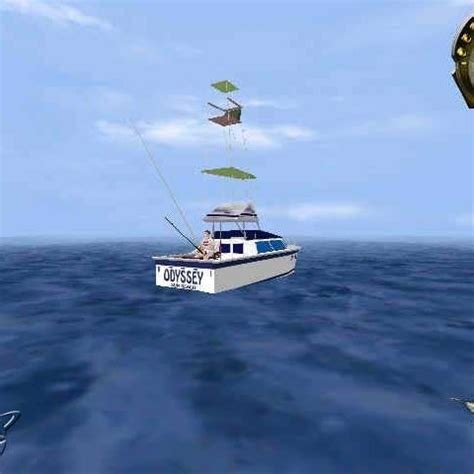
Virtual Deep Sea Fishing is a 1998 3D fishing simulation game that immerses players in deep-sea fishing across 12 global locations, using one of eight unique boats with varying abilities to catch 18 different large fish species, including sharks. Gameplay involves strategic bait selection, boat movement, and rod control to reel in fish, supplemented by tournament modes with time limits and a gallery to view catches.
Gameplay Videos
Virtual Deep Sea Fishing Free Download
Virtual Deep Sea Fishing Reviews & Reception
game-over.net (83/100): VDSF, minus a few bugs seems to be the best fishing game out there today.
Virtual Deep Sea Fishing Cheats & Codes
PC
Start the game by running VDSFishdt.exe instead of the normal shortcut, then press the following keys during gameplay.
| Code | Effect |
|---|---|
| F11 | Force a fish to bite your hook |
| F12 | Automatically catch a fish that bites |
| Forward + Back | The next fish that bites will be a tiger shark |
Virtual Deep Sea Fishing: Review
Introduction: A Niche Pioneer Casts Off
In the crowded waters of late-1990s PC gaming, Virtual Deep Sea Fishing (1998) emerged as an unlikely contender—a Korean-developed deep-sea angling sim that dared to tackle the vast, untamed oceans while most of its competitors remained anchored to freshwater lakes. As the first 3D installment of the Nakksigawang series and the first to receive an international release (via Interplay Entertainment in 1999), it arrived with a quiet ambition: to simulate the thrill of battling trophy marlin, sharks, and tuna in photorealistic open water. While fishing simulations were already a established niche—dominated by Sierra’s Trophy Bass series—Virtual Deep Sea Fishing shifted the focus from serene pond casting to the high-stakes, heart-pounding tug-of-war of big-game fishing. Its legacy is one of bold technical experimentation and regional breakthrough, yet also of frustrating repetition and uneven execution. This review will argue that Virtual Deep Sea Fishing is a compelling but flawed artifact of its time—a game that grasped the core excitement of its sport but struggled to build a fully immersive world around it, leaving a fascinating ripple in the evolution of simulation design.
Development History & Context: From Seoul to the High Seas
Virtual Deep Sea Fishing was crafted by Taff System, a Korean studio relatively unknown in Western markets at the time. The game was the latest entry in the Nakksigawang (meaning “Big Catch Fishing Fanatic”) series, which had previously seen DOS-based 2D iterations like Nakksigawang Special (1996). Under the direction of Project Director Kang-In Choi and Lead Game Designer Young-Soo Kwon, the team set out to leverage the burgeoning power of 3D acceleration (notably 3dfx Voodoo cards) to create a more visually compelling and physically realistic fishing experience. The move to 3D was not merely aesthetic; it was a necessary evolution to convey the scale and dynamism of deep-sea environments and the immense size of the game’s 18 target species, including 1,000+ pound sharks and marlins.
The technological constraints of 1998–1999 were significant. The game required a Pentium 166 MHz processor, 16–32MB of RAM, DirectX 6.0+, and a 3D accelerator for optimal performance—specs that placed it in the mid-to-high-end PC category of the era. Developing for a global audience also meant navigating localization and publishing partnerships. Interplay Productions, a Western publisher known for diverse titles (from Baldur’s Gate to Descent), handled North American distribution, bringing the game to a broader, if skeptical, audience. This East-West collaboration was noteworthy, highlighting the growing internationalization of game development. However, the game’s development cycle appears to have been tightly focused on technical execution over expansive content; with a team of 76 credited members—including dedicated roles for 2D/3D artwork, animation advising, and package design—the effort was substantial, yet the resulting content pool (12 locations, 8 boats, 18 fish) would later be criticized as limited.
In the gaming landscape of 1999, fishing simulations were a small but dedicated genre. Sierra’s Trophy Bass series was the benchmark for freshwater fishing, emphasizing realistic tackle mechanics and lake exploration. Console titles like Sega Bass Fishing (1999) were pioneering dedicated force-feedback controllers. Virtual Deep Sea Fishing entered this arena with a distinct premise: saltwater, big game, and a more “hardcore” simulation of the physical struggle. Yet it faced the perennial challenge of the genre—overcoming the perception that fishing games were passive, geriatric experiences. Its reliance on keyboard/mouse controls (rather than specialized peripherals) and its serious visual presentation aimed to counter that stereotype, but the core question remained: could a virtual fishing trip be as exciting as it claimed?
Narrative & Thematic Deep Dive: The Unspoken Tournament
Unlike story-driven games, Virtual Deep Sea Fishing has no traditional narrative, characters, or dialogue. Instead, it constructs an implied narrative through its Tournament Mode and Gallery system. The player assumes the role of an ambitious angler, progressing from casual trips to high-stakes competitions across 12 global locales (from Kauai to Sydney). The tournament structure—with multi-day events, weight quotas, and species requirements—creates a clear career arc. Briefings and the trophy gallery whisper of rivalries, legendary catches, and the growing reputation of the player-character. This minimalist storytelling taps into the universal angling fantasy: the pursuit of the “big one,” the respect of peers, and the mastery of a dangerous, unpredictable sport.
Thematically, the game explores man versus nature in its purest form. Each catch is a duel of stamina and strategy against a powerful, autonomous creature. The 18 fish species each have distinct behaviors—sharks are aggressive and dogged, marlin are explosive jumpers—forcing the player to adapt. There’s a subtle meditation on patience and preparation; success hinges on choosing the right bait, boat, and positioning, then executing flawless controls during the fight. The serene open-water atmosphere contrasts with the intense, sometimes violent, struggle on the line, mirroring the dual nature of real deep-sea fishing.
However, the thematic depth is undercut by the game’s repetitive environments and lack of ecological simulation. There are no weather changes, day/night cycles, or dynamic fish migration patterns. The ocean feels static, a mere backdrop rather than a living system. This absence of systemic depth prevents the game from probing deeper themes like environmental stewardship or the economics of commercial fishing, keeping the experience firmly in the realm of sport-for-sport’s-sake.
Gameplay Mechanics & Systems: The Tug-of-War Blueprint
At its core, Virtual Deep Sea Fishing is built on a deceptively simple loop: select location and boat → cast line → attract fish via radar/bait/position → engage in a multi-input tug-of-war → catch or lose fish → repeat. The brilliance—and frustration—lies in the execution.
Location and Boat Selection (Pre-Trip): The player chooses from 12 global fishing grounds and 8 boats. Each boat has unique stats—length (stability), beam (maneuverability), and speed—that directly impact gameplay. A faster boat can chase roaming species like tuna, while a wider, more stable vessel is better for wrestling large sharks. This adds a strategic layer before a single cast is made, encouraging players to match their vessel to the target species and location.
The Fishing Loop (On-Water):
1. Casting and Positioning: Casting is done via mouse click. The rod extends, and the bait lands. The player then uses arrow keys to maneuver the boat, guided by a radar that shows fish activity as blips. An underwater camera can be toggled, providing a first-person view beneath the surface to observe fish behavior and lure appeal. This triad of radar, camera, and boat movement is the game’s primary skill ceiling—positioning the boat so the fish approaches the hook requires practice and spatial awareness.
2. The Bite and Fight: When a fish bites, the real test begins. The player must simultaneously control the fishing rod (with the mouse: reeling in, giving slack, applying side-to-side pressure) and the boat (with arrow keys: moving forward/backward to aid or resist the fish’s pulls). Each of the 18 fish species has attributes—strength, appetite, aggression, and preferred depth—that dictate their fighting style. A marlin might make spectacular jumps requiring rapid slack-giving, while a shark trenches stubbornly, demanding constant pressure. The tension is monitored via a line stress meter and critical audio cues (a loud beep signals imminent line breakage). This dual-input system (mouse for rod, keyboard for boat) is the game’s most innovative and demanding mechanic. It successfully simulates the chaotic, full-body effort of reeling in a giant fish, requiring constant micro-adjustments.
3. Modes: The Fishing Trip mode is open-ended, perfect for practice. The Tournament Mode introduces structured challenges with in-game time limits (e.g., “five hours per day”) and specific catch requirements (e.g., “three fish over 500 lbs”) to advance. This adds pressure and long-term goals. The Gallery mode serves as a trophy room, displaying photos and stats of caught fish, providing a tangible record of achievement.
Innovations:
* The seamless integration of boat movement as a core part of the combat system, rather than just a means of transportation.
* The use of an underwater camera to actively influence strategy.
* Focusing exclusively on large, challenging fish, differentiating it from contemporary freshwater sims.
Flaws and Frustrations:
* Casting Lack of Skill: As IGN noted, casting itself offers little nuance—it’s a simple click. The real game begins after the bite, making the initial phase feel passive.
* Post-Cast Movement Limitation: Once the line is in the water, the player cannot recast or significantly adjust the line’s position without reeling in completely, which can spook fish. This can lead to long, frustrating waits.
* Bait Parity: Reviews suggest all 12 bait types function similarly, making this choice largely superficial.
* Repetition: With only 18 fish and 12 locations (many visually identical, per IGN), the gameplay loop can become monotonous. Tournament requirements often feel like variations on “catch big fish.”
* Learning Curve: The dual-control scheme is brilliant but unforgiving. New players will lose countless fish to mis-timed boat movements or incorrect rod manipulation, with little in-game tutorialization beyond the manual.
World-Building, Art & Sound: A Beautiful, Empty Ocean
As the series’ first fully 3D title, Virtual Deep Sea Fishing represented a massive leap visually from its 2D DOS predecessors. The ocean is rendered with dynamic lighting—sunlight glares on rolling swells, and distant horizons fade into atmospheric haze. Water clarity is a standout feature; looking over the side, players can see schools of baitfish and the silhouettes of larger predators in the blue depths, a效果 rarely seen in games of this era. The underwater camera reveals a surprisingly detailed seabed with coral outcrops, sunken wrecks, and varying textures, creating a sense of exploration.
Boat models are well-crafted, with polished metal, functional winches, and deck details that subtly reflect their performance differences. Weather effects (rain, overcast, sun) are present and affect visibility, though they don’t alter gameplay mechanics. The graphical ambition is clear: this was meant to be a showcase for 3D hardware.
However, this beauty is undercut by a critical flaw: environmental repetition. As IGN UK scathingly noted, “the scenery is identical” across all 12 locations. The ocean palette, wave patterns, and skybox change little, if at all. Kauai, Phuket, and Sydney might as well be the same patch of water. This severely undermines the promised “global” adventure and makes the world feel like a large but homogeneous map.
Sound design is functional but sparse. The audio feedback for line tension (the critical beeping) is essential and well-implemented. Ambient sounds—seagulls, wave lapping, boat engine—create a baseline atmosphere. However, repetitive voice clips (“That was beautiful, try again next time!” after a broken line) quickly grate. There is no dynamic soundtrack or evolving commentary to heighten tension during a fight. The soundscape is adequate but not immersive.
Overall, the game presents a technically impressive but artistically shallow ocean. It demonstrates the potential of 3D for fishing sims but lacks the artistic direction or content variety to make the world feel truly vast or diverse.
Reception & Legacy: A Divided Catch
Virtual Deep Sea Fishing received mixed to negative reviews at launch, reflected in its MobyGames critic average of 59%. The divide was stark:
- Praise (Game Over Online: 83%, Sports Gaming Network: 80%) celebrated its excitement and technical achievement. Reviewers emphasized the adrenaline of the fight, calling it “the best one on the market right now” for fishing sims. They praised the 3D graphics and the tactile satisfaction of reeling in a “monster fish.” Game Over Online’s review captured the genre’s plight: “Fishing Games… are stereotyped as for old people… if you just try it out, you may like it. It is very exciting and keeps you involved the entire time.”
- Criticism (IGN UK: 33%, PC Player Germany: 40%) was severe. IGN UK lambasted the graphical repetition, lack of visual hints for fish location, and the “depressing” fishing model due to the passive casting and limited post-cast movement. PC Player’s German review agreed, stating that despite 18 fish species, 13 locations, 12 lures, and 8 boats, “everything looks the same… after an hour you wish the digital designers would get properly seasick in a hurricane.” The consensus among detractors was that the game was technically competent but lacked the engaging variety and systemic depth to sustain interest.
Commercially, the game was a niche title. Its release by Interplay gave it visibility in the West, but it never achieved the sales or cultural footprint of Trophy Bass or Sega Bass Fishing. Its legacy is therefore twofold:
- Regional Milestone: It was the first Korean-developed fishing game to receive a major Western release, paving the way for later titles like Deep Sea Fishing 2 (2001) and highlighting the potential of the Korean game industry in simulation genres.
- Technical Prototype: Its dual-input control scheme and focus on large-game struggle influenced later fishing and “sports” simulations that required coordinated multi-input combat (e.g., some hunting and racing games). However, its failure to resolve environmental repetition and passive elements limited its direct successors.
In the broader history of virtual fishing games (as chronicled by sites like Polson Enterprises), Virtual Deep Sea Fishing sits between the early 2D DOS era and the rise of dedicated force-feedback peripherals (like Radica’s Bass Fishin’ and Sega’s fishing rods). It was a “pure” mouse/keyboard simulation at a time when the industry was moving toward tactile controllers. This made it both an anachronism and a compelling test of whether deep-sea fishing could be exciting without haptic feedback.
Conclusion: A Flawed but Historic Catch
Virtual Deep Sea Fishing is not a great game by conventional metrics. Its world is visually repetitive, its gameplay loop can devolve into mindless repetition, and its lack of dynamic systems leaves the ocean feeling like a decorative painting rather than an ecosystem. Yet, to dismiss it entirely is to overlook its significant—if imperfect—achievements.
It nailed the core thrill of big-game fishing: the White-Knuckle moment when a 1,200-pound black marlin strips line, the frantic dance of giving slack and gaining ground, the triumphant (and often tragic) final reel-in. Its control scheme, while brutal to learn, offered a more physically engaging simulation than many contemporaries. It also took a bold thematic risk by moving the genre from calm lakes to the volatile open sea, injecting a sense of danger and scale that freshwater games couldn’t match.
Historically, it is a fascinating bridge—between Eastern and Western development, between 2D and 3D simulations, and between the passive “Zen” fishing game stereotype and the action-oriented sports sim. For historians, it’s a case study in how a focused, mechanically sound core can be undermined by a lack of content breadth and artistic cohesion. For enthusiasts, it remains a cult classic that delivers unique adrenaline rushes despite its flaws.
Final Verdict: Virtual Deep Sea Fishing is a 7/10—a passionate but uneven experiment. It is essential playing for scholars of simulation design and fans of fishing game history, but its repetitive environments and steep, sometimes unfair, difficulty will likely exhaust modern players. It stands not as a timeless classic, but as a bold, ambitious tide mark: a game that showed the world the visceral excitement of deep-sea fishing in 3D, even if it couldn’t quite make the ocean feel truly endless.