
- Release Year: 1993
- Platforms: DOS, Linux, Macintosh, Windows
- Publisher: 3D Realms Entertainment, Inc., Apogee Software, Ltd., FormGen, Inc.
- Developer: Apogee Software, Ltd.
- Genre: Action
- Perspective: Top-down
- Game Mode: Single-player
- Gameplay: Arcade, Boss fights, Power-ups, Shooter, Vertical scrolling
- Setting: Futuristic, Sci-fi
- Average Score: 83/100
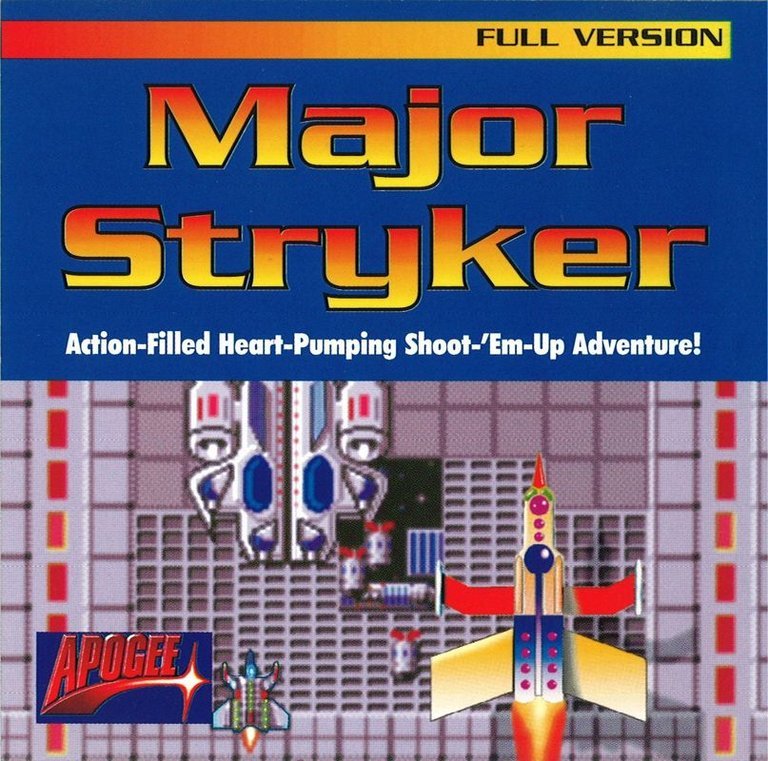
Description
Major Stryker is a sci-fi vertical shoot-’em-up game set in a futuristic universe where players pilot a spaceship to battle waves of Kreton alien enemies, rescue hostages, and defeat bosses in side-scrolling levels. Developed by Apogee Software and featuring EGA graphics, it offers arcade-style action with upgradeable beam weapons, zap bombs, and various power-ups.
Gameplay Videos
Where to Buy Major Stryker
PC
Major Stryker Free Download
Major Stryker Guides & Walkthroughs
Major Stryker Reviews & Reception
store.steampowered.com (83/100): 83% of the 31 user reviews for this game are positive.
vgmpf.com : The game is a competent shooter with lots of enemy ships and turrets to destroy.
Major Stryker Cheats & Codes
PC (DOS)
At the main title screen, type CHEAT. During gameplay, hold Backspace and press H+S to activate cheat mode. While cheat mode is active, hold Tab and press O for Fire Options, R for Rapid Fire, or S for Shield Options. For Tech Support mode, at the title screen hold Tab, press Enter, then type tech while holding Tab.
| Code | Effect |
|---|---|
| CHEAT | Displays ‘Cheat Active’ message (first step of activation) |
| [Backspace]+H+S | Toggles cheat mode on/off during gameplay |
| TAB+O | Fire options |
| TAB+R | Rapid fire |
| TAB+S | Shield options |
| tech | Enables Tech Support mode (requires holding Tab at title screen) |
Major Stryker: Review
Introduction: The Unassuming veteran of the Apogee Arsenal
In the annals of 1990s PC gaming, Apogee Software (later 3D Realms) is a titan, famously birthing Duke Nukem and Wolfenstein 3D. Yet, between the platforming exploits of Commander Keen and the FPS revolution, lies a oft-overlooked title: Major Stryker. Released in January 1993, this vertically scrolling shoot-’em-up represents a fascinating, if flawed, crystallization of its era’s technical constraints and design philosophies. It is a game that embodies the ambitious spirit of the shareware model—delivering a “commercial-level” experience for a tantalizing free taste—while grappling with the inherent limitations of DOS-era EGA graphics and the design tropes of its genre. This review argues that Major Stryker is not merely a historical footnote, but a crucial study in transitional game design: a technically impressive showcase for its time, hampered by repetitive gameplay and uneven difficulty, yet persisting as a cult favorite due to its taut controls, memorable soundtrack, and potent nostalgia. It stands as a testament to Apogee’s experimental breadth and a direct precursor to the more polished Raptor: Call of the Shadows.
Development History & Context: Forging a Shareware Star
The Studio and the Vision: Major Stryker was developed by Apogee Software, Ltd., the Dallas-based studio pioneering the “Apogee model” of episodic shareware distribution. The game was designed and programmed by Allen H. Blum III, with level design and production overseen by George Broussard. The project emerged under the working title “Strike Force” before settling on its final name. According to historical catalogs and trivia, the original vision was far more ambitious, intending to include cameos from other Apogee icons like Commander Keen, Duke Nukem, and Snake Logan. This was ultimately scrapped for a “more original storyline,” a decision that both isolated Stryker from Apogee’s budding universe and forced it to stand on its own thematic legs.
Technological Constraints and Ambitions: The game was built for DOS in 1993, squarely in the twilight of the EGA (Enhanced Graphics Adapter) era. Its most celebrated technical feat was the implementation of “triple-parallax scrolling”—three independent background layers scrolling at different speeds to create a convincing illusion of depth. This was a significant programming achievement on the hardware, pushing the EGA palette to its limits. The audio was handled via the ubiquitous PC speaker and AdLib (Sound Blaster) cards, with music composed by the legendary Robert Prince, whose work for Apogee defined the sound of early ’90s shareware. The game was distributed on 3.5″ and 5.25″ floppy disks, later seeing CD-ROM and, eventually, modern digital re-releases on Steam (2014) and as freeware (2006).
The Gaming Landscape: 1993 was a peak year for the vertical scroller. Games like Raptor: Call of the Shadows (another Apogee title, released later that year) and Xenon 2: Megablast set high bars for graphics and weapon variety. The PC space was crowded with both arcade ports and original titles. Major Stryker entered this fray not as a genre-defining innovator, but as a competent, graphically striking entry aiming to leverage Apogee’s reputation and shareware distribution to capture players’ attention.
Narrative & Thematic Deep Dive: A Sparse, Referential Affair
The plot of Major Stryker is delivered with the minimalist efficiency of a ’70s action movie trailer. After a third world war and a fragile eight-year peace, Earth is invaded by the alien Kreton military. The player assumes the role of Major Harrison Stryker, a veteran of WWIII, tasked with a one-man assault to destroy Kreton bases across three elemental planets: Lava, Arctic, and Desert. Between missions, he receives briefings from the sole other named character, the “attractive, often flirtatious” Fleet Admiral Yoshira.
Themes and Execution: The narrative is pure, unadulterated sci-fi action tropes: the lone, grizzled hero, the mysterious alien threat, and the damsel-in-distress-or-at-least- the-radio-voice. Its depth lies not in complexity but in effective shorthand. The game’s primary thematic resonance comes through its homage to James Cameron’s Aliens. This is not subtle: the default high score list is populated with character names from the film (Hudson, Vasquez, Hicks, etc.), and the infamous “Game over, man!” play-tone (reportedly added by Scott Miller, Apogee’s founder) is a direct lift. This reference served as a cultural shorthand for a specific breed of hard-pressed, futuristic marine action, perfectly aligning with Stryker‘s premise. The connection to the Duke Nukem universe (Harrison Stryker is a relative) adds a layer of broader world-building Apogee would later expand, but here it’s merely a curious trivia note.
Dialogue and Presentation: Narrative is almost exclusively conveyed through Admiral Yoshira’s briefing screen—static, with a portrait and text box. The writing is functional, setting the next stage without embellishment. The lack of in-game story beats during levels reinforces the pure, mindless action focus. The story is a vehicle, not a destination, reflecting the arcade roots of the genre.
Gameplay Mechanics & Systems: The Razor’s Edge of Risk and Reward
At its core, Major Stryker is a classic vertical scroller. The player pilots a nimble ship through six multi-scrolling levels per episode, engaging waves of Kreton fighters, turrets, and obstacles, with the ultimate goal of reaching and destroying a boss at the end of every second level.
Core Loop and Control: The control scheme is a highlight. The ship responds with precise, snappy momentum, crucial for weaving through dense bullet patterns. Input is via keyboard or joystick, and the game’s “direct control” interface leaves no ambiguity. This tightness is fundamental to its playability.
The Weapon System and Its Peril: The genius and frustration of Stryker reside in its power-up and damage mechanics. Your default weapon is a single beam. Power-up boxes (delivered periodically or from destroyed enemies) contain letters representing upgrades:
* B (Burst): Increases the number of simultaneous projectiles.
* H (Hover): Freezes the screen scroll for a few seconds, but spawns a new wave of enemies on both sides—a classic risk/reward gambit.
* R (Rapid Fire): Allows continuous fire by holding the button, a massive boost in output.
* M (Major Stryker): An extra life.
* S (Speed): Temporarily increases ship speed but makes it “jerky” and harder to control precisely—a direct trade-off.
* Z (Zap Bomb): A screen-clearing bomb (you start with 3-5 per life, can collect more). It destroys all on-screen enemies and cancels all enemy fire.
The critical, punishing rule: If you are hit while at upgraded firepower (B, R, etc.), you are instantly downgraded to a single, weak beam. If you are hit while already at basic firepower, you lose a life. Hitting a wall is an instant life loss regardless of firepower. This system creates an intense, constant psychological pressure. Players must weigh the desire for firepower against the catastrophic penalty for a single mistake, making every power-up decision tense. It encourages aggressive, skillful play to maintain upgrades, rather than hoarding a safe, weak state.
Shields and Hostages: Three shield types offer temporary protection: side shields (block left/right), rotating wave shields, and an invincibility orb. Rescuing hostages (contained in invincible capsules that can also block your shots) by ramming them awards significant end-of-level bonuses, adding a secondary objective to the primary shooting. Levels conclude with score bonuses based on enemy destruction percentage, hostages rescued, and secret achievements (like destroying all a certain enemy type).
Boss Fights: Every second level culminates in a large Kreton boss with a specific weak point that must be shot repeatedly. These fights test pattern recognition and weapon endurance, often requiring you to have preserved a strong beam to whittle down the boss’s health before your own power wanes or you make a fatal error.
Difficulty Spikes: The game’s three difficulty settings drastically alter enemy count, fire density, and power-up availability. While “Easy” is a gentler introduction, “Hard” is a brutal gauntlet of screen-filling enemies and relentless fire. This design choice amplifies the risk/reward mechanic but can lead to feelings of unfairness when patterns are poorly telegraphed or attacks come from off-screen.
World-Building, Art & Sound: Parallax as Pixelated Poetry
Visuals and Setting: The “triple-parallax scrolling” is Major Stryker‘s defining technical signature. The three-layer backgrounds—distant stars/planetary surfaces, mid-range terrain features, and foreground objects—create a remarkable sense of depth and speed for EGA. The three planetary themes (Lava, Arctic, Desert) are conveyed through stark palette shifts: blazing oranges and reds, icy whites and blues, sandy tans and purples. The sprite work is clean and discernible, with detailed enemy craft and explosive effects. However, the visual clutter can become a problem; with so many sprites on screen (a point of pride for the developers), it can be difficult to parse incoming fire from background elements, contributing to the difficulty’s perception as sometimes cheap.
Atmosphere and Direction: The atmosphere is one of relentless, high-stakes assault. There is no exploration, no break in the pace. The scrolling is constant (unless you use the H power-up), creating a forward momentum that feels both exciting and oppressive. The art style is firmly in the “hard sci-fi” camp, with angular alien technology and a utilitarian human ship design.
Sound Design and Music: This is arguably Stryker‘s most enduring legacy. Robert Prince’s AdLib score is fantastic, featuring driving, melodic tracks that perfectly match the game’s intensity. The title screen music, in particular, is a memorable, heroic fanfare that sets the tone immediately. Sound effects are satisfyingly chunky—explosions have weight, weapons crackle, and the distinct “power-up acquired” and “Zap Bomb” sounds provide crucial auditory feedback. The sound design successfully bridges the gap between arcade immediacy and PC audio’s limitations.
Reception & Legacy: A Modest Success, A Cult Classic
Contemporary Reception: Critical reception at the time was middling, averaging around 60%. German magazines like PC Joker praised its action, extras, and controls while noting typical Apogee polish. Examiner‘s later summary called it a “solid scrolling shooter” but cited a lack of weapon variety, repetitive enemies, and “choppy animations” as reasons it might not hold interest long. PC Player (Germany) highlighted its unusual (for an action game) ability to save progress, including weapon loadouts and score, between levels—a significant quality-of-life feature.
Commercial and Shareware Performance: As an Apogee shareware title, the first episode (the Lava Planet) was distributed freely, serving as a powerful demo. Its graphics and sound were impressive enough toconvince players to purchase the full three-episode set. It fulfilled its commercial purpose within the Apogee ecosystem, though it was inevitably overshadowed by the simultaneous success of Raptor: Call of the Shadows, which refined and expanded upon Stryker‘s core mechanics with greater weapon variety and polish.
Evolving Reputation and Influence: Over time, Major Stryker has not achieved the classic status of Raptor or the genre-defining fame of Apogee’s platformers or FPS titles. However, it has accrued a dedicated niche of nostalgic players, as evidenced by user reviews on sites like MobyGames recalling it as a “game I grew up with” with “awesome music.” Its primary influence is likely as a stepping stone within Apogee. The team—Blum, Prince, Broussard, Miller—would collaborate on more famous projects. Raptor, released later in 1993, borrowed the parallax engine and power-up paradigm but offered a vastly larger arsenal and less punishing damage model, suggesting lessons were learned from Stryker‘s more ruthless design. Its greatest historical contribution is as a showcase for the technical capabilities of DOS/EGA and a clear example of the Apogee shareware model applied to the shooter genre.
Conclusion: A Flawed Gem of Its Time
Major Stryker is a game caught between ambition and limitation. It is a technically audacious piece of software for 1993, pushing EGA hardware to create a layered, fast-moving visual experience. Its core risk/reward weapon system is intellectually engaging and creates a palpable tension that few shooters match. The soundtrack by Robert Prince is exceptional, providing an energetic and memorable audio backdrop.
However, its flaws are inherent to its design and era. The enemy and level repetition can lead to fatigue before the three-episode journey concludes. The difficulty, while authentic to hardcore arcade sensibilities, often feels born of opaque sprite rendering and punishing mechanics rather than pure skill mastery. Compared to the sweeping innovation of Apogee’s other 1993 releases, it feels more like a capable, best-in-class showcase than a revolutionary title.
In the grand tapestry of video game history, Major Stryker is not a masterpiece. It is, instead, a critical artifact. It demonstrates the maturation of the Apogee engine, the creative risks of the shareware era, and the design priorities of the vertical scroller genre at a crossroads. For historians, it is a precise data point: a game that demonstrated what was technically possible on a 286/386 PC, what design choices were considered engaging, and where the genre’s tropes began to show their age. For players, it remains a tight, challenging, and musically brilliant time capsule—a game where the thrill of the chase and the sting of a downgraded beam are forever intertwined. Its place is secure not in the pantheon of the greats, but in the respected ranks of the ambitious, the influential, and the fondly remembered. It is, ultimately, a Major title in the minor key of Apogee’s legendary catalog.