
- Release Year: 1994
- Platforms: Amiga, DOS, Linux, Windows
- Publisher: Atari Interactive, Inc., MicroProse Software, Inc., Nightdive Studios, LLC, Tommo Inc.
- Developer: Third Millennium Software
- Genre: Simulation, Strategy, Tactics
- Perspective: 2D scrolling
- Game Mode: Single-player
- Gameplay: Business simulation, Managerial, Space flight
- Setting: Futuristic, Sci-fi
- Average Score: 63/100
Description
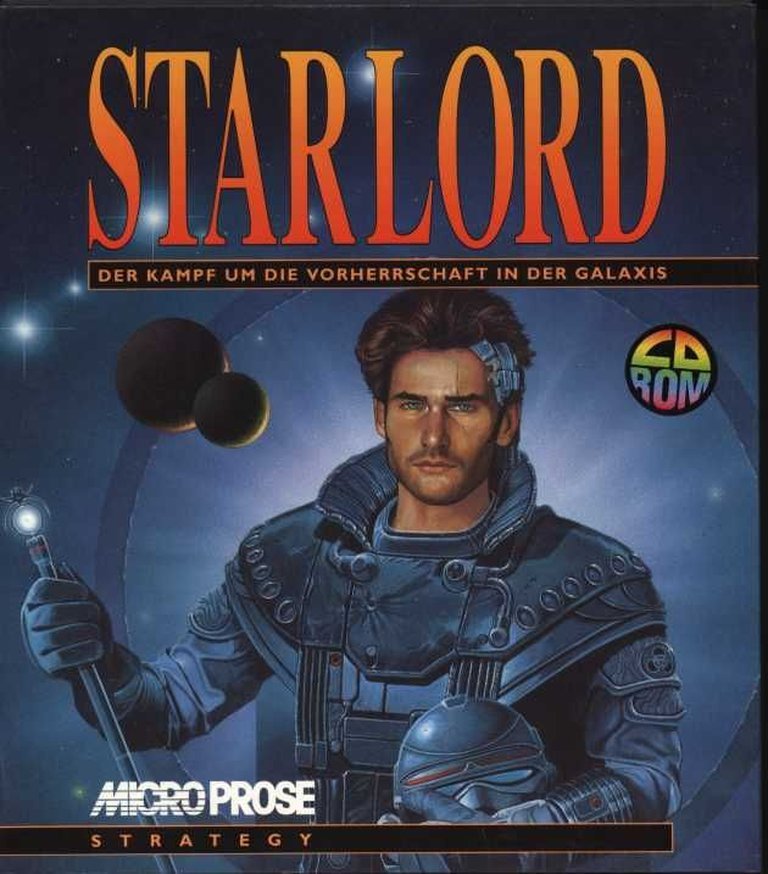
Starlord is a science-fiction strategy and simulation game where players assume the role of Starlords ruling a single planet in a vast galaxy of 1000 individually-ruled worlds. The goal is galactic dominance through resource management—balancing fuel, food, and minerals across starbases—while trading with other leaders and engaging in tactical 3D space combat to conquer planets.
Where to Buy Starlord
Starlord Free Download
PC
Starlord Patches & Updates
Starlord Reviews & Reception
amigareviews.leveluphost.com : In fact you’ll realise that the 3D battles are terrible.
Starlord Cheats & Codes
PC
| Code | Effect |
|---|---|
| SUPER180C00FF | Unlimited fuel |
| SUPER180C02FF | Unlimited water |
| SUPER180C04FF | Unlimited food |
| SUPER180C06FF | Unlimited minerals |
| SUPER180C08FF | Unlimited artefacts |
| SUPER180C0AFF | Unlimited weapons |
| SUPER180C0CFF | Unlimited starships |
| SUPER180C0EFF | Unlimited mercenaries |
Starlord: A Galactic Feudal Epic Unveiled
Introduction
In the sprawling cosmos of 1990s strategy gaming, few titles dared to blend the grand tapestry of interstellar conquest with the intricate threads of feudal politics. Starlord, the ambitious brainchild of Midwinter and The Lords of Midnight creator Mike Singleton, stands as a testament to this audacious vision. Released by MicroProse in 1994 after years of gestation, this DOS and Amiga title promised a universe of 1,000 planets, each ruled by a distinct Starlord family, all vying for galactic supremacy. Yet, despite its pedigree and scope, Starlord remains a footnote in gaming history—a brilliant but flawed experiment that oscillated between profound strategic depth and frustrating execution. This review dissects Starlord not merely as a relic of its time, but as a landmark in emergent space-strategy design, exploring its legacy, mechanics, and cultural footprint with the rigor it deserves.
Development History & Context
Starlord’s genesis predates its 1994 release by over a decade. Mike Singleton first conceptualized the game as a play-by-mail experience from 1981 to 1986, a format that inherently fostered the game’s complex political and economic systems. When development for the computer version began in 1987 under Third Millennium Software (with Singleton and Peter Barnett as core designers), it was originally slated for publisher Firebird. By 1989, however, MicroProse had swooped in, recognizing Singleton’s cult following and the project’s potential to capitalize on the burgeoning space-strategy genre.
The game’s gestation was fraught with turmoil. Advertised as early as 1989 and promised for a 1993 autumn release, Starlord faced a catastrophic last-minute cancellation. Review copies had already been distributed, with magazines like PC Joker praising its “spectacular graphics” and “rapid space battles.” As reported in PC Player (Germany), MicroProse scrapped the release at the eleventh hour, citing unpolished gameplay and technical inconsistencies. Development resumed for nearly a year, ultimately yielding a spring 1994 launch on DOS and Amiga. This delay crippled its commercial momentum, arriving just as seminal titles like Sid Meier’s Colonization and Master of Orion II dominated the market.
Technologically, Starlord pushed boundaries for its era. It employed a “Gensimulator” to dynamically generate AI opponents with unique traits, ensuring unpredictable galactic politics. The game’s hexagonal map system and multi-view 3D combat (a rarity in 1994) were ambitious, but the Amiga version suffered significant downgrades compared to the DOS original. MicroProse’s decision to prioritize PC optimization at the expense of Amiga compatibility alienated a key audience, a misstep emblematic of the era’s platform-wars.
Narrative & Thematic Deep Dive
At its core, Starlord is a feudal space opera. Players begin as a lowly Starlord ruling a single planet, aspiring to overthrow the Galactic Emperor by ascending through rigid aristocratic ranks: Earl/Countess, Duke/Duchess, and King/Queen. This ladder is not merely cosmetic; each rank grants access to superior capital ships and expanded influence, mirroring real-world feudalism where birthright defines power. The galaxy itself is a living chessboard of 1,000 planets, each governed by a distinct family, with resources (food, fuel, minerals) dictating their strength.
The narrative unfolds through emergent storytelling, not scripted events. Players forge alliances, trade goods, or declare war based on real-time AI decisions. A rival Starlord might suddenly demand tribute, while a vassal family could rebel if mistreated. This unpredictability, fueled by the Gensimulator, creates a galaxy teeming with agency. For instance, conquering a higher-ranked planet allows the player to usurp their title—a brilliant mechanic that turns conquest into political revolution.
Thematic richness permeates every layer. Resource scarcity mirrors feudal economics, where controlling mineral-rich planets is akin to owning medieval lands. The emphasis on diplomacy over brute force reflects Singleton’s belief that galactic rule requires cunning, not just cannons. Yet the narrative’s complexity is its Achilles’ heel. Newcomers drown in a sea of menus and hierarchies, with the manual (68 pages thick) as essential as the game itself. As PC Gamer UK lamented, “Underneath these problems lies a strategy game of exceptional depth… If only it had been easier to understand.”
Gameplay Mechanics & Systems
Starlord’s gameplay is a dichotomy: a meticulous empire simulator paired with jarring 3D combat.
Strategic Layer: The hexagonal galactic map is the heart of the experience. Players manage resource chains across starbases, ensuring fleets are fueled and planetary defenses are armed. Trading involves haggling with other Starlords—e.g., selling excess food for weapons—while alliances offer mutual defense against aggressors. The feudal system adds nuance: players must appease superiors (e.g., sending tribute to avoid being branded a rebel) while managing vassals who may turn if taxed too harshly. The Gensimulator ensures no two campaigns are alike, with AI opponents exhibiting traits like “aggressive expansionism” or “isolationism.”
Combat Layer: When diplomacy fails, battles erupt in a 3D cockpit view. Players pilot their capital ship, commanding fleets of starfighters and interceptors. Multi-view displays (cockpit, external, tactical) offer tactical flexibility, but execution is divisive. Critics noted that polygonal ships were hard to distinguish against the void, and combat often devolved into chaotic, speed-blurred brawls. The Amiga version’s “abrupt” 3D graphics (per Amiga Power) exacerbated this, while DOS players criticized the “orange grid overlay” that clashed with space aesthetics. Autopilot became a crutch, as Digitiser quipped: “You’ll discover your spaceship performs much better if you just leave it on autopilot.”
UI & Progression: Controls were a point of contention. Mouse navigation in the strategic layer was “haphazard” (The One Amiga), forcing reliance on keyboard shortcuts. Progression, however, was satisfying: conquering planets expanded your empire, while usurping ranks unlocked powerful ships. Yet the steep learning curve alienated casual players, with Pelit dismissing it as “a haughty, simplistic, and clumsy mess.”
World-Building, Art & Sound
Starlord’s universe is a triumph of scope over polish. The 1,000-planet galaxy, rendered with 2D scrolling on the strategic map, evoked vastness, though individual planets were represented as icons rather than unique environments. The feudal aesthetic dominated, with family crests, noble ranks, and courtly politics grounding the sci-fi setting in a recognizable power structure.
Artistically, the game was a study in contrasts. DOS players lauded the “breathtaking” battle sequences (PC Joker), where polygonal ships exploded in vibrant fireballs against starfields. The Amiga version, however, suffered from “flat” graphics and a “dead” intro (Amiga Reviews). Manual art by Blue Chip and packaging design by Joanna Wade elevated the physical product, with a comic-book backstory adding lore.
Sound design amplified the atmosphere. Paul Robotham’s score swelled during diplomatic negotiations, while battle music intensified the 3D chaos. Yet sound effects were sparse; Play Time (Germany) noted that “pompous graphics or playful animations” were absent, leaving the experience sonically thin. Despite this, ASM (Germany) praised the “coherent sound design,” highlighting its role in immersing players.
Reception & Legacy
Starlord’s reception was a tale of two platforms. On DOS, it averaged 70% from 23 critics (MobyGames), with European magazines lavishing praise. ASM awarded it 92%, calling it “an experience” thanks to the Gensimulator, while Tilt (France) lauded its “richness.” PC Action (UK) echoed this, noting players would “either love it or hate it.” On Amiga, however, the game was eviscerated. Amiga Power gave it 51%, dismissing the 3D combat as “tedious,” and Amiga Format deemed it “uninspiring.”
Commercially, Starlord was a quiet failure. Delays and platform misalignment stifled momentum, and it was overshadowed by MicroProse’s own Master of Orion. Yet its legacy endures. As a precursor to games like Distant Worlds, it pioneered emergent AI and political simulation. The Gensimulator, in particular, foreshadowed modern procedural generation. Modern re-releases on GOG (2015) and Steam (2015) introduced Starlord to new audiences, with Good Old Days noting its “complex challenge” for “dedicated players.”
Critically, its reputation has softened. Where once it was panned for complexity, it’s now revered for ambition. PC Gamer UK’s verdict—that it “could have been a game of the first order”—resonates in retrospectives. Its place in history is secure as a cult classic: flawed, visionary, and endlessly fascinating.
Conclusion
Starlord is a paradox: a game of towering ambition marred by execution gaps. Its feudal galactic empire, resource-driven diplomacy, and emergent AI remain ahead of their time, yet clumsy controls and dated combat hold it back. For strategy enthusiasts, it’s a masterclass in systemic depth; for action fans, it’s a frustrating chore.
Its legacy lies in its DNA. Starlord dared to simulate politics as much as war, proving that space strategy could be as much about intrigue as lasers. While it never achieved the ubiquity of Civilization or Elite, its influence whispers through modern titles like Stellaris. As Singleton’s swan song after Midwinter, it stands as a flawed monument to a visionary—a game that, like its galaxy, is vast, complex, and ultimately unforgettable.
Verdict: Starlord is not for the faint of heart, but for those willing to invest, it offers one of the most unique and rewarding journeys in gaming history. A solid 7/10—a stellar failure that burns brighter than many polished successes.