
- Release Year: 2006
- Platforms: Windows
- Publisher: Selectsoft Publishing
- Genre: Strategy, Tactics
- Game Mode: Single-player
- Gameplay: Cards, Match-3, Puzzle, Tile matching, Tiles
Description
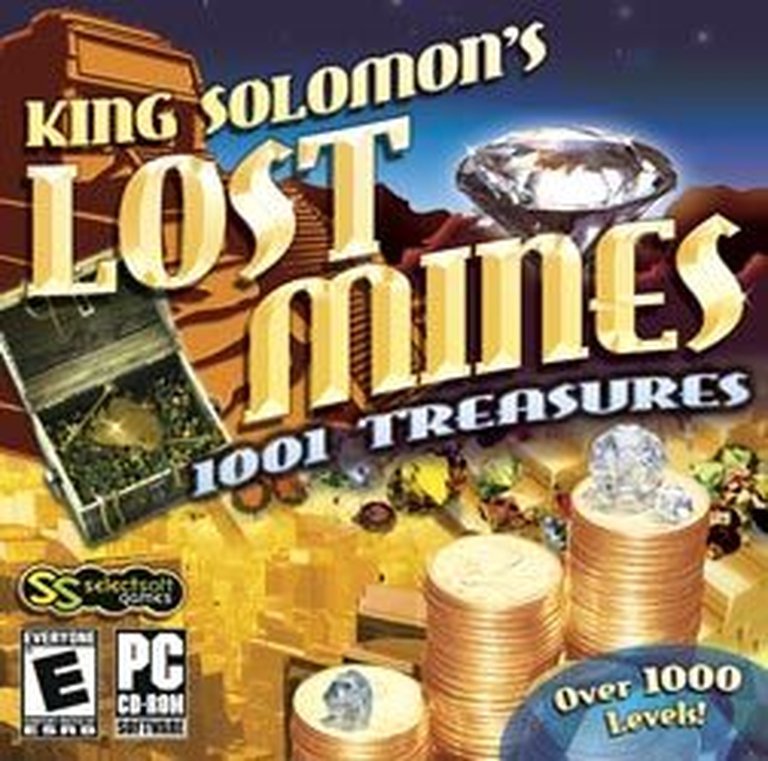
King Solomon’s Lost Mines is a single-player jewel-matching strategy game set in a treasure-hunting adventure, where players navigate over 1,000 levels by matching three or more jewels of the same color over gold or platinum cells to clear them and progress. The game features two modes—Relaxed for casual play and Challenge for timed high-scoring gameplay—alongside elements like a hint system, save functionality, obstacles such as Chain Locks, and lives that replenish at 25,000-point milestones.
King Solomon’s Lost Mines: Review
Introduction
In the pantheon of puzzle games that saturate the digital landscape, few titles wield the power of myth and legend as both a branding tool and a thematic anchor. King Solomon’s Lost Mines, released in 2006 by Selectsoft Publishing, is one such curiosity. Tapping into the enduring allure of H. Rider Haggard’s 1885 novel—a cornerstone of adventure literature that birthed the “lost world” genre—this game promises a quest for legendary wealth. Yet, rather than an action-packed odyssey, it delivers a meticulously crafted tile-matching experience spanning over 1,000 levels. While its narrative ties to the source material are tenuous at best, its design reveals a fascinating microcosm of casual gaming evolution. This review argues that King Solomon’s Lost Mines stands as a technically proficient, if thematically shallow, artifact of mid-2000s puzzle design, excelling in its core mechanics but failing to leverage its rich source material beyond superficial branding.
Development History & Context
King Solomon’s Lost Mines emerged from Selectsoft Publishing, a studio specializing in budget-priced downloadable titles for Windows. In 2006, the gaming landscape was dominated by the rise of casual and indie games, buoyed by platforms like PopCap’s Bejeweled and Microsoft’s Xbox Live Arcade. Selectsoft capitalized on this trend by creating accessible, low-cost titles with universally recognizable hooks. The choice of King Solomon’s Lost Mines as a title is intriguing: H. Rider Haggard’s novel was experiencing a resurgence in cultural relevance, thanks to film adaptations and archaeological debates surrounding the real-world “mines” (e.g., Timna Valley, Great Zimbabwe). However, the game itself developed independently of these discussions. Its development likely constrained by a limited budget and target audience (casual players), Selectsoft prioritized straightforward, mouse-driven mechanics over narrative depth. The game’s technological footprint was minimal—requiring only Windows and a mouse—reflecting the era’s push for accessibility over graphical fidelity. Released as a digital download, it exemplified the burgeoning market for bite-sized, low-risk entertainment, a precursor to the mobile puzzle boom.
Narrative & Thematic Deep Dive
Unlike its literary namesake, King Solomon’s Lost Mines contains no plot, characters, or dialogue. The absence of a narrative is conspicuous but not unexpected for a pure puzzle game. Thematically, the title is its only link to the legend. Gameplay elements—clearing “gold” and “platinum” cells to uncover treasure—symbolize the quest for Solomon’s riches. However, this connection is purely mechanical. There is no exploration of colonialism, African cultures, or the moral ambiguities central to Haggard’s work. Even the “chain lock” obstacle and “magic pouch” power-ups lack narrative context, feeling like arbitrary puzzle modifiers rather than thematic devices. The game’s two modes, “Relaxed” and “Challenge,” could metaphorically represent the allure of treasure hunting (unhurried exploration) vs. the perils of greed (ruthless competition), but this remains unexplored. Ultimately, the narrative is reduced to a veneer, leveraging the legend’s name for marketing appeal while offering no thematic substance. Players seeking the adventure of Quatermain or the mystery of Kukuanaland will find only a color-matching abstraction.
Gameplay Mechanics & Systems
King Solomon’s Lost Mines is a masterclass in streamlined tile-matching, built around a single, elegant loop: match three or more jewels of the same color while one or more jewels occupy special “gold” or “platinum” cells. Gold cells clear with one match; platinum cells require two. This simple premise evolves through increasingly complex tile patterns, demanding foresight and strategic cascades.
- Core Mechanics: The game’s genius lies in its dual-objective structure. Players must simultaneously clear jewels and target colored cells, preventing mindless matching. Power-ups like the “Magic Pouch” (which shuffles the board) and “Chain Lock” (which temporarily freezes tiles) add tactical depth without overwhelming the player.
- Progression: With over 1,000 levels, the game offers daunting longevity. Difficulty scales subtly, introducing new jewel colors and cell layouts while maintaining accessibility. The “Hint” feature prevents frustration but risks encouraging dependency.
- Modes: “Relaxed Mode” allows stress-free exploration, ideal for casual players. “Challenge Mode” introduces a timer and lives, with an extra life granted every 25,000 points. Lives are lost if the board resets due to no valid moves—a brilliant mechanic that penalizes poor planning and rewards skillful combinations.
- UI and Systems: The mouse-only interface is intuitive, with jewel swaps and selection handled cleanly. Save-game functionality and high-score tables for both modes cater to completionists and competitive players. Lives and scoring systems are transparent, reinforcing the addictive “one more level” loop.
The gameplay is robust but not revolutionary. It refines the Bejeweled-formula without innovating, relying on sheer volume and polish to engage.
World-Building, Art & Sound
Visually, King Solomon’s Lost Mines adheres to functional, cartoonish aesthetics. The jewel colors (ruby, emerald, sapphire) are vivid but generic, and the “gold/platinum” cells are adorned with simple metallic textures. Backgrounds are minimal, often static desert or cave-themed backdrops that evoke the mines’ setting without depth. This visual restraint prioritizes clarity—critical for fast-paced matching—but sacrifices atmosphere. There is no cohesive “world” to explore; the game is a series of isolated puzzles.
Sound design similarly prioritizes functionality over immersion. Upbeat, looped MIDI-style tracks play during gameplay, while sound effects for jewel matches and power-ups provide satisfying audio feedback. Yet, the audio lacks cultural authenticity or grandeur. The absence of thematic music (e.g., African rhythms, adventure motifs) underscores the game’s disconnect from its source material. While technically adequate for a casual title, the art and sound fail to evoke the mystery or peril of the legend, reducing the experience to a sterile, abstract puzzle.
Reception & Legacy
King Solomon’s Lost Mines launched with minimal fanfare and left no significant imprint on the gaming landscape. MobyGames records no critic reviews, and player reviews are absent, suggesting it was a niche, budget title overshadowed by AAA releases and more prominent puzzle games. Its commercial performance is undocumented, but its existence as a downloadable title indicates a modest, targeted audience.
Legacy-wise, the game is a footnote. It did not innovate the match-3 genre, nor did it inspire clones. Its primary historical significance lies in its branding: it exemplifies how publishers leveraged public-domain intellectual property to sell generic gameplay. The title’s endurance is limited to preservation on archival sites like MobyGames. In contrast, Haggard’s novel continues to spawn adaptations (e.g., The Librarian: Return to King Solomon’s Mines), proving the legend’s enduring power—a power the game singularly fails to harness.
Conclusion
King Solomon’s Lost Mines is a paradox: a game steeped in one of literature’s greatest adventure myths yet devoid of its spirit. As a puzzle experience, it is polished and addictive, with over 1,000 levels offering substantial value for casual players. Its dual-mode structure and life-based scoring system in Challenge Mode demonstrate a keen understanding of player psychology. However, its thematic barrenness and generic presentation reduce the “lost mines” to a branding gimmick. The game succeeds mechanically but fails narratively, serving as a cautionary tale about the risks of prioritizing accessibility over artistic ambition.
For historians, King Solomon’s Lost Mines is a fascinating artifact of mid-2000s casual gaming—a testament to how publishers mined public domain for content while ignoring its depth. It is a competent but forgettable tile-matcher, its legacy entwined not with the legend of Solomon’s riches, but with the ephemeral nature of budget digital entertainment. In the end, it is a puzzle best left lost—technically sound but spiritually vacant.