
- Release Year: 2020
- Platforms: Windows
- Publisher: Cougar Interactive
- Developer: Cougar Interactive
- Genre: Action, Sports
- Perspective: Diagonal-down
- Game Mode: Single-player
- Gameplay: Boxing, Direct control, Fighting
- Average Score: 80/100
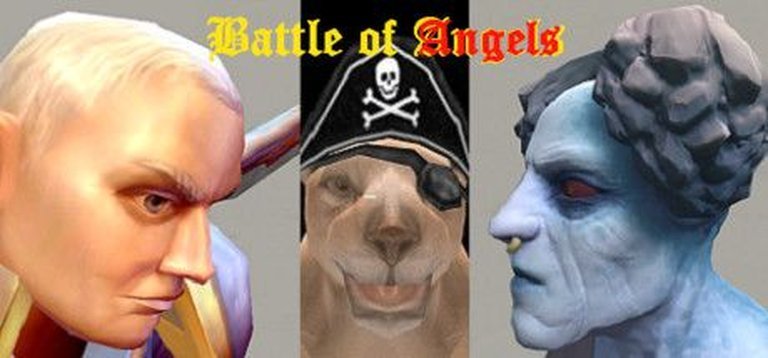
Description
Battle of Angels is an action sports game where players take on the role of an Angel tasked with transforming a crime-ridden ghetto into a paradise by defeating the malevolent spirit power who controls the city through criminal enterprises. Engaging in high-stakes boxing matches at the Roman Colosseum, players capture enemy buildings and unlock new fighting moves, with each bout’s outcome determining the resolution of city events. As victories mount, players witness tangible improvements—graffiti and trash disappear, crime rates decrease, and events shift toward non-violence—while the enemy escalates attacks in response. The game blends fighting mechanics with city transformation, culminating in a battle for the soul of the urban landscape.
Where to Buy Battle of Angels
PC
Battle of Angels: Review
Introduction
In the annals of video game history, few titles arrive as enigmatically as Battle of Angels. Released in May 2020 by the developer Cougar Interactive, this Windows-exclusive fighting-sports hybrid presents a radical concept: a boxing simulator intertwined with urban revitalization and moral conflict. Its premise—a celestial being battling demonic forces in a Roman Colosseum to transform a crime-ridden ghetto into a paradise—promises a fusion of physical combat and thematic depth. Yet, while its ambition is undeniable, the game’s execution reveals a fascinating case study in idiosyncratic design. This review dissects Battle of Angels as a product of its unique cultural moment, examining its bold narrative, unconventional mechanics, and polarizing legacy. Ultimately, it stands as a curio—a cult object with a compelling core idea undermined by technical and narrative inconsistencies, yet one that sparks conversation about games as vehicles for metaphorical storytelling.
Development History & Context
Battle of Angels emerged from Cougar Interactive, a studio with minimal prior documentation, and its creator Randall Alaimo. Released on May 14, 2020, the game arrived amid a saturated indie-fighting market dominated by titles like Dead or Alive 6 and Samurai Shodown, making its niche premise—blending boxing with urban renewal and theological conflict—both a strategic differentiator and a risky gamble. Technologically, it operated within modest constraints: minimum specs required only a 1.1 GHz processor and ATI Radeon graphics, suggesting an emphasis on accessibility over graphical fidelity. This aligns with its direct control interface, which eschews complex bindings for immediate responsiveness via keyboard, mouse, or gamepad.
The game’s creation context is critical. 2020 saw global reckonings with social inequality and urban decay, themes mirrored in Battle of Angels‘s core mission. Alaimo’s vision appears rooted in a desire to literalize moral struggle—using the visceral, primal act of boxing as a proxy for societal purification. The choice of the Roman Colosseum as the arena adds historical weight, framing combat not just as sport but as a ritualistic clash between order and chaos. This ambition, however, clashed with the realities of small-scale development. The game’s Steam store page and official description (branded with all-caps urgency like “CHANGE YOUR CITY FROM GHETTO TO PARADISE!”) reflect a DIY ethos, prioritizing raw concept over polish. Its release as a $4.99 digital download signaled a budget-conscious approach, positioning it as an experimental passion project rather than a AAA contender. This context explains its dual identity: a heartfelt allegory wrapped in a technically unrefined package.
Narrative & Thematic Deep Dive
At its heart, Battle of Angels is a parable of redemption and consequence. The narrative unfolds through two interwoven systems: event resolution and urban transformation. Players witness urban events—implicitly criminal or societal crises—then choose between two competing visions: the Angel’s idealistic proposal (e.g., “This event should end in community healing”) and the Demon Angel’s nihilistic counter (e.g., “This event should escalate into violence”). The boxing match that follows becomes the arbiter of reality, with victory or defeat determining the event’s outcome. This mechanic brilliantly externalizes moral choice: Battle of Angels doesn’t just tell players that violence has consequences; it enforces them through gameplay.
The themes are bold and unflinching. The Angel’s mission to “transform a city ghetto into a lovely looking paradise” is a direct allegory for urban renewal and social justice, with graffiti and trash visibly diminishing as fights are won. Conversely, the Demon Angel’s reign is explicitly tied to systemic rot—”drug cartels, cocaine lords, much more”—linking spiritual corruption to tangible societal decay. The game’s mature content warning underscores this duality: defeat triggers hallucinatory depictions of societal collapse, from “alcohol abuse” and “suicide” to “space alien abductions,” framing failure not as a simple game-over but as a descent into hellish dystopia.
Characterization is minimal but potent. The Angel and Demon Angel exist as archetypes, their ideologies distilled into their proposed event resolutions. The lack of traditional dialogue or backstory shifts focus to the player’s role as a divine mediator, making every fight a referendum on hope versus despair. While the narrative lacks nuance, its thematic core—using combat as a tool for societal change—resonates as a provocative commentary on agency and responsibility. The game’s greatest strength lies in this symbolic integration: winning a boxing match doesn’t just score points; it literally “captures enemy buildings” and reduces crime, transforming the cityscape into a living barometer of the player’s moral impact.
Gameplay Mechanics & Systems
Battle of Angels gameplay is defined by two loops: boxing combat and city influence. The boxing system, while simple, serves as the narrative fulcrum. Fights occur in the Roman Colosseseum, with players controlling the Angel using direct controls. Combos and special moves are acquired by “capturing enemy buildings” through victories, creating a progression system tied to urban conquest. The Demon Angel adapts dynamically—acknowledging the player’s success by “speed[ing] up his attacks”—creating a sense of escalating stakes. However, combat lacks depth: it’s a straightforward brawler with minimal defensive mechanics, prioritizing aggressive offense over strategy. This suits the game’s theme of divine intervention but risks feeling repetitive.
The city-influence system is more innovative. As players win, the urban environment visibly improves: graffiti fades, trash vanishes, and criminal “events” become “non-violent.” This visual feedback provides tangible rewards, turning abstract morality into concrete progress. Events triggered via city icons force players to choose between Angelic and Demon endings, with boxing outcomes dictating consequences. This creates a risk-reward dynamic: proposing idealistic solutions risks failure and triggering dark cutscenes, while cynical choices might secure short-term wins but perpetuate decay.
UI and controls are functional but unpolished. The diagonal-down perspective offers a clear view of the Colosseum and city, but menus lack intuitive design. The game’s “Souls-like” tag (from user reviews) is misleading; it lacks punishing difficulty or intricate mechanics, instead emphasizing thematic consistency. Ultimately, Battle of Angels‘ systems succeed in metaphor but stumble in execution—combat lacks depth, and the city-influence loop, while clever, is underdeveloped. Yet, its core idea—using victory to reshape the world—remains a standout concept.
World-Building, Art & Sound
The game’s world is a study in stark contrasts. The “city ghetto” and “Roman Colosseum” coexist as symbolic spaces: the former is a decaying urban canvas dominated by graffiti, trash, and implied criminality, while the latter is a pristine, timeless arena for divine combat. This duality reinforces the central theme of sacred versus profane. Art direction leans into simplicity, with low-poly environments that prioritize readability over detail. The city’s transformation—from blighted to utopian—is communicated through environmental changes (e.g., graffiti dissolving, debris clearing), making the player’s impact visceral. While graphically unremarkable by 2020 standards, the art serves its purpose: the Colosseum’s grandeur contrasts with the ghetto’s grit, highlighting the stakes of the conflict.
Sound design amplifies this atmosphere. The boxing matches lack elaborate soundscapes, focusing on impactful punches and crowd reactions to maintain tension. However, the real audio storytelling occurs in the event-resolution cutscenes. When the Angel proposes hope, the soundtrack might shift to uplifting melodies; when the Demon Angel wins, dissonant tones underscore the ensuing chaos (e.g., “hallucinations of monsters” or “gang violence”). The mature content warning implies graphic audio cues during losses, though specific examples remain vague. Voice acting, if present, is minimal, relying on text for ideological clashes. The game’s 27-language support (full audio and subtitles) is a surprising boon, enhancing accessibility but diluting the cultural specificity of its urban setting. Overall, art and sound establish a consistent tone: one of divine struggle in a broken world, using audiovisual shorthand to reinforce narrative themes despite technical limitations.
Reception & Legacy
Battle of Angels launched to near-total critical silence. Metacritic and MobyGames list no critic reviews, reflecting its obscurity. Player reception, however, was polarized. On Steam, 81% of 16 reviews were “Positive,” praising its unique concept and thematic ambition. User tags like “Souls-like” and “God Game” indicate players recognized its innovative fusion of genres, despite misleading comparisons. Yet, negative reviews criticized its “crashes on start” and perceived “fake reviews,” citing technical flaws and inconsistent tone. The community hub discussions echoed this: one player lamented, “Can I just die now,” while another requested a “VS Mode,” highlighting desires for multiplayer or deeper mechanics.
Legacy-wise, Battle of Angels occupies a curious niche. It didn’t spawn sequels or influence mainstream trends, but its synthesis of boxing, urban renewal, and moral choice has made it a cult object. It’s frequently cited in discussions of “games as art” for using mechanics to explore societal themes, even if imperfectly. Its Steam page remains active, with a dedicated (if small) player base drawn to its allegorical depth. In the broader gaming landscape, it serves as a counterpoint to polished AAA titles—a reminder that experimental ideas can resonate even when execution falters. Its true legacy lies in its role as a conversation piece: a flawed, passionate attempt to make players feel the weight of cosmic choice, one boxing match at a time.
Conclusion
Battle of Angels is a game of audacious ambition and uneven execution. Its core concept—using boxing matches to determine the moral fate of a city—is a masterstroke of thematic integration, transforming raw combat into a commentary on hope and despair. The narrative’s focus on urban revitalization and consequence provides a unique framework for player agency, while the stark contrast between celestial ideals and demonic decay creates a compelling allegory for societal change. However, these strengths are undermined by technical limitations and underdeveloped systems. The combat lacks depth, and the city-influence loop, while innovative, feels skeletal. Its art and sound are functional but unremarkable, and its reception, while divided, failed to propel it beyond cult status.
Yet, to dismiss Battle of Angels as merely “bad” would be to miss its significance. It stands as a testament to the power of bold ideas in independent development—a game that prioritizes metaphor over mechanics and vision over polish. In an industry often obsessed with refinement, it’s a raw, unfiltered exploration of what games can mean. While it may never achieve mainstream recognition, Battle of Angels earns its place in history as a flawed, fascinating artifact. It proves that even with imperfect execution, a game can inspire players to see combat not as violence, but as a tool for change. For those willing to look beyond its surface flaws, it offers a truly angelic experience: the chance to fight for a better world, one punch at a time.