
- Release Year: 2015
- Platforms: Steam, Windows
- Publisher: Addicting Games, Inc., Defy Media, LLC
- Developer: Collected Worlds, Fully Ramblomatic
- Genre: Action
- Perspective: Side view
- Game Mode: Single-player
- Gameplay: Arcade
- Average Score: 83/100
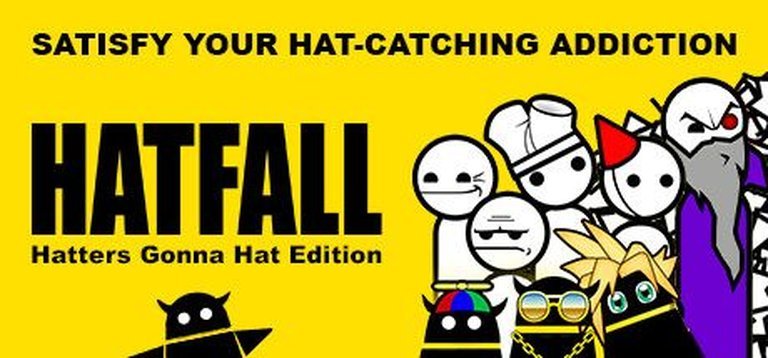
Description
Hatfall: Hatters Gonna Hat Edition is a fast-paced arcade action game developed by Ben ‘Yahtzee’ Croshaw, where players help the protagonist identify Yahtzee among a crowd of identical characters to catch falling hats from the sky. Featuring updated mini-games, new content, and a special ending for collectors who gather 1,500 hats, the game challenges players to dodge obstacles and use acquired hats to unlock additional items and NPCs, all set within a comedic narrative framework.
Gameplay Videos
Where to Buy Hatfall: Hatters Gonna Hat Edition
PC
Hatfall: Hatters Gonna Hat Edition Guides & Walkthroughs
Hatfall: Hatters Gonna Hat Edition Reviews & Reception
wasdland.com (79/100): Hat-catching addiction, indeed.
Hatfall: Hatters Gonna Hat Edition: Review
Introduction
In the sprawling, often self-referential landscape of internet culture, few figures loom as large as Ben “Yahtzee” Croshaw, the caustic yet brilliant mind behind Zero Punctuation. When he transitioned his razor-sharp wit into interactive media with Hatfall, the result was less a traditional game and more a chaotic, hat-fueled fever dream—a digital distillation of his signature brand of absurdist humor. Released on November 20, 2015, the Hatters Gonna Hat Edition for Windows stands as the definitive PC iteration of this mobile-born phenomenon. Far more than a mere cash-in on Croshaw’s fame, Hatfall is a masterclass in transmedia storytelling, a satirical critique of gaming tropes, and a surprisingly poignant exploration of identity and obsession. This review will dissect its origins, dissect its anarchic systems, and argue that beneath its frantic veneer lies a deceptively sophisticated work that has earned its place as a cult classic in the pantheon of developer-as-creator games.
Development History & Context
Hatfall emerged from the fertile, if chaotic, mind of Ben Croshaw, who developed the original browser/mobile version under his Fully Ramblomatic studio in 2015. The Hatters Gonna Hat Edition was a collaborative effort, with Croshaw partnering with Collected Worlds for porting and QA, and published by Addicting Games and Defy Media. This context is crucial: the 2015 gaming landscape was dominated by hyper-moneticized mobile games and the rise of indie darlings on Steam. Croshaw, ever the contrarian, sought to create something that felt authentically “Zero Punctuation”—frantic, self-aware, and unapologetically silly. Technologically, the game embraced constraints: fixed/flip-screen visuals and direct control interfaces were chosen for their accessibility, mirroring the simplicity of its mobile origins. Yet, the PC edition expanded this with new mini-games, updated content, and Steam integration (achievements, trading cards), aiming to deliver a more robust experience. The result was a title perfectly poised to capture the zeitgeist of an era where internet memes crossed over into interactive entertainment.
Narrative & Thematic Deep Dive
On the surface, Hatfall boasts a narrative as threadbare as its stick-figure protagonist: hats fall from the sky, Yahtzee must catch them. Yet, this “excuse plot” unravels into a surprisingly rich tapestry of satire and existential whimsy. The game opens with a mock-epic “hat-story” scroll, a blatant Star Wars parody that immediately establishes the game’s tone of loving derision. As players progress, the narrative fragments into absurdist vignettes: Yahtzee fills out insurance forms while drunk, battles an eldritch hat-god named Rondo Hat-Ton (a pun on Rondo Hatton), and even attends a horse-picture wedding. These segments are not merely gags but thematic explorations of futility, consumerism, and the performative nature of identity.
Characters serve as vehicles for Croshaw’s wit. The wizard, with his tarot-like boons and curses, embodies the arbitrary cruelty of game RNG, while the sea of identical clones forces players to question “self” in a world of digital doppelgängers. Dialogue is sparse but potent, blending Croshaw’s trademark sarcasm (“YOUR BEST ISN’T GOOD ENOUGH”) with meta-commentary (“DRAW DESK SPRITE / PLAY WIN SOUND”). Thematically, Hatfall is a meditation on obsession. The hat-catching mechanic—a literalization of the collector’s drive—satirizes gaming’s Skinner-box design, while the game’s humor hinges on the joy of meaningless pursuit. It’s a story about finding purpose in absurdity, a message delivered with the same deadpan panache as Croshaw’s reviews.
Gameplay Mechanics & Systems
At its core, Hatfall is a high-stakes test of reflexes and perception. The primary loop involves guiding Yahtzee left/right to catch falling hats while avoiding deadly projectiles (refrigerators, anvils). The escalating challenge comes from “Only Six Faces” mechanics: as more clones flood the screen, players must identify Yahtzee in seconds by observing his unique movement patterns when keys are pressed—a brilliant, if frustrating, layer of spatial reasoning. Hats function as currency, unlocking new NPC types (to ease identification), desk decorations, and mini-games. The Hatters Gonna Hat Edition introduces several new mini-games, each a self-contained parody:
– Hat-Sassin’s Creed: A mock dating sim that “crashes” into a Visual Novel with an anime-hat “girlfriend,” skewering JRPG tropes and unfinished launches.
– The Insurance Paperwork: A drunken form-filling minigame with swirling checkboxes, a tribute to bureaucratic absurdity.
– The Rolling Desk: A downhill chase where Yahtzee nets hats while dodging imps, blending platforming with chaos.
These mini-games are the game’s soul, delivering genuine laughs and variety. However, the core loop suffers from repetition and imbalance. Random wizard bonuses (double points or extra lives) make progression feel arbitrary, while the grind for hats to unlock content can wear thin. The UI is minimalist but functional, though leaderboards are relegated to Steam’s client—a minor inconvenience. Despite these flaws, the game’s systems cohere into an addictive loop, where the tension of identifying Yahtzee and the payoff of absurd minigames create a uniquely compelling experience.
World-Building, Art & Sound
Hatfall’s world is a triumph of intentional minimalism. The setting is an undefined, flat plane with a desk in the background—blank enough to highlight the falling chaos, yet detailed enough to ground the absurdity. This abstraction mirrors the game’s web origins, where simplicity was key. Art direction leans into Zero Punctuation’s aesthetic: jerky stick-figure animations, bold outlines, and a limited color palette. The visual style is not just a stylistic choice but a narrative device; the crude figures emphasize the game’s theme of identity in a homogenous digital space.
Sound design amplifies the absurdity. Ian Dorsch’s main menu music is jaunty and slightly off-key, while sound effects—from the splat of an anvil impact to the bleeps of an alternate-universe swear jar—are exaggerated and comedic. The most notable audio element is the absence of Yahtzee’s voice, limited to two words (“WRONG!” and “noooice!”). This omission forces players to engage with visual/textual humor, preserving the game’s mobile-centric charm. When the wizard is angered, the soundtrack warps into a panic-inducing cacophony, perfectly mirroring the gameplay’s descent into chaos. Together, these elements create a cohesive atmosphere that is both frenetic and endearing—a world where hats are divine, and anvils are existential threats.
Reception & Legacy
Upon release, Hatfall garnered a “Very Positive” Steam rating (84% based on 302 reviews), with players praising its humor, minigames, and faithfulness to Croshaw’s persona. Critics like Indie Gamer Chick were more mixed, calling the core gameplay “lazy” and “grindy,” arguing it lacked the bite of Croshaw’s critiques. Commercially, the game found modest success, selling over 20,000 units on Steam—a testament to its niche appeal.
Legacy-wise, Hatfall has endured as a cult phenomenon. It pioneered the “developer-as-character” indie trend, proving that a reviewer’s identity could translate into compelling gameplay. Its influence permeates meme-centric titles, while its satirical minigames (like the insurance parody) remain benchmarks for absurdist design. Though a sequel (Hatfall 2: Fedora the Explorer) was abandoned after Zero Punctuation ended, the game’s DNA lives on in Croshaw’s later work, like Baron: Fur Is Gonna Fly. For fans, it remains a beloved artifact—a chaotic, heartfelt reminder that sometimes the best games are the ones that wear their absurdity like a hat.
Conclusion
Hatfall: Hatters Gonna Hat Edition is a flawed gem—a testament to the power of embracing chaos. Its core gameplay loop is repetitive and occasionally unfair, but its minigames and thematic depth elevate it beyond a simple port. As a satire of gaming culture, it’s both incisive and affectionate; as a piece of transmedia, it’s a masterclass in persona translation. Croshaw’s voice, though sparse, permeates every pixel, from the nonsensical hat-story to the cruel whimsy of the wizard. In the grand history of video games, Hatfall may not revolutionize design, but it immortalizes a unique moment: when a critic became a creator, and hats became divine. Verdict: A chaotic, hilarious, and surprisingly profound cult classic—proof that sometimes, the best games are the ones that don’t take themselves too seriously.