
- Release Year: 1993
- Platforms: PC-98, Windows
- Publisher: Banpresto Co., Ltd.
- Genre: Adventure
- Perspective: 1st-person
- Game Mode: Single-player
- Gameplay: Decision-making, Visual novel
- Setting: Fantasy, Romance
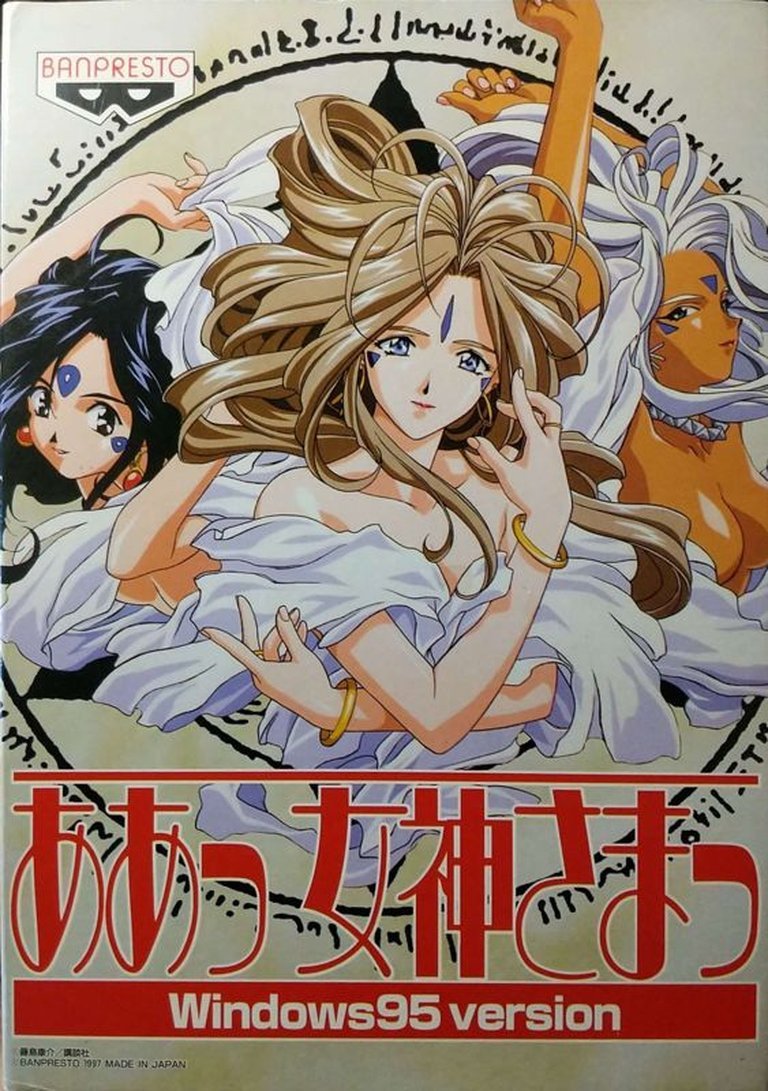
Description
Based on the anime series Ah! My Goddess, Ah! Megami-Sama is a first-person visual novel adventure that follows high-school student Keiichi after he accidentally summons the Norse goddess Verdandi (misspelled as Belldandy in the game) and wishes for her to stay with him forever. Set in contemporary Japan, the game chronicles their evolving relationship through comical misunderstandings and heartfelt moments, featuring periodic decision-making gameplay that alters dialogues and scenes while maintaining a consistent narrative core.
Gameplay Videos
Ah! Megami-Sama Reviews & Reception
pcengine-fx.com : While this game may have its share of problems, its length and occasional inventiveness make it a worthwhile playing experience for fans of the series who can understand Japanese.
Ah! Megami-Sama: Review
Introduction
In the nascent landscape of anime-licensed video games of the early 1990s, Ah! Megami-Sama (1993) stands as a pioneering yet underappreciated artifact. Released for the NEC PC-98 by Banpresto Co., Ltd., this visual novel adaptation of Kōsuke Fujishima’s seminal manga Aa! Megami-sama (later internationally known as Oh My Goddess!) arrived at a pivotal moment when interactive storytelling was just beginning to intersect with Japan’s burgeoning otaku culture. Though overshadowed by its source material’s subsequent multimedia dominance—including a beloved OVA series (1993–1994) and a long-running manga spanning 48 volumes—this game deserves scrutiny not merely as a licensed tie-in, but as a historical document of early digital narrative design. Its legacy, while modest, lies in its faithful capture of Fujishima’s romantic-comedy vision and its role in legitimizing visual novels as a viable medium for adapting beloved manga properties. This review dissects Ah! Megami-Sama through the lens of its context, narrative execution, mechanical design, and enduring impact, arguing that despite its technical limitations, it remains a charming and historically significant entry in the annals of interactive anime adaptations.
Development History & Context
Studio and Vision
Ah! Megami-Sama emerged from Banpresto, a company specializing in anime-licensed games for home computers. Its development was deeply entwined with the meteoric rise of Fujishima’s manga, which debuted in Monthly Afternoon in 1988 and quickly became a seinen sensation. The game was conceived as a “digital comic” (デジタルコミック), a nascent genre in the early ’90s that prioritized narrative interactivity over traditional gameplay. Banpresto’s vision was to replicate the manga’s tone and key events, offering fans an immersive way to experience Keiichi Morisato’s fateful encounter with the goddess Belldandy. This ambition was evident in the game’s extensive dialogue trees and branching scenes, though its core design remained rooted in the PC-98’s technical constraints.
Technological Constraints and Gaming Landscape
Released on March 20, 1993, the game leveraged the PC-98’s robust support for text-based adventures and anime-style visuals. The platform, while powerful for its time, had limited graphical capabilities compared to emerging consoles like the Super Famicom. Banpresto compensated with detailed sprite work and static backgrounds, but the primary limitation was storage: PC-98 games relied on floppy disks, restricting audio-visual richness. This context explains the game’s sparse sound design and reliance on text-driven choices, as complex gameplay systems were unfeasible. The gaming landscape of 1993 was dominated by RPGs and action games, making Ah! Megami-Sama a niche product—a visual novel in a market not yet saturated by the genre, predating titles like Visual Art’s’ Kanon (1999) by half a decade. Its 1997 PC-FX remake addressed these limitations with CD-based media, adding full voice acting and an animated opening, but this revisionist history cannot overshadow the original’s pioneering spirit.
Narrative & Thematic Deep Dive
Plot and Character Adaptation
The game meticulously adapts the manga’s foundational arc: college student Keiichi, a perpetually unlucky outcast, dials the “Goddess Hotline” in a desperate attempt to order takeout, accidentally summoning Belldandy, a First-Class goddess. His impulsive wish for her to stay with him forever binds them irrevocably, forcing Keiichi into exile from his dormitory and into the abandoned temple that becomes their home. The narrative follows Keiichi and Belldandy’s burgeoning relationship, punctuated by the arrival of her sisters—the mischievous Urd and the childlike Skuld—and conflicts with antagonists like the demon Mara. Banpresto’s translation of the manga’s charm is evident in its dialogue, which balances romantic tension with slapstick humor. For example, Keiichi’s comedic flusterings at Belldandy’s ethereal beauty and the sisters’ disruptive antics (e.g., Skuld’s inventions wreaking havoc) mirror Fujishima’s comedic timing. The game’s “periodic decision-making” allows players to influence minor interactions, such as choosing between comforting Belldandy or scolding Skuld, though these choices rarely alter the core plot—a design choice reflecting the manga’s episodic structure.
Dialogue and Thematic Resonance
The dialogue, presented in Japanese text-only format, is a faithful distillation of Fujishima’s work. Keiichi’s earnest, self-deprecating inner monologues (“Why me? A goddess?”) contrast with Belldandy’s gentle, unwavering grace, embodying the series’ central theme of unconditional love. Thematic depth emerges from the narrative’s exploration of fate and free will. Belldandy’s powers, governed by the celestial computer system Yggdrasil, symbolize the rigidity of divine contracts, while Keiichi’s human impulsiveness represents chaotic freedom. Their dynamic questions whether happiness can be engineered (via wishes) or must be earned organically—a tension underscored by demons’ temptations of power-for-favors. The game’s narrative, though linear in outcome, enriches these themes through character interactions: Urd’s schemes to “advance” the relationship highlight the absurdity of forcing love, while Skuld’s jealousy reveals the fragility of divine perfection. These elements elevate the game beyond a simple adaptation, offering a nuanced exploration of coexistence between the mundane and the divine.
Gameplay Mechanics & Systems
Core Design and Innovation
As a visual novel, Ah! Megami-Sama eschews traditional gameplay in favor of interactive storytelling. Its primary mechanic is the “periodic decision-making” system, where players choose between two dialogue options or actions at key junctures. For instance, during a date with Belldandy, players might select “Hold her hand” or “Offer her a flower,” leading to different text responses and scene variations. These choices occasionally unlock alternate endings (e.g., a “bad end” where Keiichi rejects Belldandy), but the majority of the narrative remains fixed—a pragmatic design given the PC-98’s limitations. The game innovates through its “digital comic” presentation: static backgrounds depict locations like the temple and university, while character sprites express emotion through subtle animations (e.g., Belldandy’s hair shimmering when using magic). This approach prioritizes narrative flow over engagement, creating a “page-turning” experience akin to reading a manga with agency.
Flaws and Systems
The gameplay suffers from repetition, as decision points often feel cosmetic, with minor dialogue tweaks failing to impact the story. The PC-FX version remedied this with two mini-games—a timed jigsaw puzzle and a memory-card matching game—absent in the original. These diversions, while charming, feel disconnected from the main narrative and highlight the original’s lack of variety. Another flaw is the absence of player agency in key moments; for example, the resolution of the “Lord of Terror” arc (a major manga storyline) is predetermined, stripping players of meaningful choice. Controls are functional but dated: PC-98 users navigate via keyboard, while the PC-FX remake supports mouse and gamepad. The UI, minimalist to the point of austerity, features text boxes and choice menus but no visual feedback for selections—a relic of a pre-GUI era. Despite these flaws, the game’s strength lies in its accessibility: it requires no prior gaming literacy, inviting fans to “live” the manga’s world rather than “play” it.
World-Building, Art & Sound
Visual Direction
The art direction is a direct homage to Fujishima’s style, with character designs faithfully rendered by Hidenori Matsubara (who later worked on the anime). Backgrounds, though static, are richly detailed: the temple’s tatami mats and cherry blossom trees evoke Fujishima’s signature blend of realism and fantasy. The PC-98’s 16-color palette imposes limitations, but Banpresto compensates with expressive character sprites—Belldandy’s flowing hair and Urd’s mischievous grins convey personality through subtle pixel shifts. The game’s “digital comic” aesthetic is most evident in its scene transitions, which use fade-ins to mimic manga panel changes. The PC-FX remake enhances this with an animated opening sequence, but the original’s charm lies in its hand-painted imperfections, which lend a nostalgic intimacy to the world-building.
Sound Design and Atmosphere
Sound design is notably sparse, reflecting the PC-98’s audio capabilities. The original features chiptune renditions of the anime’s opening theme, “My Heart Iidasenai,” and simple sound effects (e.g., a ding for choices). This minimalism creates a quiet, introspective atmosphere, allowing the narrative to take center stage. The PC-FX version, however, revolutionizes the experience with full voice acting from the anime’s cast—Kikuko Inoue as Belldandy and Yumi Tōma as Urd—adding emotional depth to key scenes. Music, while rudimentary, serves its purpose: soft piano tracks underscore romantic moments, while brisk melodies punctuate comedic interludes. Together, the art and sound forge a cohesive world where the mundane (Keiichi’s cramped dorm) and the divine (Belldandy’s ethereal presence) coexist, mirroring Fujishima’s thematic core.
Reception & Legacy
Launch and Commercial Performance
Upon release, Ah! Megami-Sama garnered minimal attention in Western markets due to its PC-98 exclusivity and Japanese-only content. Domestically, it resonated with core fans, particularly those of the manga, but its impact was dwarfed by the 1993 OVA series, which became a critical darling (IMDb rating: 7.4/10). The game’s average player score of 2.2/5 on MobyGames suggests lukewarm reception, likely due to its niche appeal and steep technical requirements. The PC-FX remake (1997) fared better, praised for its voice acting and mini-games, but it too was overshadowed by the franchise’s growing multimedia empire. Commercially, neither version achieved blockbuster status, cementing the game as a cult item rather than a commercial triumph.
Influence and Historical Significance
Despite its obscurity, Ah! Megami-Sama holds historical significance as one of the first visual novels to adapt a major manga property. Its “digital comic” approach prefigured modern narrative-driven games like Doki Doki Literature Club! (2017), proving that interactivity could enhance—not replace—storytelling. The game also influenced subsequent Oh My Goddess! adaptations, including the 2007 PlayStation 2 game Aa Megami-sama, which expanded on its decision-based mechanics. Culturally, it preserved Fujishima’s early vision during the franchise’s anime-centric expansion, offering a rare glimpse into the manga’s untranslated nuances. While its legacy is primarily archival, the game’s preservation efforts—such as the Charming Book supplement (1993) and fan translations—underscore its status as a cherished relic of PC-98 gaming history.
Conclusion
Ah! Megami-Sama is a product of its time and technology—a flawed but earnest attempt to translate the magic of Kōsuke Fujishima’s manga into an interactive medium. As a visual novel, it succeeds in capturing the series’ heart, offering fans a chance to experience Keiichi and Belldandy’s story through meaningful, albeit limited, choices. Its art direction and narrative fidelity are testaments to Banpresto’s reverence for the source material, while its technical constraints serve as a time capsule of early ’90s gaming. The PC-FX remake, though more polished, cannot replicate the original’s raw, unvarnished charm. Ultimately, Ah! Megami-Sama deserves recognition not as a masterpiece, but as a foundational piece in the evolution of licensed games and visual novels. Its legacy is a reminder that in the pursuit of innovation, simplicity and sincerity can create experiences that transcend their limitations. For historians and otaku alike, this game is a window into a bygone era—a testament to how even humble beginnings can shape the future of interactive storytelling.