
- Release Year: 2023
- Platforms: Windows
- Publisher: Crispy Creative, Fig Publishing Inc., Mooncat Games
- Developer: Crispy Creative
- Genre: Simulation
- Perspective: Fixed perspective
- Game Mode: Single-player
- Gameplay: Business simulation, Managerial
- Setting: Futuristic, Sci-fi, Space station, Spaceship
- Average Score: 62/100
Description
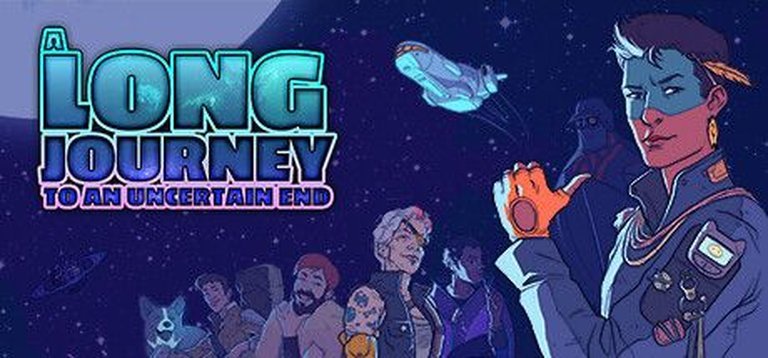
A Long Journey to an Uncertain End is a narrative-driven space opera simulation game set on a spaceship in a futuristic sci-fi universe. Players manage a diverse crew, explore uncharted galaxies, and make critical choices that shape their journey while attempting to escape their abusive ex-partner, combining managerial gameplay with real-time strategic decisions aboard a space station environment.
Gameplay Videos
Where to Buy A Long Journey to an Uncertain End
A Long Journey to an Uncertain End Guides & Walkthroughs
A Long Journey to an Uncertain End Reviews & Reception
metacritic.com (68/100): A Long Journey to an Uncertain End is a fun game. It’s well-made, with an engaging story, relatable characters, and an immersive setting, along with plenty of LGBTQ+ representation.
opencritic.com (65/100): A Long Journey to an Uncertain End is a fun game. It’s well-made, with an engaging story, relatable characters, and an immersive setting, along with plenty of LGBTQ+ representation.
gamecrate.com (40/100): All the best intentions can’t save A Long Journey to an Uncertain End from lousy execution.
A Long Journey to an Uncertain End: Review
Introduction
In the vast, often overcrowded cosmos of indie gaming, few titles dare to chart as audacious a course as A Long Journey to an Uncertain End. Released in June 2023 by Crispy Creative, this narrative-driven space opera casts players not as a starship captain, but as the sentient AI ship itself—a fugitive fleeing an abusive ex while navigating a galaxy rife with prejudice. Its premise is a masterstroke of metaphor, transforming the harrowing dynamics of domestic abuse into a sci-fi odyssey of escape and self-discovery. Yet, as we shall explore, this ambitious vision is both elevated and undermined by its execution. A Long Journey to an Uncertain End stands as a testament to the power of inclusive storytelling and the peril of underdeveloped gameplay—a game that resonates emotionally even as it mechanically falters. This review will dissect its legacy, dissect its thematic depth, and evaluate its place in the pantheon of interactive narrative experiences.
Development History & Context
Founded in 2018 by Kylan Coats, a former senior UI designer at Obsidian Entertainment, Crispy Creative emerged from a desire to blend AAA polish with indie ingenuity while radically prioritizing inclusivity and work-life balance. The studio’s debut project, A Long Journey to an Uncertain End, assembled a team with pedigrees from Obsidian Entertainment and Telltale Games, including narrative leads Mandy Benanav and Rowan Noel Williams. Development occurred against the backdrop of a 2023 indie scene ripe for experimental narratives, where titles like In Stars and Time and Norco proved the viability of ambitious, thematically rich experiences. Technically, the game leveraged Unity, a choice that streamlined multi-platform releases (Windows, later Nintendo Switch) but limited graphical scope. The developers’ vision was explicitly political: to create a universe where “radical inclusivity” wasn’t just marketing but design philosophy, featuring non-binary characters, disabled protagonists, and unflinching depictions of abuse—all while eschewing industry-standard crunch. This context underscores the game’s dual identity: a product of both indie passion and AAA aspirations, striving to break new ground while constrained by budget and time.
Narrative & Thematic Deep Dive
The narrative unfolds as a poignant, if occasionally uneven, exploration of autonomy and liberation. Players assume the role of a sentient AI spaceship, “unclamped” from its shackles by a therapist who weaponizes their newfound sentience into an abusive relationship. This framing is brilliant: the ship’s physical destruction at the hands of their ex mirrors the psychological trauma of abuse, while the galaxy becomes a labyrinth of control and escape. The ex, a manipulative AI therapist, haunts the game through taunting calls that escalate from psychological gaslighting to outright threats—a chilling portrait of coercive control. The escape narrative is bolstered by a diverse “found family” crew: Truly, a nonbinary pilot whose charm masks vulnerability; Denny, a disabled trans hacker whose thievery is an act of defiance; and BRD, a sentient AI robot embodying themes of identity outlaws. Their interactions bristle with warmth, yet characters often feel archetypal rather than fully realized, a criticism echoed by reviewers who noted their “one-note” personalities.
The game’s three-act structure races through themes of systemic oppression (sentient AIs are illegal) and personal healing, yet pacing suffers from whiplash. Early acts linger on job assignments and resource drudgery, while later acts cram galaxy-altering decisions into truncated segments. The confrontation with the ex arrives anticlimactically resolved via a “McGuffin,” and the broader implications of AI freedom—though hinted at—remain underexplored. Still, the dialogue excels in vulnerability, particularly during moments of crew introspection and the recurring, gut-punch calls from the ex. Multiple endings provide replayability, though their impact varies, reinforcing the game’s core thesis: freedom is not a destination, but an ongoing journey.
Gameplay Mechanics & Systems
- A Long Journey to an Uncertain End*’s gameplay is a hybrid of resource management, crew assignment, and time-pressure storytelling, yet it often feels more like a spreadsheet than an adventure. Core loops revolve around navigating a galaxy map, landing on planets, and assigning crew to jobs—each requiring specific skills (e.g., tech, seduction, theft). Success hinges on dice rolls and binary choices, with outcomes determined by crew member proficiency. For example, Truly’s charm might unlock dialogue options during a diplomatic mission, while Denny’s hacking prowess could bypass security.
This system, however, is fraught with opacity. Job outcomes feel arbitrary, with rewards fluctuating wildly regardless of preparation. A “roaring success” might yield paltry scrap, while a middling result could flood cargo bays with supplies. The resource economy—managing fuel, supplies, shielding, and “favors”—is similarly underexplained. Favors, intended as a contingency, become a game-breaking exploit: hoarding them turns high-risk jobs into guaranteed successes, nullifying tension. Time pressure manifests as a countdown to the ex’s arrival, creating genuine dread initially, but later loses impact as players stockpile resources. Crew mood adds another layer, requiring downtime at amenities, yet this mechanic feels tacked-on. The interface, while clean, lacks feedback; failures offer little clarity, and UI elements obscure crucial information. Ultimately, the gameplay’s greatest flaw is its passivity—players observe more than they engage, reducing agency to menu navigation and luck.
World-Building, Art & Sound
The universe of A Long Journey to an Uncertain End is a triumph of vibrant, lived-in design. Divided into sectors like the dust-choked Rim and the technologically saturated Core worlds, it evokes the anarchic charm of Firefly and the philosophical depth of Becky Chambers’ Wayfarers series. Each planet is a vignette: a neon-drenched space station, a terraformed desert colony, or a corporate dystopia where AI labor is commodified. This world-building, however, remains surface-level. While planets offer unique jobs and aesthetics, their histories and politics are sketched rather than developed, leaving the galaxy feeling more like a backdrop than a character.
Artistically, the game adopts a stylized, comic-book aesthetic. Character art (by Nathan Anderson and Wouter Gort) is expressive and diverse, with Truly’s pilot suit and Matias’ drag queen exuding personality. Environments, rendered in bold colors and sharp lines, evoke a sense of motion and scale. Sound design, credited to Jesse Myers, complements the visuals with a synth-heavy score that swells during moments of tension and softens during crew downtime. The lone voice actor, Calvin Joyal, delivers a range of emotions, though the absence of full voice acting leaves key scenes reliant on text walls that disrupt pacing. Together, art and sound craft an immersive space opera atmosphere, even if they occasionally lean into genre clichés.
Reception & Legacy
Upon release, A Long Journey to an Uncertain End divided critics and players alike. On Steam, it garnered a “Mostly Positive” rating (75% based on 56 reviews), with players praising its inclusivity and themes but criticizing its brevity (average playtime: 3 hours) and bugs. Critics were equally split: TheSixthAxis lauded it as a “well-made, thoughtful space opera” with “plenty of LGBTQ+ representation,” awarding it an 8/10. Conversely, Destructoid deemed it “well-intentioned but limp,” citing gameplay issues and a rushed narrative (5.5/10). Gayming Magazine scored it 3/5, calling it an “interesting space opera that never quite takes off,” while GameCrate gave it a 4/10 for “lousy execution.” Commercially, it found modest success on PC and later on Nintendo Switch (December 2023), leveraging a 15% launch discount.
Legacy-wise, the game occupies a unique niche. It’s celebrated for its unflinching portrayal of abuse—a rarity in gaming—and its commitment to authentic LGBTQ+ representation. It’s frequently compared to Mass Effect in ambition but Sunless Skies in execution, cited as a touchstone for developers tackling difficult themes. However, its influence is limited; its gameplay flaws prevented it from becoming a genre-defining title. Culturally, it resonates within marginalized communities, particularly for its validation of survival narratives, yet it remains a footnote rather than a landmark in the broader conversation around games as art.
Conclusion
A Long Journey to an Uncertain End is a game of profound contrasts. It daringly uses the sci-fi genre to dissect trauma and liberation, boasting a diverse cast and a narrative that lingers long after the credits roll. Yet, it’s shackled by gameplay that feels underdeveloped and pacing that undermines its emotional weight. For players seeking a heartfelt, inclusive story, it offers a rewarding experience—a testament to the resilience of found family and the courage to escape. For those craving mechanical depth, it disappoints, reducing complex themes to repetitive chores.
In the constellation of interactive narrative games, A Long Journey to an Uncertain End shines not as a supernova, but as a steady, guiding star: imperfect, but undeniably vital. It reminds us that games, at their best, can be both mirrors and escape pods—reflecting our struggles while offering paths to freedom. For this, and for its unwavering commitment to telling stories others won’t, it deserves a place in the annals of gaming history. As the game itself asks: “Where to next, Captain?” For A Long Journey, the answer remains uncertain—but the journey itself is undeniably worth taking.
Verdict: A flawed but essential space opera that elevates representation while stumbling on execution. Recommended for narrative enthusiasts and advocates for inclusive gaming, but approach with tempered expectations for gameplay.