
- Release Year: 2016
- Platforms: Windows
- Publisher: Haydee Interactive LLC
- Developer: Haydee Interactive LLC
- Genre: Action
- Perspective: Behind view
- Game Mode: Single-player
- Gameplay: Platform, Puzzle elements, Shooter
- Setting: Futuristic, Sci-fi
- Adult Content: Yes
Description
In Haydee, players control a female half-human, half-robot protagonist attempting to escape a vast sci-fi facility divided into six sections and 160 rooms, navigating deadly traps, intricate puzzles, and challenging enemies. The game combines metroidvania-style exploration with third-person shooter mechanics, emphasizing extreme difficulty through limited ammo, scarce medkits for health restoration, constrained inventory space, and sparse save points. Players must persist through trial-and-error gameplay to uncover the facility’s secrets and survive its hostile environment.
Gameplay Videos
Where to Buy Haydee
PC
Haydee Free Download
Haydee Mods
Haydee Guides & Walkthroughs
Haydee: Review
Introduction
Haydee, a 2016 indie title developed by Russian studio Haydee Interactive, stands as one of the most polarizing yet enduring experiments in challenging game design. Emerging from Steam Greenlight in just nine days, it promised a “hardcore old-style metroidvania mixed with modern-day third-person shooter mechanics,” but delivered something far more complex: a minimalist, punishing survival puzzle set within a sterile, labyrinthine facility. Its legacy is defined by two opposing forces: its unapologetic difficulty and provocative aesthetic, which sparked intense debate within gaming communities. This review deconstructs Haydee’s historical context, thematic depth, mechanical rigor, and cultural impact to determine its true place in video game history. My thesis is that Haydee transcends its controversial surface to become a masterclass in environmental storytelling and tension—a “perfect storm” of design ambition and player frustration that both exemplifies and critiques modern indie gaming’s extremes.
Development History & Context
Haydee Interactive, a small Russian collective led by Anton Smirnov (who served as game designer, programmer, modeler, and level designer), crafted the game on a custom engine with PhysX physics and middleware like Recast for pathfinding. Released on September 26, 2016, after a rapid Steam Greenlight campaign, it arrived amid a burgeoning indie scene dominated by narrative-driven titles and accessibility-focused design. Haydee defiantly rejected these trends, instead channeling the unforgiving spirit of 90s PC classics like Duke Nukem 3D and System Shock—titles where trial-and-error was not just a mechanic but a philosophy.
The development was marked by significant cuts. Beta content reveals an original protagonist, “Eva,” with a human face and arms, replaced by Haydee’s cybernetic silhouette due to technical hurdles with her animated outfit. A fully functional Shotgun and ranged enemy “Ranger” were scrapped after playtesting deemed them unfun, underscoring the team’s commitment to precise, deliberate combat. The game’s $14.99 price point (later discounted to $2.99) reflected its niche ambitions, while its 55-person credit list—including a character idea by “Jerry. The Intern”—hinted at a scrappy, passionate but inexperienced team. This context is crucial: Haydee wasn’t just a game but a manifesto, a rejection of casualization that prioritized mechanical purity over mainstream appeal.
Narrative & Thematic Deep Dive
Haydee’s narrative is a masterclass in omission. The player controls a nameless, voiceless cyborg—Haydee—trapped in a facility of six color-coded sections. No exposition explains her origin, purpose, or the facility’s nature. Instead, the story emerges through environmental storytelling: fallen Haydees litter chasms, her identical model peers hang motionless on walls, and the game’s three endings form a cycle of despair. In the “Escape” ending, Haydee reaches a door only to be locked in a room, dooming her to starve. In “Control,” she kills a rogue Haydee unit and assumes its role, restarting the facility’s iteration. In “Deadlock,” she sacrifices herself with a mine, but the activates a backup protocol, perpetuating the cycle.
These endings dissect themes of futility, identity, and artificial consciousness. Haydee’s mass-produced nature—emphasized by identical models—suggests she is one of many disposable test subjects. The facility’s sterile, automated nature (“Iteration AB16-800B-58AB-E832 Startup”) frames the escape attempt as a cruel, endless experiment. The lack of dialogue or backstory forces players to confront the horror of her existence: a being with no agency, trapped in a loop of failure. As TV Tropes notes, “The endings are shaggy dog stories,” turning survival horror into existential dread. This minimalism isn’t lazy; it’s a deliberate choice that makes Haydee’s plight more visceral and unsettling than any cutscene could.
Gameplay Mechanics & Systems
Haydee’s gameplay is a brutal fusion of exploration, platforming, and resource management. The core loop involves navigating 160 rooms across six zones, solving puzzles, and managing inventory—all while evading two enemy types: the slow, powerful “Walker” and the agile, lunging “Slasher.” Combat demands precision: headshots are critical, and ammo is scarce, turning every encounter into a tense calculus of risk and reward. Weapons like the Magnum (high damage, low fire rate) and Submachine Gun (spray-and-pray) force players to adapt to threats, while mines serve as both tools and traps—killing Haydee as easily as enemies.
Platforming is equally unforgiving. Haydee’s jump mechanics are exacting; momentum-based leaps require pixel-perfect timing, and falling damage is a constant threat. Ledge-hanging and swimming add verticality, but controls feel stiff, leading to frequent, avoidable deaths. The inventory system amplifies tension: with only 12 (Softcore) or 9 (Hardcore) slots, players must choose between health, ammo, tools like the screwdriver or gas mask, and save diskettes. Hardcore mode exacerbates this by reducing ammo drops, medkit efficacy, and introducing weapon recoil.
These systems create a “survival horror” atmosphere where death isn’t a setback but a systemic failure. As the game’s store page warns, “You will fail. A lot.” Yet, beneath the frustration lies brilliance. Puzzles—like aligning receivers with remote switches or navigating gas-filled zones—demand lateral thinking, and the lack of checkpoints forces meticulous planning. Achievements like “Genocide” (kill every bot) or “God Mode” (no damage) turn completionism into a masochistic meta-game, rewarding players who master its unforgiving logic.
World-Building, Art & Sound
Haydee’s world-building is defined by its stark, color-coded zones. The White Rooms serve as a tutorial, while the Green Rooms emphasize platforming, the Red Rooms feature industrial pipes, the Yellow Rooms are choked with toxic gas, the Black Rooms are pitch-black swarms, and the Blue Rooms require underwater navigation. Each zone’s distinct hue and minimalist architecture—from sterile whiteness to oppressive blackness—create a sense of psychological dread. The facility’s design is a character in itself: a maze of identical corridors and dead ends that mirrors Haydee’s entrapment.
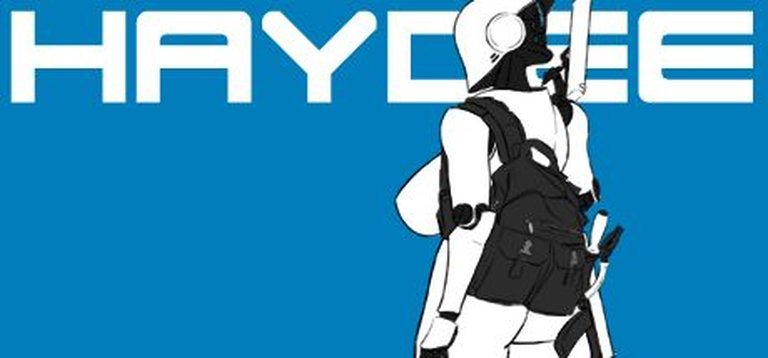
Artistically, Haydee is a study in contrasts. The titular character’s design—a curvaceous cyborg in a thong leotard and stilettos—immediately draws attention, but her featureless helmet and rigid movements evoke the uncanny valley. The camera’s lingering on her assets (a “male gaze” amplified by her “supermodel strut”) has overshadowed the game’s merits, but this design serves thematic purpose: her body is both a tool and a target, emphasizing vulnerability. Enemies like the Slasher—with their single glowing red eye—feel like extensions of the facility’s cold, mechanical will. Sound design reinforces this. Minimal, zone-specific ambient music (e.g., the ominous “Dark Theme”) and the absence of dialogue heighten tension, while diegetic cues—the clink of a mine arming, the beep of a save diskette—immerse players in Haydee’s isolation.
Reception & Legacy
Haydee’s reception was as divided as its design. Metacritic’s user score of 5.9 (“Mixed or Average”) reflects this polarity. Critics like Cubed3 praised its “fantastic, yet simple, audio-visuals” and “unconventional” challenge, calling it a “great game” that transcends its titillating premise. Conversely, others condemned its “generic” mechanics and sexualized design, with one reviewer lamenting that the developer “spent more time programming boob sway than actual gameplay.” Player reviews on Steam echoed this, with some celebrating its difficulty (“Came for the thicc, stayed for the game”) while others dismissed it as “frustrating” and “boring.”
Yet Haydee’s legacy is undeniable. It spawned two sequels: Haydee II (2020), which shifted toward survival horror, and Haydee III (2025). Its Steam Workshop became a hub for creativity, with mods ranging from character swaps to new maps—though many adult-themed mods were removed, sparking debates about censorship. The game influenced indie design by proving that a niche, mechanically rigorous title could find an audience. It’s frequently compared to Portal (for its environmental puzzles) and Mirror’s Edge (for its color-coded zones), but its true legacy lies in its polarizing impact. As one fan noted, it’s a “niche titan” that forced gamers to confront their biases about difficulty, sexuality, and art.
Conclusion
Haydee is a paradox: a game as unforgettable as it is imperfect. Its punishing difficulty, minimalist narrative, and provocative design create an experience that is as thought-provoking as it is frustrating. While its controls and enemy variety are undeniable flaws, these are overshadowed by its brilliance—a masterful synthesis of tension, atmosphere, and thematic depth. Haydee isn’t just a game; it’s a statement about the nature of struggle in artificial worlds.
Verdict: A flawed masterpiece. Haydee deserves recognition not for its titillation, but for its uncompromising vision. It remains a vital, if divisive, entry in video game history—a testament to the idea that the most memorable games aren’t always the easiest, but the ones that dare to challenge players on every level.