
- Release Year: 2006
- Platforms: Windows
- Publisher: Greenstreet Software Ltd.
- Developer: Steve J. Riggall
- Genre: Puzzle
- Perspective: Text-based / Spreadsheet, Top-down
- Game Mode: Single-player
- Gameplay: Logic puzzle, Trial and error, Word construction
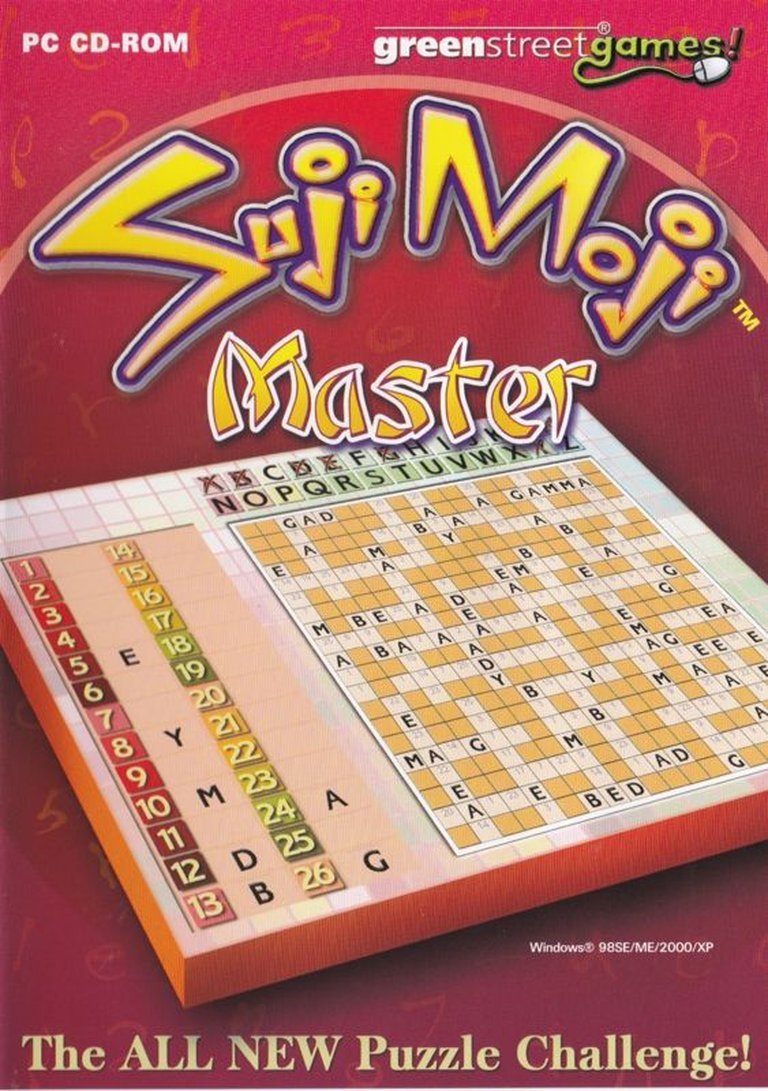
Description
Suji Moji Master is a 2006 single-player word puzzle game for Windows where players fill crossword grids without clues, starting with a blank grid or a three-letter starter word. Using logic and trial-and-error, players deduce word placements by associating letters with numbers, identifying patterns like double letters to exclude rare characters, and testing plausibility of letter-number combinations. The game features mouse controls, sound effects, three difficulty levels, a high score table, UK/US spelling options, and hint/auto-solve assists.
Suji Moji Master: Review
Introduction
In the mid-2000s, as a global sudoku craze swept newspapers and digital platforms, the puzzle genre experienced a renaissance. Amidst this wave, Suji Moji Master emerged in 2006 as a cerebral outlier from developer Greenstreet Software Ltd. While sudoku and kakuro dominated headlines, this singular word puzzle dared players to decode an enigmatic grid without traditional clues, blending linguistic deduction with numerical logic. Its legacy lies not in mass-market appeal but as a niche yet fascinating artifact of the casual puzzle boom—a testament to the era’s obsession with brain-teasers and the unexplored potential of wordplay as a gameplay mechanic. This review deconstructs Suji Moji Master’s design philosophy, execution, and place in puzzle history, arguing that its minimalist brilliance offers a pure, unadulterated challenge that transcends the limitations of its era.
Development History & Context
Suji Moji Master was crafted by Steve J. Riggall, a programmer whose portfolio spanned only five other titles, underscoring the game’s status as a passion project rather than a blockbuster endeavor. Greenstreet Software, a UK-based studio known for budget-priced educational and puzzle titles like Su Doku Master 2 and Ka Kuro Master, positioned the game as part of their “Japanese Puzzle Collection: Master Series.” This context is crucial: the 2006 gaming landscape saw puzzle games proliferate on PC and mobile platforms, driven by newspaper syndications and the accessibility of CD-ROM distribution. Technologically, the game was constrained to Windows with minimal hardware demands—no 3D acceleration or high-end specs needed. Its development ethos prioritized accessibility and replayability, offering “a lifetime of unlimited puzzles on one CD” as touted in Greenstreet’s press materials. CEO Jeff Fenton explicitly linked the game to the post-sudoku hunger for “new challenges,” positioning it as a logical evolution in the genre while emphasizing its in-house “hand-crafted” design. The era’s constraints—limited distribution channels, reliance on retail shelves—shaped its modest ambitions, but its core innovation lay in stripping away conventional puzzle scaffolding to create a raw, logic-driven experience.
Narrative & Thematic Deep Dive
Lack of narrative defines Suji Moji Master, but this absence is its thematic core. The game embodies the philosophy of pure logic, stripping crossword conventions of clues, themes, or story to distill puzzle-solving to its essence. The grid, resembling a skeletal crossword, becomes a battlefield of deduction where letters and numbers are abstract variables. The starter word—typically three letters long—serves as the only narrative anchor, a Rosetta Stone for the player to decipher. This absence of external context transforms the act of solving into a solitary meditation on language and mathematics. The game’s theme is one of epistemological purity: the player must trust only in the grid’s structure and the rules of letter-frequency logic. For instance, double-number occurrences in words hint against rare letters (e.g., “X” or “Y”), a subtle nod to linguistic probability theory. The absence of narrative isn’t a flaw but a radical statement: puzzles can be self-contained universes of pure reason. The “boss key” feature, instantly minimizing the game, further underscores this theme—puzzle-solving as a private, clandestine intellectual act, divorced from performative achievement.
Gameplay Mechanics & Systems
Suji Moji Master’s gameplay is a masterclass in minimalist design. The core loop revolves around decoding a grid where numbers (1–26) represent alphabet letters. Players start optionally with a blank grid or a starter word, then use logic and trial-and-error to fill intersecting words. Key mechanics include:
- Letter-Number Association: Players link numbers to letters (e.g., assuming “1” is “A”), then test validity by checking if associated words form plausible entries. Failed associations can be discarded, creating a risk-reward dynamic.
- Logical Deduction Tools: The “locate function” maps all instances of a starter word’s letters, revealing positional patterns. Double-number logic (e.g., a word like “11-11” likely isn’t “XX”) narrows possibilities, leveraging real-world linguistic constraints.
- Assist Features: Hints provide targeted nudges, while the auto-solve option caters to frustration tolerance. Three difficulty tiers scale puzzle complexity, and a high-score table gamifies completion speed.
- UI and Controls: Mouse-driven drag-and-drop interface ensures accessibility, with pencil marks for tentative entries. The “print & go” feature and email sharing extend play beyond the screen, emphasizing portability.
The genius lies in its emergent complexity. With no clues, every deduction feels like a breakthrough, yet the system’s simplicity—coupled with “unlimited undo”—prevents unwinnable stalemates. However, the reliance on trial-and-error occasionally undermines pure logic, especially in later puzzles. The UK/US spelling option adds localization depth, though it rarely impacts core gameplay. Ultimately, Suji Moji Master’s systems transform wordplay into a visceral, tactile experience where the grid itself is the protagonist.
World-Building, Art & Sound
Suji Moji Master exists in a world of pure abstraction. The grid, rendered in a fixed top-down perspective, is a stark black-and-white landscape with numbered squares as its sole landmarks. This minimalism evokes the aesthetic of classic spreadsheet software or simple puzzle books, creating a timeless, uncluttered space for cognitive focus. Visual cues—like highlighted double-numbers or color-coded pencil marks—guide without hand-holding, prioritizing function over flair. Sound design similarly serves utility: subtle clicks and chimes confirm actions, while the absence of ambient music keeps the player immersed in thought. The boss key’s quiet hum is the only auditory nod to external reality, reinforcing the game’s introspective tone. Unlike narrative-driven games, Suji Moji Master builds atmosphere through intellectual austerity—every empty square is a void waiting to be filled with meaning, every solved word a monument to the player’s intellect.
Reception & Legacy
At launch, Suji Moji Master received minimal critical coverage, reflecting its niche status and budget pricing. Greenstreet’s marketing targeted sudoku fans via cover-mount promotions and free printable puzzles, but the game lacked the viral traction of its contemporaries. Commercially, it occupied the shadow of Su Doku Master 2, its more recognizable sibling in the Master Series. Over time, however, its reputation has evolved among puzzle enthusiasts. Online forums and retro-gaming communities praise its “pure logic” approach, hailing it as a hidden gem for its elegant ruleset. Its legacy is twofold: it exemplifies the 2000s puzzle boom’s experimental spirit, and its letter-number decoding system prefigures modern cryptographic games like Wordle’s deductive gameplay. While it never influenced blockbuster titles, it remains a case study in minimalist design—proof that puzzle games thrive not on spectacle, but on the elegance of their rules.
Conclusion
Suji Moji Master is a paradox: a game with no story, yet one that tells the story of human reasoning. In an era of puzzle games drowning in themes and tutorials, it stands as a monument to purity. Its flaws—occasional trial-and-error drudgery and dated visuals—are eclipsed by its brilliance: a grid where every number is a mystery, every solved word a triumph. As a historical artifact, it captures the zeitgeist of 2006’s puzzle renaissance while offering a timeless challenge. For players seeking a break from bombastic narratives, Suji Moji Master remains an unparalleled exercise in logic—a quiet, cerebral masterpiece that proves the most profound puzzles are often the simplest. In the pantheon of puzzle games, it is not a bestseller, but an essential artifact—a testament to the beauty of the blank page.