
- Release Year: 2001
- Platforms: Windows
- Publisher: BBC Worldwide Ltd.
- Genre: Compilation
- Game Mode: Single-player
- Gameplay: Educational, Mini-game
- Setting: Dinosaurs, Prehistoric
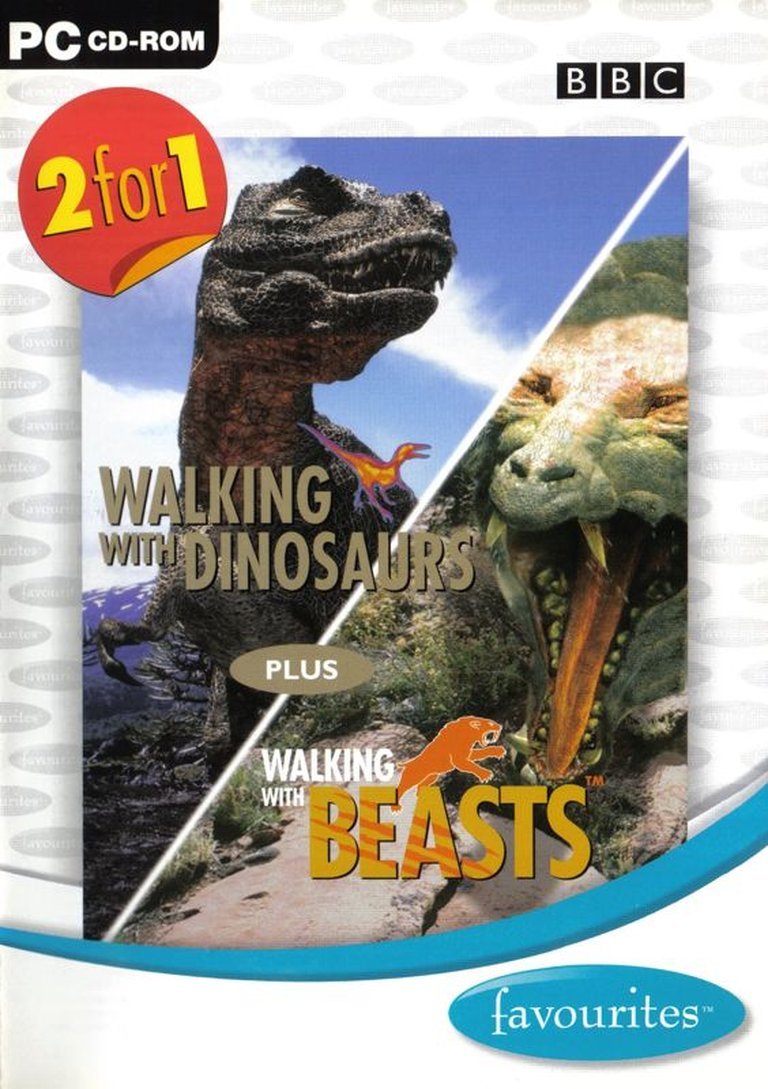
Description
Walking with Dinosaurs / Walking with Beasts is a 2001 two‑disc Windows compilation released by BBC Worldwide that combines the interactive educational title Walking with Dinosaurs—where players learn about and hunt fossils of prehistoric dinosaurs—with Walking with Beasts, a ‘save the planet’ style game set in the Cenozoic era that tasks players with protecting early mammals and their environments.
Gameplay Videos
Walking with Dinosaurs / Walking with Beasts Mods
Walking with Dinosaurs / Walking with Beasts: Review
Introduction
When the BBC first aired Walking with Dinosaurs in 1999, it rewrote the rulebook for nature documentaries, marrying cutting‑edge CGI with real‑world landscapes to make the Cretaceous feel as immediate as a modern wildlife programme. Two years later the franchise expanded its scope with Walking with Beasts, a sequel that turned the spotlight on the mammalian megafauna of the Cenozoic. The 2001 Windows CD‑ROM compilation Walking with Dinosaurs / Walking with Beasts attempts to translate that cinematic triumph into an interactive experience, delivering an educational “find‑the‑fossil” module for the dinosaur era and a “save‑the‑planet” adventure for the mammal‑rich epochs that followed.
My thesis: the compilation is an earnest, historically grounded edutainment effort that succeeds at conveying scientific wonder but suffers from dated mechanics, uneven design ambition, and a fragmented identity that leaves both casual fans and hardcore gamers unsatisfied.
Development History & Context
| Aspect | Details |
|---|---|
| Publisher | BBC Worldwide Ltd. – the commercial arm of the BBC responsible for licensing the Walking with… franchise to home‑media, books and games. |
| Developer | Absolute Studios (for the Operation Salvage segment) – a small UK studio that built the top‑down shooter around the BBC’s intellectual property. |
| Release | 2001, Windows PC (CD‑ROM). |
| Series lineage | The game is a direct off‑shoot of the BBC TV miniseries Walking with Dinosaurs (1999) and Walking with Beasts (2001). Both series were produced by Impossible Pictures, with visual effects by Framestore and animatronics by Crawley Creatures. The franchise had already amassed a suite of companion books, exhibitions and an award‑winning interactive website. |
| Technological constraints | Early‑2000s PC hardware limited the fidelity of CGI and real‑time rendering. The game used Bink Video middleware for pre‑rendered sequences and relied on a simple keyboard‑mouse control scheme. No 3‑D acceleration or physics engine was employed, which made the “save‑the‑planet” missions feel more like a series of scripted set‑pieces than a living simulation. |
| Gaming landscape | 2001 was the year The Sims dominated the casual market, while action titles like Max Payne and Grand Theft Auto III pushed narrative integration. Edutainment titles were a niche, often relegated to the “children’s CD‑ROM” shelf. Walking with Dinosaurs / Walking with Beasts entered this arena with the weight of a high‑budget documentary franchise but without the development resources of mainstream studios. |
The compilation’s dual‑disc structure mirrors the television series’ two‑part nature: Disc 1 is a quasi‑interactive documentary that encourages exploration and fossil‑spotting, while Disc 2—titled Walking with Beasts—offers a “save the planet” gameplay loop that culminates in the Operation Salvage top‑down shooter. The decision to bundle both under a single Moby ID (59925) reflects BBC Worldwide’s strategy of cross‑selling the franchise’s educational content as a single product.
Narrative & Thematic Deep Dive
Walking with Dinosaurs (Disc 1) – “Find the Fossil”
The narrative is deliberately minimal; the player is placed in a virtual museum‑style interface where each screen corresponds to a prehistoric habitat rendered from the TV series. A voice‑over (the same Kenneth Branagh narration used in the broadcast) provides scientific context, while the player clicks on terrain, plants and animal silhouettes to uncover hidden fossils.
Themes:
– Scientific discovery – the act of locating a fossil mirrors the real‑world process of paleontological fieldwork.
– Chronological storytelling – the game follows the same six‑episode progression as the series, moving from the Triassic to the Late Cretaceous.
– Accessibility – the ELSPA rating of 3+ (for the dinosaur portion) underscores the intent to reach a broad, family‑friendly audience.
Walking with Beasts (Disc 2) – “Save the Planet”
Here the narrative shifts to a speculative 2036 where humanity has mastered time travel. Players join the World Wildlife Bionetwork (WWB), tasked with monitoring Cenozoic fauna while thwarting a rogue operative, Agent Vega, who is trapping creatures for unknown motives. Each mission is anchored to a geological period (Eocene, Oligocene, Pliocene, Pleistocene, etc.) and is introduced with a short cinematic that blends archival footage from the TV series with newly rendered CGI.
Themes:
– Conservation – the overarching goal of “saving the planet” mirrors the series’ subtle environmental message about the fragility of ecosystems over deep time.
– Temporal agency – by granting the player a remote‑controlled “Explorer” vehicle, the game explores the ethical implications of observing (and intervening in) prehistory.
– Human evolution – episodes such as Next of Kin and Mammoth Journey introduce early hominins, tying the player’s mission to the eventual rise of humanity.
Both discs share a narrative through‑line: the past is a laboratory for understanding the present. The TV series’ emphasis on “what would these animals have done?” is echoed in the game’s interactive prompts, which ask the player to hypothesize animal behaviour by placing cameras, bait, or explosives.
Gameplay Mechanics & Systems
| System | Description | Strengths | Weaknesses |
|---|---|---|---|
| Find the Fossil (Disc 1) | Point‑and‑click exploration of static environments; hidden fossils are revealed by clicking on subtle visual cues. | Easy to learn; teaches fossil identification; faithful to the educational tone of the series. | No progression system; limited interactivity; repetitive “click‑hunt” loop. |
| Operation Salvage (Disc 2) | Top‑down shooter with mission‑based objectives: place cameras, release trapped animals, destroy enemy tech. Players steer the Explorer with keyboard, aim/fire with mouse, and use a radial menu to deploy items. | Clear, repeatable objectives; varied geological settings; introduces a light‑strategy layer (camera placement probability). | Clunky UI; camera‑placement percentages feel arbitrary; shooting mechanics are rudimentary, lacking enemy AI depth. |
| Difficulty Levels | Three tiers: Easy (capture any beast on video), Medium (capture specific behaviours), Hard (exact action required). | Provides scalability for younger players and casual fans. | Hard mode is unforgiving; the “chance of success” percentages are opaque, leading to trial‑and‑error frustration. |
| Scoring & High‑Score Table | Points awarded for successful recordings, animal releases, and enemy destruction; top‑10 leaderboard persists per session. | Encourages replayability for completionists. | No persistent save‑state between sessions; scores are reset on each launch, diminishing long‑term motivation. |
| Controls | Keyboard for movement, mouse for item placement and shooting. | Simple, low‑barrier input scheme. | Lack of controller support; camera‑placement UI obscures the screen. |
| Audio/Video Integration | Bink Video middleware is pre‑rendered CGI cut‑scenes from the TV series; ambient soundscapes accompany each habitat. | High‑quality footage gives the game a cinematic sheen despite hardware limits. | Transitions between video and gameplay are jarring; the audio mix occasionally drowns narration. |
Overall, the core loop can be summed up as: explore → identify → capture → report. The game’s ambition to blend education with action is evident, but the execution feels split between two disparate design philosophies: a passive museum exhibit on one side and a modest arcade shooter on the other.
World‑Building, Art & Sound
Visual Direction
- CGI Fidelity – The game re‑uses assets from the BBC series, which were already state‑of‑the‑art for 1999‑2001 television. The textures, while still impressive on a 2001 PC, betray their pre‑rendered nature when juxtaposed against the low‑poly, sprite‑based shooter environments.
- Environmental Diversity – Each Operation Salvage mission is set in a distinct paleo‑landscape (e.g., a volcanic lake in Germany, a Tethys Sea reef, a Pleistocene tundra). The background art borrows heavily from the series’ location footage (Florida, Mexico, Java, Mongolia, Ethiopia, Patagonia, Yukon), lending authenticity.
- Animatronics Influence – The design of animal models respects the series’ animatronic work (e.g., the woolly mammoth’s fur and the massive whiskers of the Gastornis). However, the real‑time engine cannot reproduce the subtle facial animations that made the TV series’ creatures feel alive.
Audio Design
- Narration – The UK version retains Kenneth Branagh’s authoritative tone, while the US version employs Stockard Channing (or Christian Slater for the Prehistoric Planet edit). The narration is largely unchanged from the TV series, providing continuity but also a sense of redundancy during gameplay.
- Soundscape – Kenny Clark’s original sound design for Walking with Beasts (a collage of animal noises, foley, and manipulated recordings) is present in the game’s background ambience. The mixing, performed by Chris Burdon, balances 64 tracks into a stereo mix that feels lush for its era.
- Music – Composer Ben Bartlett’s score, originally written for the documentary, underscores the in‑game moments with sweeping orchestral cues that shift from “grand” during exploratory phases to “tense” during combat.
The overall atmosphere succeeds in immersing the player in deep‑time ecosystems, largely because the game leans on the TV series’ production values. The audio‑visual synergy reinforces the educational goals, even if the gameplay itself feels secondary to the spectacle.
Reception & Legacy
| Metric | Data |
|---|---|
| Critical scores | MobyGames lists a 42 % average (2 critic reviews) for Operation Salvage: Wolf Magazine 4.5/10, Absolute Games 44/100. No aggregated score for the overall compilation. |
| Commercial performance | No publicly disclosed sales figures; the ELSPA “11+” rating suggests a target demographic of older children and families. |
| Awards | The Walking with Beasts TV series earned a BAFTA Interactive Entertainment Award for “Enhancement of Linear Media”, a Monitor Award for 3D Animation, and a Primetime Emmy for Outstanding Animated Program. The game itself did not win any industry awards. |
| Legacy | – Educational value – The compilation remains a reference point for early 2000s edutainment, often cited in academic papers on digital paleontology. |
– Influence on later titles – The Walking with… franchise inspired later interactive documentaries (e.g., Prehistoric Planet on Discovery Kids) and contributed to the rise of “nature‑documentary games” such as Planet Zoo’s prehistoric DLC.
– Cultural footprint – The TV series’ success eclipsed its game counterpart; the Walking with brand is more remembered for its groundbreaking visual effects than its CD‑ROM adaptations.
In hindsight, the game’s mixed reception reflects a mismatch between the franchise’s cinematic aspirations and the modest capabilities of early‑2000s PC gaming. While the compilation introduced many children to paleontology, its gameplay never achieved the depth required to become a classic in its own right.
Conclusion
Walking with Dinosaurs / Walking with Beasts stands as a fascinating artifact at the intersection of documentary filmmaking and interactive media. Its strengths lie in the faithful translation of high‑budget CGI, meticulous sound design, and a clear educational mission that mirrors the BBC’s scientific ethos. Its weaknesses—clunky controls, a bifurcated design that fails to fully integrate the “find‑the‑fossil” and “save‑the‑planet” pillars, and dated graphics—prevent it from achieving lasting gameplay relevance.
For historians of media, the compilation offers a snapshot of early 21st‑century attempts to commodify scientific storytelling. For modern gamers, it feels more like a museum exhibit than a console‑worthy title.
Verdict: Walking with Dinosaurs / Walking with Beasts earns a relegated place in video‑game history: an earnest, historically grounded edutainment experiment that succeeded in its educational intent but fell short of the interactive standards set by its television predecessor. It is a valuable reference for scholars and a nostalgic curiosity for fans of the franchise, but not a title that stands the test of time as a standalone gaming experience.