
- Release Year: 2016
- Platforms: iPhone, Linux, Macintosh, Nintendo Switch, PlayStation 3, PlayStation 4, PlayStation 5, PS Vita, Windows Apps, Windows, Xbox One, Xbox Series
- Publisher: Axolot Games, Redbeet Interactive
- Developer: Redbeet Interactive
- Genre: Simulation
- Perspective: 1st-person
- Game Mode: Online Co-op, Single-player
- Gameplay: Base building, Combat, Crafting, Diving, Engine, Exploration, Farming, Fishing, Resource collection, Sailing, Steering, Survival, Trapping
- Setting: Islands, Open ocean, Sea
- Average Score: 82/100
Description
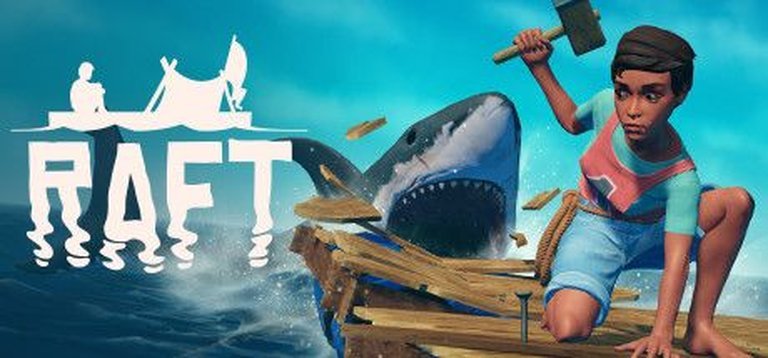
Raft is a first‑person survival simulation where players start stranded on a tiny wooden raft drifting across an endless ocean. Using a hook to collect floating debris, they must gather food, water and materials to craft tools, expand the raft into a floating base, and fend off a persistent shark. The game features resource gathering, crafting, fishing, farming, and exploration of islands and underwater wrecks, with a narrative revealed through notes and recordings. Multiplayer allows cooperative building and survival on a shared raft.
Gameplay Videos
Where to Buy Raft
PC
Raft Free Download
Raft Cracks & Fixes
Raft Mods
Raft Guides & Walkthroughs
Raft Reviews & Reception
metacritic.com (80/100): Raft is simply one of the most charming survival games I’ve played.
pcgamer.com : A choppy start leads to a compelling survival experience in Raft.
Raft Cheats & Codes
PC
Enable console via a mod, open it with the ` (tilde) key, then type the command and press Enter.
| Code | Effect |
|---|---|
| /spawn boar | Spawns a boar animal |
| /spawn chicken | Spawns a chicken |
| /spawn goat | Spawns a goat |
| /spawn llama | Spawns a llama |
| /spawn pufferfish | Spawns a pufferfish |
| /spawn shark | Spawns a shark |
| /spawn stonebird | Spawns a stonebird |
| /spawn landmark | Spawns a landmark island |
| /spawn landmark_big | Spawns a big landmark |
| /spawn landmark_pilot | Spawns a pilot landmark |
| /spawn landmark_raft | Spawns a raft landmark |
| /set blockhealth X | Sets character health to the specified value X |
| /set bonushunger X | Adds X hunger to the character |
| /set fps X | Sets the game’s frame rate to X FPS |
| /set gamemode X | Changes the game mode to the specified value X |
| /set hunger X | Sets character hunger to X |
| /set oxygen X | Sets character oxygen level to X |
| /set thirst X | Sets character thirst to X |
| /clear “item or animal” | Removes all instances of the specified item or animal from the world |
| /godmode | Enables God Mode (invulnerability) |
| /shift | Teleports the raft to the middle of the game world |
PS4
Enable console via a mod, open it with the ` (tilde) key, then type the command and press Enter.
| Code | Effect |
|---|---|
| /spawn boar | Spawns a boar animal |
| /spawn chicken | Spawns a chicken |
| /spawn goat | Spawns a goat |
| /spawn llama | Spawns a llama |
| /spawn pufferfish | Spawns a pufferfish |
| /spawn shark | Spawns a shark |
| /spawn stonebird | Spawns a stonebird |
| /spawn landmark | Spawns a landmark island |
| /spawn landmark_big | Spawns a big landmark |
| /spawn landmark_pilot | Spawns a pilot landmark |
| /spawn landmark_raft | Spawns a raft landmark |
| /set blockhealth X | Sets character health to the specified value X |
| /set bonushunger X | Adds X hunger to the character |
| /set fps X | Sets the game’s frame rate to X FPS |
| /set gamemode X | Changes the game mode to the specified value X |
| /set hunger X | Sets character hunger to X |
| /set oxygen X | Sets character oxygen level to X |
| /set thirst X | Sets character thirst to X |
| /clear “item or animal” | Removes all instances of the specified item or animal from the world |
| /godmode | Enables God Mode (invulnerability) |
| /shift | Teleports the raft to the middle of the game world |
Xbox One
Enable console via a mod, open it with the ` (tilde) key, then type the command and press Enter.
| Code | Effect |
|---|---|
| /spawn boar | Spawns a boar animal |
| /spawn chicken | Spawns a chicken |
| /spawn goat | Spawns a goat |
| /spawn llama | Spawns a llama |
| /spawn pufferfish | Spawns a pufferfish |
| /spawn shark | Spawns a shark |
| /spawn stonebird | Spawns a stonebird |
| /spawn landmark | Spawns a landmark island |
| /spawn landmark_big | Spawns a big landmark |
| /spawn landmark_pilot | Spawns a pilot landmark |
| /spawn landmark_raft | Spawns a raft landmark |
| /set blockhealth X | Sets character health to the specified value X |
| /set bonushunger X | Adds X hunger to the character |
| /set fps X | Sets the game’s frame rate to X FPS |
| /set gamemode X | Changes the game mode to the specified value X |
| /set hunger X | Sets character hunger to X |
| /set oxygen X | Sets character oxygen level to X |
| /set thirst X | Sets character thirst to X |
| /clear “item or animal” | Removes all instances of the specified item or animal from the world |
| /godmode | Enables God Mode (invulnerability) |
| /shift | Teleports the raft to the middle of the game world |
Raft: Review
Introduction
Floating adrift on an endless blue, clutching a flimsy hook, the player of Raft is thrust into a survival scenario that feels at once primitive and oddly poetic. What begins as a minimalist “hook‑and‑gather” sandbox quickly blossoms into a sprawling, narrative‑driven odyssey across a flooded world. My thesis is simple: Raft succeeds because it marries a tightly‑controlled core survival loop with a surprisingly deep, emergent story, all while fostering a cooperative experience that makes the ocean feel both hostile and communal.
Development History & Context
Origins & Early Access
Redbeet Interactive—three Uppsala University students (André Bengtsson, Semih Parlayan, Ellen Mellåker)—released a free prototype on Itch.io in December 2016. The prototype’s hook‑catch mechanic and the promise of a “survival craft on the sea” caught the attention of YouTubers such as Jacksepticeye and Markiplier, driving over seven million downloads before the game entered Steam Early Access on 23 May 2018.
Studio & Publisher
The success of the prototype prompted the trio to found Redbeet Interactive as a formal studio and to partner with Axolot Games (the publishers behind Scrap Mechanic). Redbeet’s team, now eight developers, continued to expand the game under a tight, restrictive design philosophy: keep the play area small enough to feel claustrophobic, yet give players enough freedom to explore islands and underwater wrecks.
Technological Constraints
Built on Unity, Raft had to reconcile two competing demands: a fully procedurally‑generated ocean that could stretch indefinitely, and a physically‑accurate, movable raft with hundreds of colliders. The developers solved this by “activating” only nearby colliders and merging static geometry, preserving performance even on modest hardware.
Market Landscape
When Raft launched, the survival genre was dominated by sandbox giants (Minecraft, Rust, Subnautica). Its unique “floating‑base” premise differentiated it from the land‑based or underwater‑only experiences of its peers, and its early‑access model allowed the community to shape its evolution over four years before the final chapter shipped on 20 June 2022.
Narrative & Thematic Deep Dive
The Flooded Apocalypse
Raft is set in a world where climate‑driven polar melt has submerged the planet. The backstory—revealed through scattered notes, audio logs, and environmental storytelling—unfolds across eight major locations:
| Chapter | Location | Core Narrative Beats |
|---|---|---|
| 1 | Radio Tower | Forward Scouts (Maya, Roy, etc.) build a receiver to locate signals; the tower’s notes hint at a “Utopia” beyond the waves. |
| 1.1 | Vasagatan | An abandoned luxury yacht, owned by Olof Wilkstrom, reveals class‑based attempts at escape and the first signs of mutiny. |
| 1.2 | Balboa Island | Twin siblings Bruno and Astrid manage a wildlife relay; their personal tragedies underscore isolation. |
| 2 | Caravan Town | A makeshift settlement plagued by salmonella and hyenas; the community’s desperate attempts to survive illustrate social breakdown. |
| 2.1 | Tangaroa City | A floating dome city under a failing reactor; the player discovers the hub’s internal politics and the rise of Olof’s mut. |
| 3 | Varuna Point | A submerged construction site with electric jellyfish and a “mother‑road” boss; it mirrors humanity’s abandoned infrastructure. |
| 3.1 | Temperance | Arctic research outpost with a nuclear reactor; the player restores power, confronting the consequences of reckless tech. |
| 3.2 | Utopia | The final settlement where Olof’s hyena‑army rules; the player frees the captive survivors, ending the narrative arc on a hopeful note. |
Themes
- Climate Collapse & Class Segregation – The flood is a direct allegory for rising sea levels; the elite’s floating cities (Tangaroa, Utopia) contrast starkly with the rag‑tag rafts of the masses.
- Isolation vs. Community – Early solo play emphasizes loneliness; later co‑op mode demonstrates how shared labor transforms a precarious raft into a thriving settlement.
- Human Hubris & Technological Overreach – The reactor’s failure, mutated rats, and the hyena army illustrate the dangers of unchecked scientific ambition.
- Hope & Adaptation – Despite the bleak setting, the player’s incremental progress—building a sail, a stove, a radio—embodies a perseverance narrative.
The story is deliberately low‑key: most lore is hidden in environmental cues and optional audio diaries, rewarding curious players without forcing a linear plot.
Gameplay Mechanics & Systems
Core Survival Loop
- Resource Harvesting – The player throws a hook to snag planks, palm leaves, plastic, and occasional crates.
- Crafting & Construction – Basic recipes (plank → fence) evolve into high‑tech blueprints (engine, smelter).
- Hunger/Thirst/Health Management – A three‑meter system forces constant attention; food can be farmed, fished, or hunted.
- Threat Management – A constantly circling shark attacks raft edges; later enemies include bears, mutant rats, and hyenas.
Crafting & Progression
- Blueprint Tree – Starts with simple tools, expands through research tables and discovered items. The tree is semi‑linear, ensuring a steady sense of progression.
- Automation – Nets, water purifiers, and later electric grills reduce micromanagement, letting players focus on exploration.
Combat & Defense
- Shark AI – Periodic “bite” events keep the player on edge; a spear, bow, and later electric fences provide defense.
- Island Threats – Bears on Balboa, lurkers in Vasagatan, and hyenas in Utopia add variety to combat encounters.
Exploration & Navigation
- Sailing & Steering – The addition of a steering wheel and engine transforms the raft into a true vessel, giving the player agency over direction.
- Underwater Diving – An oxygen tank and flippers let players harvest rare resources (metal, clay) but introduce new hazards (electric jellyfish, predators).
Multiplayer
- Co‑op Division of Labor – Players can assign roles (gatherer, builder, navigator) and share a single raft.
- Resource Scaling – More players increase consumption, creating a balancing act between growth and sustainability.
UI & Feedback Systems
- Minimalist HUD – Hunger, thirst, health, and a small radar for nearby debris keep the screen uncluttered.
- Journal/Notebook – Auto‑logs story entries, coordinates, and discovered blueprints, acting as both a lore compendium and a navigation aid.
Innovations & Flaws
- Innovations – The “floating base” concept, dynamic ocean currents, and the integration of story through environmental notes.
- Flaws – Early‑game grind feels punishing; raft construction can become a “furniture‑first, house‑later” mess, as noted by PC Gamer. The lack of a true fast‑travel system can make distant islands feel tedious to reach.
World‑Building, Art & Sound
Visual Direction
- Low‑Poly, Cartoon‑ish Aesthetic – Bright, saturated colors contrast with the desolate ocean, giving the game a whimsical yet urgent tone.
- Island Variety – Each major location sports a distinct biome (tropical, arctic, desert) and hand‑crafted structures, reinforcing the sense of discovery.
Atmosphere & Audio
- Ambient Soundscape – Waves, distant gulls, and the occasional shark roar create an immersive, lonely backdrop.
- Dynamic Music – Composer Jannik Schmidt’s score shifts from calm, melodic loops while drifting to tense percussion during shark attacks or boss encounters.
- Radio Cassettes – In‑game recordings provide both narrative exposition and audio texture, making the world feel lived‑in.
Sound Design
- Hook & Water Interactions – The satisfying “clink” of catching debris reinforces the core loop.
- Shark Attacks – Sudden, sharp noises cue danger, heightening tension.
Overall, the audiovisual palette underscores the theme of survival against an indifferent sea while allowing moments of calm reflection.
Reception & Legacy
Critical Reception
| Outlet | Score | Highlights |
|---|---|---|
| Gameplay (Benelux) | 81 % | “Unique, atmospheric setting; mysterious story” |
| PC Gamer | 80 % | “Compelling survival after a choppy start; empowering crafting progression” |
| Unboxed Reviews | 74 % | “Reasonably priced, enjoyable with family; concerns about future updates” |
| MobyGames | 78 % (3 critics) | “Solid survival sandbox; strong community” |
Critics consistently praised the evolving crafting system and the emergent narrative, while noting the rough early‑game pacing.
Player Sentiment
- Steam – As of February 2026, Raft holds a 93 / 100 “Very Positive” rating from over 360 k user reviews, with a 56 % positive share on Metacritic.
- Community – YouTube Let, Reddit discussions, and the “Better With Friends” Steam Award (2022) attest to a vibrant, cooperative player base.
Influence & Industry Impact
- Genre Differentiation – By confining players to a mobile base, Raft carved a niche distinct from land‑based sandbox survival games.
- Indie Success Model – Demonstrated that a small team could achieve massive success through early‑access community feedback and steady content updates.
- Cross‑Title Inspirations – Later titles such as Subnautica‑style underwater exploration and Spiritfarer’s floating‑home aesthetic have cited Raft as an influence.
Conclusion
Raft is a study in how constraints can breed creativity. Its modest beginnings—a 2 × 2 wooden platform and a single hook—have grown into a richly layered survival sandbox that balances a compelling, if understated, narrative with deep crafting and cooperative play. The game’s visual charm, atmospheric sound design, and emergent storytelling keep players invested long after the initial grind.
Verdict: Raft deserves a place among the seminal survival titles of the 2010s‑2020s. It may never achieve the universal acclaim of Minecraft or the narrative depth of The Last of Us, but its unique blend of oceanic isolation, progressive engineering, and community‑driven evolution makes it a landmark of indie design and a testament to the enduring allure of building a home—no matter how adrift it may be.