
- Release Year: 2015
- Platforms: Linux, Macintosh, Windows
- Publisher: Degica Co., Ltd.
- Developer: Pigasus Games
- Genre: Adventure
- Perspective: Diagonal-down
- Game Mode: Single-player
- Gameplay: City building, construction simulation, Point-and-click
- Setting: Fantasy
- Average Score: 65/100
Description
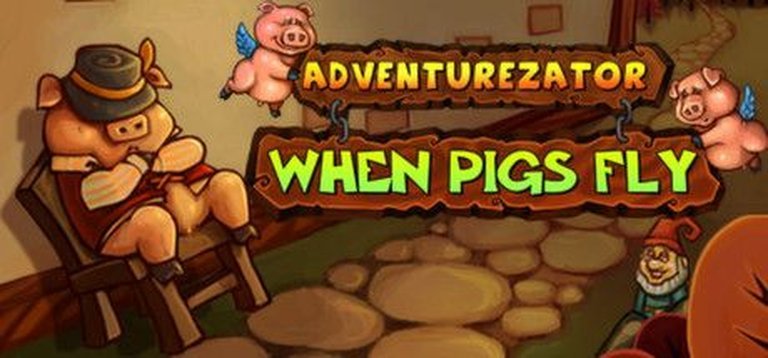
Adventurezator: When Pigs Fly is a cel‑shaded fantasy adventure that follows Edmund, a human transformed into a pig‑man, on his quest to regain his humanity with the help of his gnome companion Zookwinkle. Set in a whimsical world of villages, castles, dungeons and more, the game blends classic point‑and‑click puzzle solving with a meta‑creation platform where players can design and share their own adventure titles.
Gameplay Videos
Where to Buy Adventurezator: When Pigs Fly
PC
Adventurezator: When Pigs Fly Guides & Walkthroughs
Adventurezator: When Pigs Fly Reviews & Reception
metacritic.com (60/100): Adventurezator’s heart is in the right place, but neither the game nor its user‑creation system is quite there yet.
justadventure.com : I’d give it a pass – the game feels overwhelming and its controls are unintuitive.
geekyhobbies.com : The campaign is decent but not enough to justify purchasing the game.
steambase.io (70/100): Player Score of 70/100, indicating a mostly positive reception.
Adventurezator: When Pigs Fly – Review
Introduction
Hook: A wing‑clad swine swoops onto the screen, declares “We are Pigasus. Mighty game developers,” and invites you into a world where you are both player and creator.
Legacy: Released on 17 September 2015 for Windows, macOS and Linux, Adventurezator: When Pigs Fly is the flagship campaign of the Adventurezator platform—an ambitious attempt to fuse classic point‑and‑click adventure gameplay with a fully‑featured, no‑code game‑creation suite.
Thesis: The title delivers a charming, cel‑shaded fantasy adventure that showcases a genuinely novel sandbox, yet its execution is hampered by rough UI, limited puzzle depth, and an under‑cooked creation pipeline. As a historical artifact it marks a bold experiment in user‑generated adventure content, even if the final product feels more like a prototype than a polished masterpiece.
Development History & Context
Studio & Vision
- Developer: Pigasus Games, a small Brazilian indie team (14 credited staff, 8 developers, 6 thanks).
- Project Lead & Lead Programmer: Fabio Stange (Petrucio).
- Key Creative Leads: 3D art – Rafael Morais; 2D art – Samara Sena; Game design – Carlos Eduardo Medeiros (Peter); Writing – Paulo de Tarso; Voices – Grampa Mike.
- Publisher: Degica Co., Ltd.
The studio’s ambition, articulated in a 2014 IndieDB “behind‑the‑scenes” post, was to invert the traditional adventure‑development pipeline: instead of story dictating assets, the Adventurezator would define the asset set first, then shape the narrative around those building blocks. This “content‑first” approach was intended to guarantee that the editor would have everything needed for any fantasy setting—rural villages, castles, dungeons, etc.
Technological Constraints
- Engine: Unity (custom cel‑shaded visual pipeline).
- Target Platforms: Windows, macOS, Linux; minimum specs were modest (1.7 GHz dual‑core CPU, 4 GB RAM, 512 MB VRAM).
- Era Landscape (2015): The indie market was saturated with point‑and‑click revivals (e.g., Thimbleweed Park) and user‑generated content platforms (e.g., LittleBigPlanet, Minecraft). Adventurezator attempted to carve a niche at the intersection of adventure storytelling and sandbox creation, a space largely unexplored at the time.
Funding & Release
- Initially launched via a Kickstarter campaign (mid‑2013), promising a “Madness! Brilliant madness.”
- The game shipped on Steam, GOG, and itch.io for $19.99, with post‑launch patches (1.0.1‑1.0.3) addressing UI scaling, achievement unlocking, and missing assets (e.g., Alchemy Kit).
Narrative & Thematic Deep Dive
Core Plot
The single‑player campaign, When Pigs Fly, follows Edmund, a human merchant who scams a wizard, is transformed into a pig‑man, and must collect alchemical ingredients to regain his humanity. His companion, Zookwinkle the Gnome, provides comic relief and occasional hints.
Characters & Dialogue
- Edmund – a sarcastic anti‑hero whose transformation forces him to confront his own greed.
- Zookwinkle – a whimsical, overly enthusiastic gnome whose dialogue often references classic fairy‑tale tropes.
- Supporting Cast: Includes parodic versions of Isaac Newton, the Seven Dwarves, and “Weeping Angels” (a clear nod to Doctor Who). The writing (Paulo de Tarso) blends slapstick humor with meta‑commentary on adventure‑game conventions.
Themes
- Transformation & Redemption: Edmund’s pig‑form is both a literal and metaphorical loss of humanity, prompting players to consider the cost of selfishness.
- Meta‑Adventure: The campaign itself serves as a tutorial for the sandbox, blurring the line between playing a story and building one.
- Fairy‑Tale Subversion: By inserting absurd elements (flying pigs, peeing pigasus fountains) into familiar mythic settings, the game satirizes the rigidity of classic adventure tropes.
Endings & Replayability
Three to four distinct endings are tied to hidden puzzles and optional dialogue branches, encouraging multiple playthroughs. Some endings require solving a “Weeping Angel” puzzle that references Doctor Who lore, rewarding genre‑savvy players with extra humor.
Gameplay Mechanics & Systems
Core Loop
- Point‑and‑Click Exploration: Diagonal‑down isometric view; click to move, interact, or rotate the camera (left/right only).
- Puzzle Solving: Collect items, use “action tables,” converse with NPCs, and occasionally engage in instant‑death combat that sends you back to the level start.
- Inventory & Objectives: UI displays a goal list, inventory, and active characters; UI elements can be toggled for a cleaner view.
Creation Tools (Adventurezator)
| System | Description | Notable Strengths | Weaknesses |
|---|---|---|---|
| Level Editor | Drag‑drop placement of pre‑made objects (fountains, doors, NPCs). | Rapid prototyping; no scripting required. | Fixed asset library; no custom textures. |
| Actor Editor | Assemble characters from a palette of heads, bodies, and accessories. | Simple character creation for non‑technical users. | Limited animation options; no facial expression control. |
| Cutscene Editor | Timeline‑based placement of images, sounds, and effects. | Enables cinematic storytelling without code. | Lacks advanced transitions; requires pre‑made assets. |
| Campaign Editor | Chain levels together, define objectives, and set branching paths. | Facilitates multi‑chapter adventures. | No built‑in publishing pipeline beyond Steam Workshop. |
| Free‑Form Object Interaction | Objects automatically react (e.g., a cup fills a fountain). | Encourages emergent gameplay. | Interaction rules can be opaque; occasional bugs (e.g., off‑screen buttons). |
UI & Controls
- Point‑and‑Select Interface (MobyGames).
- Camera Rotation limited to horizontal axis; vertical tilt absent, causing occasional navigation frustration (as noted by Just Adventure).
- Resolution Issues: Early builds suffered from UI elements disappearing at high resolutions; patched in 1.0.3.
Combat & Crafting
- Combat is essentially a puzzle: you must avoid instant death or find a hidden “strength” item.
- Crafting (alchemy kit) appears in later patches; used to combine ingredients for the spell reversal.
Performance & Stability
- Unity engine provides decent frame rates on modest hardware.
- Linux users reported a black‑screen launch bug (strace shows “bad hardware address length”), later addressed in patches.
World‑Building, Art & Sound
Visual Direction
- Cel‑Shaded 3D style (MobyGames). The aesthetic blends cartoonish charm with a slightly retro isometric feel, reminiscent of Ultima 6 and Monkey Island (as per Just Adventure).
- Environment Sets: Fancy Castle, Rural Village, Dungeon, etc., each designed first as a concept diagram, then refined by art director Samara Sena. This pipeline ensured that each level contained a full suite of reusable assets.
Audio Design
- Full Audio with subtitles (Steam).
- Voice Acting: Provided by Grampa Mike, delivering a deliberately over‑the‑top performance that matches the game’s comedic tone.
- Music & SFX: Light, whimsical orchestration that reinforces the fantasy setting without overwhelming the player.
Atmosphere & Immersion
- The fantasy setting is populated by anthropomorphic pigs, gnomes, and classic fairy‑tale figures, creating a playful yet slightly absurd atmosphere.
- The cutscene editor and dynamic object interactions contribute to a feeling of a living, reactive world, though occasional UI glitches can break immersion.
Reception & Legacy
Critical Reception
- Adventure Gamers (2016): 60 % (3/5 stars) – praised charm and potential, criticized unfinished systems and UI quirks.
- Gameplay (Benelux, 2015): Mixed Dutch review; highlighted “genius” moments and “less‑than‑ideal” sections.
Player Sentiment
- Steam Community (2026): 70 % player score (mostly positive) based on 104 reviews; common praise for the editor’s accessibility, but frequent complaints about combat death traps, hidden UI elements, and the steep learning curve of the creation tools.
- Common Issues: Achievements not unlocking (fixed in 1.0.3), resolution‑dependent UI bugs, and a lack of a thriving user‑generated adventure ecosystem.
Influence & After‑effects
- Industry Impact: While Adventurezator never sparked a wave of point‑and‑click creation platforms, it demonstrated that integrated level editors could be bundled with a narrative campaign—a concept later echoed in titles like Dreams (Media Molecule) and The Swords of Ditto (RPG Maker‑style).
- Community: The Steam Workshop hosts a modest collection of fan‑made scenarios (e.g., “Halloween Prison Break,” “Pigasus Arena”). The game’s longevity owes more to its sandbox potential than to its core campaign.
Legacy Assessment
- Historical Position: Adventurezator stands as a courageous early‑adopter of user‑generated adventure content, predating many modern “no‑code” game‑making tools. Its mixed reception reflects the difficulty of delivering both a polished adventure and a robust creator suite within a modest indie budget.
Conclusion
Adventurezator: When Pigs Fly is an ambitious hybrid that succeeds in delivering a whimsical, cel‑shaded adventure while simultaneously offering a surprisingly capable, script‑free creation suite. The campaign’s humor, meta‑narrative, and multiple endings provide a respectable single‑player experience, but the UI roughness, limited puzzle depth, and under‑developed distribution channels keep it from achieving mainstream acclaim.
Verdict: A cult‑class experiment that will delight creative players willing to overlook its technical hiccups. For historians of indie game design, it is a noteworthy case study in how a small team can attempt to democratize adventure‑game development—if not a must‑play for the casual adventure fan.
Final Rating: ★★★☆☆ (3 out of 5) – Potential outweighs polish, making it a fascinating footnote in the evolution of user‑generated content tools.