
- Release Year: 2013
- Platforms: Windows
- Publisher: UIE Inc.
- Genre: Compilation
- Average Score: 67/100
Description
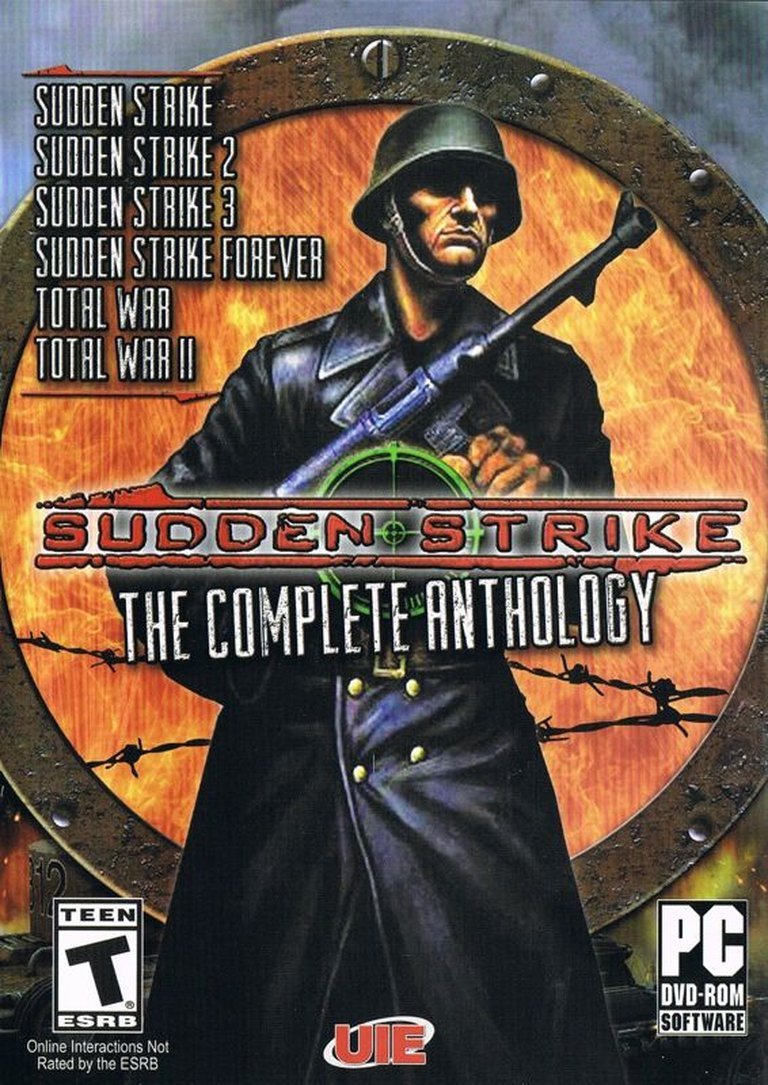
Sudden Strike: The Complete Anthology is a compilation of real-time tactics games set during World War II, including titles from the Sudden Strike series and related games like Total War. Players take command of historical military units—such as infantry, tanks, and artillery—for factions including the Soviets, Germans, and Allies, focusing on tactical combat without resource gathering or base development.
Sudden Strike: The Complete Anthology Reviews & Reception
retro-replay.com : Sudden Strike: Anthology offers a rich tactical real-time strategy experience that sets itself apart by focusing on frontline engagements rather than base building.
metacritic.com (67/100): Worth a look. Even if you are not a fan of the period or prefer more traditional RTS games, you will probably find that the challenges offered by the diverse campaigns will suck in more of your time than you expected.
Sudden Strike: The Complete Anthology: A Monument to Tactical Purity in the RTS Genre
Introduction: The Uncompromising Battlefield
In the pantheon of World War II real-time strategy games, few series have commanded the fierce loyalty and ignited such passionate debate as Fireglow Games’ Sudden Strike. Emerging from the Russian development scene at the dawn of the new millennium, it carved a distinct identity by rejecting the burgeoning trend of base-building and resource-gathering micro-management. Instead, it offered a brutal, cerebral, and unflinching focus on the tactical Command & Conquer was deconstructing. Sudden Strike: The Complete Anthology (2013), a compilation released over a decade after the series’ debut, serves not as a remastered collection but as a curated museum piece—a raw, unvarnished archive of a specific, austere design philosophy. This review argues that the Anthology’s primary value lies not in graphical fidelity or modern conveniences, but in its role as an essential historical document, preserving a challenging and influential strand of RTS design that prioritized battlefield realism and tactical depth over accessibility. It is a demanding, sometimes frustrating, but ultimately profound testament to the idea that warfare is a puzzle of logistics, terrain, and timing, not a race to build the biggest tank.
Development History & Context: Forged in the Fires of Post-Soviet Innovation
The story of Sudden Strike is intrinsically linked to its developer, the Russian studio Fireglow Games. Operating in the early 2000s, Fireglow was part of a wave of Eastern European studios that leveraged technical ingenuity and a deep, pragmatic understanding of PC hardware constraints to create compelling strategy experiences. While Western studios like Blizzard and Westwood were refining fantasy and sci-fi RTS templates, Fireglow looked to the past—specifically, to the hardscrabble realism of DOS-era tactics games like Counter Action (1996)—and reimagined them for the 3D-accelerated era.
Sudden Strike (2000) was built on a proprietary 2D isometric engine, a conscious choice that allowed for precise control of hundreds of units on modest systems. This technical decision directly enabled its core gameplay: dense, chaotic formations where every soldier and tank had a visible presence. The constraints forced a minimalist UI and a focus on what could be clearly represented on screen—line-of-sight, cover, and unit specialization. The series’ evolution, charted through Sudden Strike II (2002), Sudden Strike: Forever (2001, an expansion/standalone), and the pivot to full 3D with Sudden Strike 3: Arms for Victory (2007), mirrors the industry’s own technological journey. The 2013 Complete Anthology, published by UIE Inc., was less a new development and more a re-packaging effort, compiling the core titles and the obscure “Total War” sub-series spin-offs (Total War: Sieg oder Niederlage and Total War II) into a single DVD-ROM release. Its context is therefore one of preservation, catering to a dedicated niche audience and retro gaming enthusiasts, rather than attempting to reinvent the series for a new generation.
Narrative & Thematic Deep Dive: The Grammar of Combat
Narrative in the Sudden Strike series is not a linear plot but a thematic tapestry woven from historical vignettes. There are no protagonists with personal arcs; the “story” is the conflict itself, told through mission briefings and the geographical sweep of the campaign maps. The original trilogy (Sudden Strike, Forever, II) constructs a panoramic, globetrotting view of WWII, moving from the frozen steppes of the Eastern Front to the bocage of Normandy, the deserts of North Africa, and the jungles of the Pacific. Each mission is preceded by a text briefing that outlines historical objectives—”secure the bridge at X,” “hold the city center until reinforcements arrive,” “destroy the enemy artillery position.” These are not dramatic monologues but concise military orders, framing the player as a faceless commander executing grand strategy.
The underlying theme is one of grim, operational realism. Victory is not about annihilating every enemy; it is about securing a specific terrain feature or completing a logistical task. This reinforces the game’s mechanical focus on supply lines and unit preservation. The inclusion of factions like Japan in Sudden Strike II and the focus on asymmetric warfare (e.g., Japanese infantry with banzai charges versus fortified Allied positions) highlights the series’ commitment to doctrinal authenticity. The narrative experience is therefore cumulative and implicit. By the time a player has battled through the urban attrition of Stalingrad in one campaign and the island-hopping brutality of the Pacific in another, they have not followed a story but absorbed the geography and material conditions of the war. It is history as a systems-based simulation, where the “plot” emerges from the interplay of terrain, unit capabilities, and mission parameters.
Gameplay Mechanics & Systems: The Unforgiving Calculus of War
The soul of Sudden Strike resides in its merciless, systemic gameplay. It is a “real-time tactics” (RTT) game in the purest sense, eschewing the “strategy” of economic development entirely. The player begins each scenario with a pre-defined force and a clear objective. There is no tech tree to climb, no base to build, no resources to mine. The only “economy” is the management of existing assets: ammunition for certain units, fuel for vehicles, and the critical issue of unit reinforcement via scripted events or captured depots.
- Core Loop & Pause-Fu: The central gameplay loop is a cycle of reconnaissance, positioning, and precise execution. The infamous “pause-and-issue-commands” mechanic (present in some titles/modes) is not a casual convenience but a necessity. Controlling dozens of infantry squads, each with distinct roles (assault, anti-tank, machine gun, mortar), and coordinating them with armor and artillery requires a commander’s patience. The game rewards meticulous planning over frantic clicking.
- The Holy Trinity: Cover, Line-of-Sight, and Suppression: This is the mechanical trinity that defines Sudden Strike. The isometric and later 3D engine meticulously calculates visibility. Trees, walls, and hills block sight. Infantry must “go to ground” to reduce casualties from small-arms fire. Artillery and aircraft have a “con” phase, requiring the player to designate a target area before firing, making them vulnerable during this time. Suppression is a tangible state; pinned infantry are ineffective until rallied. Understanding and manipulating these systems is the key to victory.
- Unit Design & “Rock-Paper-Scissors” on a Grand Scale: Unit interactions follow a brutal, almost mathematical logic. Light infantry are slaughtered by machine guns. Machine guns are vulnerable to flanking infantry or mortar fire. Tanks dominate open ground but are impotent in dense urban environments without infantry support. Anti-tank guns are potent but fragile. Aircraft are devastating but costly and vulnerable to AA. This creates a constant, dynamic web of counters where the “best” unit is always the one the enemy is least prepared for.
- Logistics as Tactics: Perhaps the most profound and punishing mechanic is supply. Tanks without fuel or ammunition become static pillboxes. Infantry without ammunition are useless. Ammunition and fuel trucks are soft, slow-moving targets that must be protected. Missions often devolve into desperate fights over supply dumps or the protection of vital supply convoys, transforming abstract logistics into heart-pounding combat.
- Flaws in the System: The series is notoriously unforgiving. Pathfinding for large units in complex terrain (especially cities) can be erratic, leading to tanks getting hopelessly stuck on rubble or infantry piling up at doorways. The AI, while capable of aggressive flanking, can also be passive or fail to exploit breakthroughs. The user interface, even in later titles like Sudden Strike 3, remains cluttered and can be overwhelming. These are not mere annoyances; they are fundamental friction points that define the series’ steep learning curve and “hardcore” reputation.
World-Building, Art & Sound: The Aesthetic of Desolation
The presentation of Sudden Strike is a masterclass in functional, atmospheric design that prioritizes clarity over spectacle.
- Visuals & Environment: The original 2000 game’s isometric sprite-based graphics, while dated, possess a stark, almost diagrammatic beauty. Unit sprites are distinct and identifiable at a glance—a critical feature in the chaos of battle. The terrain is the true star. Environments are not just backdrops but active participants: the crumbling stone walls of a French village, the dense, line-of-sight-obscuring forests of Belarus, the open, exposed deserts of Libya. Sudden Strike II introduces higher-resolution sprites, more detailed terrain, and weather effects like rain and overcast skies that affect visibility. Sudden Strike 3’s shift to full 3D was a double-edged sword; it allowed for more dynamic camera angles and impressive explosions but sometimes sacrificed the pinpoint clarity of the 2D era, with units blending into complex 3D landscapes.
- Sound Design: The soundscape is brutal and immersive. The staccato crack of Mosin-Nagant rifles, the deep thump of a mortar round, the terrifying scream of a Stuka dive-bomb siren, the roar of a Panther tank engine—these are not just effects but tactical information. You hear enemy armor approaching before you see it. You identify incoming artillery by the sound of its flight. The minimalist, almost ambient musical score (when present) is often tense and foreboding, letting the sounds of war dominate.
- Atmosphere of Brutality: Together, these elements create an atmosphere of palpable tension and consequence. A burning tank is not a cool explosion; it’s the loss of a valuable asset, its crew perishing. A smoke screen is not a visual effect; it’s a vital tactical shroud. The world feels weighty and destructive. The “feel” is one of cold, hard realism, devoid of the heroic glamour of many other WWII titles. It is the war of mud, steel, and desperate survival.
Reception & Legacy: The Cult Classic’s Journey
Sudden Strike’s reception at launch was a study in regional and critical dichotomy. It was a massive commercial success in Germany and Eastern Europe, perfectly resonating with an audience that valued historical authenticity and tactical depth. In North America, reviews were more mixed. Metacritic’s aggregated score for the original PC release sits at a “mixed or average” 69, with critics praising its deep tactics but frequently panning its brutal difficulty, opaque interface, and pathfinding issues. As summarized in the provided critic quotes: it was “a rare gem” in a sea of similar games (Adrenaline Vault) but also “flat out stinks” for those expecting a more traditional RTS (CNET Gamecenter).
Its legacy is profound but specific. Sudden Strike helped codify the “real-time tactics” genre, creating a clear lineage from the simpler Counter Action to later, more accessible titles like Company of Heroes (which retained the focus on cover and squad-based tactics while adding a more robust economic layer and a superb presentation). It proved there was a market for games that treated WWII as a logistics and positioning puzzle. The series maintained a passionate cult following, particularly in Europe, leading to numerous sequels, expansions, and re-releases (as evidenced by the multiple “Anthology” entries on MobyGames). The Complete Anthology (2013) itself is a footnote in this legacy—a practical, if confusingly named, compilation aimed at keeping the core games available. Its true significance is as a time capsule, preserving the stark, uncompromising design of the early 2000s Fireglow era.
Conclusion: A Difficult, Essential Artifact
Sudden Strike: The Complete Anthology is not for everyone. It is a demanding, often punitive, and aesthetically dated collection that requires patience, historical interest, and a tolerance for systemic friction. Its UI feels archaic, its pathfinding can be infuriating, and its lack of hand-holding will alienate players accustomed to the guided experiences of modern RTS.
Yet, for the historian of game design, it is indispensable. It represents a peak—or perhaps a final stand—of a pure tactical simulation mindset within the WWII genre. It asks the player to think like a logistics officer and a field commander simultaneously, where victory is measured in meters of gained ground and preserved ammunition, not in a towering kill/death ratio. The anthology’s value is in its completeness, offering the full, unadulterated evolution from the 2D isometric masterclass (Sudden Strike), through its expanded sequel (II), to the ambitious but divisive 3D transition (Arms for Victory). It is a direct portal to a different era of game design, one where computational limitations bred creativity and a focus on systemic depth over graphical spectacle.
Final Verdict: Sudden Strike: The Complete Anthology is a 8/10 for connoisseurs and historians; a 5/10 for the general audience. It earns its place in video game history not as a timeless classic for all, but as the definitive preservation of a challenging, influential, and brutally intelligent design philosophy. It is the difficult, unvarnished truth of digital warfare, buried in a compilation that serves as both a tribute and a warning to a bygone era of strategy gaming.