
- Release Year: 2004
- Platforms: Android, iPad, iPhone, Macintosh, Windows
- Publisher: Betacom (UK) S.A., Big Fish Games, Inc, InterAction studios
- Developer: InterAction studios
- Genre: Action
- Perspective: Side view
- Game Mode: Co-op, Hotseat, Single-player
- Gameplay: Balloon popping, Cannon defense, Dogfighting, Power-ups, Shooting
- Setting: Islands, South Pacific
Description
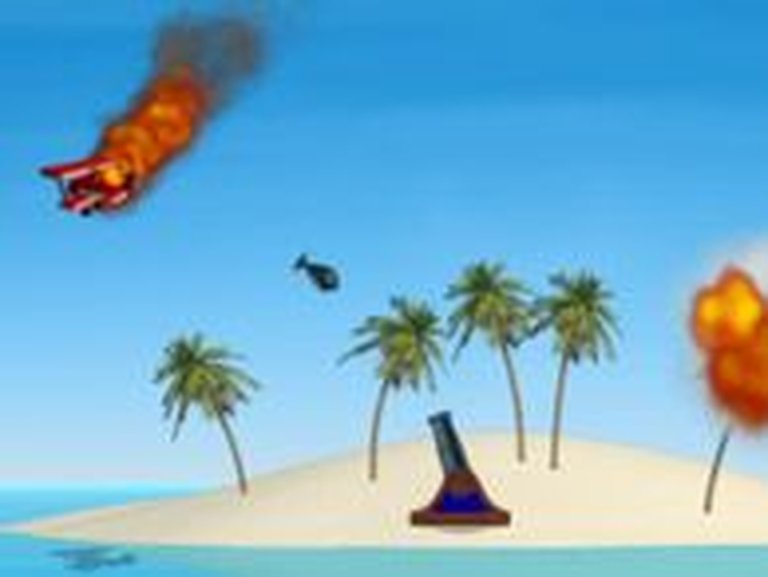
Island Wars 2 is an arcade-style shooter set in the South Pacific where two rival islands wage a whimsical war over palm trees. Players defend their island by manning a cannon to shoot down enemy balloons, planes, robots, and ICBMs in single-player campaigns, local multiplayer battles, or custom game modes, with additional features like Balloon Pop and a screensaver.
Gameplay Videos
Island Wars 2 Free Download
Island Wars 2 Guides & Walkthroughs
Island Wars 2: A Tropical Turf War For the Ages – An Historical and Critical Reassessment
Introduction: Palm Trees, Planes, and Persistent Charm
In the vast, often-overlooked archives of early-2000s PC gaming, there exists a title that perfectly encapsulates a specific, vanished era of accessible, shareware-era arcade design. Island Wars 2, released in July 2004 by the then-one-man-band operation InterAction studios (primarily Konstantinos Prouskas), is not a game of epic narratives or graphical fidelity. It is, on its surface, a absurdist playground: two infinitesimally small South Pacific islands, each bearing a handful of palm trees, locked in a perpetual, childish feud. The stated gripe? “Each other’s palm trees.” Yet, beneath this veneer of silliness lies a rigorously designed, mechanically pure, and surprisingly deep competitive shooter that captures the spirit of the arcade golden age while injecting it with a dose of indie creativity. This review posits that Island Wars 2 is a significant cult artifact—a masterclass in minimalist game design that prioritized emergent gameplay, local multiplayer camaraderie, and systemic variety over cinematic pretension. It represents a conscious, successful counterpoint to the increasingly complex and solo-oriented game design trends of its time.
Development History & Context: The Solo Auteur in a Downloadable Dawn
Island Wars 2 exists at a fascinating technological and commercial inflection point. Developed and published by InterAction studios, a Greek outfit led by Konstantinos Prouskas (credited for programming, design, and the “Sun & Beach” music), the game was a product of the burgeoning digital distribution era. Released in 2004, it straddled the tail end of the classic shareware model and the rise of dedicated casual game portals like Big Fish Games (a noted publisher for the title). The technological constraints were those of early 2000s mainstream PCs: a recommended 500MHz CPU, 512MB RAM, and a DirectX 9.0-compatible 3D card. This necessitated a visual style that was bright, crisp, and stylized over realistic—a choice that aged gracefully.
Prouskas, as a solo or tiny-team developer, was free from the committee-driven design of AAA studios. This autonomy is evident in the game’s idiosyncratic structure. The vision was clear: a fast, pick-up-and-play aerial combat game with a unique day/night phase system and a robust suite of game modes. The landscape of 2004 was dominated by military shooters (Call of Duty, Half-Life 2) and complex RPGs. Into this stepped a defiantly simple, physics-light, top-down arcade shooter about palm trees. Its release on Windows, followed by ports to Mac (2009), iOS, and Android (2012), shows an adaptive understanding of where casual and retro-focused audiences were migrating.
Narrative & Thematic Deep Dive: The Art of the Silly Reason for War
Island Wars 2 presents a narrative so barebones it becomes a thematic statement. There is no lore, no backstory, no character with a name beyond “Player 1” and “Player 2” (or “Red” vs. “Blue”). The “plot” is delivered in a single, iconic sentence from the developer’s site: “Two islands wage war against each other in the South Pacific seas. Their gripe? Each other’s palm trees.” This is the pure expression of the “Silly Reason for War” trope, as cataloged by TV Tropes.
The thematic depth here is intentionally superficial yet profoundly resonant with a specific kind of playful gaming ethos. The palm tree is the ultimate “Video-Game Lives” mechanic made literal and visual. It is not an abstract health bar; it is a concrete, destructible object under threat. Defending your palm trees isn’t about maintaining a statistic; it’s about physically protecting a silly, animated tree from cartoonish bombs. This removes all narrative pretension and places pure, unadulterated competitive tension at the forefront. The conflict is eternal, reason-less, and cyclical—perfectly mirroring the game’s own loop of morning, noon, and evening phases. The “war” is a permanent state of playful antagonism, a sandbox for mechanical exploration rather than a story to be consumed. Even the inclusion of a “Christmas Edition”—replacing palm trees with Christmas trees and biplanes with sleighs—reinforces this: the core conflict is a timeless, season-agnostic feud, a ritual rather than a saga.
Gameplay Mechanics & Systems: Asymmetric Loops and Systemic Elegance
The heart of Island Wars 2 is its core “Classic War” or “Duel” mode, a brilliant masterclass in asymmetric multiplayer design. A match is played over a set number of “days” (2-10), each day divided into three distinct phases:
- Morning Phase: Player 1 (Red) pilots a biplane, attempting to bomb Player 2’s (Blue) palm trees. Player 2, on their tiny island, operates a static, island-mounted anti-aircraft cannon to shoot down Red’s plane and its bombs.
- Afternoon Phase: Roles are reversed. Blue attacks, Red defends.
- Evening Phase: Both players pilot biplanes in a pure, symmetrical dogfight. Points are scored for destroying the opponent’s plane.
This structure is genius in its simplicity. It creates natural, built-in role swaps that prevent one player from being perpetually on the offensive or defensive. The “Asymmetric Multiplayer” is subverted by design every 10 minutes, fostering a complete understanding of both offensive and defensive play. The palm trees are the only constant objective, creating a direct, tangible link between the bombing runs and the final dogfight’s stakes.
The “Invasion” mode represents the game’s substantial single-player/co-op offering. Here, 1-2 players (co-operatively on one island) must survive 50 waves of increasingly chaotic enemy attacks. The enemy roster, as detailed by TV Tropes and the developer, is a masterclass in escalating threat design:
* Goombas: Slow, one-hit-kill hot-air balloons.
* Zerg Rush: Late-wave swarms of bomber planes and missiles.
* Giant Mooks: Slow but heavily-armored Carpet Bombers.
* Macross Missile Massacre: ICBMs, homing bombs, and torpedoes can fill the screen.
* Recurring Bosses: Giant blimps with patterned attacks, culminating in a “Kaizo Trap” final boss that unleashes a final torpedo swarm upon destruction.
Power-ups, delivered by popping blue or red bonus balloons, provide temporary but crucial advantages: “Quad Damage” (red), “Invincibility Power-Up” (blue “Defensive Protection”), a rapid-fire “Bubble Gun” (a pseudo-spread shot), a “Lightning Gun” for continuous damage, and a “Power-Up Letdown” in the form of the weak Autocannon. These last only for the current wave, forcing strategic timing.
The “Mutator” system is a standout feature for a 2004 indie title. Players can activate seven modifications before a match, such as “Matrix bullet-time” or解锁ing an experimental “PX35 Palmkiller” aircraft. Crucially, as noted in the game’s rules and TV Tropes, using mutations or cheats halves your final “rating” score or invalidates it entirely, creating a hardcore skill-based meta-game for leaderboard chasers.
The “Balloon Pop” mode is a pure speed-and-reflex test, while “Free-For-All” is the comprehensive custom-game suite, allowing players to tweak 10+ variables (number of palm trees, island size, bomb distance). The “Screensaver” mode is a charming, self-playing demo showcasing fireworks and AI dogfights, a nod to the era’s love of customizable screensavers.
The UI is functional, minimalist, and effective. The “Rating” system—calculated from hits taken, palms destroyed, and palms remaining—provides a clear, comparative metric for victory beyond simple scores, encouraging efficient, defensive play.
World-Building, Art & Sound: A Timeless Tropical Postcard
The game’s world is a masterclass in evocative minimalism. The South Pacific setting is rendered in a stylized, bright side-view with simple, clean geometry. The islands are literal “Far Side” islands—tiny specks with a cannon and three palm trees against a vast, shimmering blue ocean. This visual hyper-simplicity focuses the player’s attention entirely on the sky, where the conflict occurs. The lack of visual clutter is a design strength.
The “particle effects”—explosions, smoke, water splashes—are colorful and satisfying, providing crucial feedback without overwhelming the scene. The overall art direction has aged with grace; its cartoonish, cel-shaded aesthetic (though not strictly cel-shaded) avoids the texture-mud of many 2004 contemporaries.
The sound design is where the game’s personality truly sings. The music, composed by Rutger Hoedemakers (“Sun & Beach” ©1994) and Mark M. Salud (“1-2-3 Dance Mon” ©1997), is a collection of quirky, upbeat, tropical-themed MIDI tunes. The CNET review explicitly states: “whatever you do don’t turn off the music as the game’s quirky tunes add a great dimension to this tropical romp.” This is not hyperbole. The music is infectious, setting a lighthearted, frantic mood that perfectly complements the absurd on-screen action. Sound effects for cannon fire, plane engines, and explosions are crisp and arcade-perfect. Together, the audio-visual package creates an enduring, cheerful atmosphere that is immediately recognizable and deeply nostalgic.
Reception & Legacy: The Cult of the 80%
Official critical reception for Island Wars 2 is sparse but positive. MobyGames records an 80% average from two critics: CNET (2009) and VictoryGames.pl (2005). The CNET review, while noting the game can become repetitive, heavily praises its music and compares its graphics favorably to older arcade games, suggesting a deliberate retro aesthetic. VictoryGames.pl calls it “Simple rules, high playability, nice graphic and sound design will attract every player like a magnet.” Player reception, though based on a single rating on MobyGames, averages 4.3/5, indicating strong satisfaction among those who sought it out.
Its commercial life was that of a niche downloadable title, likely finding its audience through portals like Big Fish Games and the developer’s own site. Its legacy is not one of mainstream influence but of cult endurance and conceptual purity. It has no direct “children” in AAA studios, but its DNA can be felt in:
* The local multiplayer arena-brawler/sports hybrid genre (think Super Smash Bros. but in the sky).
* Modern indie titles that embrace minimalist mechanics and high skill ceilings (e.g., Lethal League, SpeedRunners).
* The “one more round” addictive loop of casual and mobile shooters, though few match its tight control schemes.
The fact that the developer’s high score table still lists entries from 2018, with players achieving 100% ratings (requiring flawless play on the hardest difficulty, per the “Easy-Mode Mockery” trope), is proof of a dedicated, long-term community. The game’s simplicity is its gateway, but the depth of its systems—the perfect asymmetry, the mutators, the brutal Invasion mode—creates a lasting competitive scene for those who look for it.
Conclusion: A Definitive Verdict on a Miniature Masterpiece
Island Wars 2 is not a game that will revolutionize the industry or break technological barriers. It is, instead, a perfect artifact of a specific design philosophy: that profound fun can emerge from a handful of simple rules, a clear objective, and a presentation that oozes personality. Its “silly reason for war” is not a weakness but a liberating strength, shedding the weight of narrative to focus on pure, interactive conflict. The triad of daily phases creates a rhythm unmatched in multiplayer design, and the Invasion mode stands as a surprisingly robust and challenging single-player/co-op experience for its time.
Its flaws are those of its ambition and scope. The graphics, while timeless in style, are undeniably basic. The campaign, for a solo player, is essentially the Challenge mode against AI islands. Without a friend on the same keyboard, a significant portion of its magic is unavailable—a relic of the pre-online-local-multiplayer era for casual games.
Yet, its place in video game history is secure. It is a testament to the power of the indie developer in the early 2000s, a loving parody of war game tropes, and a brilliantly tuned arcade experience. It is a game that understands its core loop so completely it can afford to be about nothing but that loop. For historians, it is a crucial case study in minimalist, systemic design. For players, it remains a hidden gem—a tropical paradise of palm-tree politics where the only ideology is “shoot the other guy’s tree, defend your own, and enjoy the killer soundtrack.” Island Wars 2 did not conquer the world, but on its own tiny islands, it reigns supreme.