
- Release Year: 2019
- Platforms: Linux, Macintosh, Windows
- Publisher: ERMedia, Plug In Digital SAS
- Developer: ERMedia
- Genre: Action
- Perspective: Side view
- Gameplay: Metroidvania
- Setting: Futuristic, Sci-fi
Description
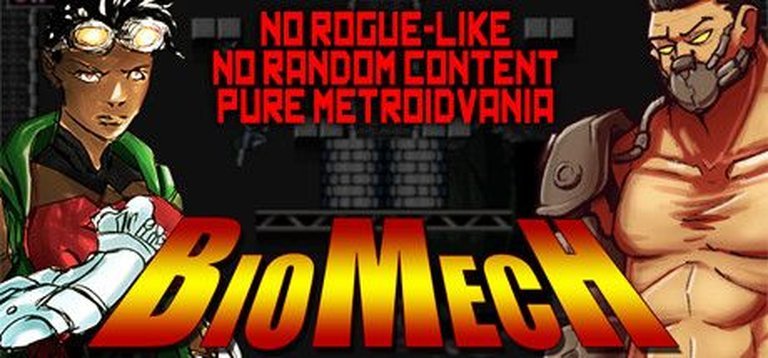
BioMech is a 2D side-scrolling Metroidvania game set in a sci-fi future, where players assume the role of Tatiana Rocheva, a Russian soldier enhanced with cybernetic limbs after capture and torture. Her mission is to infiltrate a secret, potentially automated weapons facility hidden in the Siberian forest to determine its purpose and eliminate unsafe technology. The game emphasizes handcrafted, interconnected maps, non-linear progression, mandatory and optional upgrades, and carefully designed boss fights, bridging retro aesthetics with modern gameplay without rogue-like elements.
Where to Buy BioMech
PC
BioMech Guides & Walkthroughs
BioMech: A Cybernetic Symphony of Constraint and Precision
Introduction: The Ghost in the Machine
In the landscape of indie gaming, where the Metroidvania genre has become a crowded, often formulaic arena, BioMech emerges as a striking anomaly—a game that consciously rejects the prevailing trends of procedural generation and rogue-like unpredictability in favor of a meticulously crafted, almost architectural design philosophy. Released in 2019 by the singular developer known as Ezekiel Rage under the ERMedia banner, BioMech is not merely a throwback to 8-bit sensibilities; it is a deliberate argument for the enduring power of handmade, deterministic game design. Based on a comic book property, it casts players as Tatiana Rocheva, a cyborg soldier on a clandestine mission into a Siberian automated weapons facility. This review will posit that BioMech’s greatest strength—its uncompromising, handcrafted structure—is also the source of its most significant limitations, resulting in a game that is a fascinating, if niche, case study in polarizing design. It is a game that asks players to value deliberate pacing and curated challenges over emergent novelty, creating an experience that is both refreshingly focused and potentially isolating for audiences weaned on randomness.
Development History & Context: The One-Man Metroidvania
The Visionary and the Engine
BioMech is the brainchild of a single developer, Ezekiel Rage, operating as ERMedia. This immediately places it within the long and hallowed tradition of “bedroom developer” projects, but with a crucial modern twist: its creation in Construct 3, a HTML5-based game engine popular for its accessibility to independent creators but often viewed with skepticism for performance and depth in complex genres. The choice of Construct 3 is a defining contextual element. It speaks to a development philosophy prioritizing rapid prototyping and cross-platform deployment (Windows, macOS, Linux) over raw technical horsepower or bespoke engine tooling. This constraint likely shaped every aspect of the game, from its 2D pixel-art aesthetic to its relatively modest system requirements (1GHz CPU, 512MB RAM). The goal was not to compete with Hollow Knight or Ori on a graphical level, but to channel the spirit of the NES and SNES eras through a modern, web-friendly lens.
A Comic Book Origin in a Saturated Market
The game’s basis on a pre-existing comic book is unusual for an indie Metroidvania, which typically spring from wholly original concepts. This source material provided a ready-made protagonist (Tatiana Rocheva) and a foundational premise (cybernetic soldier, Siberian facility), saving the developer from world-building from a blank slate. However, it also meant the game’s narrative and aesthetic had to reflect a specific, already-established tone—one of gritty, post-Cold War sci-fi and physical trauma transformed into technological augmentation. Released in 2019, BioMech entered a market saturated with acclaimed titles in its chosen genre. Its explicit, vocal rejection of “rogue elements” and “random content” was both a marketing pitch and a necessary differentiation strategy, carving out a space for players fatigued by the endless runs of Dead Cells or Rogue Legacy and yearning for the pure, deliberate progression of Super Metroid or the original Castlevania: Symphony of the Night.
Narrative & Thematic Deep Dive: Flesh, Steel, and Isolation
The Construction of a Cyborg Protagonist
Tatiana Rocheva is not a blank-slate avatar. Her backstory is one of profound violation and reassembly: a Russian soldier captured and tortured in Iraq, subsequently “outfitted with enhanced cybernetic limbs.” This is a narrative rich with post-humanist and cyberpunk themes. Her mission is not one of galactic salvation but a grim, tactical infiltration: to investigate a silent weapons facility in the Siberian wilderness. The setting itself—an uninhabited, frozen forest hiding an automated complex—evokes deep-seated Cold War anxieties about hidden, autonomous weapons and the dehumanizing scale of industrialized conflict. Tatiana is the ultimate deniable asset; a human turned machine sent to dismantle other machines.
Thematic Resonance of “Backtracking”
The game’s most repeated feature tagline—”Backtracking is not a dirty word”—is a direct thematic and mechanical thesis. In a narrative about a lone operative navigating a silent, labyrinthine facility, backtracking ceases to be a game-design crutch and becomes a diegetic act of exploration and re-contextualization. Returning to a previously impassable area with a new ability mirrors Tatiana’s own reinforced body, allowing her to physically and mentally re-engage with a hostile environment she was once powerless against. The non-linear story progression suggests a narrative pieced together from environmental clues, logs, and the architecture itself, aligning with the Metroidvania tradition of environmental storytelling.
Multiple Endings: Agency Within a Closed System
The promise of “Multiple endings” based on player actions within this handcrafted world introduces a layer of moral ambiguity. Does Tatiana destroy all technology? Does she preserve some? The “enemy” remains faceless, automated, raising questions about the nature of threat and the ethics of unilateral destruction. The endings provide a payoff for a non-linear journey, rewarding meticulous exploration and potentially different playstyles, though the source material gives no specifics, leaving the precise nature of these conclusions to the player’s discovery.
Gameplay Mechanics & Systems: The Calculus of Precision
Core Loop: Acquisition and Access
The quintessential Metroidvania loop is present and rigorously adhered to: explore a sprawling, interconnected map, defeat enemies and bosses to gain permanent upgrades (health, damage, new movement abilities), and use those upgrades to access previously unreachable areas. The critical differentiator is the “handcrafted, interconnected maps” design. There is no randomness. Every enemy placement, every hidden passage, every power-up location is a deliberate, authored puzzle. This creates a game whose progression is a logical, traceable path of cause and effect. Acquiring the “Dash” or the “Double Jump” isn’t a lucky find; it is a key that meticulously unlocks specific, pre-ordained sections of the map.
Combat and Boss Fights: “Carefully Balanced”
The description’s emphasis on “Carefully balanced boss fights” suggests a design philosophy away from unfair spikes or reliance on rare drops. Boss encounters are likely deterministic duels of pattern recognition and execution, testing the player’s mastery of the abilities acquired up to that point. This aligns with the game’s overall ethos: victory is earned through skill and system mastery, not attrition or randomization. The combat system for regular enemies is presumably tight and responsive, centered on Tatiana’s cybernetic abilities—dashes, slashes, and special attacks—with the “Pixel Art” style demanding precise hitboxes and animations.
UI and Interface: Direct Control
The “Interface: Direct control” classification indicates a focus on immediate, responsive player input, essential for a game built on platforming precision and combat timing. The noted controller limitations (specifically mentioning 8bitdo gamepads and “some controllers”) due to Construct 3 engine restrictions are a significant blemish. They represent a point of friction between the developer’s vision of a smooth, retro experience and the practical realities of engine tooling on a diverse PC hardware landscape. For a game demanding precision, input inconsistency can be a fatal flaw.
Innovation vs. Flaw: The Roguelike Rejection
The most explicit design innovation is the rejection of roguelike elements. In 2019, this was a bold stance. It means the game has a fixed difficulty curve, a single, handcrafted narrative path per playthrough, and no permanent meta-progression between runs. This will appeal to purists who see the “true” Metroidvania as a singular, authorial journey to be mastered. However, it also means the game’s replay value hinges entirely on the quality of its core loop and the incentive of multiple endings, lacking the infinite variety of a Dead Cells.
World-Building, Art & Sound: The Aesthetics of Decay
Visual Direction: 8-Bit and Atrophic Sci-Fi
The “8-Bit” and “Pixel Art” tags are central. BioMech is not attempting the lush, detailed pixel art of a Stardew Valley or the stunningly animated sprites of Shovel Knight. Its aesthetic is more evocative of early NES or late MSX—limited color palettes, simpler sprite designs, and a focus on readability over graphical fidelity. This serves the narrative perfectly: the Siberian facility is a place of brutalist, decaying industrial design. The pixelation imposes a sense of distance and abstraction, making the environment feel simultaneously retro and eerily timeless. The “Atmospheric” tag suggests a masterful use of limited visuals to create mood—dark corridors, flickering lights, stark monochrome exteriors contrasting with the glow of machinery and Tatiana’s cybernetic limbs.
Sound Design: The Unseen Symphony
Details are scarce, but the inclusion of an “Original Game Soundtrack” (a separate 86MB download) confirms a dedicated musical score. For an indie game of this scope, the soundtrack likely combines chiptune sensibilities with more atmospheric, ambient tracks to underscore the isolation and tension of the Siberian base. Sound effects for abilities, combat, and environmental hazards would be crucial for gameplay feedback, especially given the precision demands. The soundtrack’s availability as a standalone product indicates the developer’s pride in this component, suggesting it is an integral part of the intended experience rather than an afterthought.
Reception & Legacy: The Niche of the Pure
Critical and Commercial Silence
Upon release, BioMech existed almost entirely in the indie and “Metroidvania” enthusiast spheres. MobyGames shows it is “Collected By” only 7 players as of the latest data—a staggering number for a commercially released title, indicating minuscule commercial reach. Steam user reviews are “Mixed,” with only 45% of 11 reviews being positive. This tiny sample size is itself a significant data point: the game flew far under the radar. The positive reviews likely praise its pure, focused design and successful capture of a classic feel. The negative reviews probably cite the perceived simplicity, the controller issues, or a difficulty seen as “old-fashioned” rather than “challenging.”
Legacy: A Curated Artifact
BioMech’s legacy is not one of influence on the mainstream, but of being a curated artifact within a specific subculture. It is a game for the player who says, “I want a new Super Metroid, with no compromises.” Its influence is likely seen not in broad trends, but in reinforcing a counter-narrative to the “roguelite boom.” It demonstrates that a single developer can still create a cohesive, large-scale, non-randomized Metroidvania using accessible tools. The community discussion on Steam, with threads about specific boss fights and item locations (“Is the tank boss immortal?”, “1 item left in Sigma Lab?”), reveals a dedicated, if small, player base engaging with it as a precise puzzle box to be solved.
Comparison to the Genre Titans
When stacked against the giants—Hollow Knight‘s vast, haunting world; Ori‘s fluid, beautiful movement; Cave Story‘s emotional storytelling—BioMech consciously abdicates competition in scale and polish. Its ambition is one of purity. It is less a successor to these titles and more a parallel development, a game that could have been a niche ROM hack in the early 2000s but was made with modern distribution tools. Its “bridging the gap between retro and modern” claim is about design ethos, not technical presentation.
Conclusion: A Flawed Gem for the Discerning Explorer
BioMech is not a great game by conventional metrics of reach, polish, or mainstream appeal. Its Steam “Mixed” rating, microscopic player count, and documented input issues are tangible liabilities. Yet, to dismiss it would be to miss its profound, if narrow, achievement. It is a testament to the enduring viability of the authored, non-procedural Metroidvania. In an era where “replayability” is often synonymous with random generation, BioMech argues for the value of a single, perfected journey.
It succeeds as a focused, deliberate, and thematically cohesive experience. The world, though small in player count, feels intentionally built and logically connected. The narrative of a reassembled cyborg infiltrating an automated facility is perfectly mirrored in the gameplay of a player reassembling their capabilities to unlock a fixed world. For the patient player willing to overlook technical rough edges and engage with a deliberately old-school challenge, BioMech offers a rare thing: a pure, uncorrupted taste of the Metroidvania formula as it might have been imagined in the mid-90s, preserved in amber and delivered via a 2019 indie release. Its place in history is not as a landmark, but as a curious and commendable holdout—a game that looked at the direction its genre was heading and confidently, stubbornly chose to walk a different, lonely path. It is a game for historians and completionists, a fascinating footnote that proves the genre’s classic tenets still have currency, even in a market that has largely moved on.