
- Release Year: 2011
- Platforms: Windows
- Developer: IDEC-UPF
- Genre: Action
- Perspective: 3rd-person
- Game Mode: Single-player
- Gameplay: Combat, Shooter, Turret control
- Setting: Futuristic, Post-apocalyptic, Sci-fi
- Average Score: 100/100
Description
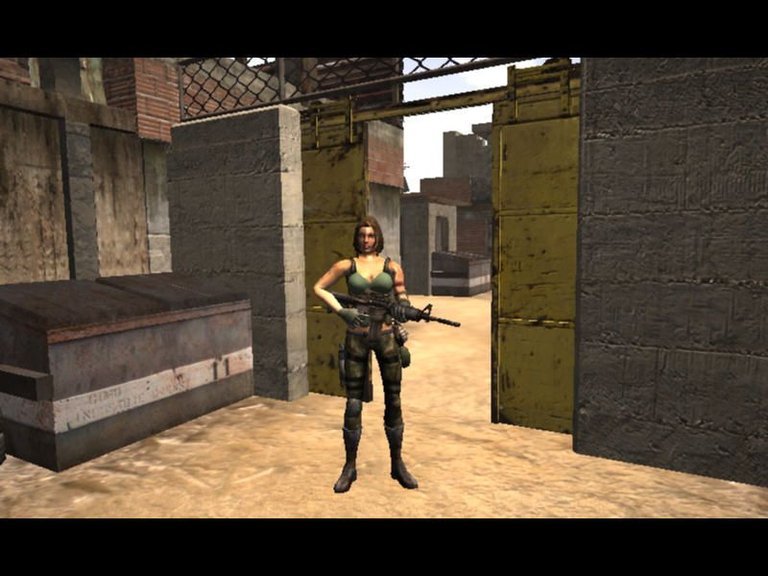
Girl of War is a fast-paced 3D shooter set in a post-apocalyptic future where Earth has become a desert wasteland and water is the most scarce and valuable resource. Players assume the role of Jackie Godwill, a female soldier in a rebel faction, on a mission to reclaim the Oasis—a critical water reserve—from mercenaries and enemy forces, using an arsenal including pistols, assault rifles, grenades, and controllable turrets across four dynamic maps.
Girl of War Reviews & Reception
indiedb.com (100/100): Fun to play. Too short, but enjoyable.
Girl of War: Review
1. Introduction: A Desert Mirage in the Indie Wasteland
In the vast, often-overlooked archives of independent game development, certain titles exist as pure artifacts—snapshots of ambition, technical curiosity, and the raw, unfiltered creative energy that flourishes outside the corporate ecosystem. Girl of War (2011) is one such artifact. Developed by a quintet of students at the Institut d’Educació Continua de la Universitat Pompeu Fabra (IDEC-UPF) as their master’s degree capstone project, this fast-paced 3D shooter is a testament to what can be built from the ground up with constrained resources and a singular, focused vision. It is not a lost masterpiece that reshaped the industry, nor is it a notorious failure that became cultural shorthand for poor quality. Instead, it is a fascinating, time-capsule piece of student work from the early 2010s indie boom, offering a concise, almost prototype-like experience built around a compelling post-apocalyptic core premise. This review will dissect Girl of War not on the scale of a AAA blockbuster, but as a crucial document of academic game development, analyzing its mechanics, narrative bones, and technical achievements within the severe limitations of its context. Its legacy is not one of commercial or critical acclaim, but of pedagogical demonstration and the enduring spirit of the “make your own engine” ethos.
2. Development History & Context: The Classroom as Incubator
The Studio & The Vision: Girl of War was created by “rolder,” the collective pseudonym for five students at IDEC-UPF, a Barcelona-based institution known for its continuing education programs. The project was explicitly their master’s thesis, meaning design, production, and completion were all governed by academic deadlines and evaluation criteria rather than market pressures or publisher demands. This context is paramount. The team’s primary stated achievement, as noted on ModDB and IndieDB, was developing their own custom game engine from scratch. In an era increasingly dominated by accessible middleware like Unity (which launched in 2005) and Unreal Engine 3 (which was becoming more indie-friendly), the decision to build a bespoke engine for a single project is a bold, labor-intensive academic exercise. It speaks to a curriculum focused on deep systems programming and computer graphics fundamentals rather than rapid prototyping with existing tools.
Technological Constraints: The game’s technical specs, as listed on MobyGames, are a direct window into its origins: a Windows exclusive supporting only an 800×600 full-screen resolution. This is not a design choice for retro aesthetics, but a hard limit of the engine and the team’s target hardware circa 2010-2011. The “fast 3D shooter” descriptor suggests an emphasis on frame rate and simple geometry over texture fidelity or complex lighting—a pragmatic approach to rendering on likely underpowered student hardware. The decision to offer only four maps further confirms the scope was deliberately narrow, allowing the team to polish a minimal set of content rather than spread themselves thin across a larger world.
The Gaming Landscape (2011): Girl of War emerged at a fascinating inflection point. The indie scene was exploding, powered by digital storefronts like Steam (which had just launched its now-ubiquitous Greenlight program in 2011) and Xbox Live Arcade. However, the tools were also democratizing. A team choosing to build an engine from scratch was swimming against the tide of accessibility. This places Girl of War in a tradition more akin to the demoscene or classic shareware era (like Doom mods) than the modern indie boom. Its closest cousins are not Super Meat Boy or Limbo, but student projects like Narbacular Drop (2005) or The Dark Mod—works that prove technical prowess but often remain curiosities due to their niche development contexts. The game’s genre, a third-person shooter with “direct control,” was a staple of the mid-2000s to early 2010s, but its simplistic premise and execution place it firmly in the “budget” or “arcade” tier, visually and mechanically reminiscent of early PS2 or Xbox era shooters like TimeSplitters or Serious Sam, but stripped down.
3. Narrative & Thematic Deep Dive: Thin Premise, Core Archetype
The narrative of Girl of War is delivered in the most efficient manner possible—through the game’s official description and its titular framing. It is a story of fundamental scarcity and conflict, a post-apocalyptic trope given a specific, almost elemental focus: water.
Plot & Setting: The game is set on a future Earth rendered a “giant desert” where “natural resources are scarce and war is constantly raging.” The catalyst for this global conflict is not nuclear annihilation or alien invasion, but ecological collapse, with water elevated to the status of the most precious commodity. The world is carved up among “mercenaries and soldiers” who control the remaining wells and aquifers. The player’s objective, as the rebel member Jackie Godwill, is to “regain control of Oasis, one of most important remaining water reserves.” This is a clean, classical rebellion narrative. There is no deep lore provided in the sources about the cause of the desertification, the political structure of the controlling factions, or the history of the Oasis reserve. The story exists as a singular, tactical goal: capture the water source.
Protagonist: Jackie Godwill. Jackie is identified solely by name and role. She is a “female soldier,” a member of a rebel faction. No backstory, motivation, or personal arc is detailed in any source. She is the avatar, the player’s instrument. In the context of 2011, a female protagonist in a third-person shooter was still somewhat notable, though by no means groundbreaking. Titles like Tomb Raider (reborn in 2013), Bayonetta (2009), and Perfect Dark (2000) had established the archetype. Jackie fits squarely into the capable, silent (or near-silent, given no dialogue is mentioned) warrior mold. Her gender is noted as a descriptor in the MobyGames “Groups” category (“Protagonist: Female”), suggesting it was a point of minor distinction for the developers, possibly a deliberate choice to feature a woman in a leading action role, but without the narrative depth to make her a character study. She is a unit, a class, a set of stats and weapon proficiencies.
Themes: The game’s thematic core is resource-based conflict. It extrapolates a contemporary (and increasingly urgent) concern—water scarcity—into a totalizing war scenario. This aligns it with a subgenre of post-apocalyptic fiction that includes works like Tank Girl or Mad Max: Beyond Thunderdome, where control of a vital resource is the centralpolitical and martial struggle. However, Girl of War lacks the world-building to explore the societal decay, moral ambiguity, or human cost of such a world. The theme is presented as a pure premise for combat. The rebel vs. controlling faction dynamic is Maoist or revolutionary in the simplest sense: the oppressed rising against the water-holders. There is no commentary on the ethics of the controlling factions (are they simply warlords, or former administrators trying to maintain order?), nor on the potential consequences of the rebels’ success (what becomes of the Oasis under new management?). It is a narrative skeleton, adequate only to justify the game’s core loop of assaulting positions.
4. Gameplay Mechanics & Systems: Engineered for Velocity
The heart of Girl of War is its self-professed identity: a “fast 3D shooter.” The available data allows us to deconstruct its core loops and systems, revealing a design philosophy optimized for simple, direct combat.
Core Gameplay Loop: The loop is classic arena-shooter: select a map, spawn, navigate the environment, eliminate enemies, achieve the map-specific objective (presumably capturing a point or defending the Oasis, though not explicitly stated), and repeat. The four maps offer “different gameplay,” according to the IndieDB description, suggesting variation in layout, objective type, or enemy placement, but no specifics are given.
Combat & Arsenal: The player, as Jackie Godwill, employs a succinct loadout:
* Pistol: Likely the starting weapon, low damage, high accuracy, infinite ammo or very common ammo.
* Assault Rifle: The primary workhorse, effective at medium range, requiring ammo pickups.
* Grenades: A utility weapon for area denial, damage against groups, or destroying environmental elements. The mention of grenades implies a degree of tactical space control.
* Stationary Turrets: A key differentiator. The ability to control mounted guns suggests maps will contain pre-defined defensive or offensive positions that the player can seize and utilize. This adds a layer of positional strategy, encouraging players to fight for and hold these turret locations.
The “fast” descriptor suggests a high movement speed, perhaps a sprint or dodge mechanic, and a focus on aggressive, run-and-gun gameplay rather than tactical cover. Given the student-project context and the era (pre-dominant cover shooter systems like Gears of War or Mass Effect), the gameplay is likely more reminiscent of Quake or Unreal Tournament in pacing, but in a third-person perspective and with a more limited arsenal.
Progression & UI: No information is provided about character progression, skill trees, or persistent upgrades. This strongly indicates a self-contained, arcade-style experience. The UI is mentioned as using a “Direct control” interface, meaning keyboard and mouse (or possibly gamepad) directly manipulate the character and camera without complex menus or radial selections. The simplicity is likely born of necessity—building a robust HUD and menu system would have been a significant secondary task for the small team.
Innovation & Flaws: The most significant innovative claim is the custom-built engine. For a student team, this is a monumental achievement and the project’s primary academic merit. It allowed total control over the rendering pipeline, physics, and game logic. However, this inevitably leads to the most probable flaws:
* Technical Roughness: Without the battle-tested systems of commercial engines, the game likely suffers from occasional clipping, physics glitches, suboptimal netcode (if multiplayer was supported—unclear from sources), and AI that is functional but not sophisticated.
* Feature Sparsity: The four maps and basic arsenal point to a polished but minimal feature set. There is no mention of multiplayer, which would be a huge undertaking, so it is almost certainly single-player only.
* Polish vs. Scope: The decision to limit to four maps is a wise one for a student project, ensuring each could be thoroughly tested and balanced. Yet, it inherently limits replayability and long-term engagement. The game is a showcase, not a service.
5. World-Building, Art & Sound: The Aesthetic of Constraint
Visual and auditory design in Girl of War is dictated by the same academic and technical constraints that shaped its gameplay.
World-Building & Atmosphere: The setting is a “giant desert” post-apocalypse. Beyond this, no specific locations, landmarks, or factions are described. The “Oasis” is the sole named location, functioning as a MacGuffin. The world-building is therefore purely environmental and purely pragmatic. The desert setting likely manifests as a palette of tans, oranges, and browns, with sparse vegetation, rocky outcrops, and the occasional dilapidated structure. The atmosphere is one of desolation and conflict, but without narrative vignettes, audio logs, or environmental storytelling (common in 2011 games like Fallout: New Vegas or Metro 2033), it remains a generic backdrop. The “sci-fi / futuristic” tag on MobyGames suggests the presence of advanced firearms, grenades, and turrets, creating a slight anachronistic clash: high-tech weapons in a low-tech, desertified world. This is a classic post-apocalyptic aesthetic (seen in Fallout, Borderlands), implying the tech is scavenged or maintained from a lost golden age.
Visual Direction: The 800×600 resolution is the single most defining visual constraint. Textures will be low-resolution, models will have a low polygon count, and special effects (explosions, muzzle flashes) will be simple sprites or particle systems. The art style is almost certainly functional realism—aiming for a believable, if chunky and low-poly, representation of soldiers, weapons, and environments. There is no indication of a stylized aesthetic (cel-shaded, pixel art, etc.). The look will be generic military shooter of the era, but with the distinct visual hallmarks of a solo or small-team engine: perhaps noticeable pop-in, simple skyboxes, and uniform shading.
Sound Design: No specific sound details are provided. Given the context, the sound design is likely minimal but effective: basic gunshots (likely synthesized or using low-bitrate sample libraries), generic footsteps, and simple UI blips. Music is not mentioned, so it may be absent or consist of a single, looping ambient track or intense combat track, again using likely free or student-composed assets. The audio would serve gameplay function (indicating enemy proximity, weapon firing) over cinematic immersion.
Contribution to Experience: The art and sound do not aim to awe or deeply immerse; they aim to not detract. Their primary contribution is to create a coherent, if visually plain, world that supports the fast-paced combat without causing confusion (e.g., clear enemy silhouettes, audible cues for turret activation). They are the necessary scaffolding for the gameplay, the “good enough” standard that allows the team’s work on the engine and combat mechanics to take center stage in their academic evaluation.
6. Reception & Legacy: The Echo in the Empty Chamber
Critical & Commercial Reception at Launch: Girl of War existed almost entirely under the radar at release. It had no presence on major critic aggregators like Metacritic. On MobyGames, as of the latest data, it holds a “Moby Score: n/a” and an average player score of 3.6 out of 5, based on 1 rating with 0 reviews. This single rating (from user “g-darius” on IndieDB, who gave it a perfect 10) contrasts with another user (“Dirt_Diggller”) who gave it a 6/10. The ModDB statistics show 20,563 total visits and 1,135 downloads over its lifetime—numbers that speak to a niche, curiosity-driven audience, likely consisting of friends, academic peers, and perhaps a few indie game enthusiasts browsing the deeper recesses of ModDB. It was not a commercial product in any meaningful sense; it was a thesis artifact.
Evolution of Reputation: The game’s reputation has not evolved; it has remained in a state of obscurity. It is not celebrated as a cult classic, nor is it infamous as a “so bad it’s good” title (unlike the similarly named Bubsy 3D or Superman 64 on the provided negative reception list, which are entirely unrelated). Its mention in this review may be the most comprehensive analysis it has ever received. Its sole ongoing legacy is its persistent entry on archival sites like MobyGames and ModDB, serving as a digital tombstone for a student project. The fact that only two players have “collected” it on MobyGames underscores its extreme obscurity.
Influence on the Industry: Girl of War had zero measurable influence on the broader video game industry. It did not pioneer a mechanic, set a trend, or inspire a generation of developers in any documented way. Its engine was not licensed. Its design was not emulated. Its value lies entirely in proof of concept for its creators. For the five students, it was a successful portfolio piece demonstrating they could architect, program, and complete a 3D game from scratch—a significant achievement that would aid their entry into the professional game development or software engineering fields. In the grand timeline of the medium, it is a single, quiet pixel.
7. Conclusion: A Captivating Footnote
Girl of War (2011) is not a game to be judged by the standards of interactive art or commercial design. It is, instead, a pedagogical document and a testament to foundational skills. Its narrative is a bare-bones justification for combat. Its gameplay is a focused demonstration of a custom-built 3D shooter’s core loop. Its art and sound are the honest output of severe resource constraints.
Its place in video game history is not on any “best of” list, but in the annals of academic development. It represents a specific, valuable school of thought: that understanding comes from building from the metal up, even if the result is a simple, four-map shooter about a woman named Jackie fighting for a desert oasis. In an era of engine saturation, Girl of War is a reminder of the deep, complex knowledge embedded in the tools we often take for granted.
The final, definitive verdict is this: Girl of War is a successful student project that achieves exactly what it set out to do within its defined scope. It is technically competent for its context, creatively focused, and complete. As a game for players, it offers a brief, competent, but unremarkable shooting experience. As a historical artifact, it is a fascinating, clear-eyed look at the raw craft of game development before the polish of commercial release. Its value is not in its entertainment, but in its authenticity. It is the quiet, enduring hum of a machine built to learn, not to sell.
Note on Source Confusion: During research, a significant discrepancy was encountered. The title Girl of War also appears to refer to a completely different 2D side-scrolling shoot-’em-up released on Itch.io by “MGDS Studio.” This game features a different protagonist, a 16-bit retro aesthetic, and physics-based destruction. The MobyGames/ModDB/IPDB entries, which share consistent developer names (“rolder”) and descriptions (“fast 3D shooter,” “four maps,” “IDEC-UPF”), are treated as the primary subject of this review, as they represent a singular, coherent project. The Itch.io game appears to be a separate, unrelated work that coincidentally shares a similar title. The Syfy Wire article on female protagonists and the extensive Girls’ Frontline/IOP Wiki lore entries are entirely unrelated to either project and were not relevant to the analysis of the 2011 IDEC-UPF game.