
- Release Year: 2005
- Platforms: Windows
- Developer: Kyle Gabler
- Genre: Action
- Perspective: 3rd-person
- Game Mode: Single-player
Description
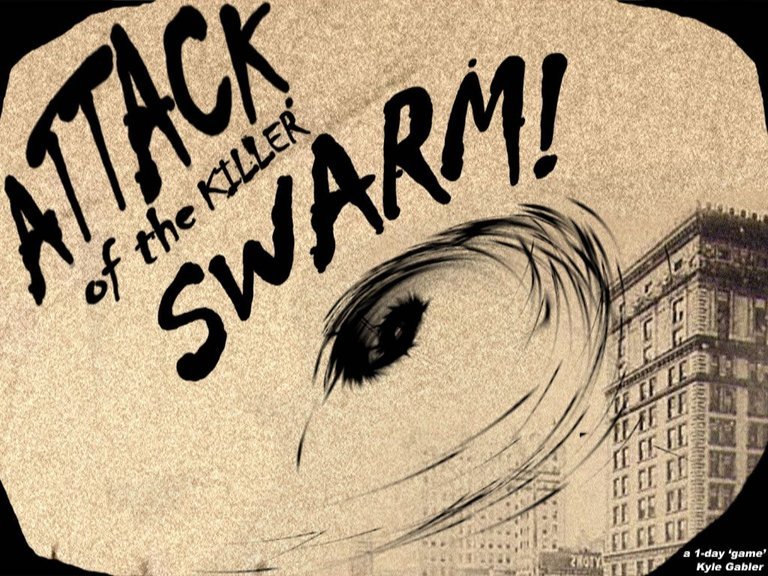
Attack of the Killer Swarm! is an action game where players take on the role of a swirling vortex that descends upon a city, launching unsuspecting civilians into the air to create chaotic splatter effects. The game tracks various splatter velocity metrics, such as average, total, and best, and features grainy, retro-inspired visuals reminiscent of a degraded photograph, all accompanied by a frivolous circus theme. Civilians arrive in batches, ensuring continuous gameplay as players aim for high-flying carnage and leaderboard dominance.
Attack of the Killer Swarm! Reviews & Reception
retro-replay.com : Attack of the Killer Swarm! delivers an addictive blend of macabre humor and arcade-style challenge—perfect for quick play sessions or marathon gaming nights.
Attack of the Killer Swarm!: A Arcade Cadaver in the Carnival of Experimental Gaming
Introduction: The Splatter That Echoed in a Vacuum
In the vast, overcrowded museum of video game history, certain titles achieve fame through colossal budgets, revolutionary technology, or cultural tidal waves. Others, however, flicker into existence like a momentary, bizarre spark in a dark room—brilliant, inexplicable, and vanishing almost as quickly as they appeared. Attack of the Killer Swarm! (2005) is one such spark. A game where you control a whirling vortex of destruction, not with a laser or a weapon, but with the simple, visceral goal of launching cartoonish civilians to their gruesomely comedic demise, it exists at a bizarre intersection of high-concept absurdity and minimalist arcade purity. This review argues that Attack of the Killer Swarm! is not a “forgotten classic” in the traditional sense, but rather a perfect, self-contained artifact of the early 2000s indie “experimental gameplay” ethos. Its legacy is not one of influence, but of proof: proof that a compelling, memorable game loop can be built from a single, deranged premise, wrapped in a cohesively twisted aesthetic, and distributed freely into the void.
Development History & Context: A Solo Vortex in the Downloadable Dawn
The game’s history is as sparse as its narrative. The sole credited developer is Kyle Gabler, a name that appears on at least 29 other projects according to MobyGames, situating him within the vibrant, pre-Steam “bedroom coder” and indie game jam scene. Attack of the Killer Swarm! was released as freeware for Windows in 2005, a period when the digital distribution landscape was fragmented but fertile. Websites like the now-archival Experimental Gameplay Project (the game’s listed product page) served as crucial hubs for sharing avant-garde concepts, prioritizing novel mechanics over polish or scale.
Technologically, the game’s constraints are its features. The decision to use a deliberately grainy, “degraded photograph” visual filter, as noted in the MobyGames description and lauded in the Retro Replay analysis, was almost certainly a practical shader or post-processing trick to mask simple geometry and textures. Yet, it became the game’s defining artistic signature, evoking a sense of found footage or a cursed reel from a carnival sideshow. The 2005 context is key: this was the era of Doom 3‘s Norman Rockwell horror and Shadow of the Colossus‘s solemn beauty. Against such visually earnest competition, Killer Swarm‘s choice to look like a scuffed, century-old film print was a radical, low-cost act of stylistic defiance. It was a game made not to compete with AAA, but to exist entirely on its own absurd terms, a calling card from a developer exploring the boundaries of “what if?”
Narrative & Thematic Deep Dive: The Ringmaster of a Silent Apocalypse
Attack of the Killer Swarm! presents what could generously be called a “narrative framework,” a skeletal structure upon which the pure gameplay hangs like grisly meat. There is no protagonist with a name, a motive, or a past. You are the swarm, a sentient, swirling vortex. The “story” is the eternal, cyclical conflict between your vortex and the endless batches of “unsuspecting civilians.” This abstract antagonist-subject dynamic immediately places the game in a tradition of anti-heroic or entity-based play seen in titles like Katamari Damacy or Proteus, but with a distinctly darker, more slapstick punchline.
The theme is established not through dialogue (there is none) but through audio-visual juxtaposition. The Moby description and Retro Replay review both highlight the “frivolous circus theme” and “whimsical circus soundtrack.” This is the game’s profound and unsettling core irony: the music of jubilant, harmless carnival mayhem—calliope tunes, cheerful brass—underscores gameplay of violent, airborne splatter. The game transforms you into the ringmaster of a grotesque circus act. The level titles mentioned in the Retro Replay review—”Downtown Mayhem,” “Suburban Blitz,” “City Plaza Carnage”—function as macabre showbilled acts. They provide a mock-serious context, implying a traveling spectacle of destruction that revisits different “venues.”
Environmental storytelling, as noted, is minimal but potent: tattered banners, overturned stands, cheering or recoiling bystanders in the background. These details suggest a world that has normalized, or at least spectates, your vortex’s rampage. The civilians aren’t screaming in terror; they are simply there, like targets in a midway game of chance. This creates a chillingly satirical commentary on desensitization and spectacle, where mass casualty becomes a performance art. The game’s lack of conventional narrative isn’t a failure; it’s the thematic point. You are not a hero avenging a tragedy; you are the entertainment. The only story is the one you write with your splatter statistics.
Gameplay Mechanics & Systems: The Calculus of Chaos
The genius of Attack of the Killer Swarm! lies in the brutal elegance of its core gameplay loop, which the Retro Replay review captures perfectly: “move your vortex over crowds, pick up as many targets as you can, then release them at the perfect moment for peak velocity.” This is a game about physics, timing, and spatial control.
-
The Vortex & The Splatter: You control a 3rd-person swirling vortex (the “other” perspective on Moby). The control scheme is mouse-based, implying direct and fluid movement. The primary action is the automatic suction of civilians when the vortex passes over them. The critical decision is the release. Releasing too early yields a low, pathetic arc. Releasing too late means you’ve already passed your optimal launch window. The physics seem to weight velocity against height, with “splatter” being the triumphant result of a high-velocity impact against the ground or scenery. The “maximum splatter effect” is the explicit, unchanging goal.
-
The Metric Obsession: In a stroke of addictive design, the game tracks “average, total and best splatter velocity” on-screen. This transforms a simple physical act into a persistent score-attack puzzle. You are not just playing to clear the screen; you are playing to optimize a three-part statistical profile. A single, spectacular “best” throw can carry your average, but consistent performance is required for a high “total.” This creates a compelling “one-more-try” compulsion: Just one more batch to beat that best velocity.
-
Wave & Environment Progression: The Moby description states: “When all people are gone, a new batch is dispatched.” This is the wave system. The Retro Replay review adds crucial depth: “Early stages feature sparsely populated streets… As you progress, denser crowds force you to juggle multiple targets.” This introduces a gentle difficulty curve, shifting the puzzle from “launch one person high” to “manage a crowd and find the best single release point amongst many.” Furthermore, the mention of “power-ups and environmental hazards… gusty wind tunnels that boost your throw distance to explosive barrels” suggests a layer of interactive stage design. These elements add strategic variance—do you aim for the wind tunnel or risk the explosive barrel for a potential splash damage bonus? This moves the game from pure physics sandbox to a stage-based puzzle game.
-
Innovation & Flaws: The innovation is the “splatter velocity” metric itself. It quantifies a traditionally qualitative, violent action, gamifying destruction through data. The primary “flaw” is also its feature: extreme simplicity. There is no character progression, no unlockable vortices (presumably), no narrative advancement. For players seeking progression systems or content, it is barren. Its depth is mastery-based and self-generated. The “flaw” is a lack of long-term goals beyond the leaderboard.
World-Building, Art & Sound: A Grainy Carnival of the Damned
The aesthetic of Attack of the Killer Swarm! is its most immediately striking and commented-upon element. It is a masterclass in cohesive, low-resource stylistic choice.
-
Visual Direction: As repeatedly noted, the “grainy” filter mimicking a “degraded photograph” or “aged film stock” is total. It applies to every texture, every animation. This does two jobs: it cheaply obscures graphical simplicity, and more importantly, it establishes an eerie, historical, and “cursed” tone. This isn’t a modern city being destroyed; it feels like a memory of destruction, or a scene from a lost, horrific reel. The muted sepia tones (Moby/Retro Replay) sink the world into melancholy, making every “bright splash of blood red upon impact” (Retro Replay) a shocking, vibrant punctuation mark. The color theory is purposefully grotesque yet beautiful.
-
Sound Design: The “frivolous circus theme” (Moby) is the auditory anchor. It is not just background music; it is diegetic to the thematic world—the soundtrack to your sideshow performance. The “jaunty carnival tunes” and “ringmaster commentary” (Retro Replay) between waves solidify the framing device. The sound of the splatter itself is presumably a wet, satisfying thwump or splat, providing crucial feedback. This audio-visual pairing is genius: the cheerful, old-timey music creates a profound cognitive dissonance that heightens the dark humor and makes the act feel both silly and unnerving.
-
Atmosphere: The resulting atmosphere is playfully macabre. It’s the feeling of a ghost town carnival after dark, where the games are rigged and the prizes are your sanity. The grainy visuals suggest something illicitly recorded. The circus music suggests something meant to amuse. The act of vortex-launching is anything but. It’s an atmosphere of carnivalesque horror, a term that fits the game’s spirit perfectly.
Reception & Legacy: The Quiet After the Splat
Contemporary Reception (2005): By all available metrics, Attack of the Killer Swarm! existed in a state of near-perfect obscurity. MobyGames records only 2 player ratings (averaging 3.1/5) and zero critic reviews. There is no evidence of coverage on major gaming sites of the era. Its distribution was likely confined to the Experimental Gameplay Project and word-of-mouth among a tiny subset of players fascinated by avant-garde freeware. It was a non-event in the commercial landscape, a ghost in the machine of mid-2000s gaming.
Evolution of Reputation: Its reputation has not so much “evolved” as it has been rediscovered and canonized by a specific niche. Platforms like Retro Replay (reviewing it in 2026) treat it as a curated artifact, a “refreshingly quirky arcade experience” worth highlighting precisely because of its obscurity and singular vision. Its Moby “Related Games” list—filled with titles simply called Swarm from 1979 to 2021—reveals it as one node in a long, bizarre lineage of games about insect/entity hordes, but one with a uniquely abstract and comedic angle. Its legacy is not one of direct influence on mainstream series, but of being a touchstone for game design students and enthusiasts studying minimalist mechanics, thematic unity through aesthetic, and the power of a single, well-executed idea. It is a beloved, quirky footnote in the history of the “experimental gameplay” movement Gabler was part of.
Conclusion: A Perfect, Hollow Victory
Attack of the Killer Swarm! is not a great game by any conventional measure. It has no story, no depth of systems, no graphical fidelity, and no lasting cultural footprint. To judge it by such standards is to fundamentally misunderstand its existence. It is, instead, a perfectly realized game idea. In less than 5MB of code, it creates a complete, satisfying, and thematically cohesive experience: a physics-based score-attack game wrapped in the aesthetic of a haunted carnivalscape, where the player’s role is a gleeful agent of absurd destruction.
Its place in history is not as a milestone, but as a specimen. It demonstrates that compelling gameplay can spring from a single, bizarre mental image (“what if I was a vortex launching people?”). It proves that a strong, consistent aesthetic (grainy circus horror) can provide all the world-building a minimalist design requires. And it highlights the era that allowed such personal, non-commercial experiments to be shared and preserved, albeit on the very fringes of the record.
The final, definitive verdict is this: Attack of the Killer Swarm! is a brilliantly successful failure. It fails to be a blockbuster, a classic, or an influencer. But it succeeds utterly at being exactly what it set out to be—a short, sharp, chaotic splatter of creative madness that, for the few who find it, leaves a grainy, indelible stain on the memory. It is the game design equivalent of a brilliant, one-minute cartoon from the early days of animation: disposable, grotesque, impossibly creative, and utterly unforgettable once seen. In the endless carnival of gaming, it is the strange, silent booth at the back that, for a moment, lets you be the terrifying main attraction.