
- Release Year: 2009
- Platforms: Windows
- Publisher: Focus Multimedia Ltd.
- Developer: Big Fish Games, Inc
- Genre: Adventure
- Perspective: 1st-person
- Game Mode: Single-player
- Gameplay: Puzzle elements
- Setting: Fantasy
Description
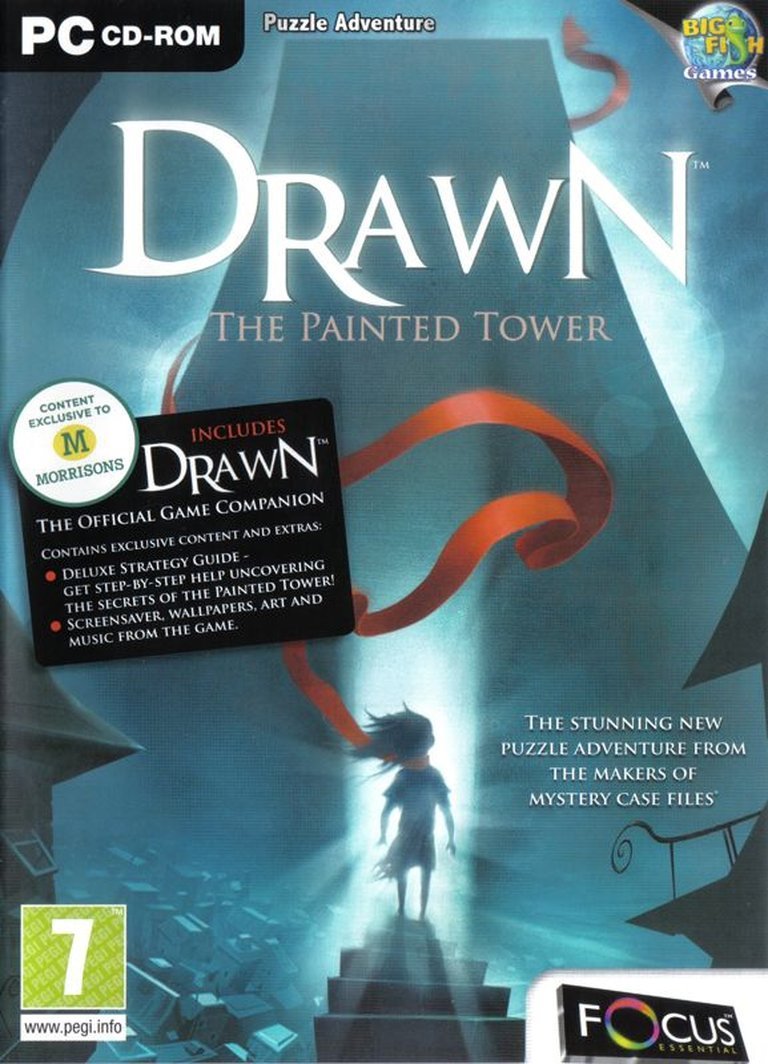
Drawn: The Painted Tower is a first-person adventure puzzle game set in a whimsical fantasy world where players explore intricately painted scenes to solve challenges and uncover a story. This Morrisons Edition includes the original game along with the Official Game Companion, offering a deluxe strategy guide, screen saver, desktop wallpapers, game music, and a production art slide show for enhanced immersion.
Drawn: The Painted Tower (Morrisons Edition) Guides & Walkthroughs
Drawn: The Painted Tower (Morrisons Edition) Reviews & Reception
rgamereview.com : The Painted Tower is an imaginative and compelling adventure game.
Drawn: The Painted Tower (Morrisons Edition): A Regional Relic in the Pantheon of Casual Adventure
Introduction: The Allure of the Painted World
In the crowded marketplace of late-2000s casual gaming, where hidden-object scenes and simple puzzles dominated digital storefronts, Drawn: The Painted Tower emerged as a beacon of artistic ambition. Developed by Big Fish Games and released in 2009, it wasn’t merely another entry in a saturated genre; it was a heartfelt, visually sumptuous fairy tale that used its core mechanic—a protagonist whose drawings come to life—as a narrative and gameplay engine. The Morrisons Edition, a UK-exclusive supermarket bundle released by Focus Multimedia, represents a fascinating historical footnote. It is not a revised game but a meticulously packaged collector’s item, pairing the core experience with a deluxe strategy guide and a suite of supplemental digital art. This review will dissect the base game’s legacy as a landmark of casual adventure design, using the Morrisons Edition’s bonus materials as a lens to understand its intended audience, its artistic process, and its place as a polished, if brief, chapter in the evolution of narrative-focused puzzle games.
Development History & Context: Big Fish Studios and the Casual Crown
Drawn: The Painted Tower was the inaugural title in its series, developed by Big Fish Games, Inc., the company that, by 2009, had essentially defined the casual download market through its own portal. The studio operated under a clear design philosophy: accessible, story-driven games with high production values for a non-hardcore audience. The technological constraints of the era—targeting mid-2000s Windows PCs and early Macs with modest system requirements—meant the game employed pre-rendered 2D backgrounds with interactive elements, a common and efficient method for delivering detailed art without the overhead of a full 3D engine.
The creative vision, led by designers Chris Campbell and Brian Thompson (who also served as Art Director), was to create a “painted” aesthetic that felt tangible and magical. This manifested in the game’s central conceit: exploring worlds that are literally paintings created by the young protagonist, Iris. This wasn’t just a visual theme; it dictated the entire structure. Puzzles involved restoring torn canvases, using sketches as functional items, and interacting with environments that blended hand-drawn artistry with simple, clickable interactivity. Released in September 2009 for Windows and Mac, the game arrived at the peak of Big Fish’s dominance, competing with titles from companies like PopCap and Secret Society, but carving a niche with its stronger narrative through-line and its commitment to a unified, fairy-tale atmosphere.
The Morrisons Edition, likely released later in 2009 or early 2010, speaks to the game’s commercial success and its appeal to a broad, mainstream audience. Its distribution through a major UK supermarket chain indicates Big Fish and Focus Multimedia’s strategy to reach beyond the digital “impulse buy” into the physical retail space, targeting casual gamers and families browsing the software aisle. The inclusion of a full “Deluxe Strategy Guide” as installable software explicitly acknowledged that a segment of its players valued guided experiences and collectible extras as much as the challenge itself.
Narrative & Thematic Deep Dive: A Curse, a Captive, and the Power of Creation
The plot of Drawn: The Painted Tower is elegantly simple yet rich with archetypal resonance. A “bleak land shrouded in shadows” is cursed by an evil King and his Chancellor. The kingdom’s hope rests on Iris, a young girl imprisoned in the eponymous tower, whose innate magical ability allows anything she draws to become real. The player arrives as a mysterious outsider, contacted via a message-scarf thrown from a window. They are aided by Franklin, Iris’s loyal servant, who has been turned to stone—a permanent, silent sentinel who serves as both greeter and hint system.
The narrative is delivered sparingly through notes, environmental storytelling, and brief dialogues with the quirky inhabitants of the painted worlds Iris has created. These worlds—a haunted farm with a melancholic Scarecrow, a Witch Doctor’s chaotic hut, a whimsical Theater stage, a cavernous Hall of Giants, and the fiery/icy domains of a Dragon—are not just puzzle hubs; they are fragments of Iris’s psyche and her desperate attempts to maintain hope and create beauty under duress. Thematically, the game explores creative power as salvation, the custodial nature of art (restoring torn paintings, completing sketches), and linear progression as ascent—both physically up the tower and narratively toward rescuing the source of light.
The curse’s mechanism is cleverly integrated: it has “locked” the tower’s doors and marred Iris’s paintings. The player’s journey is one of restoration, fixing not just locks with keys, but broken art with canvas fragments and sketches. The final revelation—that the King’s Chancellor is the source of the curse and that Iris’s rescue requires a final, selfless act of drawing—provides a poignant, if swift, conclusion. The story’s strength lies in its consistency and its seamless marriage to gameplay; every puzzle reinforces the theme of mending a broken, painted world.
Gameplay Mechanics & Systems: The Architecture of a Gentle Puzzle
Drawn: The Painted Tower is a first-person point-and-click adventure with heavy hidden-object and puzzle integration. Its systems are designed for accessibility with a satisfying depth.
- Core Loop & Navigation: The player navigates static, beautifully painted screens from a first-person perspective. A cursor changes contextually: a hand for picking up items, a jigsaw piece for using inventory items, a magnifying glass for close-up inspection, and a speech bubble for dialogue. Navigation arrows appear at screen edges or on specific hotspots, creating a often-linear but clear path through each “room” or painting.
- Inventory & Object Combination: Inventory items are stored at the bottom of the screen. The game frequently requires combining items (e.g., a Fishing Line + Pole = Fishing Pole; two Net pieces = a Net). These combinations are logical and often telegraphed by the items’ names and uses.
- Painting Restoration & “Sketch” Mechanics: The game’s signature mechanic is entering and repairing Iris’s paintings. This typically involves:
- Finding Canvas Fragments to patch a torn painting.
- Finding a specific Sketch (e.g., “Sketch of a Handle,” “Sketch of a Bell”) and placing it on the painting to activate or alter it.
- Sometimes, being inside the painting to perform tasks for its inhabitants (the Scarecrow, the Witch Doctor), which yields items needed elsewhere.
- Puzzle Diversity: The game excels at variety within its gentle difficulty curve. Puzzles include:
- Jigsaw-style reassembly (reassembling torn notes, restoring window panes).
- Logic sequences (the Stone Circles number puzzle in Chapter 5, the “Friend or Foe” lion tile puzzle).
- Environmental manipulation (outlining clouds with chalk to make it rain, positioning mirrors to reflect light).
- Mini-games (the Spider puzzle where clicking eyes toggles adjacent ones; the color-mixing puzzle in the Cave of Sorrow; the chess-like “Merchant’s Game”).
- Object hunt and use (classic adventure fare, like finding a key for a chest).
- The Hint System – Franklin: A brilliant, diegetic system. The player clicks on Franklin’s portrait in the corner to see a list of current objectives. Requesting a hint for an objective causes Franklin to slowly recharge (the timer is longer the farther the player is from his statue). Multiple hints are available per objective. This system is non-punitive, removes frustration, and perfectly fits the game’s benevolent, magical tone.
- Flaws & Linear Design: The game’s greatest weakness is its often extreme linearity. There is little room for alternative solutions or non-sequential exploration. Objectives are clearly listed, and the path, while beautiful, is a guided tour. Some puzzles can feel contrived (the exact sequence of actions needed for the Scarecrow’s components, the specific order of chalk drawings). The final chapter, “The Book,” is essentially a long, non-interactive fetch-quest across all previous locations, which can feel like padding. The ending is notoriously abrupt, resolving the central conflict with a single click after a brief cinematic, leaving the painted world’s fate and the player’s role feeling underexplored.
World-Building, Art & Sound: The Painted Tower’s True Magic
This is where Drawn: The Painted Tower achieves its classic status. Its art direction, credited to Brian Thompson and the art team (including Hamzah Kasom and Soi H. Che), is not just a style but the game’s foundational language.
- Visual Philosophy: Every background is a lush, hand-drawn painting. The contrast is key: the gloomy, stone-grey architecture of the Painted Tower itself versus the vibrant, saturated fantasy worlds within Iris’s paintings. This visual dichotomy immediately communicates the core conflict: a world of shadow versus a world of creative color and life.
- Environmental Storytelling: The Farm is wistful and autumnal; the Witch Doctor’s lair is a chaotic collection of magical curios; the Theater is opulent and slightly eerie; the Hall of Giants is monumental and ancient. Each painting feels like a distinct storybook illustration come to life, populated with wonderfully animated creatures (the melancholy Scarecrow, the frantic Witch Doctor, the proud Dragon).
- Animation & Detail: Subtle animations are everywhere: drifting clouds, flickering candle flames, rustling leaves, the blinking of a Griffon’s eye. These bring the static art to life, justifying the “painted world” premise. The production art slideshow in the Morrisons Edition is a masterstroke, allowing players to see the evolution from rough monochrome sketches (“Production Art Slide Show”) to final colored scenes, deepening appreciation for the craft.
The sound design, by Andrew Sayers, is equally integral. A melancholy, atmospheric musical score underscores every scene, shifting appropriately from the mysterious strains of the tower to the jaunty theater music or the cavernous echoes of the Hall of Giants. Sound effects are crisp and imaginative. The voice acting (for the few speaking characters) is competent and well-suited to the fairy-tale tone, with Franklin’s silent stone presence and Iris’s few, hopeful lines being particularly effective.
The Morrisons Edition bonus content directly feeds into this appreciation. The Deluxe Strategy Guide, presented as a virtual book with annotated screenshots, allows players to see the intended solution paths and, implicitly, the designers’ puzzle logic. The desktop wallpapers and screensaver let the art extend beyond the game. Most valuably, the Production Art Slide Show is a genuine behind-the-scenes treasure, showcasing the artistic pipeline and highlighting that the game’s magic was built on paper, pixels, and painstaking design.
Reception & Legacy: A Casual ClassicForged in Oil Paint
Upon release, Drawn: The Painted Tower was met with positive to very positive reviews from casual and adventure-focused outlets. Gamezebo awarded it 4.5/5 stars, lauding its “hand-drawn art style” and “strong storyline.” IGN gave its sequel, Dark Flight, a 7.5 (“Good”), but the first game’s reputation was solidified when Adventure Gamers ranked it #76 on their “Top 100 All-Time Adventure Games” list in 2011—a remarkable feat for what was marketed as a “casual” title. It received a “Casual Game of the Year” nomination at the 2010 Interactive Achievement Awards (now the D.I.C.E. Awards), cementing its industry recognition.
Critics and players consistently praised its lovely art, engrossing music, clever puzzles, and polished interface. The common critiques mirrored its design limitations: a thin plot, a slightly disjointed quest as it jumps between paintings, linear gameplay, contrived puzzle solutions, and that abrupt, unsatisfying finale.
Its legacy is twofold. First, it proved that “casual” adventure games could possess authentic artistic merit and emotional weight, bridging a gap between hardcore narrative adventures and simple hidden-object games. It helped establish Big Fish Games as a purveyor of quality story-driven casual titles. Second, it spawned a trilogy (Dark Flight, Trail of Shadows) and a remastered series (Redrawn: The Painted Tower, 2021 by Friendly Fox Studios), demonstrating its enduring brand value. The Morrisons Edition itself is a legacy artifact—a physical manifestation of the game’s success in the pre-digital-storefront era, designed for the collector and the player who wanted to prolong their engagement with the world through art books and guides.
Conclusion: An Imperfect Masterpiece of its Time
Drawn: The Painted Tower is not a flawless gem, but it is a definitively charming and accomplished one. Its narrative is a slender fairy tale, its puzzles occasionally frustratingly opaque, and its structure relentlessly linear. Yet, its world-building is transcendent. The commitment to a singular, painted aesthetic permeates every system and screen, creating an experience that feels more like exploring a living storybook than solving a series of disconnected challenges. The Morrisons Edition, with its strategy guide and art compendium, actually enhances this appreciation, explicitly marketing the game’s beauty as a product to be owned and revisited.
For the historian, it stands as a high-water mark for Big Fish’s in-house development in the late 2000s—a game that used its casual constraints to focus on atmosphere and artistic cohesion rather than complexity. For the player, it remains a warm, gentle, and visually stunning adventure that, despite its flaws, captures a unique magic: the idea that a world can be saved not by force, but by the careful, loving act of putting the pieces back together. It may not be the deepest or longest adventure ever made, but in the gallery of painted towers, its colors shine with a distinct and memorable light.