
- Release Year: 2017
- Platforms: Android, iPad, iPhone, Windows
- Publisher: Bipedal Dog LLC
- Developer: Bipedal Dog LLC
- Genre: Action
- Perspective: Top-down
- Gameplay: Shooter, Space flight
- Setting: Futuristic, Sci-fi
- Average Score: 80/100
Description
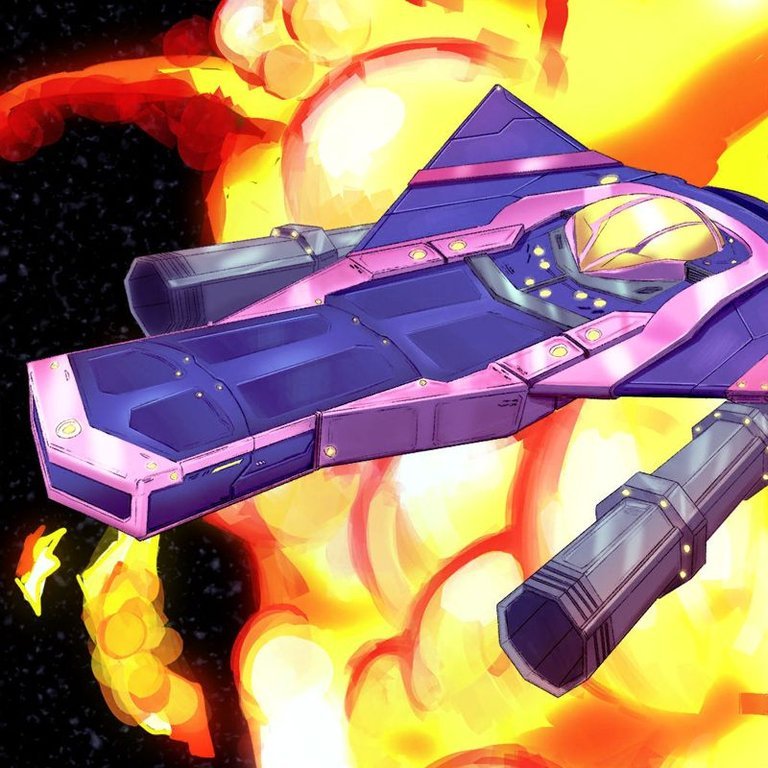
Blast Rush is a top-down, 2D sci-fi shooter where players pilot a spaceship through intense levels, relying on infinite screen-clearing bombs to defeat waves of enemy drones after their guns overheat. Set in a futuristic space battle, the game offers 40 challenging levels, randomized onslaughts, three distinct ships, and one-thumb controls with retro 16-bit-style graphics.
Where to Buy Blast Rush
PC
Blast Rush Reviews & Reception
metacritic.com (80/100): Turning the shmup genre on its head, Blast Rush Classic kicks things up a notch with its focus on firepower and incredible sense of speed.
Blast Rush: The Infinite-Bomb Shmup That Defied Scarcity
Introduction: A Bomb With No Limits
In the canon of shoot-’em-ups (shmups), scarcity is sacred. From the legendary three-lives-and-three-bombs rule of R-Type to the painstaking resource management of modern bullet-hell titles like DoDonPachi, the genre’s tension is forged in the fires of limitation. Blast Rush, a 2017 mobile title from the clandestine one-person studio Bipedal Dog, entered this hallowed space not with a refinement, but with a revolution—or perhaps a heresy. Its central, audacious promise, emblazoned in its App Store description, is simple: “infinite screen-clearing explosives.” This is not a power-up; it is the foundational premise. In a genre where a single bomb is a last resort, Blast Rush asks: what if escaping tight spots wasn’t a rare privilege, but a constant, available right? This review will argue that Blast Rush is a fascinating, deeply flawed, and profoundly obscure deconstruction of shmup dogma. It is a game built on a brilliant, counter-intuitive design pillar that ultimately creates a unique kind of chaos,One that prioritizes frantic, instinctual survival over strategic resource management. Its near-total critical and commercial obscurity is not a condemnation of its quality, but a symptom of its fiercely niche, almost antagonistic design philosophy that deliberately sidelines the very skills traditional shmup fans cherish.
Development History & Context: The Vision of a Lone Wolf
Blast Rush is the product of Bipedal Dog LLC, an entity that exists almost entirely as a pseudonym for its sole credited creator, Ray Barnholt, who served as both Designer and Programmer. This immediately places the game in the long, proud tradition of indie “bedroom coder” projects, where a single vision can be implemented without compromise. The game was built in Unity, a engine that by 2017 had democratized game development but also created a glut of visually generic mobile titles. Blast Rush’s stated goal—to capture “screamin’ 16-bit-style graphics and sound”—was a direct aesthetic rebellion against the smooth, vector-based, or 3D-rendered look common in mobile shmups of the era.
The gaming landscape of late 2017 was one of mobile maturation and indie experimentation. The App Store was saturated with free-to-play gacha shooters and minimalist “one-tap” arcade games. Blast Rush’s one-thumb control model places it squarely in this latter camp, akin to the zeitgeist of games like Super Hexagon or Downwell. However, where those games boiled complexity down to a single, crisp input, Blast Rush attempted to inject the dense, pattern-dodging chaos of a arcade shmup into that same minimalist control scheme. This was a technical and design challenge of the highest order: how do you render, let alone survive, a “constant stream of enemy bullet patterns” with a control input limited to essentially “move and auto-fire”? The answer, as we will explore, is through a complete inversion of power dynamics.
Narrative & Thematic Deep Dive: The Story in the Mechanics
A thoughtful subsection on narrative must begin with a stark admission: Blast Rush has no narrative. There is no story, no characters, no dialogue, and no setting beyond the most generic sci-fi descriptors (“enemy mothership,” “reinforcements,” “fighter ships”). The official blurb provides pure functional context: “The core of the enemy mothership is destroyed and reinforcements are approaching fast, but your guns are overheated and weak.” This is not lore; it is a mechanical justification. The player’s ship is vulnerable offensively (overheated guns) but possesses a singular, overwhelming defensive/offensive tool (infinite bombs).
This vacuum of narrative is, in itself, a thematic statement. Blast Rush reduces the space opera of traditional shmups to a pure, abstract test of reflexes. The “enemy drones” are not alien invaders with a backstory; they are vectors of death, moving patterns to be navigated. The most profound thematic undercurrent emerges from its core twist, as stated on the official website: “the enemies are the bullets.” This is not merely poetic license. In traditional shmups, bullet patterns are separate, often colorful, projectile sprites spawned by enemy units. In Blast Rush, the enemy formations themselves constitute the threat—their movement, their clustering, their very existence is the bullet hell. You are not dodging shots from enemies; you are dodging the enemies. This collapses the distinction between the antagonists and their weaponry, creating a world of pure, unmediated threat. The theme becomes one of overwhelming, inseparable opposition, where the solution (the bomb) is not a targeted weapon but a desperate, area-denial tool that indiscriminately clears the screen of both enemy and bullet. It’s a bleak, existential gameplay loop: your only tool for survival is a complete erasure of your surroundings, followed by an immediate rush back into the void as new threats seamlessly coalesce from the emptiness.
Gameplay Mechanics & Systems: Empowerment Through Annihilation
The genius and flaw of Blast Rush reside entirely in its mechanics.
Core Loop & The Bomb-Centric Paradigm: The game presents 40 structured levels or an endless “Rush” mode. The player controls a top-down ship in a 2D scrolling arena. The primary input is a single thumb: dragging to move. The ship auto-fires a weak, presumably “overheated” shot. The bomb is the star. Activated by a separate, on-screen button or gesture, the bomb clears the entire screen of damage, destroying all minor enemies and bullets. Crucially, there is no limit to its use. Its cooldown is short, and it is always available. This single design decision shatters the core risk/reward calculus of every shmup ever made. In Ikaruga, you weigh the safety of a bomb against a boss pattern. In Blast Rush, the bomb is your primary movement mechanic. The gameplay becomes a rhythmic dance of: dodge frantically → bomb to reset → dodge the next wave → bomb again. Strategic conservation is dead; replaced by a循环 of panicked, screen-clearing desperation.
Innovative (and Flawed) Systems: The “enemies are the bullets” philosophy manifests in enemy design. Waves aren’t pre-formed patterns to memorize, but dynamic, swirling swarms that flood the screen. The tension doesn’t come from learning a fixed sequence, but from adaptively navigating a constantly shifting, deadly mass. A noted feature, implied by the official site’s “blast styles,” and hinted at in user reviews, is the “side blast”—an automatic, smaller explosive triggered when the player makes a quick lateral movement. This is a fascinating attempt to integrate the bomb mechanic directly into the movement controls, rewarding sharp, precise dodges with partial screen clears. It’s a system that encourages aggressive, risky movement but is buried so deep in the mechanics that many players (as the Grouvee review suggests) likely never discover it.
Character Progression & Variety: The “three distinct fighter ships and bomb types” from the ad blurb suggest a layer of strategic choice. Without access to the game, we can only infer possible differentiations: perhaps one ship has a faster bomb cooldown but weaker movement, another a wider bomb blast but slower refire. This variety is essential, as the base gameplay loop is so uniformly frantic that different ship/bomb combinations are the only potential source of long-term engagement. However, the lack of any traditional progression (no power-ups, no weapon upgrades beyond the infinite bomb) means the “progression” is purely the player’s skill in surviving more complex swarms.
UI & Controls: The “one-thumb control” is a masterstroke of mobile-first design and a significant barrier to depth. It enforces a simplicity that clashes with the visual chaos. The HUD is presumably minimal, keeping focus on the ship and the oncoming death-mass. The primary flaw is the total lack of tactical nuance. With infinite bombs, the challenge ceases to be “how do I use my resources wisely?” and becomes “how fast can I tap the bomb button while dragging my thumb?” This reduces a cerebral, pattern-based genre to a test of gross motor speed and screen-tapping endurance.
World-Building, Art & Sound: 16-Bit Style, 21st-Century Chaos
Blast Rush consciously evokes the “screamin’ 16-bit-style graphics and sound” of the Sega Genesis and Super Nintendo eras. On a 2017 mobile device, this was a deliberate aesthetic choice, aligning with the retro indie wave. The visuals are likely characterized by chunky sprites, bright, limited color palettes, and a visible, scrolling grid or starfield. The top-down perspective maximizes screen real estate for the chaotic enemy swarms. The art direction doesn’t build a world; it builds a playfield. There is no environmental storytelling, no distinct alien architecture—just abstract, geometric threats against a void.
The sound design, composed by Felicia Connor (“Felikitty!”), is highlighted as a key selling point. The official website promotes a separate FM and synthwave soundtrack available on streaming platforms, suggesting a score that is more album than mere game audio—driving, relentless, and electronic. The in-game sound effects are likely punchy, retro explosions and laser zaps. The combination is potent: the nostalgic, melodic synthwave provides the feeling of a classic space opera, while the gameplay delivers a brutally modern, minimalist interpretation of that chaos. The atmosphere is not one of lonely, atmospheric space (like Galaga), but of claustrophobic, relentless assault. The art style’s retro trappings make the sheer density of on-screen objects feel like an overload of an older hardware generation’s capabilities, but controlled by a modern, unbomb-limited player.
Reception & Legacy: A Curious Curiosity in the Age of Data
The critical and commercial reception of Blast Rush is defined by its near-invisibility. On MobyGames, it has a “n/a” MobyScore and is “Collected By” only 7 players. On major aggregator sites, its presence is minuscule: OpenCritic lists it in the -1st percentile, a statistical footnote indicating virtually no critic coverage. The single critic review on Metacritic (for the PC “Classic” version) is an 80/100 from Gamers Heroes, which praised it for “turning the shmup genre on its head” with its “focus on firepower and incredible sense of speed.” This glowing review stands in stark contrast to the scant user feedback.
Player impressions, where they exist, are telling. A review on Grouvee (rating 4.2/10) states: “This moved wayyy too fast for me and made me feel kinda sick. It’s pretty much a shmup with unlimited explosives… when it started up at full speed I just couldn’t really follow what was going on [on] the screen. I do think this game seems fairly well-made and probably has an audience, but I’m not it.” This encapsulates the core divide: Blast Rush is not a game for shmup traditionalists seeking pattern memorization. It is a game for players who might enjoy the feeling of a shmup without the commitment. On Backloggd, it holds an average rating of 2.7/5 from 5 ratings, with 50 users backlogged—suggesting it’s a curiosity purchased in bundles (notably the 2020 Bundle for Racial Justice on Itch.io, as noted by one user) but rarely played deeply.
Its legacy is one of niche influence and quiet re-releases. The original 2017 mobile game was followed by Blast Rush LS in 2025 for Nintendo Switch and Windows, suggesting a small but dedicated enough fanbase or developer ambition to warrant an enhanced edition. The Steam Community discussions for the Classic version are dominated by technical issues (“Broken achievements,” “Soundtrack is missing all the tracks”), not gameplay debate. It has not spawned clones or directly influenced major titles. Its influence is philosophical: a proof-of-concept for an “unlimited bomb” shmup, a design curiosity discussed in niche forums and among players who value radical mechanical subversion over polish or popularity. It exists in the same category as other minimalist, rule-breaking indies—a game that asks a fascinating “what if?” question, even if the answer is “it’s too chaotic to be broadly satisfying.”
Conclusion: A Brilliant, Flawed Artifact of Pure Design
Blast Rush is not a great game by conventional metrics. It is often overwhelming, visually messy, and devoid of the strategic depth that defines the shmup genre’s greatest entries. Its narrative is nonexistent, its presentation rudimentary, and its audience infinitesimal. Yet, to dismiss it would be to miss its profound, if flawed, conceptual bravery.
As a historical artifact, Blast Rush is a singular design experiment. It takes the most sacred resource in bullet-hell design—the bomb—and makes it infinitely abundant, thereby forcing a complete recalibration of the player’s relationship to danger and screen-space. It replaces the cerebral puzzle of pattern memorization with a primal, reflexive loop of survival and reset. In doing so, it highlights just how much of the shmup experience is built on the psychology of scarcity.
Its place in video game history is not on a pillar alongside Gradius or Touhou. It is, instead, in a smaller, more intriguing museum: the wing dedicated to “failed but fascinating experiments.” It is a game that dared to break the genre’s most fundamental rule and, in doing so, revealed why that rule exists. The chaos it creates is not a triumphant new form, but a cautionary tale about the loss of tension. For the historian, Blast Rush is an essential case study in design constraints and the unintended consequences of their removal. For the player, it is a brief, dizzying, and ultimately unrewarding thrill ride. Its legacy is that of a question asked, and an answer received: infinite bombs don’t create ultimate power; they create a different, and for most, less satisfying, kind of challenge. It remains, proudly and obscurely, the infinite-bomb shoot-’em-up that nobody asked for, and almost no one played.