
- Release Year: 2015
- Platforms: NES, Windows
- Publisher: Retrotainment Games LLC
- Developer: Retrotainment Games LLC
- Genre: Action
- Perspective: Side view
- Game Mode: Single-player
- Gameplay: Beat ’em up, brawler
- Setting: 1980s, Halloween
- Average Score: 87/100
Description
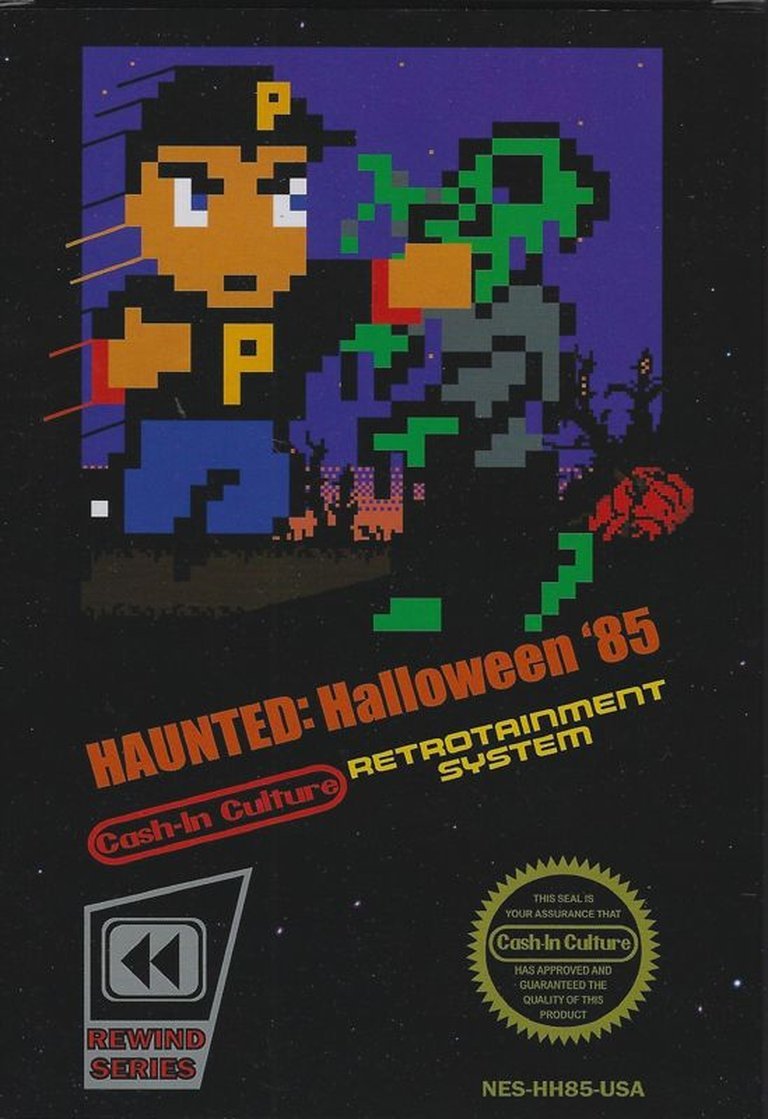
Set in the autumn of 1985 in the small town of Possum Hollow, Haunted: Halloween ’85 follows Donny, a new student who arrives at school on Halloween to find it overrun by ghosts and zombies. As a retro-style beat ’em up with 2D scrolling and challenging gameplay, Donny must battle through six levels of supernatural horrors to uncover the mystery and save his town from a haunting outbreak.
Gameplay Videos
Where to Buy Haunted: Halloween ’85
PC
Haunted: Halloween ’85 Guides & Walkthroughs
Haunted: Halloween ’85 Reviews & Reception
hardcoregamer.com (87/100): Retro enthusiasts rejoice, we have a rather amusing title for you today.
3rd-strike.com (87/100): Retro enthusiasts rejoice, we have a rather amusing title for you today.
Haunted: Halloween ’85: A Modern Relic Forged in 8-Bit Steel
Introduction: The Ghost in the Machine
In an era where “retro” often means a filter applied to a modern engine, Haunted: Halloween ’85 emerges as a startling and profound anomaly: a genuine, new video game, coded from the ground up in 6502 Assembly language for the Nintendo Entertainment System™ (NES). Released in 2015/2016 by the passionate collective Retrotainment Games, it is not a re-release, an emulation, or a pastiche—it is a homebrew cartridge that runs on original hardware. This audacious act of digital archaeology makes Haunted: Halloween ’85 more than a game; it is a deliberate, technical love letter to a bygone era of constrained creativity. Yet, to dismiss it as mere nostalgia would be a critical failure. Beneath its authentically flickering 8-bit veneer lies a tightly designed, punishingly fair, and atmospherically rich action-platformer that holds its own against the very classics it venerates. This review will argue that Haunted: Halloween ’85 succeeds not merely through its historical novelty, but through its masterful synthesis of NES-era design philosophy—precise controls, grueling challenge, and vivid world-building—with a modern sensibility for pacing, feedback, and cohesive narrative, securing its place as a landmark title in the contemporary homebrew movement.
Development History & Context: Coding in the Shadows of Giants
The Studio and Vision: Retrotainment Games, LLC, operated as a tight-knit team of dedicated preservationists and creators. The project was spearheaded by programmer Damian Yerrick, who single-handedly wrote the entire game in 6502 Assembly—the raw, processor-specific language of the NES. This was not a choice of convenience but one of principle; to truly honor the hardware’s limitations and capabilities, one must speak its native tongue. The design was a collaborative effort between Greg Caldwell and Tim Hartman, with Zachary Curl providing the lead visual art. The team’s stated goal, as evidenced by the final product and interviews, was to create a game that felt like it could have been a lost title from 1985, complete with the aesthetic and mechanical hallmarks of the period, but with a polish and coherence that sometimes eluded developers of the actual 8-bit era due to tight deadlines.
Technological constraints as a Creative Catalyst: The development was a masterclass in working within the NES’s infamous restrictions: 2KB of PRG ROM for code (later expanded with mapper tricks), 2KB of CHR ROM for graphics, a palette of 54 colors (with strict per-sprite/scanline limits), and a CPU clock speed of 1.79 MHz. Every sprite, every tile, every sound channel was a precious resource. The art style, noted as reminiscent of River City Ransom (Technōs Japan, 1989), showcases how clever use of limited palettes and sprite multiplexing can create expressive characters and detailed environments. The game was initially released on a physical NES cartridge in October 2015, a stunning 21 years after the official end of the console’s commercial life cycle, and subsequently ported to Windows via Steam in 2016.
The 2015-2016 Gaming Landscape: The game arrived amidst a tidal wave of “retro-inspired” indie games (Shovel Knight, Axiom Verge, Cuphead). However, Haunted: Halloween ’85 stood apart. While contemporaries used modern engines to mimic a retro look, Retrotainment built a real artifact. This placed it at the epicenter of the “homebrew” scene, appealing to hardcore preservationists, NES modders, and critics who saw it as the purest form of retro revival. Its release capitalized on a growing cultural resonance for 1980s nostalgia, but Grounded it in tangible, historical craft.
Narrative & Thematic Deep Dive: The Horror of Being Late
Plot as Scaffolding: The narrative is a perfect distillation of 1980s kid-horror, à la The Monster Squad or Ghostbusters. The protagonist, Donny Johnstown (“at least that’s what my friends call me… ’cause I’m Donny… from Johnstown”), is an every-kid. His motivation is profoundly, beautifully mundane: he stayed up all night playing his NES, overslept, and must race to school to attend the Halloween dance and hold the hand of his crush, Tami. This immediate, relatable stakes—the terror of social ruin—is catastrophically amplified when he arrives to find his school transformed into a warzone of zombies, ghosts, and supernatural hazards.
Dialogue and Tone: The game’s introductory scroll, delivered in a deliberately clunky, earnest font, sets the stage with a storyteller’s cadence: “Let me tell yinz about Halloween.. In 1985..” This use of regional dialect (“yinz”) immediately roots the story in a specific, working-class American milieu (the fictional town of Possum Hollow). The tone balances Spielbergian wonder with Carpenter-esque dread. Donny’s internal monologue is simple, his goals clear. The horror is not existential but chaotic and absurd: friendly faces become zombies, pumpkins become lethal, and the school’s architecture becomes a surreal, haunted funhouse. The sequel hook—”the reason the town is no longer haunted!”—frames the entire adventure as a folk tale already told, giving the gameplay the weight of myth-making.
Themes: At its core, the game explores the suburban gothic. The horror infiltrates the sacred spaces of childhood: the school, the mall, the neighborhood streets. It’s a rites-of-passage allegory; Donny must literally fight his way through a monstrous transformation of his world to secure a moment of innocent connection (holding Tami’s hand). The ultimate, darkly ironic twist—climbing “out of your own grave”—elevates the conflict from saving the town to a literal struggle against one’s own undeath, a potent metaphor for the anxieties of growing up. The 1985 setting is not incidental; it’s the peak of the “satanic panic” era, where suburban fears were projected onto Halloween, cartoons, and heavy metal. Haunted taps into that specific cultural nervousness.
Gameplay Mechanics & Systems: The Precision of Punishment
Core Loop & Control Scheme: Haunted: Halloween ’85 is a side-scrolling beat ’em up / platformer hybrid. Players traverse left-to-right stages filled with enemies, hazards, and platforming challenges, culminating in a boss fight. Control is the quintessential NES layout: D-pad for movement, A to jump, B to punch. A simple, three-hit combo can be strung together, and a command-roll (down + A) provides a dodge. This simplicity is a strength; the challenge emerges from enemy placement, environmental threats, and the demanding physics of Donny’s jumps, not from a complex move list.
The Innovation of the Health System: The game’s most brilliant systemic twist is its health-as-zombification meter. Donny has no numeric hearts or a bar. Instead, each hit drains his “life color.” He begins with a healthy pink hue. Damage turns him progressively paler, then green—the unmistakable hue of the game’s zombies. This creates a constant, visual tension. Players aren’t just managing a number; they are watching their hero become the monster. It ties the gameplay mechanic directly to the narrative and thematic core. Healing comes via Candy Corn pick-ups, a perfect Halloween-specific health item that feels both whimsical and grim in context.
Difficulty & Progression: The game is deliberately, classically hard. Enemies are aggressive, deal significant damage, and can hit from surprising angles (e.g., the Feathered Fiend black birds dive-bombing from off-screen). Checkpoints are zone-based; dying restarts you at the beginning of the current screen, but losing all lives forces a full level restart (with nine continues). This structure demands pattern recognition, memorization, and mastery—a direct echo of Ghosts ‘n Goblins or Ninja Gaiden. The six levels (School, Neighborhood, Forest/Mall, Cemetery, Sewers, Final Confrontation) each introduce new enemy types and hazards, escalating complexity.
Boss Design & Flaws: Bosses are a mixed bag, a point noted by critics. Some, like the Ghost in the Bookcase (a clear, loving nod to the Ghostbusters library ghost), are memorable, stage-specific spectacles requiring you to attack a weak point while navigating a moving, hazardous environment. Others can feel like larger, spongier versions of regular enemies, lacking a unique gimmick. The hit detection, while generally fair, can occasionally be “NES-hard”—a frustration inherent to the era’s design, where a pixel’s width determines life or death. A reported final boss bug on some versions also mars an otherwise polished experience.
UI & User Experience: The interface is beautifully minimalist. The only on-screen elements are the score, extra lives, and the crucial, ever-present life color indicator on Donny’s portrait. No clutter, no modern map markers. The player is alone in the haunted suburb, just as Donny is.
World-Building, Art & Sound: Possum Hollow, 1985
Setting & Atmosphere: The world of Possum Hollow is a masterclass in environmental storytelling on a 16×16 tile grid. The game’s opening level—the trashed school—is a masterpiece of decay. Shattered glass, burst pipes, flipped desks, and floating, haunting books create a sense of violent, supernatural disruption. This isn’t a generic zombie apocalypse; it’s your school, defiled. Subsequent levels maintain this grounded-in-reality horror: the creepy cemetery with its tilting tombstones, the jagger bushes (poisonous, jumping pumpkins) that turn a familiar autumn decoration into a lethal obstacle, the suburban backyards with climbable trees, and the claustrophobic sewers. The setting is a hyper-specific, late-October 1985 America, where Halloween decorations are ubiquitous and the threat feels both personal and communal.
Visual Direction: Zachary Curl’s art is stunningly expressive for the hardware. Donny’s animations—his running, his punching combos, his dazed stumble after being hit—are fluid and full of character. Enemy sprites are distinct and often grotesquely charming. The backgrounds use clever parallax scrolling (where possible on NES) and detailed tilework to create depth. The color palette is moody, favoring oranges, purples, and sickly greens, perfectly capturing the Halloween aesthetic while maintaining a grim, twilight atmosphere. It truly looks like a lost Sunsoft or Konami title from the era.
Sound Design & Music: Thomas Cipollone’s chiptune soundtrack is a highlight, arguably surpassing many actual NES releases in melodic strength and thematic appropriateness. Tracks shift from tense, creeping basslines for exploration to frantic, pulse-pounding arpeggios for combat. The music doesn’t just accompany the action; it defines the emotional texture of each stage. Sound effects are punchy and satisfying—the thwack of a punch, the gurgle of a zombie, the shing of a continue coin—and are crucially used for gameplay feedback (e.g., a distinct sound for a successful hit vs. a blocked one). The audio engine, with contributions from Alexander Semenov (Shiru) and Bradley Smith, maximizes the NES’s limited sound channels to create a surprisingly rich and ominous soundscape.
Reception & Legacy: From Curiosity to Canon
Critical and Commercial Reception: Upon its dual release, Haunted: Halloween ’85 was met with significant curiosity and largely positive reviews from the niche press that covered it. Hardcore Gamer awarded it a 3.5/5, praising its solid action and authentic feel. 3rd-Strike.com gave it an 8.6/10, lauding its visuals, gameplay, and “amusing” premise. The aggregated critic score sits at 71% (from one listed source). On Steam, it has maintained a “Mostly Positive” rating (75/100) from hundreds of user reviews, with many explicitly purchasing it to play on original NES hardware via emulation or flash cartridges. Its commercial success was modest but significant for a homebrew title, selling an estimated 1,000+ physical cartridges through partners like Cash-In-Culture Games—a remarkable number for a game with no official Nintendo license.
Evolution of Reputation and Influence: Initially celebrated as a novelty—”a new game for the NES in 2015!”—its reputation has solidified into one of respect for its design. It is now frequently cited in discussions of the best modern homebrew titles and is seen as a benchmark for authenticity. Its influence is subtle but present:
1. Proof of Concept: It demonstrated that a skilled, dedicated team could not only replicate NES development but create a title with modern design sensibilities (clear visual feedback, balanced difficulty) within strict 8-bit constraints.
2. Inspiration for the Homebrew Scene: It likely emboldened other developers to pursue genuine NES/SNES development, fueling a vibrant independent scene that operates outside corporate nostalgia.
3. Bridge Between Eras: For younger players discovering it on Steam, it serves as a gateway to understanding 8-bit design. The lack of hand-holding, the reliance on pattern memory, and the lethal precision required offer a visceral education in pre-QTE, pre-waypoint gaming.
Conclusion: A Definitive Verdict for a Digital Relic
Haunted: Halloween ’85 is a triumph on multiple levels. As a technical achievement, it is a feat of engineering and passion, a testament to the enduring knowledge of 8-bit architecture. As a game design exercise, it is a masterclass in distillation, using a minimal control set and a single, brilliant health mechanic to build a cohesive, tense, and rewarding experience. As a piece of world-building, it perfectly captures a specific, eerie moment in the American cultural imagination.
Its flaws—the occasional boss unevenness, the harsh but authentic hitboxes—are not bugs but features of its genetic code. They connect it directly to the lineage of Ghosts ‘n Goblins and Castlevania, games that demanded respect through repeated failure. Does it dethrone the giants of the NES library? No. But it confidently joins their ranks, not as an imitation, but as a legitimate contemporary of those classics, made decades later with the same spirit.
In the annals of video game history, Haunted: Halloween ’85 will be remembered as more than a curiosity. It will be remembered as a corrective and a declaration. It corrected the misconception that “retro” equals “emulated.” It declared that the language of 8-bit game design is not a dead dialect but a living, breathing one, capable of expressing fresh ideas and delivering pure, unadulterated gameplay joy. For historians, it is a primary source document. For players, it is a terrifyingly fun and impeccably crafted action-platformer. For the medium itself, it is a vital reminder that innovation can also be found in looking backward, with rigor, love, and a deep understanding of the machine. Possum Hollow may no longer be haunted, but its legacy, thanks to this little game, is perfectly, hauntingly preserved.