
- Release Year: 2017
- Platforms: Windows
- Publisher: magnussoft Deutschland GmbH
- Developer: magnussoft Deutschland GmbH
- Genre: Compilation
- Average Score: 43/100
Description
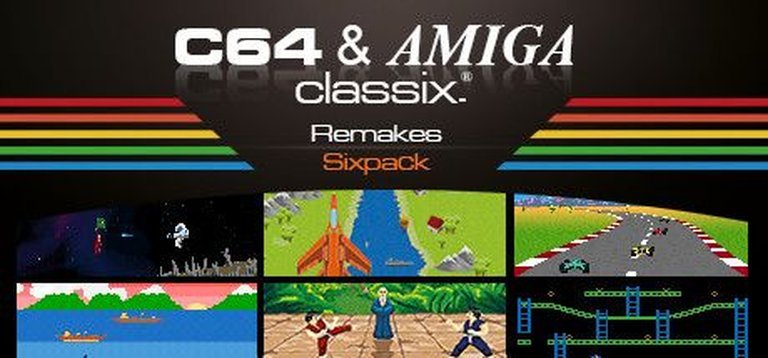
C64 & Amiga Classix Remakes Sixpack is a compilation game for Windows that features six faithfully remade classics from the Commodore 64 and Amiga eras. Players can dive into a nostalgic array of genres, including a jump-‘n-run in ‘Jump Boy’, racing with pit stops in ‘Pitstart’, karate combat, a sci-fi shooter set on the moon Io in ‘Drop Sector’, river jet navigation in ‘River Attack’, and submarine warfare in ‘Seawolf III’, all updated with modern touches while retaining their original retro charm and variety.
Where to Buy C64 & Amiga Classix Remakes Sixpack
PC
C64 & Amiga Classix Remakes Sixpack: Review
Introduction: A Digital Time Capsule with Rusty Hinges
In the vast, often-overlooked archives of gaming history, the 8-bit Commodore 64 and 16-bit Amiga eras represent a crucible of raw creativity, where technical constraints forged innovative gameplay. The 2017 compilation C64 & Amiga Classix Remakes Sixpack, published and developed by the prolific German studio Magnussoft, arrives not as a groundbreaking reimagining but as a digital preservation effort—a six-pack of nostalgic carbonated beverages from a bygone decade. Its thesis is simple, almost humble: to faithfully resurrect six obscure or semi-forgotten titles from that era for modern Windows PCs. The review that follows must therefore navigate a unique paradox. This is a product with minimal narrative depth, no original creative vision beyond emulation, and a reception that speaks more to the challenges of retro revival than to the quality of the source material. Its significance lies not in innovation, but in its role as a cultural artifact representing a specific, recurring niche in the gaming ecosystem: the budget-priced, low-fidelity remake of pre-internet classics.
Development History & Context: The Magnussoft Assembly Line
Studio & Vision: Magnussoft Deutschland GmbH is not a household name like Nintendo or Capcom; it is a workhorse of the European retro gaming scene. Since the early 2000s, the studio has built a business model around licensing and re-releasing compilations of classic Commodore 64, Amiga, and Atari ST games. Their output is staggering—the MobyGames database lists over 70 games credited to project lead Maik Heinzig alone. The “Classix” series is their flagship, with entries like C64 ClassiX (2000), Amiga ClassiX (2001), and the “Sixpack” variants being iterative updates. The vision for Sixpack (2017) is clear: extract six titles from their vast licensed library, apply a minimal “remake” sheen (often simply porting from their earlier Android releases, as credits note “Porting from Android / Rainbow Arts”), and package them for Steam at a low price point ($7.99 / €7.79). There is no ambition to re-engineer or reinterpret; the goal is preservation and accessibility.
Technological Constraints & Landscape: The original games spanned from 1982 (River Raid) to the mid-80s. Their development was defined by severe memory limits (64KB for C64), limited color palettes, and processor speeds measured in megahertz. The 2017 “remakes” operate under a different constraint: a tiny budget and minuscule development window. The Steam system requirements—an Intel Core Duo 2 2.5 GHz, 512MB RAM, DirectX 9.0c—are themselves archaic for 2017, indicating a development approach that prioritizes maximum compatibility over visual fidelity. The gaming landscape of 2017 was dominated by photorealistic AAA titles and the early days of the indie “retro revival” boom (e.g., Shovel Knight). Sixpack exists in a separate, parallel market: one for players seeking not inspired homages, but literal, unaltered copies of their childhood, warts and all.
Narrative & Thematic Deep Dive: The Elegance of Absence
A profound analysis of plot, character, and theme for C64 & Amiga Classix Remakes Sixpack is, by necessity, an analysis of nothing. The compilation is a pure mechanics-first assemblage of arcade and early home computer games. Any narrative is incidental, mechanistic, and stated in the briefest of terms on the title screen or manual:
- Jump Boy: A platformer where a boy must navigate treacherous levels. The “story” is the act of jumping.
- Drop Sector: A Lunar Lander-esque game where the player “protect[s] the mine workers on the moon Io from alien attacks.” Theme: Cold War-era sci-fi resource defense, reduced to dodging and shooting.
- Pitstart: A top-down racing game with “pit stops.” The theme is motorsport simulation in its most abstract form.
- Karate: A one-on-one fighting game. Theme: martial arts tournament, conveyed solely through sprite design and move names.
- River Attack: The player maneuvers a jet “skillful across the river – past your besiegers.” Theme: Vietnam War-era “riverboat” action, distilled into a scrolling shooter.
- Seawolf III: A submarine simulator where you “sink submarines.” Theme: naval warfare, reduced to sonar pings and torpedo angles.
There is no dialogue, no character arcs, no thematic subtext. These are game poems, where meaning is derived entirely from interaction, pattern recognition, and score acquisition. The underlying theme of the compilation itself is digital archaeology—the act of digging up these mechanical fossils and placing them in a modern context, where their simplicity is either a refreshing purity or an uncurable obsolescence.
Gameplay Mechanics & Systems: A Museum of Archaic Design
The core gameplay loops are direct extracts from 1980s design philosophy, with any “remake” changes being cosmetic or minimal quality-of-life adjustments (like higher-resolution sprites).
Core Loops & Innovation:
* Jump Boy: A precision platformer demanding pixel-perfect jumps and memorization of level layouts. Its innovation is in its challenging level design within tight constraints.
* Drop Sector: A resource management action game. The loop involves landing safely, mining, and fending off enemies with limited fuel and ammo. It’s a tense balance of risk/reward.
* Pitstart: Racing with a unique pit-stop mechanic. Players must manage car damage and refueling, adding a strategic layer to the top-down driving.
* Karate: A pioneer of the fighting game genre. Its innovation is in having distinct stances and moves (punch, kick, block) before the era of complex combos or special moves.
* River Attack: A forced-scrolling shooter. The loop is constant aiming, dodging obstacles (both environmental and enemy), and managing weapon heat or ammo.
* Seawolf III: A first-person submarine simulation from inside the conning tower. It uses a minimalist periscope view and sonar, requiring spatial reasoning and timing.
Flawed Systems by Modern Standards: The compilation is a showcase of archaic, often frustrating, design:
* Opaque Mechanics: No tutorials. Players are expected to learn by dying repeatedly. Seawolf III‘s sonar and torpedo mechanics are cryptic without the original manual.
* Punishing Difficulty: High damage, limited lives, and no continues in some titles reflect the arcade quarter-munching ethos. Modern players may see this as unfair, not challenging.
* Minimal UI/Feedback: Health, ammo, or fuel are often represented by single-digit meters or blinking lights. Audio cues are primitive bleeps (though the “remake” likely retains the original chiptune aesthetic).
* Lack of Saving: The expectation is a single, perfect run. This is not a bug in the remake; it is a faithful feature of the source material.
The “innovative” system here is the compilation itself—a single executable with a launcher menu. It offers no cross-game saves, no unified achievements, no leaderboards. It is a museum exhibit where you can only look, not touch the glass.
World-Building, Art & Sound: Authenticity Over Aesthetics
Visual Direction: The “remake” tag is somewhat misleading. Based on descriptions and the series’ history, the visual upgrade is likely a clean filter or slight resolution bump on the original pixel art, not a full 3D overhaul. The art style is pure late-80s/early-90s: limited color palettes, blocky sprites, tile-based backgrounds. The world-building is implied through these graphics—the green and brown of River Attack, the stark grey of Drop Sector‘s moon base, the dojo in Karate. It’s a world of suggestion, not detail.
Sound Design: This is where the era’s soul often resides. The original C64 SID chip and Amiga Paula sound chip produced iconic, melodic, and rhythmic chiptunes that are more memorable than any in-game narrative. A faithful remake must preserve these soundscapes. The description’s “touch of nostalgic retro feel” hinges entirely on this audio fidelity. The sound effects—blips, explosions, engine roars—are as much a part of the gameplay feedback as the visuals. Any “remix” or update would likely be sacrilege to the target audience.
The compilation’s atmosphere is one of authentic shallowness. The mood is set by the hardware it mimics: beige CRTs, the hum of a floppy drive, the tactile click of a joystick. It does not strive to build a world; it strives to replicate a feeling—the feeling of inserting a cartridge or disk and hearing that startup jingle.
Reception & Legacy: A Niche Preserved, A Mainstream Ignored
Critical & Commercial Reception: Formal critic reviews are non-existent for this title. MobyGames lists no critic reviews, and Metacritic has no professional scores. The only quantitative data is the Steam user score of 43/100 based on 7 reviews, split 3 positive to 4 negative. This poor reception is the most telling critical data we have. Negative reviews almost certainly cite:
* “Overpriced for six ancient games.”
* “No improvements, just a lazy port.”
* “Controls feel clunky.”
* “Where are the modern features (save states, rewind)?”
Positive reviews would be from die-hard retro enthusiasts who value the sheer convenience of having these specific titles on a modern platform without setting up an emulator.
Evolution of Reputation: The reputation of Sixpack is inextricably linked to the reputation of its source games and the Magnussoft brand. For collectors and preservationists, it is a useful, if expensive, archival tool. For the broader gaming public, it is invisible. It has no cultural footprint. Kotaku’s mention is a mere listing in a “Week in Games” roundup, treating it as a minor curiosity.
Influence on Industry & Genre: The influence is negative and cautionary. Sixpack represents the wrong way to revive retro games for a modern audience. It demonstrates that simply re-releasing old code without context, modern wrappers, or meaningful enhancements leads to poor reception and niche utility. It contrasts sharply with successful models like the SEGA Ages series (which adds robust modern features) or the Evercade cartridge system (which markets physical preservation). Sixpack’s legacy is as a counter-example: proof that nostalgia alone is not a sufficient product pillar. It keeps the flame of specific, obscure titles alive in a commercial format, but does nothing to expand their audience.
Conclusion: A Faithful, Flawed Artifact of Preservationism
C64 & Amiga Classix Remakes Sixpack is not a game to be judged on its creative merits, for it has none of its own. It is a vessel. Its sole function is to carry six distinct, historically significant (if personally obscure) game designs from 1982-1985 into a 2017 Windows executable.
Its strengths are absolute fidelity and convenience. For the player who owns Drop Sector on a floppy disk but lacks a working C64, this is the only legal, ready-to-play option. The controls are reportedly functional, and the games run. As a piece of software archaeology, it is competent.
Its fatal weaknesses are its total lack of curation, context, or modern accommodation. It offers no history, no developer interviews, no scans of original box art, no “game ratings” from the era. It makes no effort to bridge the gap between 1985 and 2017. The 43/100 Steam score is not an indictment of the original games’ design, but of this specific delivery method’s failure to meet modern expectations for value, polish, and features.
Final Verdict: C64 & Amiga Classix Remakes Sixpack is a curator’s failure but a historian’s curiosity. It successfully prevents six titles from fading into total digital obscurity, yet it presents them in a stark, uninviting, and commercially tone-deaf package. It is a testament to the enduring power of pure gameplay mechanics—you can still enjoy the tense submarine hunts of Seawolf III or the frantic platforming of Jump Boy. However, it is also a stark reminder that preservation without presentation is a service only to the already-converted. In the pantheon of video game history, it will not be remembered as a classic, but as a footnote: the year Magnussoft shipped another six-pack, and the world largely yawned, before moving on to the next nostalgia-bait compilation. Its place is not on a pedestal, but in a specific, dusty shelf of a dedicated retro collector’s library.