
- Release Year: 2013
- Platforms: Windows
- Publisher: Torn Banner Studios, Inc.
- Genre: Compilation
- Average Score: 90/100
Description
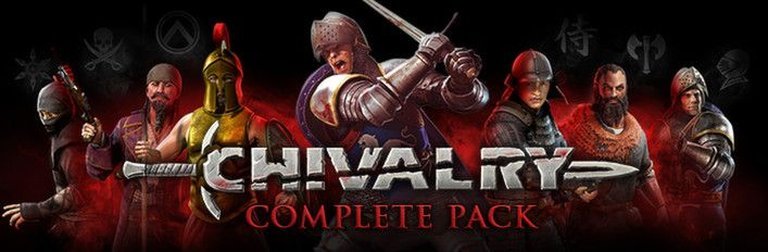
Chivalry: Complete Pack is a compilation that bundles Chivalry: Medieval Warfare and Chivalry: Deadliest Warrior, set in the medieval fantasy kingdom of Agatha during King Argon’s crusade against Tenosia. The lore reveals a backdrop of political strife with the rise of the Mason Order, and players engage in large-scale, first-person melee combat across desert landscapes and fortifications, embodying classes like knights and archers in brutal, team-based battles for control and survival.
Chivalry: Complete Pack Reviews & Reception
metacritic.com (90/100): I’m rather enamoured by the unique flavour of online combat presented by Chivalry. It’s fresh and fun, and like the very best games is easy to get into yet incredibly hard to master. I’ve honestly not had this much competitive online joy since Battlefield 3, and to think a $25 indie title can provide a level of enjoyment up there with a $100 million game like Battlefield is testimony to the skill of the developer.
Chivalry: Complete Pack Cheats & Codes
PC
| Code | Effect |
|---|---|
| aoc_slowmo 99999 | Sets slow motion time scale to 99999 |
| aoc_slomo 9999 | Sets slow motion time scale to 9999 |
Chivalry: Complete Pack: The Bloody, Brilliant, and Flawed Foundation of Medieval Melee
Introduction: A Niche Forged in Steel
In the landscape of multiplayer gaming, dominated for decades by ballistic confrontations and fantastical abilities, Chivalry: Medieval Warfare arrived in 2012 as a stark, brutal, and powerfully focused anomaly. It was not a game about precise headshots or cool-down management; it was about the visceral, clumsy, and terrifying physics of men hacking at each other with broadswords, the thwack of an arrow finding its mark, and the deafening clang of shield against steel. The Chivalry: Complete Pack, bundling the seminal 2012 title with its 2013 expansion Deadliest Warrior, represents the entire initial commercial vision of Torn Banner Studios—a vision that would carve out a permanent, if deeply divisive, niche in the genre of historical combat simulators. This review argues that Chivalry is a landmark title not because it perfected its craft, but because it defined a modern one. It is a game of extraordinary, often frustrating, authenticity—a clunky, buggy, yet profoundly immersive experience whose core combat loop remains one of the most satisfying and deep melee systems ever attempted in a mainstream multiplayer title. Its legacy is twofold: as the progenitor of a small but passionate genre, and as a cautionary tale about the challenges of translating complex physical simulation into a polished, accessible product.
Development History & Context: From Mod to Commercial Pioneer
The story of Chivalry is intrinsically linked to the modding scene. It was born from Age of Chivalry, a total conversion mod for Valve’s Half-Life 2 (using the Source engine) created by a core team that would later form Torn Banner Studios. Under the direction of Steve Piggott, and with design from Justin Pappas and Andrew Seyko, the team sought to commercialize and expand their creation. The transition from a free Source mod to a standalone commercial product using Unreal Engine 3 was a monumental leap. This shift, as noted in Wikipedia, allowed for “improved graphics,” “interactive environments,” and a “more intuitive movement system,” but it also presented significant technological hurdles. The developers were no longer constrained by a modding framework but were now responsible for all engine integration, networking code, and asset creation.
The era of its release (2012-2013) was a golden age for ambitious indie multiplayer experiments. Games like Battlefield 3 represented the AAA pinnacle of large-scale combat, while War of the Roses (2012) offered a more stat-heavy, historically-minded competitor. Chivalry‘s pitch was different: pure, unadulterated, first-person medieval brutality. Its successful Kickstarter campaign in September 2012 (prior to its October 2012 release) demonstrated a ready audience starved for this specific fantasy. The initial PC-exclusive stance, later softened for ports to Xbox 360 and PlayStation 3 (handled by Mercenary Technology) and eventually current-gen consoles (by Hardsuit Labs), speaks to a development cycle stretched thin by ambition, with porting struggles often cited by users as a source of technical issues.
Narrative & Thematic Deep Dive: The Saga of Agatha
While often dismissed as a simple backdrop for mayhem, Chivalry possesses a surprisingly dense and politically charged lore, largely delivered through external materials like the official game manual and fan-wikis, and pieced together by the community from map names and objective descriptions. The narrative is a medieval political thriller and civil war set in the fictional realm of Agatha.
The catalyst is King Alphonso Argon’s unprovoked crusade against the southern land of Tenosia. His most trusted general, Malric Terrowin, opposed the venture, foreseeing its folly. His warnings prove correct: the crusade collapses in the Tenosian desert, Argon and his heir, Prince Danum, go missing, and the exhausted army faces annihilation. This creates a power vacuum. The steward, Feydrid Kearn, remains loyal to the lost king and prepares to return home with the main force. Malric, commanding the elite Mason Order (a force he had assembled prior to the war based on merit and strength), seizes the moment. He propagandizes Argon’s death, claims royal lineage, and establishes a new, meritocratic kingdom from the ruins of the old order, rebuilding his capital in the formidable Vantear fortress, the Trayan Citadel.
The conflict that defines the game’s maps is the inevitable clash: Feydrid Kearn’s loyalist Agatha Knights, defending the homeland and seeking the true king, versus Malric’s expansionist Mason Order, seeking to impose their new philosophy of strength across all of Agatha. The map progression, as debated on Reddit and Steam, forms a loose campaign narrative:
* Hillside: The Mason fleet returns to find the Agathian port hostile, initiating the invasion.
* Stoneshill / Citadel: Masons assault the Agathian castle to kill Feydrid.
* Dark Forest: The hunt for the remaining royal family in hiding.
* Battlegrounds: A desperate Agathian counter-attack pushing toward the Mason citadel.
* Citadel (Alternate): The final assault on Malric’s fortress (if Agathians win Stoneshill).
Thematically, the lore explores classic concepts: legitimacy vs. meritocracy, the cost of imperial overreach, and the cyclical nature of civil war. Malric is not a mustache-twirling villain but a pragmatic, if ruthless, realist who believes the old monarchy failed. The Agatha Knights fight for tradition and lawful succession. This moral ambiguity, unfortunately, remains largely unexplored in-game, leaving players to project their own allegiance based on aesthetic preference or the simple joy of the slaughter. The Deadliest Warrior expansion, a tie-in with the Spike TV show, largely abandons this lore for historical celebrity matchups (Spartan vs. Ninja, etc.), creating a tonal disconnect that feels like a separate, arcade-style mode bolted onto the main game’s narrative framework.
Gameplay Mechanics & Systems: The Deep, Messy Heart of Combat
Chivalry‘s genius and its greatest frustration lie in its combat system, a direct evolution from the Age of Chivalry mod. It is a physics-based, stamina-driven melee sim that prioritizes timing, positioning, and reading an opponent over rapid reflexes alone.
Core Combat Loop: Players choose from four mirrored classes for either faction:
1. Archer: Ranged specialist, fragile, with secondary melee weapons.
2. Man-at-Arms: Fast, agile, using one-handed weapons and shields; the master of parries and dodges.
3. Vanguard: Mid-range, using long polearms or greatswords; features a powerful sprint attack that can break guards but leaves the user vulnerable.
4. Knight: Slow, heavily armored tank, wielding massive two-handers or the unique ability to use a longsword one-handed with a shield.
Each class has a stamina bar governing attacks, blocks, and dodges. Blocking is directional and stamina-intensive. A well-timed parry (a precise block that momentarily staggers the attacker) is a high-skill, high-reward maneuver. Weapons have distinct wind-ups, release points, and “dragging” or “acceleration” mechanics where the swing’s arc can be manipulated to trick an opponent’s guard. This creates an incredible skill ceiling where top players can feint, drag, and accelerate attacks in ways that look like glitches to the uninitiated but are, in fact, intentional and deep systems.
Game Modes: The standout is Team Objective, a brilliant asymmetric mode where one team attacks (breaching gates with rams, looting villages, assassinating a king) and the other defends. This creates dramatic, emergent narratives. Other modes like Last Team Standing, Capture the Flag, and Team Deathmatch provide variety but lack the coherent spectacle of Objective.
Flaws in the System: The complexity is a double-edged sword. The learning curve is brutally steep. New players often feel helpless, dying to seemingly teleporting opponents or invisible attacks. The UI is functional at best, often obstructive (the server browser was notoriously finicky). Hit registration, while largely praised for its consistency by veterans, was perceived as inconsistent by many, often due to the game’s ruthless interpretation of weapon hitboxes versus visual feedback. Team-killing is rampant, a product of the chaotic third-person melee and friendly fire being on by default—a feature some champion as “realistic” and others despise as a toxic necessity.
Deadliest Warrior adds a layer of friction. Its classes (Spartan, Ninja, Viking, etc.) have wildly different mechanics (e.g., Spartan phalanx stance, Ninja smoke bombs) that don’t always mesh with Medieval Warfare‘s core balance, feeling more like a fun, unbalanced sideshow.
World-Building, Art & Sound: Grinding Realism
The aesthetic is one of gritty, grounded pseudo-realism, not high fantasy. Unreal Engine 3 powers a world of muddy fields, wooden fortifications, and stone keeps. Textures are often drab—browns, grays, greens—prioritizing readability of enemy silhouettes over painterly beauty. The character models are bulky and heavily armored, selling the weight of the combat. The animation work is fundamental: the heavy, wind-up-heavy swings, the staggering recoil from a solid hit, the desperate flailing of a disarmed man—all sell physicality.
The sound design is exceptional and core to the experience. The metallic clang of a parry, the dull thud of an arrow impacting armor, the visceral splat and gurgle of a fatal throat slash—these sounds provide crucial audio feedback in the heat of battle. The environment is filled with the screams of the dying, the clatter of dropped weapons, and the distant roar of burning oil. The infamous, exaggerated gore—dismemberment, decapitations, and spurting blood—is not just for shock value; it is a critical UI element. A cleanly severed head is an undeniable, satisfying signal of a perfect strike, cutting through the visual chaos.
The audio, however, also highlights a weakness: environmental repetition. Many maps use similar asset sets, leading to a sense of déjà vu that several critics (like AusGamers) noted as a downfall.
Reception & Legacy: A Cult Classic Forged in Controversy
Upon its PC release in October 2012, Chivalry: Medieval Warfare was met with generally favorable reviews, holding a Metacritic score of 79. Critics praised its unique, intense, and fun combat. Destructoid noted “every hit, parry and block feels real,” while PC Gamer famously compared it to “Quake to War of the Roses’ Battlefield,” highlighting its faster, bloodier pace. AusGamers gave it 90/100, calling it a testament to indie skill.
However, criticisms were consistent: a limited class selection, repetitive environments, and a preponderance of bugs and glitches—from getting stuck on geometry to inconsistent hit detection. User scores (7.7 on Metacritic) reflect this bipolar experience: passionate love from those who overcame the learning curve, and severe frustration from those who bounced off it. Commercial performance was surprisingly strong for a niche PC title: 1.2 million copies by August 2013, hitting 2 million by October 2014. This success, achieved without a traditional marketing blitz, proved the viability of hardcore melee combat.
Its legacy is profound but specific. It directly inspired a new wave of melee-focused multiplayer games, most notably the sublime Mordhau (2019) and its own official sequel, Chivalry 2 (2021). These successors explicitly cite Chivalry as their inspiration, refining its systems with better netcode, more content, and more polished presentation. Yet, for many veterans, the original’s raw, unrefined “feel”—the particular weight and momentum of its swings—remains unmatched. It created a genre but also a community ethos centered on passionate, often argumentative, lorecraft (as seen in Reddit threads dissecting map order and faction morality) and a tolerance for jank in pursuit of that perfect, physics-based climax.
Conclusion: An Imperfect, Foundational Masterpiece
Chivalry: Complete Pack is not a perfectly aged game. Its graphics show their 2012-2013 roots, its bugs remain infamous, and its Deadliest Warrior half feels like a curiosity. Yet, to dismiss it on these grounds is to miss its monumental achievement. Torn Banner Studios, against significant technical and design odds, created a multiplayer combat system of stunning depth and physicality. They built a world—however thinly sketched—that inspired a community to write its own history. They proved that a game could be fun because of its complexity and realism, not in spite of it.
The Complete Pack value lies in its completeness: it offers the full, sprawling Medieval Warfare experience with its iconic maps and classes, plus the wild-card Deadliest Warrior for variety. For the historian, it is the essential artifact—the rough, brilliant, and often frustrating blueprint. It is a game that asks more from its players than most, and in return, offers moments of unparalleled, sweat-drenched triumph. It stands as a foundational pillar of the historical melee genre, a flawed but fiercely loved classic that secured its place in history not by being the best at everything, but by being the first and most passionate at the most important thing: making you feel the weight of a sword in your hands and the terror of an enemy’s charging shield wall.
Final Score: 8.5/10 – A landmark title whose technical shortcomings are outweighed by its unparalleled combat depth and its undeniable influence on a generation of melee games.