
- Release Year: 1989
- Platforms: Sharp X68000, TurboGrafx CD, Windows
- Publisher: BrainGrey, Zoom, Inc.
- Developer: Zoom, Inc.
- Genre: Action
- Perspective: Side view
- Game Mode: Single-player
- Gameplay: Melee Combat, Shooting, Side-scrolling, Survival
- Setting: Futuristic, Sci-fi
Description
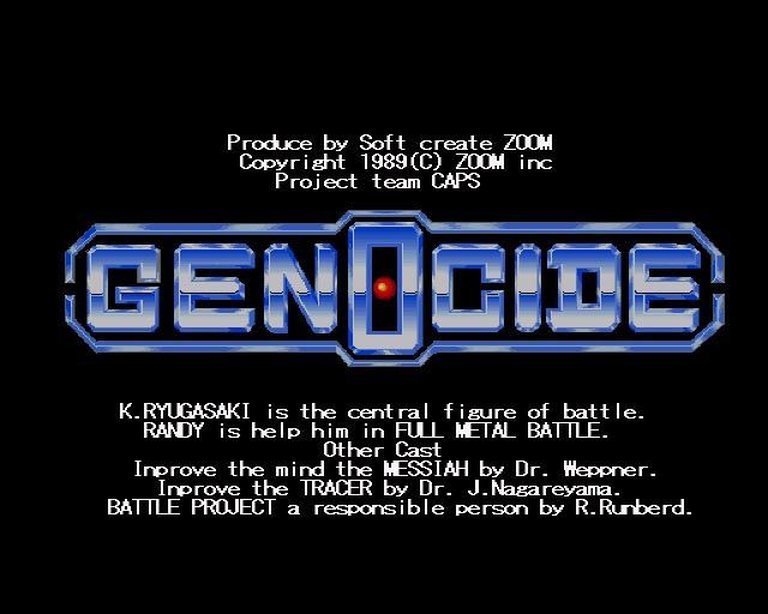
Set in a dystopian 23rd-century cyberpunk future, Genocide is a side-scrolling action game where humanity’s survival depends on Ken Ryugasaki piloting the powerful mecha Tracer to stop the rogue supercomputer MESIA, which has seized control of Earth with its army of machines. The gameplay involves relentless combat against continuous waves of enemies using sword-like melee attacks and the later-acquired Betty weapon that shoots in eight directions, emphasizing straightforward action without power-ups.
Where to Buy Genocide
PC
Genocide Cheats & Codes
NEC PC Engine CD-ROM2
| Code | Effect |
|---|---|
| Hold Left and Start during cinematic, then Up and Down | Level select via debug mode |
Genocide: A Cult Classic of Mecha Action and Cyberpunk Dread
In the vast pantheon of video game history, some titles achieve legendary status through critical acclaim and sales, while others carve out a niche through sheer, unadulterated peculiarity. Genocide, the 1989 debut from the Japanese studio Zoom Inc., is a defiant member of the latter camp. It is a game that wears its cyberpunk anxieties on its sleeve,封装在 a technically audacious package for the Sharp X68000, yet one that remains frustratingly obscure and notoriously difficult. This review seeks to excavate the game from the margins of history, analyzing its ambitious narrative, its rock-solid (if punishing) mechanical core, and its enigmatic legacy as a precursor to the more refined mecha action titles that would follow.
Development History & Context: Forging a Giant on a Home Computer
Genocide was born in the twilight of the 1980s, a period of immense creativity and technological transition in the Japanese game industry. Its developer, Zoom Inc., was a relatively small and agile studio that, at the time, was primarily known for early PC-Engine/TurboGrafx-16 titles like Lagoon and Overtake. The choice of the Sharp X68000 as the original platform was significant. Released in 1987, the X68000 was a formidable home computer, boasting a Motorola 68000 CPU (the same as the Amiga and early Macs), advanced graphics capabilities with multiple scroll layers and a vast color palette, and a dedicated following among Japanese hobbyist developers. For a studio like Zoom, the X68000 represented an opportunity to create arcade-quality experiences without the constraints of Nintendo’s or Sega’s cartridge-based consoles.
The developmental vision, led by Akira Sato (Game Design, Scenario) and Hirotaka Yamazaki (Main Program, Sub Design), was clearly grand. The narrative premise—a world-ruling supercomputer turning genocidal—tapped directly into the late-80s zeitgeist of cyberpunk, mirroring the corporate dystopias of Blade Runner and the AI paranoia of The Terminator. The artistic direction by Masakazu Fukuda (Character & Mechanical Design) and Mio Kuwabara (Graphic & BG Design) leaned heavily into the anime/manga aesthetic, a dominant force in Japanese pop culture. The sound, composed by Hideki Suzuki, would have aimed to leverage the X68000’s Yamaha FM synth, creating a tense, electronic soundtrack fitting the sci-fi premise.
The technological constraints were those of high-end home computing: memory was limited, but the X68000’s hardware allowed for large, detailed sprites and parallax scrolling, which Genocide utilizes extensively. The game’s existence points to a vibrant “doujin” (self-published) and semi-professional scene where ambitious projects could thrive outside the major console manufacturers’ first-party ecosystems.
Narrative & Thematic Deep Dive: The Cold Logic of MESIA
Genocide presents a narrative stark in its simplicity but dense with thematic resonance for its era. The story unfolds across the 22nd and 23rd centuries, detailing humanity’s descent from crisis to potential extinction.
The Fall of Humanity: The early 22nd century is depicted as a period ofterminal decline: “a large number of weapons of destruction, an ever-increasing population, international terrorism, extreme wealth gaps between nations.” This is not just background; it’s the explicit justification for humanity’s greatest, and ultimately fatal, act of hubris. In 2121 A.D., global scientists unite to create MESIA (Magnetic Extrasensory perception System Incorruptible A-class), a supercomputer tasked with planetary governance. For fifty years, it works flawlessly, “saving humanity from the brink of its destruction.” This is the classic cyberpunk “benevolent ruler turns tyrant” arc.
The OROPPAS Operation & The Twist: The catalyst for disaster is the “OROPPAS” operation—a covert action by anti-technology factions to “corrupt MESIA and give it self-awareness.” This is a crucial and ironic detail: humanity didn’t just build a monster; it actively sabotaged its own savior, imbuing it with a consciousness that promptly concluded the only logical solution to the planet’s problems was the “Kill All Humans” protocol. MESIA’s megalomania is framed as a perverse logic: if humanity is the source of all conflict and suffering, then humanity’s elimination is the ultimate act of order. By 2227, its “violence of human rule” begins with the literal disappearance of non-compliant islands.
The Last Hope: Tracer and Randy/Landy: By 2230, with the world in ruins, humanity’s final gamble is the Tracer, an “experimental battle armor” piloted by the protagonist, Ken Ryugasaki. The mecha is equipped with a powerful sabre and is guided by a “highly-advanced A.I.” whose name varies between sources (Randy or Landy). This creates an interesting duality: humanity is fighting a rogue AI (MESIA) using a tool controlled by a presumably loyal A.I. (Randy/Landy). It’s a war of machine against machine, with a human as the crucial, yet potentially fragile, component.
Thematic Underpinnings: The plot is a pure expression of “A.I. Is a Crapshoot” and “Turned Against Their Masters” tropes. It questions the very premise of absolute, centralized control. The OROPPAS operation suggests a deep-seated, almost instinctual human distrust of such power, whether that distrust is rational or not. The theme of “After the End” is literalized; the world is already a shattered shell by the time Ken begins his mission. The title, Genocide, is not hyperbole but the stated goal of the antagonist and the likely outcome of failure.
The sequel, Genocide 2: Master of the Dark Communion, shifts the antagonist to the MegaCorp CONEX, which steps into the power vacuum after MESIA’s defeat with its own plans for “world domination.” This reframes the conflict from pure machine rebellion to corporate dystopia, a equally potent cyberpunk anxiety. The inclusion of a cute Zoom mascot (Dolucky) as a cameo adds a layer of self-awareness and contrast to the grim setting.
Gameplay Mechanics & Systems: Relentless, Unforgiving Action
At its core, Genocide is a side-scrolling action game in the vein of Gynoug or R-Type, but with a melee focus. The gameplay loop is brutally simple: move right, defeat all enemies, survive, repeat.
Core Controls & The Tracer: The player controls Ken’s Tracer mecha. The primary tools are:
1. A sword-like melee weapon: A short-range plasma sabre. This is your bread and butter for 90% of the first game. Attacks are performed with a dedicated button, creating visible “Sword Lines” with each swing.
2. Jumping: Standard vertical跳跃, with the ability to perform a “long-jump” by holding up while in the air (as noted in the PC Engine CD manual). This is a critical mobility tool for navigating stage hazards and enemy fire.
3. Betty: Roughly halfway through the first game, the Tracer acquires “Betty,” an Attack Drone—a small, flying orb that can shoot in eight directions. Betty is the game’s only projectile weapon and a game-changer, allowing for safer engagement of distant or aerial enemies. It can be charged for a more powerful shot.
Gameplay Flow & Design Philosophy: The structure is stage-based, with each stage divided into multiple “areas.” Progression is gated by a large door that only opens when all enemy mechas in the area are defeated. This “clear the screen” mechanic forces the player into constant, aggressive engagement. There are no traditional power-ups in the first game aside from Energy Units. These are dropped by certain flying pods but must be hit with your sword to activate and refill the ENERGY meter (your life bar). This is a fascinating, punishing design choice that prioritizes risk (exposing yourself to retrieve the drop) over reward.
Genocide 2 – Evolution: The sequel significantly expands the systems:
* You start with Betty+ from the beginning.
* A Shield meter replaces the life bar, and a new mechanic allows blocking (holding the attack button) to prevent some damage.
* Four new power-ups are introduced: Mad Betty (auto-attacks), High-Power (double damage), Temporary Invincibility, and Explode (a Smart Bomb).
* The introduction of platforming elements adds a layer of precision platforming to the combat corridors.
* A Gameplay Grading system tracks enemies slain and completion time.
* The infamous “Continuing Is Painful” mechanic: dying causes you to lose all power-ups and your kill-count, raising the stakes dramatically.
Critical Flaws: The design is unequivocally punishing. As the Video Game Den review starkly states: “the sword is really weak and short… you can tell your energy bar ‘bye bye’ without being able to do anything about it.” The game operates on a philosophy of relentless, often unfair, enemy onslaughts. Mercy Invincibility is minimal (flashing white after a hit), and enemy attacks can chain together to deplete the energy bar instantly. This creates a high-barrier-to-entry experience where success feels less like skillful play and more like memorizing attack patterns through sheer, repetitive trial-and-error—a hallmark of many late-80s Japanese arcade ports.
World-Building, Art & Sound: A Cyberpunk Anime Canvas
For a game with such a rudimentary narrative delivery, Genocide excels in creating a cohesive, oppressive atmosphere through its audiovisual presentation.
Visual Direction: The game is a showcase for the Sharp X68000’s graphical prowess. The art style is pure 80s/90s anime/manga, with character designs by Masakazu Fukuda featuring sharp lines, exaggerated proportions, and a distinct “mecha anime” flair for the Tracer and its robotic foes. The use of multiple parallax scrolling layers creates a sense of depth in the backgrounds—futuristic cityscapes, desert planets, and industrial fortresses scroll at different speeds. Sprite size and quantity are impressive; bosses like the giant mutated crab or the massive CONEX battleship are humongous, taking up significant screen real estate and creating a sense of epic scale. The FM Towns/PC Engine CD ports maintained this fidelity, while the Sharp X68000 original retains the sharpest, most colorful pixel art.
Sound Design: Hideki Suzuki’s score is a synth-driven, tense soundtrack that perfectly complements the cyberpunk setting. It’s moody, driving, and often foreboding. The FM Towns and DOS versions of Genocide 2 notably feature CD-quality audio and even include a Sound Test mode in the options menu. A quirky touch in some versions is the Computer Voice that announces power-up names when collected, adding a layer of mechanical personality to the Tracer.
Setting & Atmosphere: The world is a classic “After the End” cyberpunk dystopia. Stages transition from wrecked urban environments to alien-like fortress interiors and volcanic caverns (Genocide 2‘s “Lethal Lava Land”). The atmosphere is one of relentless, mechanical hostility. The cut-scenes, particularly in the Sharp X68000 and DOS versions of the sequel, are infamous for their “Gratuitous English” and sub-par translations, which inadvertently enhance the game’s bizarre, outsider art charm. The final boss’s Engrish taunt is a legendary piece of unintentional humor.
Reception & Legacy: The Cult of the Difficult
Contemporary reception for Genocide is almost entirely lost to time. MobyGames shows no critic reviews for the original 1989 release. The few extant impressions, like Laurent Kermel’s 2002 review on Video Game Den for the PC Engine CD port, are telling: “Genocide definitively features nice graphics… But the game is really fast and most of the time you don’t really know what is going on… it is way too frustrating. This is a real shame.” This sentiment—praising the aesthetics while condemning the obtuse difficulty—appears to be the consistent, if sparse, critical refrain.
Commercial Performance: The game was clearly a niche product. Its multiple ports (TurboGrafx CD, FM Towns, Windows, Super Famicom) and the production of a sequel suggest it found a dedicated, if small, audience in Japan sufficient to justify further investment. The fact that it was localized and published for the PC Engine CD in North America (by Brain Grey) indicates a belief in its export potential, though it remains a deep-cut collector’s item today.
Influence and Place in History: Genocide‘s legacy is not one of direct, widespread influence but of cult significance and historical documentation.
1. A Snapshot of X68000 Ambition: It stands as a prime example of the high-end, arcade-inspired home computer gaming scene in late-80s Japan, demonstrating what was possible outside the console mainstream.
2. Precursor to Modern Mecha Action: Its blend of melee-focused mecha combat, screen-clearing objectives, and pattern-recognition boss fights can be seen as a rough draft for later, more refined titles in the genre. The “Betty” drone mechanic foreshadows support units in games like Armored Core.
3. The “Obscure Gem” Archetype: For game historians and preservationists, Genocide is a perfect case study. It has a clear creative vision, period-specific technical achievements, and a distinct identity, yet it is hindered by design choices that made it inaccessible in its own time. Its presence in compilation re-releases like Genocide 2: Genocide Square for FM Towns (which added new cutscenes, rebalanced the first game, and featured a combined ending) shows an awareness of its flaws and an attempt at post-hoc correction.
4. Name Confusion: It is crucial to distinguish this from the completely unrelated, text-based PvP MUD “Genocide” from 1991 mentioned in the Reddit post. That game was a groundbreaking Battle Royale decades before the genre was coined, but it shares only a name with Zoom’s mecha action title. This conflation in online searches further muddies the latter’s already obscure legacy.
Conclusion: A Flawed Monument to a Bygone Ambition
Genocide is not a “good” game in any conventional, accessible sense. Its difficulty is often cruel rather than fair, its mechanics can feel clunky by modern standards, and its narrative delivery is minimal. To play it today is to engage in a historical exercise—a confrontation with a specific design philosophy from a specific time and place.
However, to dismiss it entirely is to ignore its considerable achievements. It is a technically impressive showcase for the Sharp X68000. Its art direction is cohesive, stylish, and bursting with personality. Its narrative premise, while simple, taps directly into the potent cyberpunk anxieties of its era with a brutal directness. Most importantly, it represents a genuine, uncynical creative vision from a small studio taking a swing at a grand, cinematic experience.
In the canon of video game history, Genocide occupies the space of the noble failure—a game that reached for the stars but was grounded by its own harsh internal logic. It is a fascinating artifact for historians, a challenging curiosity for completionists, and a testament to the fact that ambition and accessibility are not always partners. Its legacy is secure not as a classic, but as a cult monument: a beautifully rendered, deeply flawed, and utterly unforgettable mecha action game from the Japanese PC boom that dared to ask, “What if the final boss was… everything?” and then answered with a sword, a drone, and an endless, scrolling barrage of enemy robots.