
- Release Year: 2008
- Platforms: Windows
- Publisher: MyRealGames.com
- Developer: DayTerium
- Genre: Strategy, Tactics
- Perspective: 1st-person
- Game Mode: Single-player
- Gameplay: Puzzle elements, Tile matching puzzle
- Setting: Christmas
Description
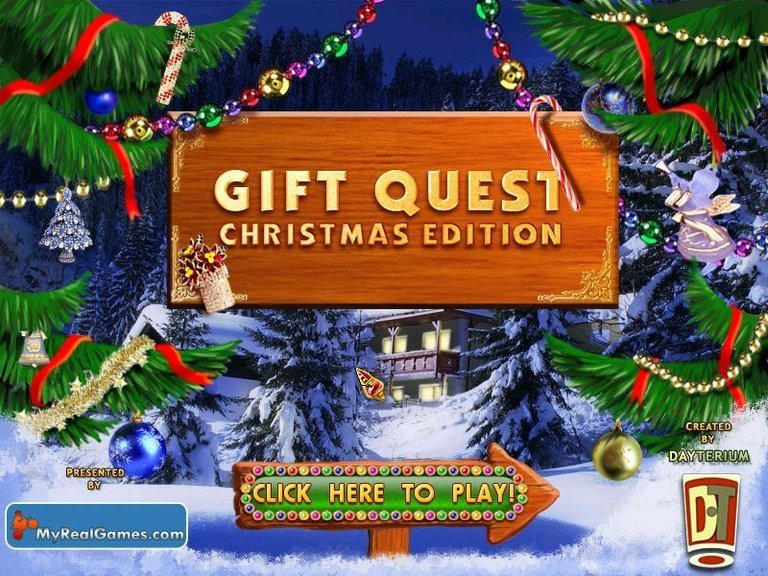
Gift Quest: Christmas Edition is a casual, single-player tile matching puzzle game set in a festive Christmas atmosphere. Players match holiday-themed tiles like gingerbread men and presents across four modes—Adventure with 40 levels, Puzzle with 100 levels, Quads requiring square matches, and Relax for endless play—featuring mouse-controlled gameplay and free access.
Gameplay Videos
Gift Quest: Christmas Edition: Review
1. Introduction: The Ornament in the Puzzle Box
In the bustling mid-2000s ecosystem of casual PC gaming, a familiar pattern emerged: a popular genre would be born, refined, and then rapidly cloned, reskinned, and repackaged for every demographic and holiday under the sun. Beneath this wave of derivative software lies a fascinating microhistory of game design’s most accessible form—the match-3 puzzle—and the commercial pressures that shaped it. One such fleeting artifact is Gift Quest: Christmas Edition (2008), a freeware seasonal spin-off from developer DayTerium and publisher MyRealGames.com. On the surface, it is a quintessential “cookie-cutter” title: a direct, minimalist re-theming of its progenitor, Gift Quest, swapping hearts for holly. Yet, as a historical document, it is invaluable. It represents the logical endpoint of a specific design philosophy—where gameplay fidelity to a proven template supersedes any ambition for narrative or artistic identity. This review will argue that Gift Quest: Christmas Edition is not a game to be judged by its fleeting entertainment value, but as a pristine fossil of the casual puzzle boom’s most commodified era. Its entire existence is a study in efficiency, seasonal marketing, and the stark separation of mechanical gameplay from thematic presentation, a divide that would later blur as the genre matured.
2. Development History & Context: The Assembly Line of Festivity
The Studio & The Vision: DayTerium’s Output Model
DayTerium, the developer credited on MobyGames, remains a shadowy entity with virtually no public-facing history or portfolio beyond the Gift Quest series and a handful of similarly obscure casual titles like Birds On A Wire and Great Secrets: Da Vinci. This scarcity of information is itself telling. DayTerium exemplifies the mid-2000s “casual studio”—often a small team or even a solo developer contracted by portals like MyRealGames.com to produce volume. Their vision, as inferred from the final product, was not one of creative auteurism but of template replication. The “vision” for Gift Quest: Christmas Edition was explicitly commercial: to create a seasonal variant that could be rapidly deployed to capture holiday search traffic and casual players looking for festively-themed time-wasters. The fact that it is “virtually identical” to its parent title, as repeatedly noted in source descriptions, confirms a development process focused on asset swapping (tiles, backgrounds) over systems design.
Technological Constraints & The “Web 2.0” Casual Landscape
The technological specs listed—Windows 98/ME/2000/XP/Vista, a 166 MHz processor, 32 MB RAM, and a mere 7.3MB download size—paint a clear picture. This was a game built for the age of dial-up modems and low-spec “family computers.” The “Fixed / flip-screen” visual style and “1st-person” perspective (a misnomer in puzzle games, likely meaning a static board view) were not artistic choices but necessities of a lightweight, browser-or-download casual engine. The year 2008 sits at a fascinating crossroads: the inexorable rise of Facebook games like Bejeweled Blitz was beginning, but the downloadable .exe casual game, distributed through portals like MyRealGames.com, Big Fish Games, and Oberon Media, still dominated. Gift Quest: Christmas Edition is a relic of this downloadable era, a time when “freeware” meant a sponsored, ad-supported or bundled .exe, not a freemium mobile app. It existed in a ecosystem hungry for endless variations on a theme, and DayTerium’s output model was perfectly suited to supply that demand.
3. Narrative & Thematic Deep Dive: The Absence of Story as a Statement
To speak of a “narrative” in Gift Quest: Christmas Edition is to expose its core design philosophy. There is none. The source material provides zero mention of plot, characters, dialogue, or any lore. The “Gift Quest” title is a thematic veneer with no narrative justification. You are not a character on a mission to deliver presents; you are an abstract cursor manipulating Christmas icons.
This absence is not an oversight but a deliberate, calculated design stance. In the hierarchy of casual puzzle game development circa 2008, narrative was a non-factor. The genre’s success was (and largely remains) predicated on the purity of its mechanics—the satisfying click of a match, the tension of a timer, the cognitive loop of pattern recognition. Any attempt to graft a story onto this loop would have been seen as unnecessary bloat, increasing development time and file size for no measurable return in player retention for this specific audience. The Christmas “theme” exists solely at the sprite level: gingerbread men, presents, etc., replace generic gems or fruits. It is a skin-deep association designed to trigger a Pavlovian seasonal response—”This is festive, I should play it in December”—but it creates no diegetic world. The backgrounds are generic “themed” backdrops, not locations in a story. The “Adventure” mode’s 40 levels are not a journey but a difficulty curve, a series of increasingly complex board states. The most profound thematic statement the game makes is that the holiday season, in the context of casual gaming, is purely an aesthetic packaging for a timeless, repetitive, and ultimately storyless activity. This makes it a pure specimen of gameplay mechanicus, divorced from narrative ornamentation.
4. Gameplay Mechanics & Systems: A Masterclass in Derivative Design
Core Loop & The Four-Pronged Attack
The game’s mechanical heart is the standard match-3 loop: swap two adjacent tiles to create a line of three or more identical icons, which are then removed, causing tiles to cascade down. Points are scored, and the primary win condition in most modes is clearing special “golden tiles” before a timer expires. This loop is executed with flawless, if uninspired, competence. The brilliance of the clone lies not in innovation but in flawless replication of a satisfying feedback loop. The source details its four distinct modes, each serving a different player psychology:
- Adventure (40 levels): The “campaign.” It introduces progression and special tile types, creating a structured learning curve. The mechanics described are rich for a simple clone: Magic Wands (earned in-game, used to remove single obstructive tiles), Bonus Tiles (likely score multipliers), Armour Tiles (requiring multiple matches to clear), Teleport Tiles (shuffling board elements), and Single/Double Lock Tiles (requiring adjacent matches to unlock). This array introduces tactical depth without breaking the core loop, offering players small “aha” moments as they learn to manipulate these systems to solve the level’s golden-tile puzzle.
- Puzzle (100 levels): A “clear the board” mode. Here, strategy shifts from timed pressure to spatial planning. The player must methodically eliminate all tiles, likely with a limited number of moves, emphasizing prediction and board-state analysis over speed.
- Quads: The most mechanically distinct mode. The fundamental rule changes: tiles can only be swapped if the move creates a square of four or more identical tiles. This transforms the game from a linear matching exercise into a spatial geometry puzzle. It heavily restricts valid moves, forcing the player to think in two dimensions and often leading to a more deliberate, almost Tetris-like planning process. This is the game’s one genuine mechanical twist, a clever variant that could have been the seed for a unique series.
- Relax: The “endless” Zen mode. The timer is removed or less punishing; the goal is simply to fill a score-bar to advance levels. This mode panders directly to the casual player’s desire for low-stress, repetitive engagement—a digital fidget spinner for the mid-2000s.
Interface & Innovation
The “Direct control” interface via mouse is the genre standard and perfectly suited. There is no UI complexity to speak of, which is a strength. The game’s “innovation” is purely in its scope of content (140+ structured levels across modes) and the integration of the special tile systems into the Adventure mode. Its “flaws” are those of the template: a reliance on random number generation for tile drops can lead to unwinnable states through no fault of the player, a common frustration in the genre that Gift Quest does nothing to mitigate.
5. World-Building, Art & Sound: The Festive Facade
With no narrative world, “world-building” is reduced to aesthetic construction. The source explicitly states the game uses “Christmas-themed” tiles and backgrounds. Based on the common descriptors (“gingerbread men, presents etc.”) and the era’s technical limits, we can reconstruct its visual language:
* Tiles: Likely 2D, brightly-colored, simple sprite art. Icons would be recognizable holiday symbols rendered in a cute, non-threatening style—gingerbread people, wrapped gifts with ribbons, candy canes, perhaps snowmen or Santa hats. They are functional icons first, festive illustrations second.
* Backgrounds: “Themed backgrounds” suggests static, tiled or patterned backdrops for the game board—perhaps a snowy night sky, a fuzzy fireplace mantle, or a simple red-and-green pattern. They serve to mute the visual monotony of the board but do not create a cohesive environment.
* Atmosphere: The atmosphere is one of cozy, low-stakes festivity. It aims for the feeling of a Christmas cookie decorating session more than a snowy adventure. The fixed/flip-screen presentation means no scrolling, no immersion—just a flat, festive playing field.
Sound Design is not mentioned in the sources, which is a significant omission. For a game so reliant on rhythmic feedback (the pop of a match, the ding of a special tile), sound would be crucial. We can infer it used simple, repetitive MIDI-style jingles: a short, cheerful snippet of “Jingle Bells” on a match, a triumphant chord for level completion, and perhaps a ticking clock for the Adventure timer. It would be non-intrusive, serving only as auditory feedback for game events, never as atmospheric composition. The soundscape, like the visuals, is purely functional ornamentation.
6. Reception & Legacy: The Ghost in the Machine
Critical & Commercial Reception
There is no evidence of any critical or player reception at launch or since. The MobyGames entry has a “Moby Score” of n/a, zero critic reviews, and at the time of writing, only 1 player has added it to their collection on that site. The Kotaku page is a dead-end metadata page with no linked articles. The Backloggd and other sites show no ratings or plays. This is the digital equivalent of a forgotten stocking stuffer. Its commercial performance is equally obscure, but as a freeware title from a portal distributor, its “success” was likely measured in download counts from MyRealGames.com, numbers now lost to time. It existed, was downloaded by thousands (or tens of thousands) of people looking for a quick Christmas puzzle fix in December 2008, and was then uninstalled or forgotten by January.
Historical Legacy & Industry Influence
Gift Quest: Christmas Edition has no discernible influence on the industry. It did not pioneer a mechanic, define a trend, or achieve cult status. Its legacy is purely archaeological. It is a perfect case study in:
1. The Commodification of Theme: It demonstrates how seasonality was applied as a thin veneer to existing mechanics with minimal development cost, a practice that continues today in mobile “seasonal events.”
2. The “Template Clone” Business Model: It is a direct ancestor to the thousands of hyper-casual mobile games that are reskins of a single core prototype. DayTerium’s process—take a working base game (Gift Quest), change the art assets, change the music, release it as a new product—is the blueprint for the reskin economy.
3. Archival Scarcity: Its obscurity (1 collector on MobyGames) highlights the fragility of casual game history. These were not preserved as cultural artifacts but as disposable software. Its primary value now is as a data point, confirming the existence of a specific product in a specific sub-genre at a specific moment. It sits in the Gift Quest series timeline (Valentine’s -> Base -> Christmas) as proof of a seasonal release strategy that was briefly common for downloadable casual games before the market consolidated around a few giants.
7. Conclusion: A Perfectly Imperfect Time Capsule
To judge Gift Quest: Christmas Edition by the standards of a “good game” is to miss its historical significance. It is not fun in a way that transcends its context; it is fun in a way that is entirely of its context. It is a competent, occasionally clever (in the case of Quads mode), but fundamentally soulless execution of a then-proven formula. Its every aspect—from the lack of narrative to the recycled systems to the festive skin—speaks to a design ethos of maximum efficiency and minimum risk.
Its place in video game history is not on a pedestal but in a display case labeled “Casual Puzzle Ephemera, Late 2000s.” It is a Rosetta Stone for understanding the business and design of the pre-Facebook casual space. It proves that the match-3 genre’s appeal was so powerful that it could sustain dozens of identical variants, differentiated only by the holiday on the box. In its quiet, unassuming anonymity, Gift Quest: Christmas Edition tells us more about the industrial realities of game development than any acclaimed AAA title. It is the sound of a game being made not to be remembered, but to be consumed—a ghost of Christmas past, haunting only the abandoned directories of old hard drives and the sparse databases of preservation sites. For that, it earns a peculiar form of respect: as a flawless specimen of its kind.
Final Verdict: Historically Significant (as a primary source), but Critically Mediocre. A 4/10 as a game to play today; a 10/10 as a document of its era.