
- Release Year: 2019
- Platforms: Windows Apps, Windows, Xbox One
- Publisher: Digital Phoenix UG
- Developer: Digital Phoenix UG
- Genre: Puzzle
- Perspective: Top-down
- Game Mode: Single-player
- Gameplay: Healing, Infection control, Puzzle
- Setting: Healthcare
Description
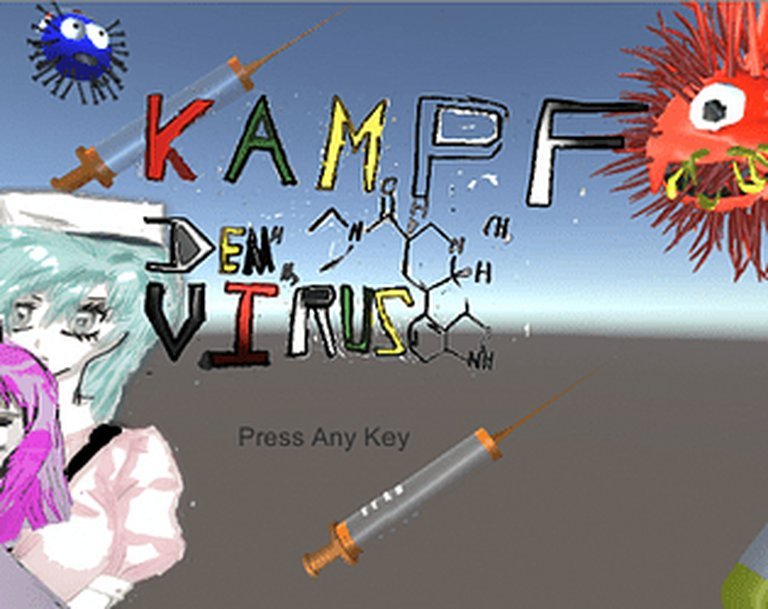
Kampf dem Virus is a top-down medical-themed puzzle game where players control a syringe to heal infected tissue using medicine, racing against time as infections spread and multiply. With no plot beyond this premise, the Xbox One version incorporates COVID-19 pandemic references and a ‘toilet paper famine’ meme-inspired item that halves infections on use.
Kampf dem Virus: A Prescient Artifact of Pandemic-Era Game Design
1. Introduction: A Game Ahead of Its Time, Then Right On Time
In the vast and often peculiar annals of video game history, few titles occupy as curious a temporal niche as Kampf dem Virus (German for “Fight the Virus”). Developed by the minuscule German studio Digital Phoenix UG and released for Windows on December 8, 2019, this top-down, fixed-screen medical puzzle game appears at first glance to be a niche, almost quaint indie project. Yet, its development and release trajectory intricately intersect with a global event that would redefine the modern world: the COVID-19 pandemic. This review argues that Kampf dem Virus is not merely a competent but obscure puzzle game; it is a fascinating, unintentional cultural artifact. Its genius lies not in profound complexity or Narrative depth, but in its remarkable—and often awkward—synchronization with a global crisis, transforming a simple gameplay concept about cellular infection into an accidental satire of pandemic anxiety, healthcare system critiques, and mass hysteria. To analyze it is to examine a game that was conceptually anachronistic, contextually hyper-relevant, and ultimately a poignant case study in how external reality can violently reshape a creative work’s meaning and reception.
2. Development History & Context: The Phoenix from Obscurity
2.1. The Studio: Digital Phoenix UG
Digital Phoenix UG (haftungsbeschränkt) was, and remains, an ultra-low-profile German indie studio, essentially a two-person operation. The credits, consistent across all sources, list Manuel Peters as Producer and Michael Kumpmann as the sole programmer, 3D artist, and sound designer. Their portfolio, visible on platforms like MobyGames and itch.io, reveals a pattern of eclectic, small-scale projects—from the surreal vaporwave-inspired Aqua Fortis Aqua Valis to titles like Kampf dem Terror (2006). This context is crucial: Kampf dem Virus was not born from a well-funded studio with pandemic foresight but from a tiny team working within the accessible, democratized ecosystem of Unity. It represents the “bedroom developer” ethos, where a single idea is prototyped, polished, and published with minimal overhead.
2.2. Technological Constraints & Artistic Vision
Built in Unity, the game’s technical specifications are modest by any standard. The “Fixed / flip-screen” visual perspective and “Anime / Manga” art style point to a deliberate, stylized choice rather than a limitation. The top-down view of a tissue sample, rendered with simple 3D models and cell-shaded or anime-esque textures, serves a functional purpose: clarity. The player must quickly discern healthy tissue, infected cells, and floating virus particles. This aesthetic also imbues the sterile medical scenario with a vaguely playful, almost Kemono Friends-like charm, softening the grim premise. The limited scope is both a strength—keeping the focus on pure puzzle mechanics—and a weakness, confining the experience to a single, repetitive visual plane.
2.3. The Gaming Landscape & The Unfortunate Timing
The game’s planned release window—late 2019—placed it in apost-pandemic world. Its core mechanic (infections spawning more viruses, creating an exponential threat) is a timeless puzzle concept, evoking games like Lemmings or Bangai-O where managing cascading events is key. However, its thematic labeling as a “medical themed puzzle game” with a “Healthcare” narrative tag made it a sitting duck for real-world events. As the SARS-CoV-2 virus began its global spread in early 2020, the game’s title and premise underwent a metamorphosis from generic to terrifyingly specific. Digital Phoenix UG, rather than retreat, leaned into this coincidence, especially for the Xbox One port.
3. Narrative & Thematic Deep Dive: The Plot That Wasn’t (and the Plot That Was)
3.1. The Studied Absence of Plot
Per the MobyGames description, Kampf dem Virus has “no plot besides the premise of healing infected tissue.” This is a radical narrative choice for a game so explicitly themed. There are no characters, no dialogue, no cutscenes explaining why this tissue is infected or who the syringe-wielding protagonist is. The player is an abstract force of healing, a disembodied will battling a abstract biological process. This vacuum is filled entirely by player interpretation and, post-2020, by overwhelming external context. The game is a pure mechanics sandbox, a laboratory experiment where the goal is simply to restore equilibrium. This minimalism could be seen as a strength, creating a universal metaphor for containment, but it also leaves the experience feeling sterile and unmoored.
3.2. The Accidental Narrative: COVID-19 and the Toilet Paper Famine
Where the narrative explodes into vivid, satirical life is in the Xbox One version, reworked to include references to the COVID-19 pandemic. The Microsoft Store description is a masterclass in unintentional (or perhaps brilliantly opportunistic) comedy:
“Fear, Terror, Panic… threatens everything: Social Contacts, the economy, society, and most important of all: Toilet Paper.”
This text transforms the game from a medical puzzle into a direct parody of early 2020 mass panic. The introduction of the special “toilet paper item,” which destroys half of the current infections, is a stroke of absurdist genius. It is not a medically accurate tool; it is a meme made literal, a power-up that directly addresses the infamous “toilet paper famine” of March 2020. This item elevates the game from a simple puzzle title to a piece of pandemic folk art, a interactive joke about the irrationality of crisis response. It weaponizes internet culture within a game of cellular management, making the player feel the fleeting, chaotic relief of stumbling upon a roll of Charmin in a desolate aisle.
3.3. Embedded Social Commentary: Healthcare as Difficulty
The game’s most baked-in thematic element, present from the initial Windows release, is its dual difficulty modes named after the German healthcare system: “Privatpatient” (Private Health Insurance) and “Kassenpatient” (Public Health Insurance). As described on itch.io and ModDB:
– Privatpatient (Easy Mode): “the game is really easy and you can save the patient without much effort.”
– Kassenpatient (Hard Mode): “your job as doctor will be pretty harsh and the survival of the patient is not that likely.”
This is not a subtle joke; it is a blunt, cynical critique of systemic resource inequality, transplanted into a puzzle game. The “hard mode” isn’t just more viruses—it’s a simulation of underfunded, overwhelmed public healthcare. The “easy mode” represents a well-resourced, efficient private system. This layer, likely conceived as a piece of local German satire, gained universal resonance during a pandemic that exposed catastrophic healthcare disparities worldwide. The game, therefore, contains two distinct narrative layers: the ahistorical, sterile puzzle; and the deeply historical, socio-economic critique of pandemic response, all wrapped in a bow of toilet paper humor.
4. Gameplay Mechanics & Systems: Crisis Management 101
4.1. Core Loop: The Infection Spread Equation
The fundamental gameplay loop is elegantly described but deceptively deep:
1. Assess: View the top-down grid (or free-form area) containing patches of infected tissue (red), healthy tissue, and floating virus particles.
2. Act: Control a syringe (arrow keys) and deploy pills (Ctrl/Space) onto infected cells to heal them.
3. React: Each healed infection is removed. However, viruses constantly spawn from remaining infected tissue and can create new infections upon contact or over time.
4. Manage/Crisis: The infected area must be kept under a threshold. “If too much tissue gets infected, the patient dies.” This is the loss condition—a tipping point of exponential growth.
5. Win: Clear all infection from the level.
This is a real-time strategy puzzle akin to Puzzle & Dragons or Dr. Mario, but with a territory-control and exponential-growth twist. Success depends not just on speed but on prioritization: do you heal clustered infections first, or target virus spawn points? It’s a tense, frantic balancing act reminiscent of containing an outbreak.
4.2. Controls & Interface: Bare-Bones Efficiency
The interface is “Direct control” via keyboard. The simplicity is total: arrow keys to move, one button to fire pills. There is no complex menu, no inventory management beyond the special Xbox item, no character stats. This purity keeps the focus squarely on the spatial puzzle. The UI is likely minimal, showing only the current infection percentage or a “patient health” meter. This design philosophy aligns with the arcade-puzzle genre—accessibility and immediate comprehension are key.
4.3. Innovative & Flawed Systems
Innovations:
– Theme-Mechanic Integration: The link between “viruses creating new infections” and the real-world concept of R0 (reproduction number) is strikingly direct. It’s one of the few games to model an epidemiologic principle (exponential spread) in its core mechanics.
– Cultural Satire as Game Design: The “Privatpatient/Kassenpatient” isn’t just a difficulty slider; it’s a thematic statement. The “toilet paper item” is game design as topical joke.
– Minimalist Clarity: The top-down, fixed-screen view eliminates camera control issues, making the puzzle’s state always perfectly legible.
Flaws:
– Lack of Depth: With no power-ups (outside the Xbox exclusive), no different virus types, no environmental hazards, and a single core action, the game likely lacks long-term engagement. Level design would be the sole variable.
– Repetitive Aesthetics: The “Anime/Manga” art style, while distinctive, applied to a single repeating cell-tissue motif would become monotonous quickly.
– Unbalanced Release Context: The PC version’s complete lack of pandemic context makes it feel oddly disconnected from its own title post-2020, while the Xbox version’s heavy-handed references might feel dated quickly.
5. World-Building, Art & Sound: A Laboratory of Style
5.1. Setting & Atmosphere
The setting is explicitly “healthcare” but abstractly rendered. It is not a hospital, but a microscopic biological space. The atmosphere is clinical yet cartoonish. This dualism—serious subject, silly aesthetic—creates a cognitive dissonance that is the game’s defining tone. The “world” is a petri dish, a contained system where the player is god-like micro-surgeon.
5.2. Visual Direction: Stylized Sterility
The “Anime / Manga” tag suggests characterful, expressive designs, but applied to biological entities. One can imagine the infected tissue as blobby, cute-but-menacing monsters (like Katamari Damacy‘s microbes) or the syringe as a chirpy anime character. The fixed-screen perspective creates a diorama-like feel, a contained puzzle box. The Unity engine allows for clean, colorful 3D models with cel-shading, prioritizing readability over realism. This approach makes the medical theme accessible and non-threatening, a necessary choice to offset the grim “patient dies” consequence.
5.3. Sound Design: The Unheard Hero
Michael Kumpmann is credited for sound design. With no musical details provided, one must infer a likely approach: functional, loop-based audio. Expect sterile, beeping heart-monitor sounds for life, sharp “plip” or “squish” effects for pill deployment and healing, and ominous, rising drones or heartbeat sounds as infection spreads. The sound design’s primary job is to provide clear audio feedback for game states. Its subtlety may be its strength, allowing the player’s imagination—or the cacophony of real-world news in 2020—to fill the sonic space. A playful, poppy J-pop-inspired track for the menu, cutting to tense electronica during gameplay, would perfectly match the anime medical aesthetic.
6. Reception & Legacy: The Game That Wasn’t (And the Game That Was)
6.1. Critical & Commercial Reception: A Ghost in the Database
By any mainstream metric, Kampf dem Virus is a commercial and critical non-entity.
– No MobyScore (n/a).
– Zero critic reviews on MobyGames.
– Zero player reviews on MobyGames, ModDB, or RAWG.
– PlayTracker Insight shows 0 Popularity Score, 0 Playing/Backlogs/Replays.
– The game exists in the bottom quartile of IndieDB rankings (Rank ~42,000 of 76,614).
– It was free on itch.io and the Microsoft Store.
This data paints a picture of a game that vanished without a trace in the PC space. Its “release” was an event for a handful of downloaders. There is no evidence of press coverage, YouTube Let’s Plays from prominent creators, or community discussion. It is, for all intents and purposes, a lost game.
6.2. The Xbox One Relaunch: A Second, Stranger Life
The Xbox One release (May 12, 2020) represents a fascinating, belated rebranding. The Microsoft Store description is a full narrative rewrite, framing the game as an elite pandemic response simulator with toilet paper at stake. This version did not receive new reviews either, but its very existence on a major console storefront gives it a different archival status. It is no longer just a forgotten Unity puzzle game; it is a historical document of indie developers acutely reacting to, and monetizing (in a satirical way), a global trauma in real-time. It stands as a primary source for how the cultural imagination processed COVID-19 through the medium of games.
6.3. Influence & Place in History
Kampf dem Virus has had no discernible influence on subsequent game design. Its mechanics are not seen in later viral-themed games (Plague Inc. was already a hit). Its legacy is not one of innovation but of perfect, accidental timeliness. It belongs in a small museum of ” pandemic-adjacent games” released circa 2020, alongside titles like Coronavirus Attack (controversial) or the Plague Inc. pandemic scenario. Its true historical value is anthropological:
1. The Hyper-Local Satire: It demonstrates how a developer’s local socio-political context (German healthcare debates) can create mechanics that gain global, unintended meaning.
2. The Micro-Studio Pandemic Response: It captures the scramble of tiny studios to make their existing products relevant to a breaking news cycle, resulting in a jarring but honest product.
3. The Limits of Indie Discovery: Its utter obscurity highlights how thousands of games fade into digital noise, their cultural moment—no matter how potent—unseen by all but a few.
7. Conclusion: The Fate of a Foretold Mirror
Kampf dem Virus is, ultimately, a paradox. As a pure puzzle game, it is likely competent but forgettable—a solid 2.5-star experience with a neat infection-spread mechanic. Its lack of depth, repetitive presentation, and zero marketing consigned its PC version to immediate oblivion.
However, as a cultural artifact, it is uniquely, hauntingly significant. It is the game that, without trying, held up a funhouse mirror to the COVID-19 pandemic and reflected our fears (exponential spread), our critiques (healthcare inequity), and our absurdities (toilet paper panic) with bizarre accuracy. The Xbox One version, with its meme-infused power-up and panicked store description, is a time capsule from the anxious, surreal early days of lockdown.
Its verdict in video game history is not one of quality or influence, but of serendipitous testimony. It proves that a game’s meaning is never solely contained within its code; it is co-authored by the world that plays it. Kampf dem Virus will never be mentioned alongside Pong or The Legend of Zelda. But for the historian studying how digital culture absorbed a global pandemic in real-time, it is an essential, quirky, and deeply human footnote—a small game that, for a fleeting moment, understood the world’s fear better than most. Its final, silent score of n/a on MobyGames is perhaps the most perfect rating it could receive: an undetermined value, forever suspended between a simple puzzle and an unconscious chronicle of our shared madness.