
- Release Year: 1998
- Platforms: Windows
- Publisher: Accolade, Inc.
- Developer: MindSpan
- Genre: Sports
- Perspective: Behind view, Diagonal-down
- Game Mode: LAN, Online PVP, Single-player
- Gameplay: All-Time team, Amateur draft, Custom league, Dynasty mode, Player aging, Schedule generator
- Setting: Baseball, Real-world
- Average Score: 71/100
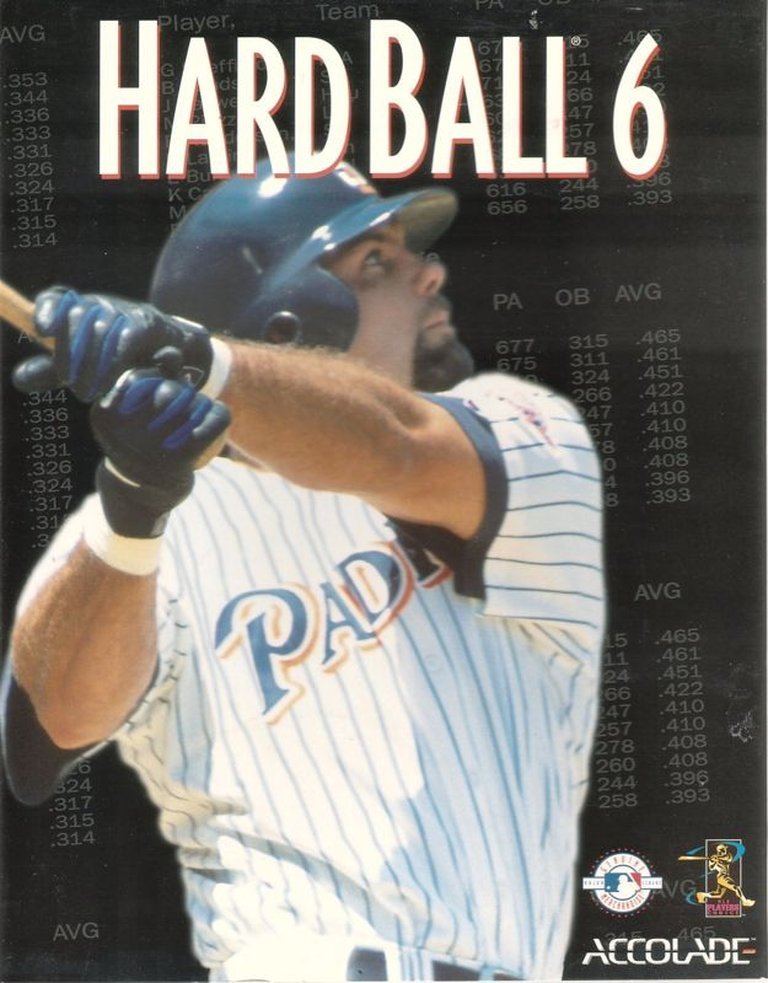
Description
HardBall 6 is a baseball simulation game that builds on the HardBall series with full Major League Baseball licensing, featuring real teams and players. It introduces 3Dfx enhanced graphics and includes gameplay modes such as Dynasty Play (where players age over time), Interleague Play, Consecutive Season Play with an amateur draft, and a custom league and schedule generator, complemented by play-by-play commentary from Greg Papa and multiplayer support via modem, serial, and LAN connections.
Gameplay Videos
HardBall 6 Free Download
HardBall 6 Guides & Walkthroughs
HardBall 6 Reviews & Reception
ign.com : Hardball 6 is probably the best choice.
espn.com (71/100): There’s no doubt it’s got some good things to offer – just not as many as you might expect for a sequel that spent this long in development.
HardBall 6 Cheats & Codes
PC
Enter codes at the indicated screen.
| Code | Effect |
|---|---|
| Ctrl + E + B + A | Edit batting average |
| Ctrl + S + P + D | Fast player |
| Ctrl + W + C + G | Win game |
| Ctrl + T + E + N | Add 10 to score |
| Ctrl + H + R + 1 | Home runs |
| Ctrl + 1 + 2 + 3 | Instant third out |
| Ctrl + S + O + B | Instant third strike |
| Ctrl + I + C + T | More injuries |
| Ctrl + F + S + T | Super fastball |
| Ctrl + A + S + G | 1996 All-Star game |
| Ctrl + N + M + P + L | Always catch fly balls |
| Ctrl + A + N + C + S | Always steal bases |
| Ctrl + B + H + M | Big Heads |
| Ctrl + F + L + Y | Flying players |
| Ctrl + I + P + M | Invisible players |
| Ctrl + M + T + M | Short players |
| Ctrl + N + S + A | Strikes do not count |
| Ctrl + T + P + M | Tall players |
| Ctrl + S + K + N | Thin players |
| Ctrl + A + P + M | Alien team |
| Ctrl + B + A + T | Aluminum bats |
| Ctrl + A + P + E | Ape team |
| Ctrl + E + A + S | EA Sports team |
| Ctrl + E + A + T | Programmer team |
| Ctrl + T + E + T | Tetris mini-game |
| Ctrl + W + S + G | World Series game |
| Ctrl + E + T + L | Edit player stats |
HardBall 6: The Swan Song of a Simulation Pioneer
1. Introduction: A Legacy on the Line
The year is 1998. The sports video game landscape is a fierce battleground, dominated by the polished, marketing-behemoth juggernaut of EA Sports and its Triple Play baseball series. Into this arena steps a veteran, Accolade’s HardBall series, a lineage stretching back to 1985. Now under the purview of the internal MindSpan studio, HardBall 6 arrives not just as another annual update, but as a title carrying the immense weight of a decade-long legacy. Tasked with modernizing a beloved franchise for the dawn of the 3D accelerator era and finally securing the full, coveted Major League Baseball license, its success was far from guaranteed. This review will argue that HardBall 6 is a profound paradox: a game of towering ambition and deep, systemic ingenuity, simultaneously undermined by a compromised technical presentation and a development process that, despite a two-year cycle, felt fundamentally rushed. It stands as a poignant, flawed capstone to an important series—a game that understood the soul of baseball simulation better than most, but could not master the new hardware gods it sought to worship.
2. Development History & Context: The Two-Year Gamble
The HardBall series had established a reputation for solid, if somewhat arcade-leaning, simulation throughout the early-to-mid 90s. With HardBall 5 (1995) released, the expectation was a typical one-year development cycle for a 1997 sequel. Instead, MindSpan was granted an unprecedented two years. The reason, as documented in both Wikipedia and contemporaneous previews, was a total commitment to building a new three-dimensional game engine from the ground up, one that would leverage the burgeoning 3Dfx Voodoo graphics standard. The game was originally slated for a Q2 1997 release; the engine work delayed it by a full year to April 1998. This extended timeline promised a technological leap, but also raised expectations to an almost untenable degree.
The context of 1998 is critical. The PC was undergoing a graphical revolution. Triple Play 99 (released late 1997) had already set a new high bar for visual fidelity and fluid animations. HardBall 6’s attempt to embrace 3D was not optional; it was existential. Furthermore, licensing was a constant thorn. Previous entries only had the MLB Players Association license, meaning real player names but fictional teams. HardBall 6 finally secured the dual license—both the league and the union—allowing for authentic team logos, stadiums, and full 162-game schedules with real club names. This was a monumental coup for Accolade, a feature their marketing could finally hang their hat on. The developer’s vision was clear: marry the deep, manager-friendly simulation modes fans expected with a modern 3D presentation and the ultimate realism of full MLB branding. The technological constraints were immense—harnessing 3Dfx without alienating non-accelerated users, creating a new engine that could handle complex physics and animations, all within a stretched-but-still-finite budget. The result would be a game pulled between these poles.
3. Narrative & Thematic Deep Dive: “As Real As It Gets”
HardBall 6, like nearly all sports simulations, lacks a traditional narrative. Its “story” is emergent, generated by the user’s management decisions and on-field outcomes. However, its thematic core is a fiercely pursued, almost philosophical, commitment to emulative realism. The tagline “As Real As It Gets” wasn’t just marketing fluff; it represented a design philosophy that sought to replicate the strategic tensions, statistical outcomes, and experiential feel of professional baseball.
- The Simulation vs. Arcade Dialectic: The game’s primary thematic tension is the balancing act between accessible “pick-up-and-play” action and deep, numbers-driven management. Modes like Dynasty Play (with player aging affecting attributes) and Consecutive Season Play with the Amateur Draft directly confront the career manager, simulating the long-term building and decay of a franchise. This speaks to a core theme of temporal consequence—your decisions in the draft and trades ripple across seasons. In contrast, the All-Time Team mode, pitting you against a roster of Hall of Famers in their prime years (e.g., 1927 Babe Ruth), taps into a fantasy of baseball history, allowing for “what if” matchups that celebrate the sport’s pantheon.
- The Illusion of Authenticity: The full MLB license is the game’s great narrative tool. It transforms abstract teams like the “New York Wolves” (a series staple) into the Yankees, Mets, Dodgers, etc. The names on the back of the jerseys—Ken Caminiti on the cover, Barry Bonds, Mark McGwire—ground the game in the specific, drug-era zeitgeist of 1998 baseball. This licensing is the game’s primary claim to a “realistic” identity. Yet, the narrative is subtly undercut by systemic quirks. The IGN review notes the confusing reuse of retired player names for rookies, and the absence of financial management (salaries, payrolls) creates a significant simulation gap. The theme becomes one of selective authenticity: the surface layer (names, logos) is real, but the underlying economic engine is abstracted.
- Commentary as Atmospheric Storytelling: Greg Papa’s play-by-play is the game’s constant narrative voice. However, as multiple reviews (PC Joker, Game Revolution) note, his lines are repetitive and lack the contextual depth of Triple Play‘s Buck Martinez/Jim Hughson duo. He provides the “what” (the pitch, the hit) but rarely the “why” (statistical splits, pitcher-batter history). This reinforces the theme that HardBall 6 provides the skeleton of the baseball experience but struggles to inject it with rich, contextual life.
4. Gameplay Mechanics & Systems: Brilliant Ideas, Rough Execution
Here is where HardBall 6 justifies its existence and reveals its deepest flaws.
- Core Gameplay Loops – Batting & Pitching: The game’s most celebrated innovation is its situational hitting and pitching interface. Unlike simpler timing-based systems, batting requires you to select a hit type (Grounder, Line Drive, Fly, Opposite Field) and aim a floating cursor with the D-pad to the anticipated pitch location. Pitching uses a similar cursor to place the ball. This creates a fantastic, skill-based layer of prediction and counter-prediction. As the Adrenaline Vault review states, “you may be able to find some things that you do not like about it, but generally HardBall 6 is a very solid title,” largely due to this deep batting mechanic. It makes each at-bat a cerebral mini-game.
- Fielding & Baserunning: These systems are more conventional. Fielding involves positioning a fielder and using a power bar for throws. The criticisms are damningly consistent: catchers are sloppy at blocking balls and throwing out runners, and outfielders almost always hit a cutoff man, even on routine singles. This breaks the simulation theme, making defense feel scripted and powerless compared to the active, skill-based batting.
- Management & Franchise Modes: This is the game’s undeniable strength. Dynasty Play with aging players, the amateur draft, interleague play, and a custom league/schedule generator provide a staggering depth of options. You can run a franchise for years, developing rookies and watching veterans decline. The inclusion of the All-Time team is a perfect cherry on top for fantasy leagues. However, as IGN and Computer Gaming World (CGW) lament, the user interface for these modes is horrendous. “Moving the mouse over a player’s name flashes a playing card across half the screen, amidst numerous flashing red buttons.” This is not just an aesthetic failing; it’s a functional one that actively impedes the very management experience the game’s systems are built to support.
- Multiplayer & The Online Frontier: HardBall 6 holds a significant historical footnote: it was the first baseball game to support MPlayer.com for online multiplayer. This was a major selling point in 1998, enabling modem, serial, LAN, and internet play. For its time, this was a cutting-edge feature that connected players in a way most rivals did not, directly feeding into the communal, competitive spirit of sports gaming.
5. World-Building, Art & Sound: The Aesthetic Faltering
If the gameplay systems were the mind, the presentation was the face—and it was heavily bruised.
- Visuals & the 3Dfx Bet: The transition to 3D was the game’s major technical gamble and its greatest failure. While the stadium backdrops are praised by some (e.g., Adrenaline Vault notes they are “pretty good”), the player models are almost universally panned. Reviews from PC Player (Germany), PC Action, PC Games, and PC Joker all use similar language: “blocky,” “squared-off legs,” “not so detailed,” ” polygons not as lovingly designed as the competition.” The animation is described as “unspektakulär” (unspectacular) and “einfallslos” (unimaginative). Even with a 3Dfx card, scrolling is reported to stutter (PC Games). The IGN review is succinct: “the players appear misshapen and the field lines are somewhat jagged.” This was a catastrophic misstep; in a year where Triple Play 99 was being praised for its realistic grass and smooth animations, HardBall 6 looked like a step backward, a rough prototype masquerading as a finished product.
- Sound & Commentary: Greg Papa’s commentary is serviceable but lacks the dynamic range and situational awareness of the Triple Play duo. The PC Joker review calls it “teils unsauber” (partly unclean) and repetitive. Sound effects, credited to the legendary Tommy Tallarico, are functional but not exceptional. The overall soundscape fails to build a convincing ballpark atmosphere compared to the “heckling, popcorn calls, and crowd noises” that impressed the Vancouver Computes panel in Triple Play 99. The audio contributes to a sense of a game that is mechanically present but atmospherically vacant.
6. Reception & Legacy: A Mixed, Bittersweet Farewell
HardBall 6 and its PlayStation variant (HardBall ’99) met with “mixed” reviews (GameRankings: 68% PC, 64% PS). Theaggregate scores mask a clear critical consensus: brilliant, deep simulation wrapped in a technically and aesthetically disappointing package.
- Critical Split: The reviews form two clear camps. The first, represented by Adrenaline Vault (80%), PC Player (78%), and GameSpot (71%), acknowledges the flaws but champions the unparalleled feature set and satisfying core batting mechanic. “It will not be for everyone, but it is sure to please most fans,” says Adrenaline Vault. The second, more brutal camp—Computer Gaming World (50%), GameRevolution (42%), PC Joker (59%)—sees the graphical and interface failures as fatal. CGW’s conclusion is devastating: “Fine-tuning is what makes a game great, and HARDBALL 6 isn’t that great.” The two-year development did not yield a polished product; it yielded a game that still felt “rushed out the door.”
- Commercial & Historical Fate: The HardBall series, once the all-time best-selling baseball game according to Accolade’s own press releases, was clearly losing the war for public perception to EA Sports. The PlayStation version (HardBall ’99) fared even worse (GameRankings 51%), suggesting the problems were core to the game, not just PC-specific. A “2000 Edition” was quickly released for Windows in 1999, a barebones data update that did nothing to address the engine’s shortcomings. This was the last major HardBall release. The series would go dormant, its legacy permanently anchored to this flawed, ambitious sixth entry.
- Influence: Its primary legacy is two-fold: 1) It demonstrated the high-wire act of transitioning a beloved sim series to 3D, a lesson learned the hard way by others. 2) Its pioneering support for MPlayer.com was a significant step toward the always-connected sports gaming world we know today. However, in terms of direct influence on game design, it was overshadowed. Triple Play 99 and, later, High Heat Baseball were cited as superior alternatives that better balanced sim and arcade with presentation. HardBall 6 became a cautionary tale about the perils of prioritizing a new engine over polish and the difficulty of competing with a titan like EA on its own terms.
7. Conclusion: A Flawed Titan
HardBall 6 is a game of magnificent what-ifs. What if the 3D engine had been another year in the oven? What if the UI had been designed by a human being? What if Accolade had the resources of EA? It is a testament to the strength of its core baseball simulation—the Dynasty mode, the amateur draft, the situational batting—that it remains fondly remembered by a niche of hardcore fans who valued strategic depth above all else. The Adrenaline Vault called it “a very solid title,” and in its mechanical bones, it is.
Yet, to evaluate it solely on mechanics is to ignore the holistic experience of a 1998 video game. In an era where presentation was becoming inextricably linked to perceived quality and realism, HardBall 6 stumbled spectacularly. Its blocky players, stuttering animations, and ugly management screens created a constant cognitive dissonance for the player. You were constantly reminded you were playing a game, not simulating baseball. For a title billing itself as “As Real As It Gets,” this was a fatal contradiction.
Its place in history is therefore bittersweet and specific. It is the last gasp of a great independent sports simulation lineage. It is a fascinating case study in ambition exceeding technical and design execution. It proved that deep systems could not compensate for a subpar shell in an increasingly visual market. HardBall 6 is not a great game by the conventional metrics of its time, but it is an important and deeply interesting one—a monument to a series that built its identity on understanding the intricate dance of baseball, and a tragic example of how that understanding can be lost in the translation to a new technological paradigm. It deserves to be remembered, analyzed, and learned from, even if it is rarely recommended for a casual play today.